J&R (Patchogue, Long Island)

J&R overall score: 67

UPDATE: THIS LOCATION IS NOW CLOSED!

I’ve eaten at J&R many times, at all locations on Long Island. It all depends on who is doing the cooking, really, but I’ve noticed that some locations are better than others. Patchogue, for example, is a better location than Islip. See below:

Flavor: 6

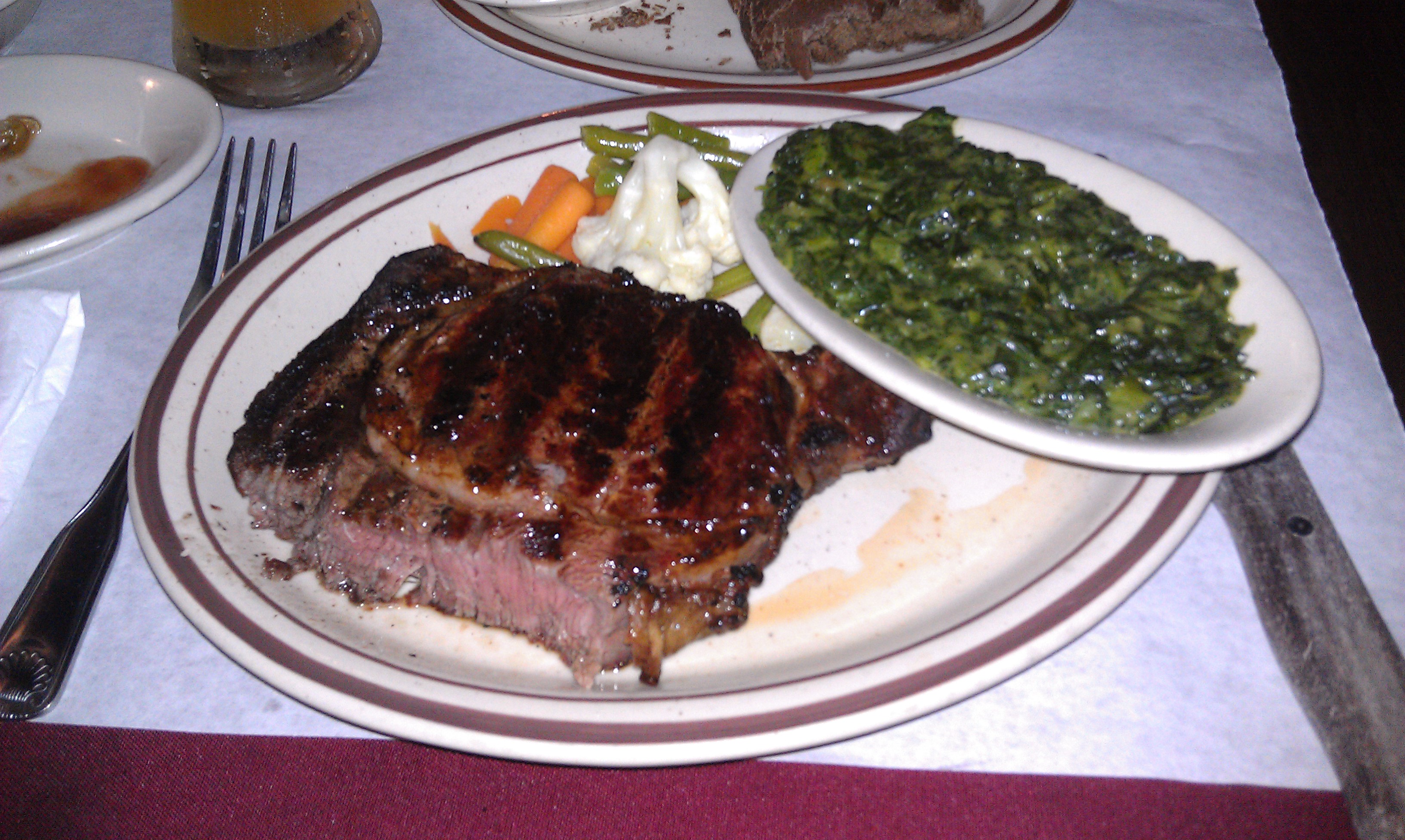
For the price, J&R delivers what amounts to an average choice grade steak. The sad part is that the steak here can sometimes taste as good or better than some of the places charging lots of money for a prime cut. I had the broiled ribeye here because in the past I have had the marinated ribeye. I almost went with a filet, but changed my mind last minute. This is the kind of place where a marinated steak is a wise selection, because the process imparts tenderness and flavor into the less-than-best cuts of beef. I enjoyed it for what it was: a cheap, local joint where I could chow on a half decent steak. The meat was cooked much more evenly and correctly as opposed to Islip, so I bumped the score up a point here.

Choice of Cuts & Quality Available: 7

This is essentially going to be the same as my earlier review of J&R in Islip, since they have the same menu and cuts available.

Portion Size & Plating: 7

Nothing has changed here either from the previous J&R review of the Islip location. One thing I will mention is that I didn’t think my steak was actually 24oz. I realize that several ounces cook away in the process, and that steaks are weighed before cooking, but this boneless cut seemed more like an 18oz-20oz cut to my eyes.

Price: 8

Again same as J&R in Islip. The bill for four meals was $108. Half the price of Murtha’s and a quarter the price of the big boys in NYC.

Bar: 8

I’ve raised the bar score for the Patchogue location by a point, because it is a nice long stretch of real estate with a great selection of beers and specials. It is also across the street from a great fun pub called the Brickhouse Brewery.

Specials and Other Meats: 6

See the J&R Islip review again for this section – it remains unchanged.

Apps, Sides & Desserts: 6

J&R steaks come with a soup/salad and a side. I had a salad with blue cheese – nothing fancy, but it did the job. For my side I picked the creamed spinach, which was creamy but lacked character. The steak dinners also come with a little bit of steamed veggies on the plate (cauliflower, carrots, and beans). We skipped apps and desserts.

Seafood Selection: 4

J&R seemingly has a lot to choose from aside from clams and oysters. My wife had twin lobster tails, but they were EXTREMELY salty… like RUINED. Total suckage, because she could barely eat her meal. Her baked potato was the best part of the meal, she said. In hindsight we should have sent it back. I took two points here from the earlier review score for that major blunder.

Service: 8

Our waitress was nice – she even offered up an Italian ice place for us to grab dessert when she heard us talking about going on the hunt for ice cream.

Ambiance: 7

This J&R is much nicer than the Islip one in terms of bar, so that kinda overtakes the score on ambiance as well.

Shove This Wiener In Your Mouth

So here is another recipe for your meat eating needs. This time we are exploring the wonderful world of tubed meat; the hot dog. This recipe and technique has NEVER let me down when entertaining guests. It’s cheap, easy, and fucking scrum-diddly-umptious. In short this is the best fucking hot dog meal you will ever eat in your entire meaningless life. I call it the Chesapeake Dog.

INGREDIENTS

• the cheapest canned beer you can find
• half sour pickles
• hot dogs (preferably ones that plump while boiling)
• buns
• iceberg lettuce
• jalapenos
• onions
• ketchup
• dijon mustard
• sri racha sauce
• old bay seasoning
• bay leaves
• garlic powder
• pepper
• onion powder
• chili powder
• corn on the cob
• large boiling pot
• serving plate
• tongs
• a healthy sense of dick joke humor

STEP 1

Get a big boiling pot out onto your stove and dump an equal ratio of beer and water into it to serve as the base of your boiling liquid (for you complete idiots out there, that means three cans of beer and three cans of water, or six and six depending on how much you are making). I like to use Schaefer since it is usually under $7 for a 12-pack at my grocery store. Occasionally I will use Guinness as well, but that is kind of a waste of good beer, in my opinion.

Add your spices to the liquid – a few heaps of old bay, a few bay leaves, a healthy amount of pepper, onion powder and garlic powder too. You can drop an onion in there too if you have an extra laying around. Cut it up a bit so you can use it later rather than having a full soggy onion lapping around in there. Add your hot dogs and corn on the cob into the liquid and bring to a boil.

The corn is key here, because it adds a sweetness to the cooking liquid that will balance out the heat from the sauce you will make down below. Plus, nothing beats a good boiled corn on the cob as a side for your meat dish… except maybe more meat. Bust the corn in half if the pot is smaller.

STEP 2

While waiting for the dogs to blow up, you can prep your garnishes, fixings and sauces.

Slice the lettuce thinly, like the shredded lettuce you see at the sandwich shop. Slice your pickles and jalapenos long ways so that you can stretch them along the length of the hot dog buns when you assemble the dogs later on. Gather all ye sliced items neatly on a fixings plate and keep it all in the fridge until the dogs are done.

STEP 3

Now for the spicy onion hot dog sauce. First, thinly slice up an onion or two so that rings or long strips are formed (don’t chop, in other words). Leave some aside for raw garnish or toppings – add them to the fixings plate. With the remainder, you can chop into smaller bits if you like, but either way you must throw them in a small sauce pan on medium heat with a little olive oil at the bottom. Sweat them down so they get a little soft, and then lower the heat to simmer. At this point you can also add in the onion that is boiling away with the hot dogs too, or you can leave that for additional toppings later. Next add lots of ketchup so that the onions are covered. Stir often while trying to maintain light bubbling pops on the top. You dont’ want it boiling like crazy – just an occasional bubble. You’ll also want to add sri racha chili paste to your desired spice level during this phase as well.

STEP 4

Slam a Schaefer. Shotgun it if you still consider yourself a man. Get a good buzz going for yourself; after all, you deserve it. You have a huge pair of balls and a hot dog of your own swinging between your legs. When you are born blessed with equipment like that, there is a lot of responsibility that comes along with it. Slamming beers is one of those few male responsibilities than we can also take joy in at the same time. So drink up. The only place you need to go today is your backyard. Shit man, get tanked if you want.

STEP 5

Once the dogs are nice and fat, you can shut the heat before they start to split and burst. Don’t pluck them out of the water, however, until you are ready to assemble them on the buns. If desired, you can throw the dogs on the grill for some char flavor, but it is totally not necessary since these dogs will pack a nice flavor punch as is.

Remove the corn and onions with the tongs, letting them drip dry before transferring to a serving plate. Keep the onions along the side like a garnish, but coat both the onions and corn with a little chili powder.

STEP 6

Now you will get the hot dog factory ready; you will become a one man conveyer belt of meat. Here’s how you set them up for best eating practice:

Open bun, place pickle and jalapeno down first. Then create a nice cushion of shredded lettuce for the hot dog to sit on. Add the dog, and then top with the onion sauce and one or two thin slices of raw onion. Throw on a little dijon mustard and you are ready to rock.

Why all this work for a simple hot dog meal, you ask? Because they’re fucking better this way. The standard hot dog has no texture aside from the initial skin snap when you bite the dog, and that is almost disgusting. This method gives you hot and cold, it gives you crunch and softness, and it gives you sweet and heat, along with a really amazing grouping of flavors in general. So fuck this boring ass hot dog:

STEP 7

As always, eat… and then shit. As a side note, make sure you crack an inappropriate amount of dick jokes throughout the entire cooking, eating and shitting processes.

Hike Up Your Skirt A Little More

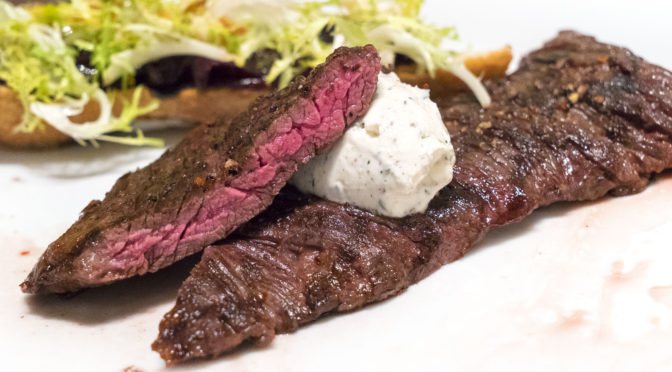
With Memorial Day celebrations upon us, I figured I would share a sure fire way to impress guests at a BBQ. I chose skirt steak because it is likely going to be one of the cheapest cuts you can find in the grocery store and still prepare it deliciously with very little effort. So hike up your skirts a little more, and show your BBQ friends the stankin’ ass pair of balls you have dangling underneath.

INGREDIENTS

• skirt steak
• olive oil
• lime juice
• lime – optional
• garlic cloves
• garlic powder
• kosher salt
• fresh cracked pepper
• fresh habanero pepper (or jalapeno, or dry crushed red pepper) – optional
• fresh oregano – optional
• tupperware
• a grill
• a pair of tongs
• a plate
• a knife
• a pair of balls the size of eggs

STEP 1

In the grocery store, look for a cut with the least connective tissue still clinging to it. This would be thick, white flappy stuff. You’ll have to trim some of that off when you get home, so if you can avoid it ahead of time, then that’s helpful.

It’s always best to cook it right away; the fresher the better. It may be a few days since it was butchered, maybe longer. I like to go to the grocery store and come home to immediately start cooking. No fridge needed.

STEP 2

Place the steak in a tupperware container with an inch or two of olive oil in it. The steak can fold over; it doesn’t need to be a huge tupperware container. Next chop up your garlic and peppers, because you are going to soak the steak in there with some crushed garlic cloves and chopped habanero peppers. This olive oil soak isn’t as critical with a fatty steak like skirt, but this technique also works really great on more dense meats, or cuts without much marbling or fat content. Also if you are too vaginal for habanero, or if your shitty grocery store doesn’t have them, you can use jalapeno, crushed red pepper flakes, or nothing at all. But if you don’t like spicy foods, then go fuck yourself because that means you’re an asshole anyway.

Leave it in the tupperware at room temperature if you plan to cook it the same day, which I highly recommend. Know that the longer you leave the peppers in, the spicier it will get, and the longer you let it soak in the oil and garlic, the more tender and flavorful it will get, as that shit soaks into the meat.

Whatever you do, DO NOT PUT THE LIME JUICE IN THE SOAKING LIQUID. Lime juice has acids and enzymes in the citrus that will break down meat and essentially cook it. In fact that’s how ceviche is made with raw seafood.

STEP 3

Wait. Even an hour will make a difference with this soak. And yes; you want the meat to be room temperature before it hits the grill. Occasionally you should turn the meat to ensure that all sides and surfaces are coated and get soaked in the goodness.

In the meantime you can start prepping your sides. I like grilled asparagus with steak, as I tend to shy away from starches when I am eating a steak dinner. Avoiding starch will leave more room in your gut for meat.

If you have a charcoal fired grill, you can start that up while you wait too. I use a gas grill because it’s fast. I’m impatient, so I like my grill ready when I am.

Let the grill get psychotically hot. Close the lid and crank it all the way. Some of the best steakhouses cook their meat at around 700 degrees for the initial outer cooking. They often use lower heat for thick cuts during a second cooking phase, to get the middle perfectly cooked without overcooking the outside. We won’t need to do that with skirt steak, since it is thin. So the hotter, the better.

STEP 4

Now that your meat has been soaking for a while, take it out and pat it dry with paper towels. Get all the oil off. You want the meat to hit the grill bone dry. It may seem like a waste of olive oil, but I promise you it will be worth it once you take that first bite.

STEP 5

Season the mother fucker generously with kosher salt, cracked black pepper, garlic powder, and whatever else your heart desires. But don’t overdo it otherwise you will drown out all the great flavor you just imparted into the meat during the soaking process.

This isn’t baking, so you don’t need exact measurements here or anything with the seasoning. My wife is a baker and the great thing about grilling as opposed to baking is that grilling is more free form, more relaxed. With baking my wife needs precision, and she needs her measurements to be as close as possible to her recipes. If she goes off a few grams everything can get screwed up. With grilling you pretty much have to be an invalid to fuck it up.

STEP 6

So your grill is hot as shit now, and you are ready to start cooking. Grab your tongs, a serving plate, the lime juice, and your meat. You’re ready to rock!

Lay the meat horizontally across the grill bars. When the meat hits the grill it should scream and sizzle. Nice and hot. That means you are going to get some great char lines.

So you’re wondering what the fuck the lime juice is for, right? Well here is where it comes into play. I like to use a spray bottle for the lime juice, because you don’t want to add too much liquid to the meat during the cooking process, otherwise you will steam cook your meat and it will turn gray and soft on the edges instead of that nice crispy charred outside that you expect when grilling. So just give the meat a good mist every so often to get that flavor on there. Another option is you can use fresh limes. Slice them up and lay them on the upper surface of the meat as it cooks. Then, when you flip the meat, put the slices back on top of the meat again, or surround the meat by placing the slices directly on the grill beside the meat. Trust me you’ll taste the lime. Last, you can also zest the rind onto the meat when you season it.

I also like to throw some fresh oregano from my garden on the grill during this time too. Throw it everywhere; on the grill, on the meat, on your prick, etc. It gives it a nice herb-kick!

STEP 7

Watch your watch. Two to three minutes a side on a steak this thin, and on a grill this hot, should be plenty. What I like to do is probably overboard; I like to do one minute with the top open, one minute shut. Then I flip the steak and do another one minute open, one minute shut. If it still needs more, I flip the steak again to get crossed grill marks (turn vertically) and do one minute open. Then flip the steak again and do the final minute with the grill top shut.

Think of it this way: closing the lid causes the center of the meat to cook more. However with a thin steak like this you may not even need to do the lid closing; it’s just a technique I thought I’d share with you assholes anyway. Also keep in mind that the more you flip and move the meat, the less defined grill marks you will have on the finished product (apprearance IS important).

STEP 8

Remove the meat from the grill with the tongs and let it rest for a few minutes. The meat is still cooking even though it’s off the heat, and the juices are still going to come out if your seasoning and crust doesn’t lock in all the juices. Whatever you do, DO NOT CUT IT WHILE IT’S HOT! If you cut it now it will bleed out and become a runny mess. When you let it rest, you give the steak the opportunity to reabsorb all the delicious, savory meat juices that would otherwise fall out if you cut it while it was still sizzling. That’s why I hate when steakhouses do this with the porterhouses for two or three people. They ruin it. As a result they have to add tons of butter to keep it succulent. Then you’re increasing your fat intake, you’ll get the meat sweats afterwards, etc. It’s not a good scene. With a hot cut you’d have to eat it fast, when it’s too hot. Then you burn your mouth. Then you can’t taste it because you blew out your taste buds. Then for the next three days you’re eating flaps of dead skin that slough off the roof of your mouth throughout the day. That sucks.

So let it rest. If you have any juices in your resting plate afterwards, you can reduce them down in a pan to create a sauce.

STEP 9

Slice into square shaped portion sizes by running your knife WITH the grain of the meat. However, while eating or when slicing prior to service, you want to use a really sharp knife and cut AGAINST the grain. This technique is referred to as cutting “on the bias.” This increases tenderness, makes for a nicer appearance, and the meat holds together better when the striations are cut in this way.

Garnish with a wedge of lime, and use that to dress the meat a bit with a quick squeeze before eating.

STEP 10

Eat. Then, later, you can shit it all out.

Frankie & Johnnie’s (37th St.)

Frankie & Johnnie’s overall score: 79

In a last minute, game time decision to grab some steaks, I took my wife and the super awesome guy who built this website out to dinner as a thank you gesture for all the work put into getting this page into legitimacy. It turned out to be a really fucking good meal.

Flavor: 9 (updated to 8)

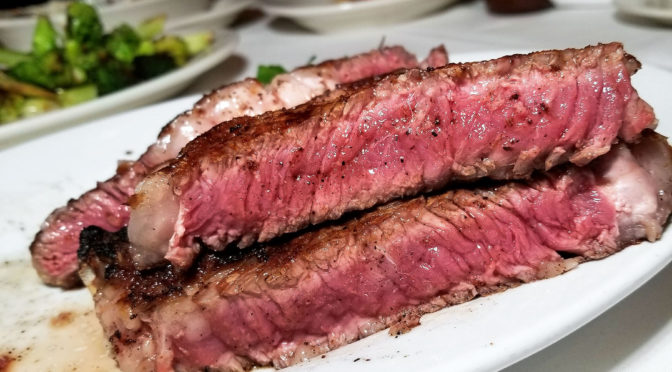
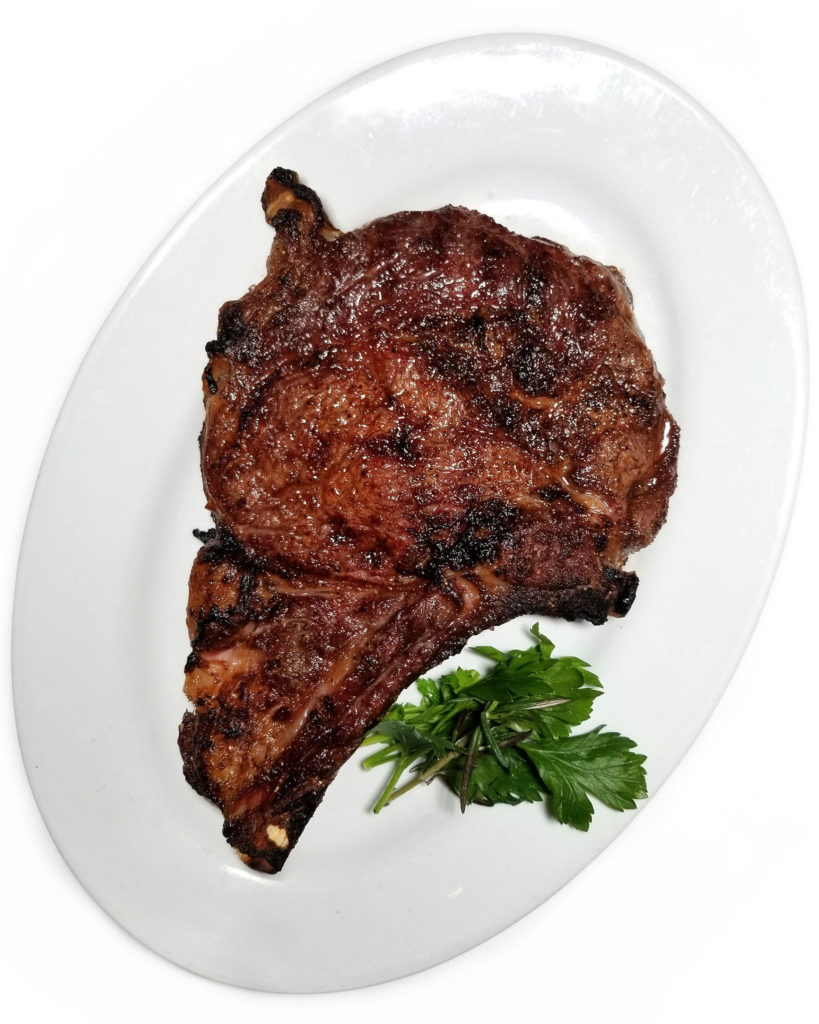
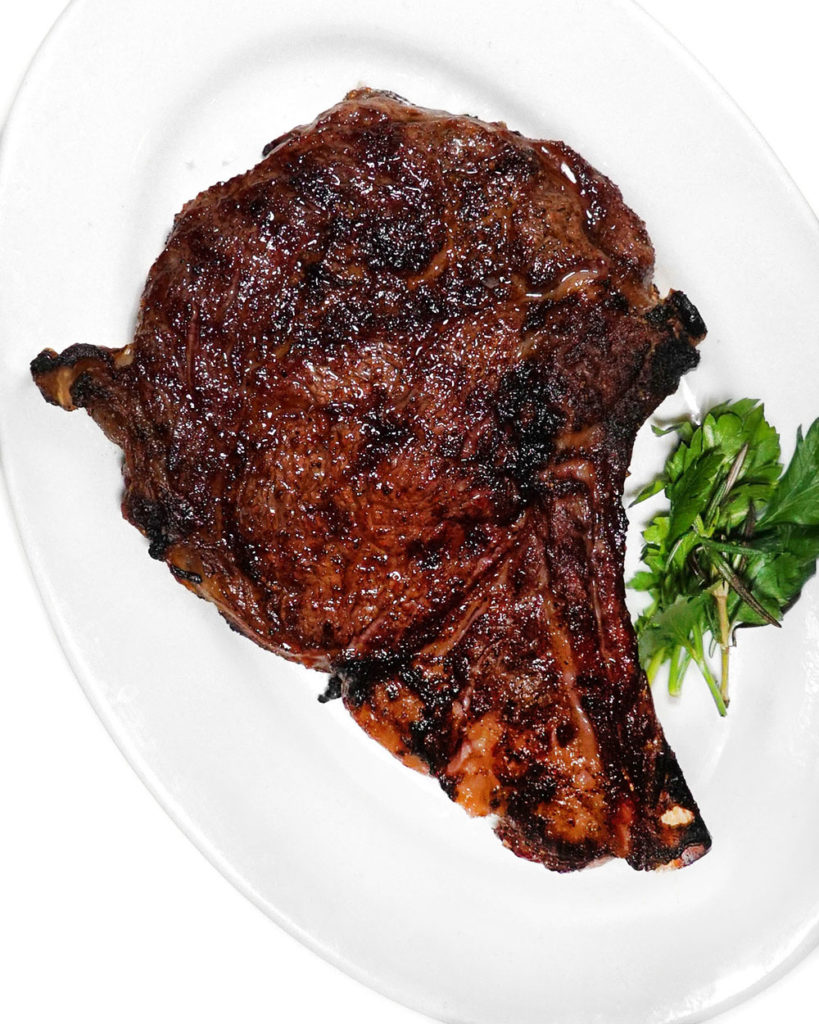
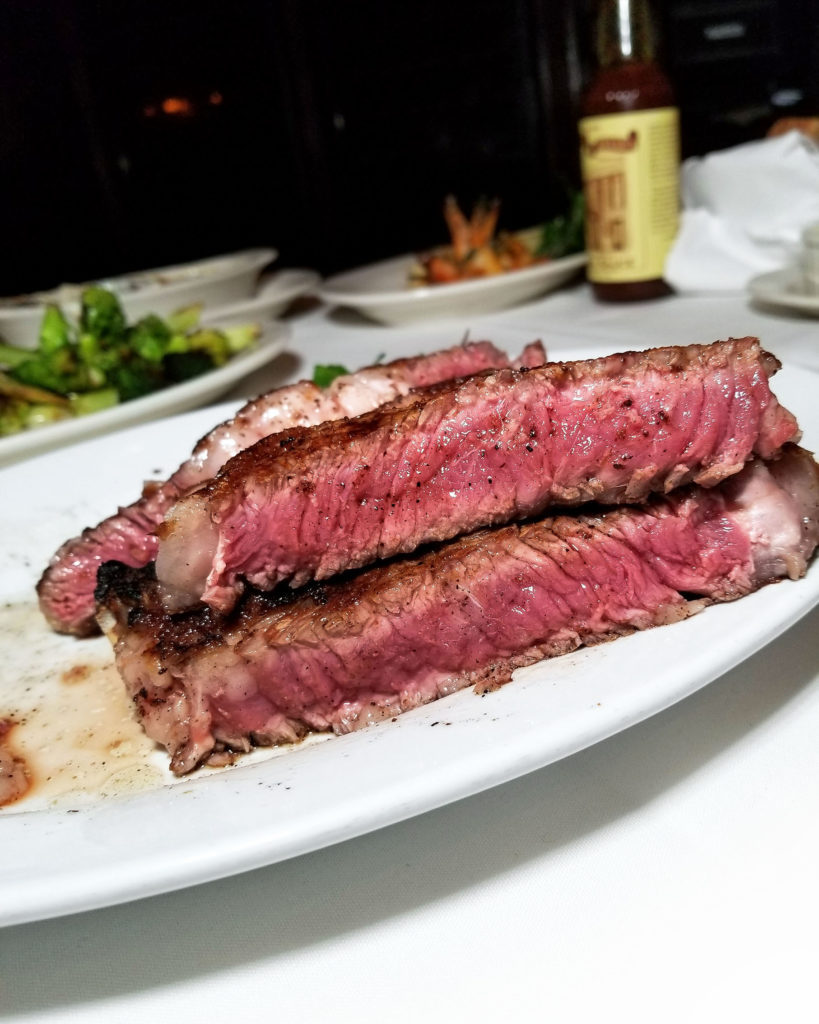
We got the peppercorn crusted ribeye for two that was on special here. It was beautifully cooked to right between medium and medium rare, like we asked. If I had to guess I’d say it was maybe 36-40oz, but it had no waste on it. It came pre-sliced, but not in the shitty style of how most places serve the “porterhouse for two.” You know the drill and how it is at those shit boxes; it comes out on a screeming hot bowl-plate, and the bleed-out liquid pools underneath the carcass. It’s like a culinary horror movie where the star of the film gets killed at the end instead of living happily ever after. Then the meat becomes dry unless you destroy the soft tissue in your mouth and eat it right away, while it is still 17 million degrees. No – Frankie & Johnnie’s respects the meat! They let it rest and cool down, and there was absolutely no run-off under the sliced meat. NONE. It held all its juices, and the deliciousness was locked in tight. It has a great char on the edges, and the peppercorn crusting added interesting flavor, though I thought the peppercorn was not really necessary. Even the blubber was smooth and edible on this fucker – like you could smear it on bread instead of using butter, kinda like roasted bone marrow but less gamey. It was served with a gravy boat of sauce – likely a catching of flavorful drippings and juices from the cooking process, clarified, and reduced just a bit for cohesion. It was fucking drinkable. Bravo to this place.

Choice of Cuts & Quality Available: 9 (updated to 8)
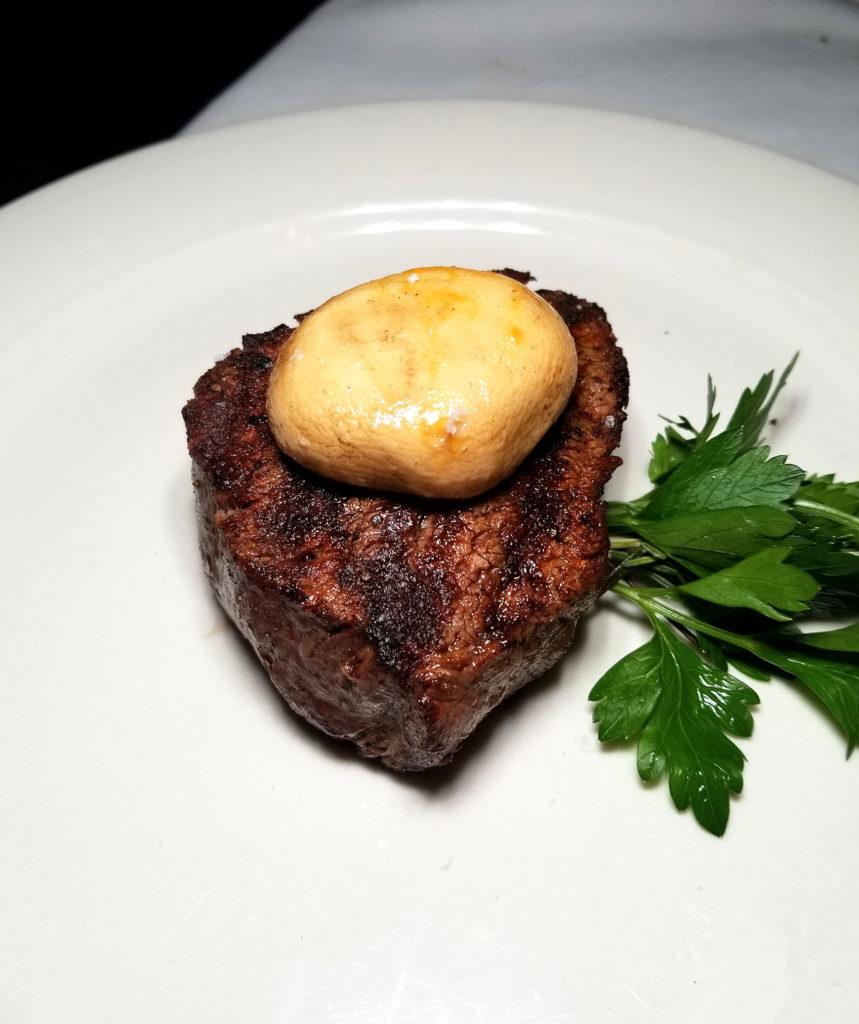
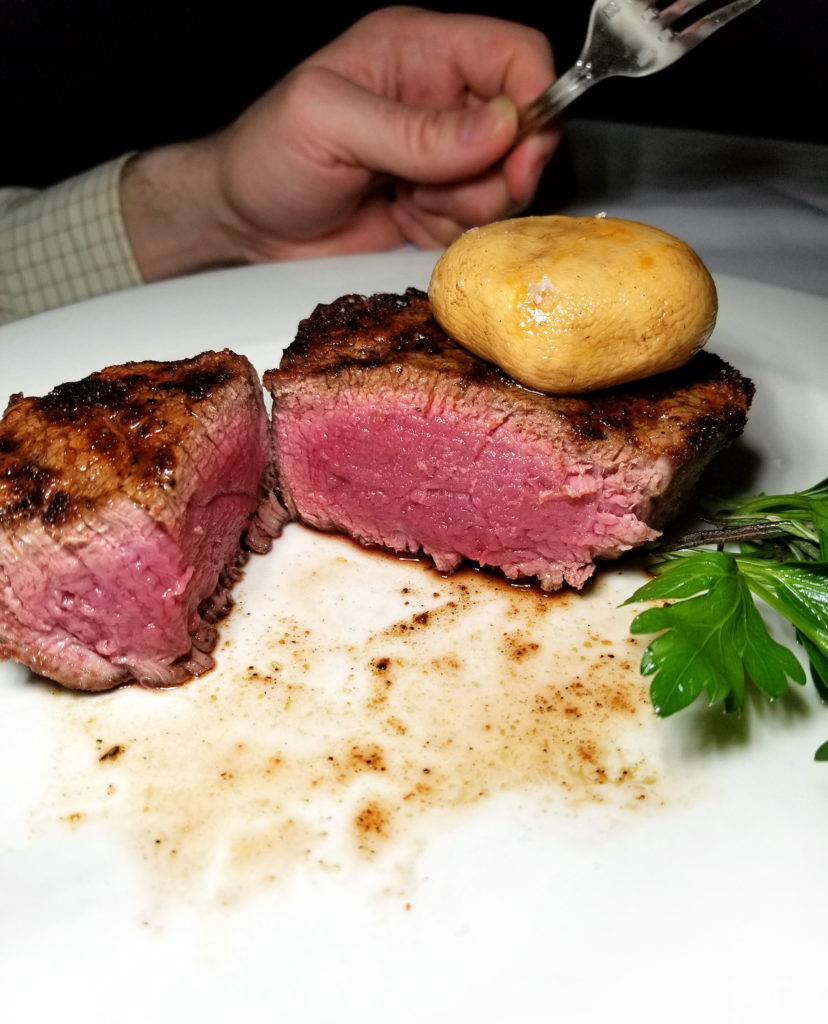
The menu online is very different from what they have on site, so I was pleasantly surprised to see more variety than I expected. They had the basics in the following form: filet with a mushroom cap (in two sizes), ground filet mignon (think elevated “chopped steak”), “sirloin steak” (which I assume is a lesser version of a strip cut, but aged nicely), a ribeye, a t-bone (a “lesser” porterhouse, but for one), and porterhouses for two or three. In addition, and on special, they had the ribeye for two that I described above. All the beef is dry aged and prime quality, and on top of the good beef selection they also have a great selection of alternameats (see the other section below). All that was missing was, say, a flank or a skirt cut.
Portion Size & Plating: 8
Sizes here are good but not off the charts. As I mentioned the ribeye for two was certainly enough given the fact that there was no waste. It was in the 36-40oz range, and while I have had ribeye for one at 39oz, the quality here surpassed nearly all other large portioned cuts that I’ve had. The filet comes in 8oz flavor, or 12oz flavor. You see the trend? Not too massive, but all good. So you get bang for your buck.
Price: 9
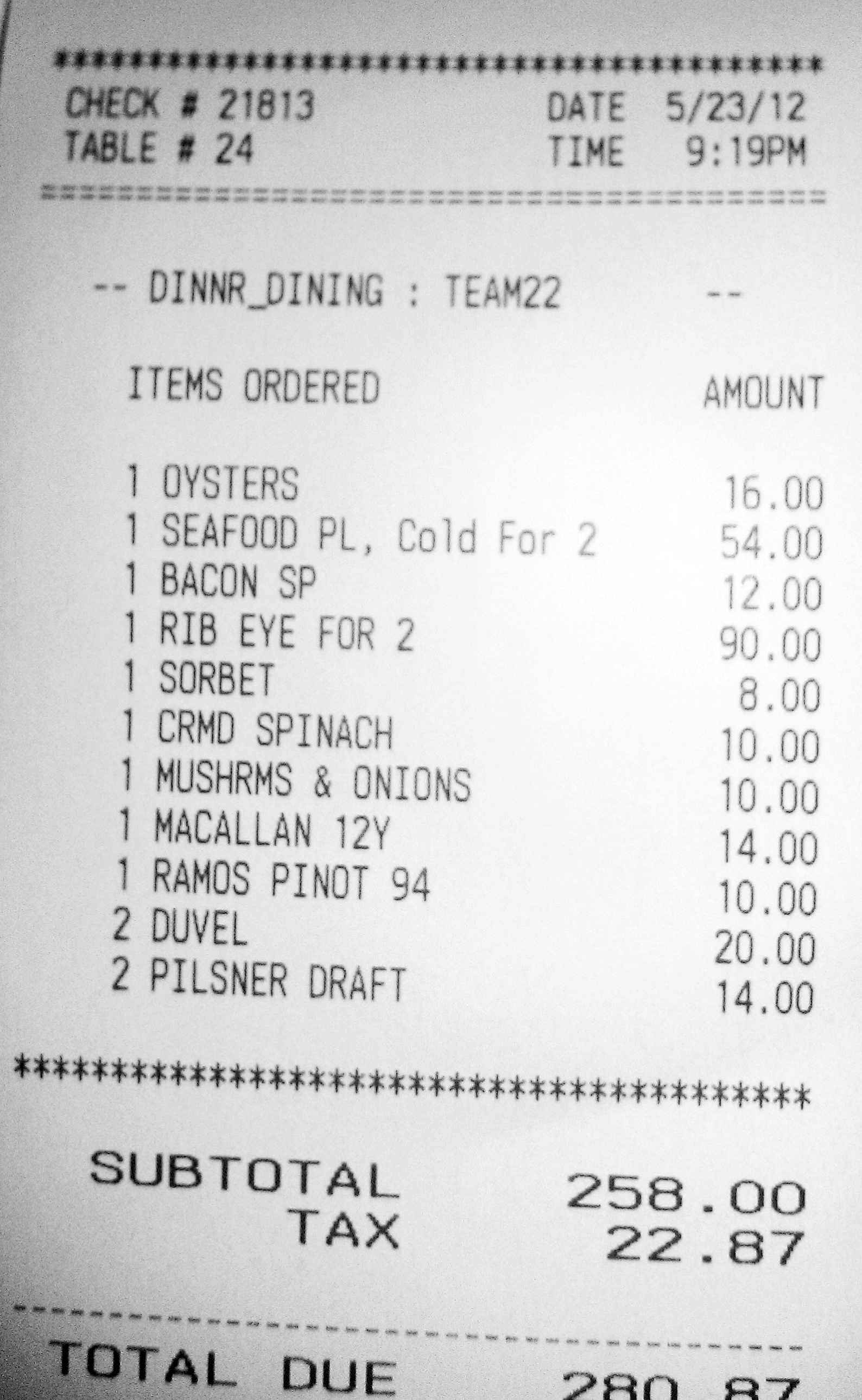
The prices here are actually really great for NYC. Nothing breaks $50 for a singular cut of meat, and most items from the beef side of things come in around mid $40s. The ribeye for two was $90. For a special cold seafood tower, an order of oysters, a bacon app, a special ribeye for two, two sides, a dessert, and four drinks the bill only came to $281 after tax. Not bad at all for a thoroughly enjoyed meal. I only took a point off because they mistakenly charged me for and served me a scotch that cost $4 more than the one I actually ordered.

Bar: 7

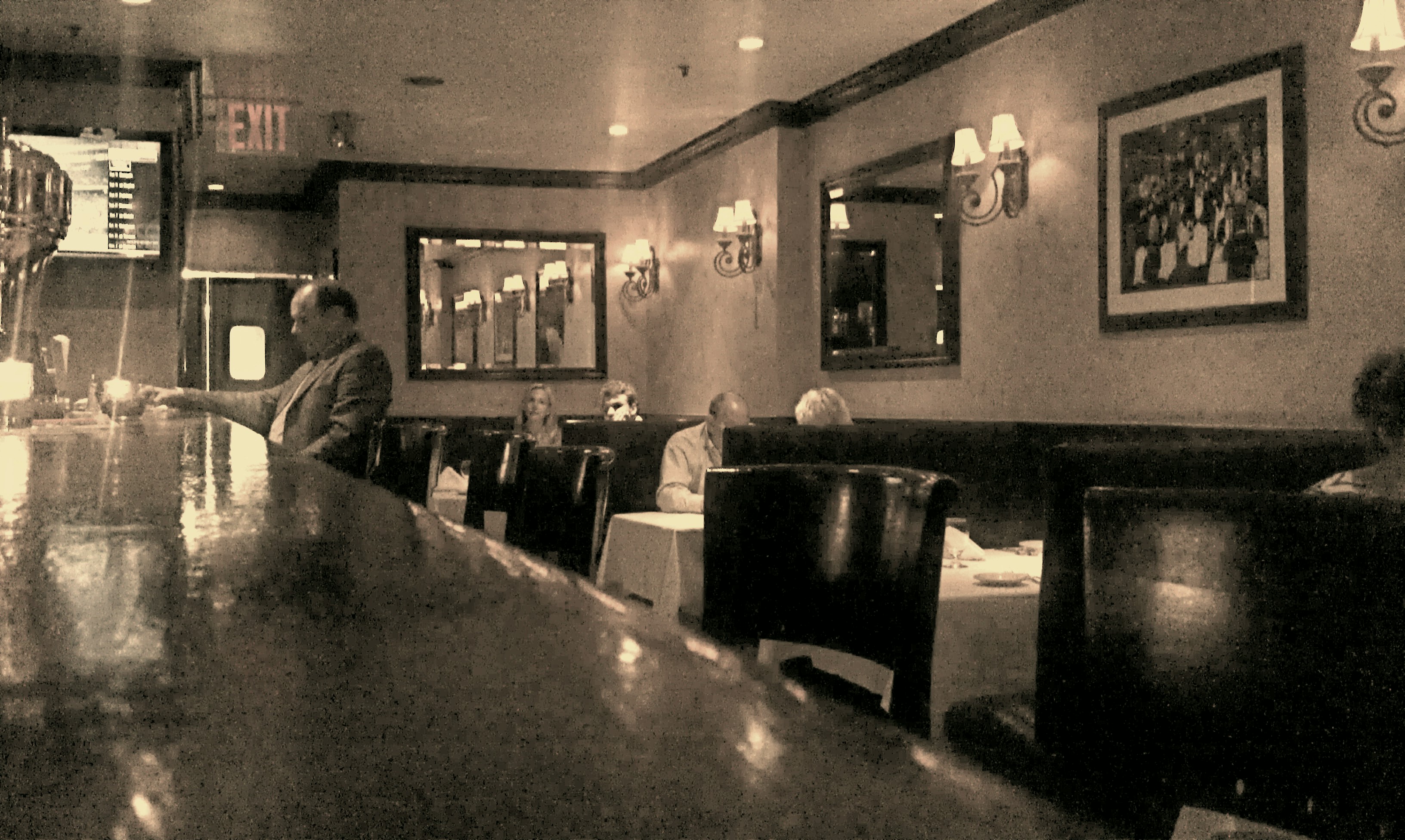
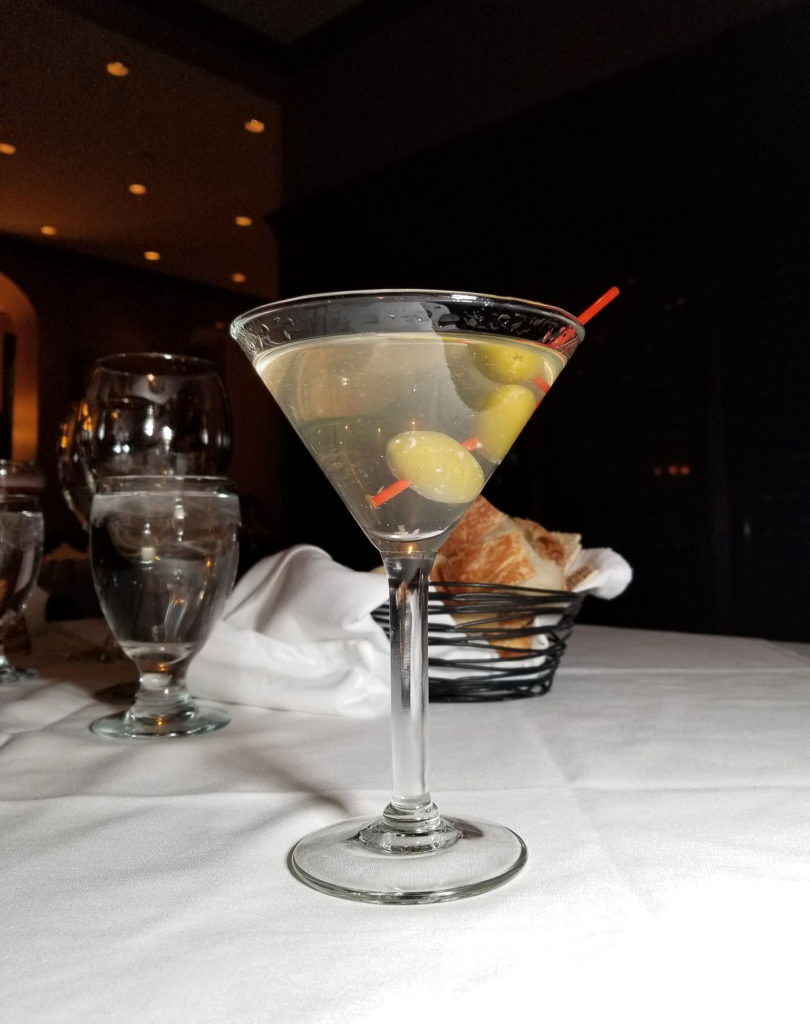
Frankie & Johnnie’s is set up a bit odd, but they make good use of the space. When you walk in, you are in a small entry hall with the greeter. There is a stairway up to the main dining room, and a short stairway down into the bar area, which extends backward on the ground floor level. It is dim, but lively. It has one flat screen tv, and across are a bunch of tables for bar dining. The martini was made perfectly, though a bit on the pricey side at $13-$14. Since it isn’t adjacent to the windows, it lacks a certain feel that I’ve come to want at restaurant bars. Contrast with Del Frisco’s bar, which is big, open, and right along the windows. See a picture of the bar and seating area below:

Specials and Other Meats: 8

On special was the ribeye for two, a hot seafood platter app, a cold seafood platter app, and an apple smoked thick cut bacon app. I would have liked to see a marinated flank or skirt to round out the beef selection, but otherwise it was a decent showing, especially considering we ordered three of the four items on special. As for other meats, they offered a great and unique selection; double loin lamb chops, pork chops, veal porterhouse, calves liver, and chicken (for pussies and broads).

Apps, Sides & Desserts: 7 (updated to 6)

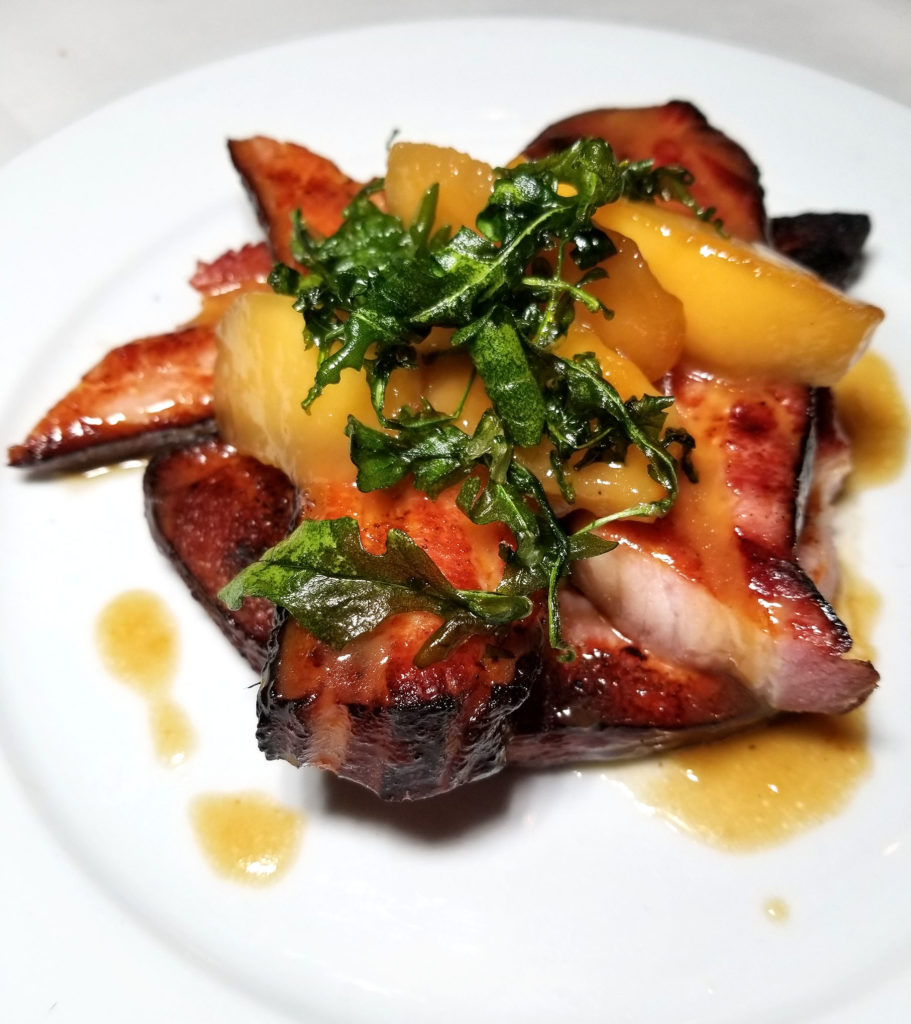
We started with a plate of Pine Island oysters and the apple bacon app. The bacon was nice and thick, though one piece I had was a bit stringy since it was the end of the belly. The apples added a nice sweetness and acidity to contrast the fat. The oysters were creamy, crisp, cold, clean, and packed a lot of flavor. My wife had the cold seafood platter. It’s meant to serve two people, but I thought it was a little small for that (and pricey at $54). It had two oysters, two clams, two shrimp, some lump crab meat, and a half lobster (likely a small 1lb jammy). It was all very tasty though, so size was the only issue. The creamed spinach is a staple at any steak meal. Here it was average – yummy but not stellar. It was creamy, but a bit too loose. I’ve had better at Wolfgang’s. The mushrooms and onions were sweet and earthy. They did a good sautee job on them – not too salty, oily or buttery. For dessert we tried the coconut sorbet; it was airy, natural tasting, and creamy, yet did it not feel or taste like dairy. I guess that’s why it’s called sorbet and not ice cream, but it had the consistancy of ice cream.
Seafood Selection: 9 (updated to 8)

They offer Maine and African lobster, broiled salmon, shrimp scampi, Chilean seabass, and pan seared tuna for seafood entrees (along with a quiffy surf & turf). There’s also lots of the standard stuff on the app side of the menu, like the raw bar, crab cakes and all manner of cocktails.

Service: 9

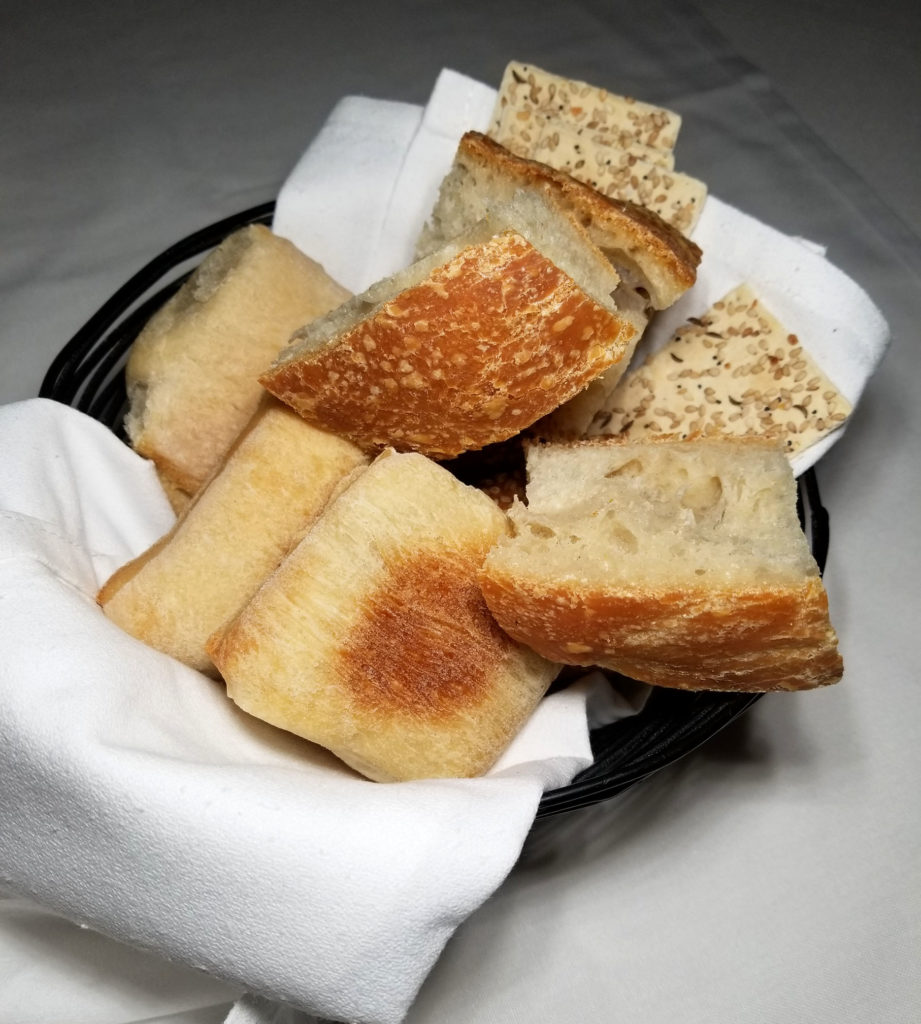
The waiter was great – he gave us enough space but he was always there when we needed him. He was cheerful and happy, but not in the fake “TGI Friday’s” kind of way. He was genuine. All the servers were dressed with formal attire (vests and ties), and the staff was mixed male and female. The bread assortment consisted of some onion bread, garlic bread, flat bread, and other dinner rolls. The bread was warm but the butter was cold.

Ambiance: 8

Despite a slight lacking in the bar area, Frankie & Johnnie’s main dining room has elegant decor, lofty ceilings, and plenty of space. It is classy but not stuffy. In the rear there is a huge fireplace with lots of dark wood trim surrounds. Very nice. One down side is the lack of a bathroom on the dining floor. You have to go down to the back of the bar area, and that shitter isn’t that nice to begin with. Mediocre at best.

UPDATE: 1/18/18

After a re-visit many years later, I had to drop the score down a few points. The rib eye was flavorful but lots of the fat was inedible. The filet had more flavor, despite having less character.

Rib Eye: 7/10

Filet Mignon: 8/10

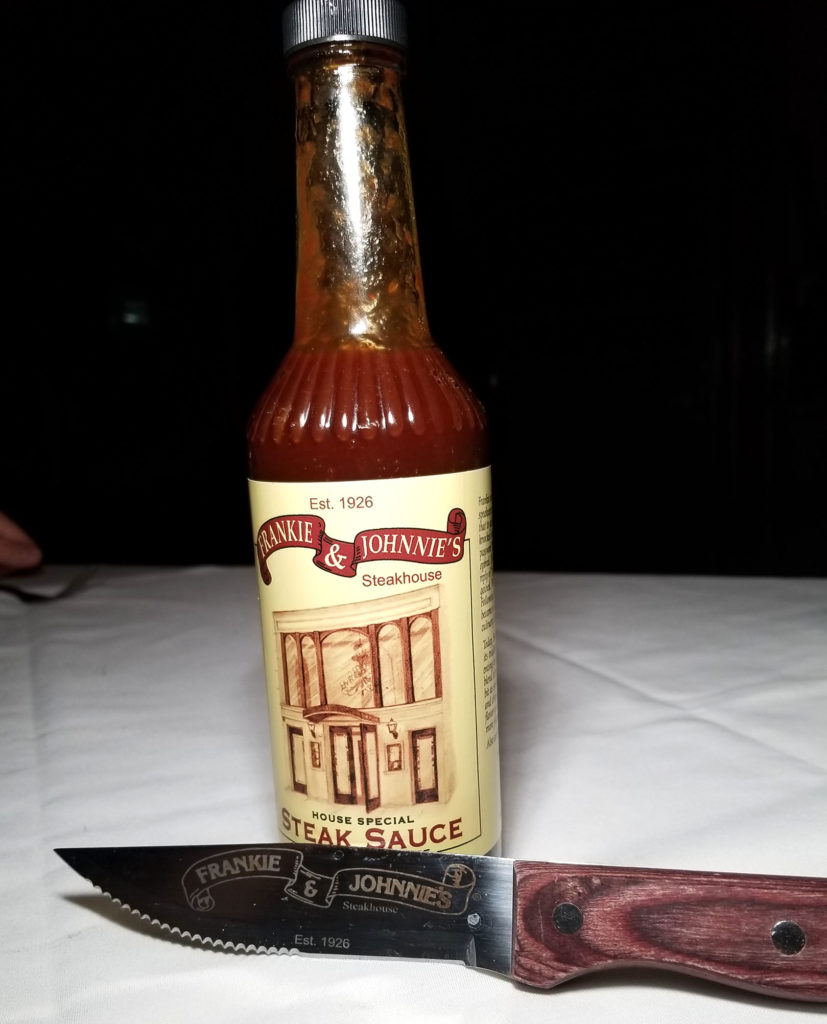
Steak Sauce

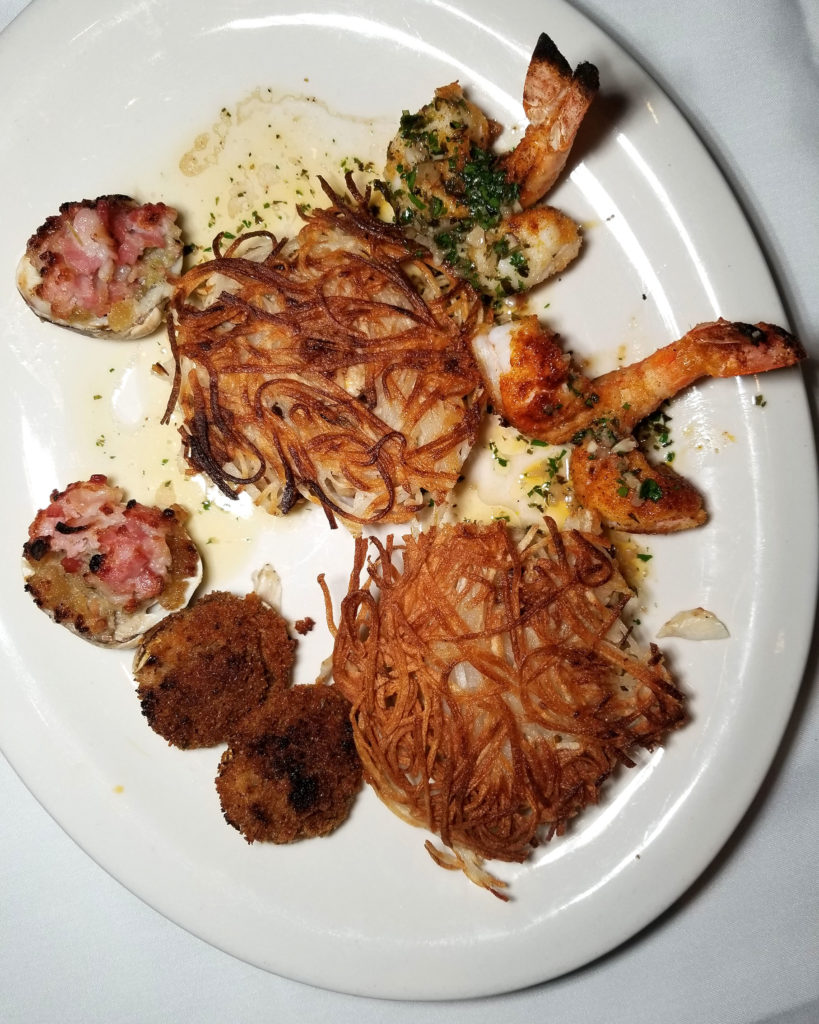
The seafood appetizer special for two, I thought, was going to be a chilled seafood platter. It turned out to be crab cakes, baked clams, and shrimp scampi. It wasn’t bad, in fact i liked the crab cake’s potato crust. It was just a little bit skimpy for a dish “for two.”

Mixed Seafood Grill

The bacon was a bit too fatty. I enjoy eating fat bacon, but perhaps this needed to be cooked for a longer amount of time at a lower temperature, to ensure that all the chewy bits became soft.

Bacon

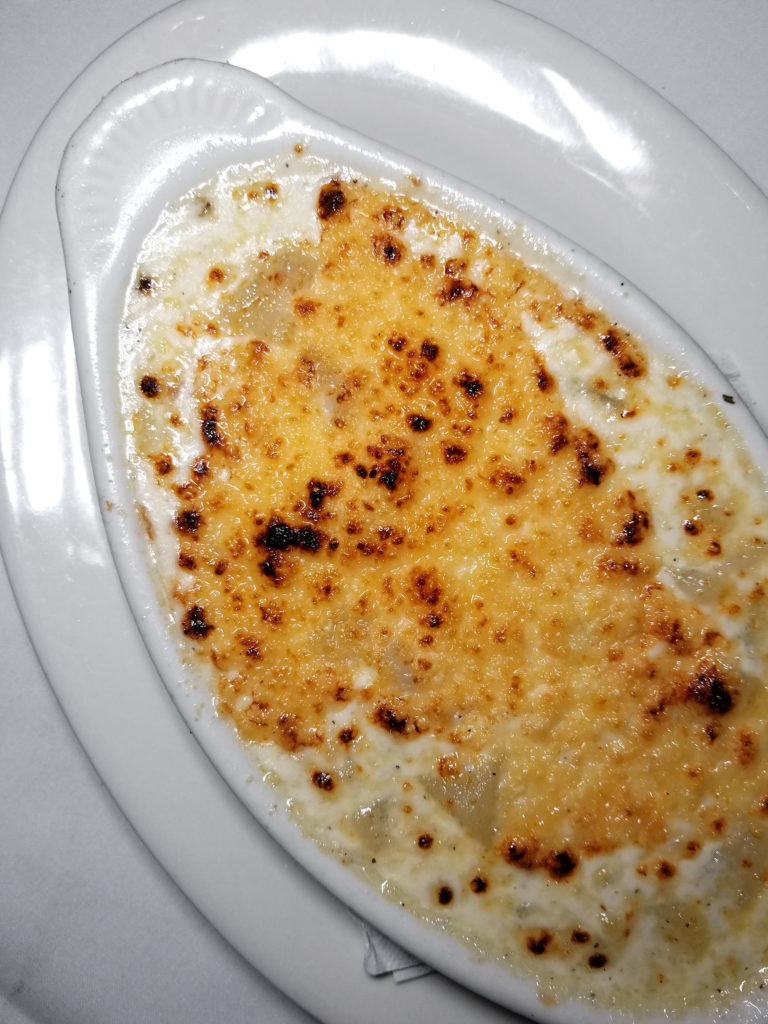
The potatoes were cut into chunks as opposed to sliced thin. The result inside was a thin, soupy consistency that wasn’t too good.

Potatoes Au Gratin

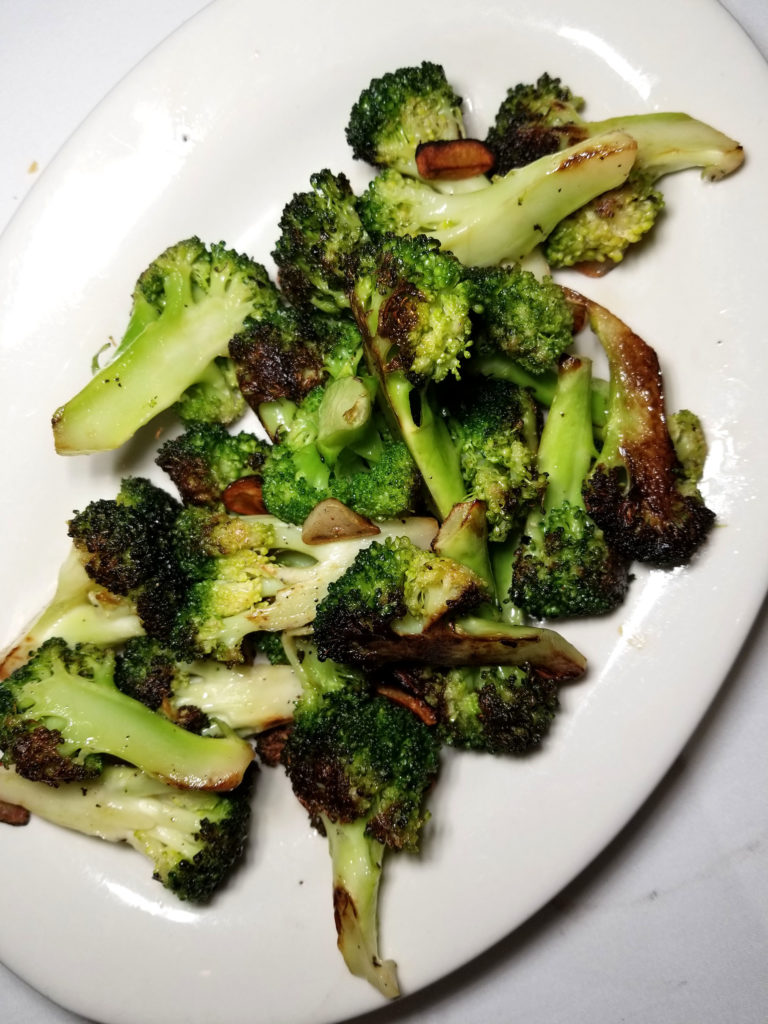
The broccoli was great. Simple garlic and oil preparation, crisped and sautéed nicely.

Broccoli

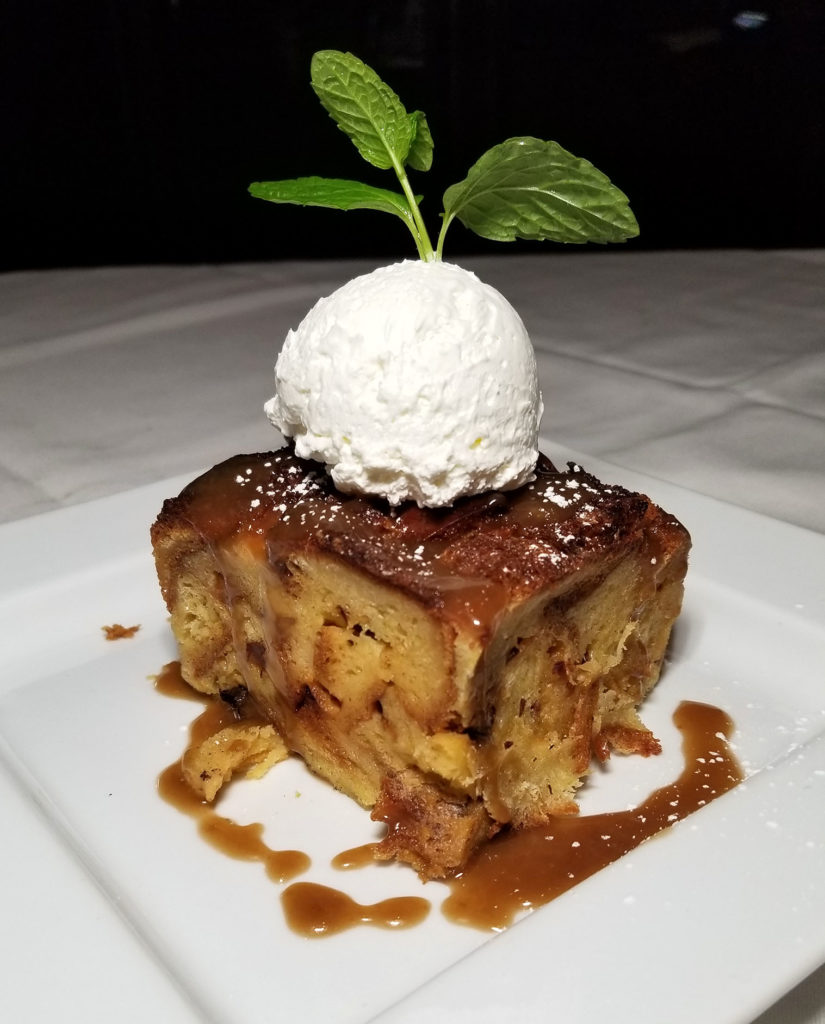
Both the bread pudding and the chocolate lava cake lacked flavor. Particularly the lava cake. The outside was rubbery and flavorless.

Bread Pudding

FRANKIE & JOHNIE’S
32 W. 37th St.
New York, NY 10018

Wagyu and Kobe Beef

Most people usually associate the word Wagyu with insanely jacked-up prices, so high that they make your asshole pucker up tighter than a virgin’s snatch on prom night. Well here’s a quick low-down on the delicious shit:

Wagyu is a compound word of sorts. Wa means Japan, and gyu means beef. Hence, beef that hails from Japan. In the beef world it’s a term used when referring to four Japanese breeds of cattle that are genetically predisposed to intense marbling in their muscles. The four breeds of cattle are Black, Brown/Red, Polled and Shorthorn.

Until recently, Japanese beef was not imported into the United States, so any time you saw Wagyu on a restaurant menu, it was either a lie or an incomplete description. It was most likely beef from either an Australian or American hybrid Wagyu cross-breed animal.

Hybrid beef isn’t something that should be frowned upon. Many of the Wagyu cross-breeding programs produce excellent, highly marbled beef that strikes a nice balance between the traditional, robustly beefy flavors of the United States and that buttery-soft, intensely marbled Japanese stuff (which eats more like foie gras or some other protein, different from what we usually think of when we eat beef).

Lots of people get their panties in a bunch when you call the cross-bred stuff Wagyu, even at levels of full blood and purebred. They tend to confuse the literal translation of the word Wagyu (Japan beef) with the breed of cattle that the word represents.

The Wagyu breed is not and should not be region specific. Just as Angus did not cease to be Angus when it was imported from Scotland to the United States in the 1800’s, Wagyu does not cease to be Wagyu when it moves abroad. Both breeds are named for the locations where they originated.

In fact, almost every major European cattle breed was named after the location where it originated. Does that mean the ones that are raised in America should be called something else? No! We don’t call a German Shepherd an American Shepherd just because the breeder operates in New York. We don’t do that even when the animal isn’t purebred! So why treat Wagyu differently? It’s stupid.

On the flip side, the Wagyu breeds should not be confused or conflated with something like Kobe beef, which has some strict parameters to its regional product branding. That’s right, it’s a brand.

Kobe Beef

What exactly is Kobe beef? The easiest way to think about Kobe beef is to liken it to Champagne. To be called Champagne, the bottle has to be from the Champagne region of France, otherwise it’s just “sparkling wine.” The same logic applies to Kobe beef.

Under Japanese law, Kobe beef is a very specific product from a specific place, from one breed of cattle, with very strict rules. Kobe derives from a strain of the Japanese Black breed of Wagyu cattle known as Tajima. It’s said that the cattle are hand-fed using high-energy feed, including beer and beer mash, to ensure tenderness and high fat content. Basically, they’re grain-fed. The cattle are also apparently hand-massaged to reduce stress. I guess it’s only fair to pamper these beautiful beasts if we’re going to slice them up and grill them!

Note that real Kobe beef is typically not readily or easily available in the United States, so if you see it on a menu, understand that it may likely be a knock off (though probably still very good) from a place other than the Kobe region of Japan. As of the time of this book writing, there are only about nine places on America’s east coast that sell legit Kobe beef.

Other Regions of Japan

Several other regions of Japan have also branded themselves as beef specialty production zones similar to Kobe. Miyazaki produces some excellent beef, and beef from this prefecture is more commonly seen at high-end steakhouses and Japanese restaurants here in the United States. Matsusaka in Mie, Japan and Hida in Gifu, Japan are other areas that produce similarly outstanding beef. Both of them are harvesting Japanese black breeds of Wagyu, and holding the final product to rigorous quality standards.

Even Hokkaido has set itself apart with what is called “Snow Beef.” This product from the cold region of Hokkaido is said to be a unique expression of beef with intense flavor that can only be created in this rare environment. It’s said that the mountainous climate causes extra fat to develop in the animals, and that the cold weather lowers the melting point of their fat. This supposedly creates sweetness in the meat. I’ve tasted this stuff. It’s great, but I don’t know how much of that copy I believe. The purveyors from Japan are masterful at marketing their products.

Japanese Beef Marketing

People who love Japanese beef also love to talk about how the animals are given beer. “Drunk happy cows,” they say. They’re not drunk. They’re fed beer mash, which is likely just a waste byproduct from Japan’s booming beer-making businesses. We do the same here in the United States with whiskey mash byproducts.

Some producers in Japan are incorporating olives into the feed, and it makes for some deliciously enticing marketing campaigns. This is similar to how many United States beef producers incorporate different foodstuffs into their cattle feed depending on their localized and regional agriculture markets (almonds in California, sunflower seeds in New York, etc.). The Japanese are adept at marketing these feeding programs, and we could learn a thing or two from them.

Meat lovers here in the United States would go nuts for “almond-fed beef.” They’d be drunk with excitement for “whiskey beef.” Just imagine the wine pairings that could be had with beef that was fed different crushed wine grape varietal byproducts, which would’ve otherwise been discarded as waste from a winery’s pressing operation.

In reality, the United States and Japan’s feeding programs aren’t all that different. The animals eat grass, grain and a smattering of additional fermentation, distillation and industrial byproducts. The difference is really in the animals’ genetics when it comes to how much intramuscular fat they can develop.

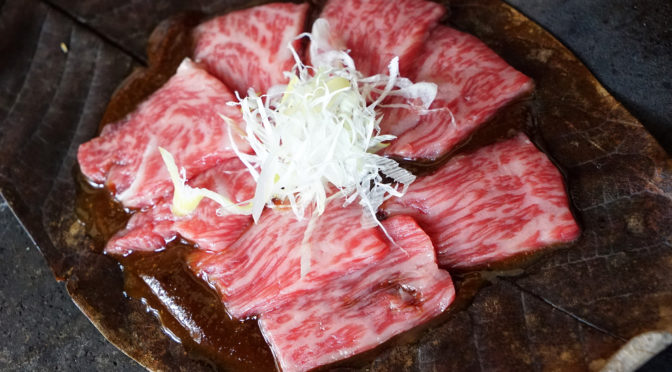
I really don’t give a fuck where the meat is from, to be honest. If it looks like this, I’m salivating.
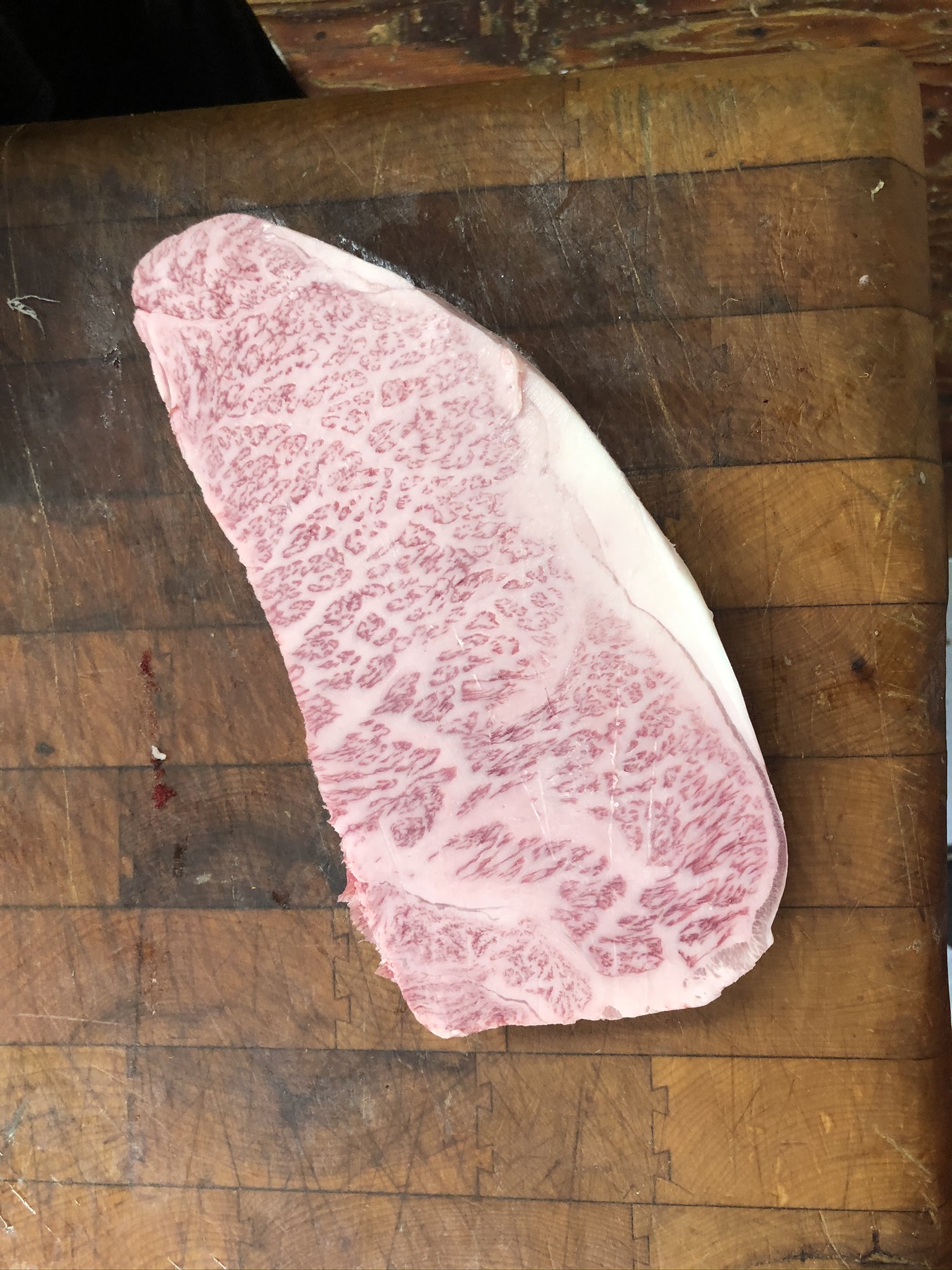
That’s probably about BMS 12, aka ultra-high prime.

OLD POST:

What exactly IS Wagyu and/or Kobe beef? You see it on menus all the time, right? And usually with insanely jacked-up prices, so high that they make your asshole pucker up tighter than a virgin’s snatch on prom night.
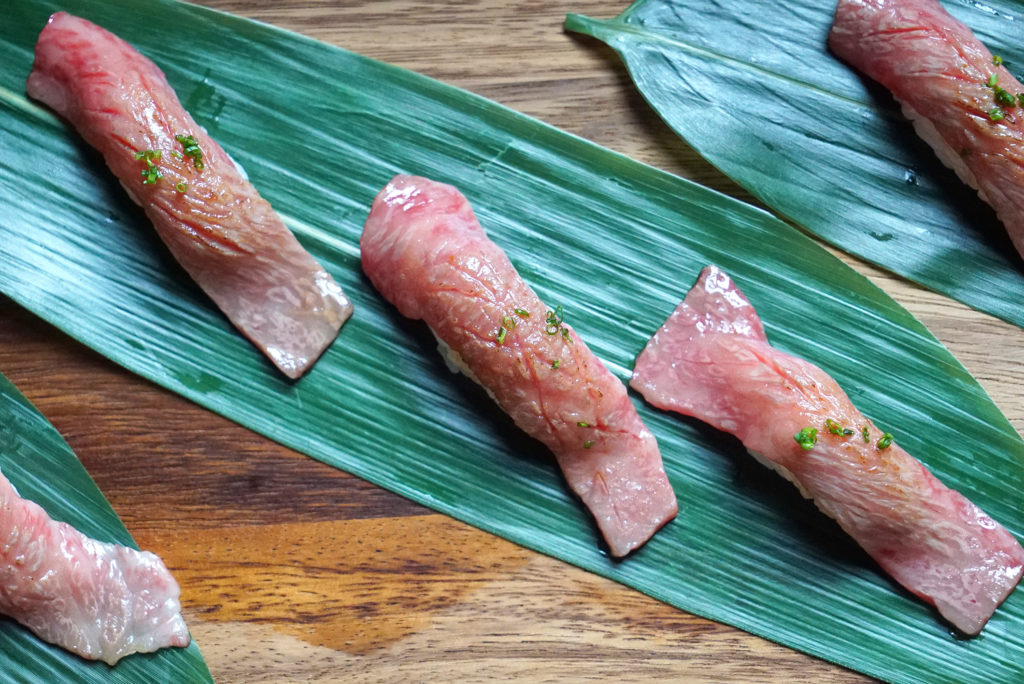
dsc08999

Well here’s a quick low-down on the delicious shit:

Wagyu: This is a term used to describe 4 Japanese breeds of cattle that are genetically predisposed to intense marbling of fat. There’s also two grading scales WITHIN the world of Wagyu. First is a letter and number pairing: A, B, or C and 1-5 within each grade, with A5 being the most marbled and C1 being the least. The second is the BMS (Beef Marbling Standard) score, which is a scale of 1-12. The best quality you can get in the US is A5 BMS 11 (not exactly sure why we can’t get A5 BMS 12). When this shit is on a menu, it’s pretty fucking expensive, and usually sold by the ounce. The four breeds of cattle are Japanese Black, Japanese Brown/Red, Japanese Polled and Japanese Shorthorn.

Kobe: Basically, this is beef from drunk, fat, happy Japanese cows, or so the myth goes. Under Japanese law, Kobe beef is a very specific product from a specific place, from one breed of cattle, with very strict rules. It is said that the cattle are hand-fed using high-energy feed, including beer and beer mash, to ensure tenderness and high fat content. The cattle are also hand-massaged to reduce stress. I guess it’s only fair to pamper them if we’re going to slice ’em up and grill ’em! NOTE that REAL Kobe beef is typically NOT available in the USA, so if you see it on a menu, understand that it may likely be a knock off (though probably still very good) from a place other than Japan. Kobe derives from a strain of the Japanese Black breed of cattle known as Tajima.

Matsusaka: This is also a Japanese Black breed, hailing from the Matsusaka region of Mie, Japan.

Hida Beef: I’ve written a bit more extensively on this brand after attending an event. It is Japanese Black that derives from the Hida region of Gifu, Japan. Click HERE for more info.

Okay now that we have a little bit of the basics set up, you should check out this informative expose on the US beef and restaurant industry’s misuse of the terms Kobe and Wagyu. It is a four part series that dives deep, and dovetails with some similar frustrations I expressed after dining at Sparks. Bottom line: if you see Kobe or Wagyu on a menu in the USA, know that it is meaningless and likely an imitation (though still quite possibly a delicious piece of meat), because the US does not import beef from Japan. I personally have seen and ordered “Kobe style” or “Australian Wagyu” items on menus at some of these places.

PART 1
PART 2
PART 3
PART 4

BUT WAIT!!! THERE’S MORE!!! Now, just to confuse you even further, SOME Japanese beef is now allowed back in the USA. See the link below.

New Info as of 9/28/12 – some Japanese meats allowed back into the US

Mmmmmmm…. I really don’t give a fuck where it’s from. If it looks like this, I’m salivating.
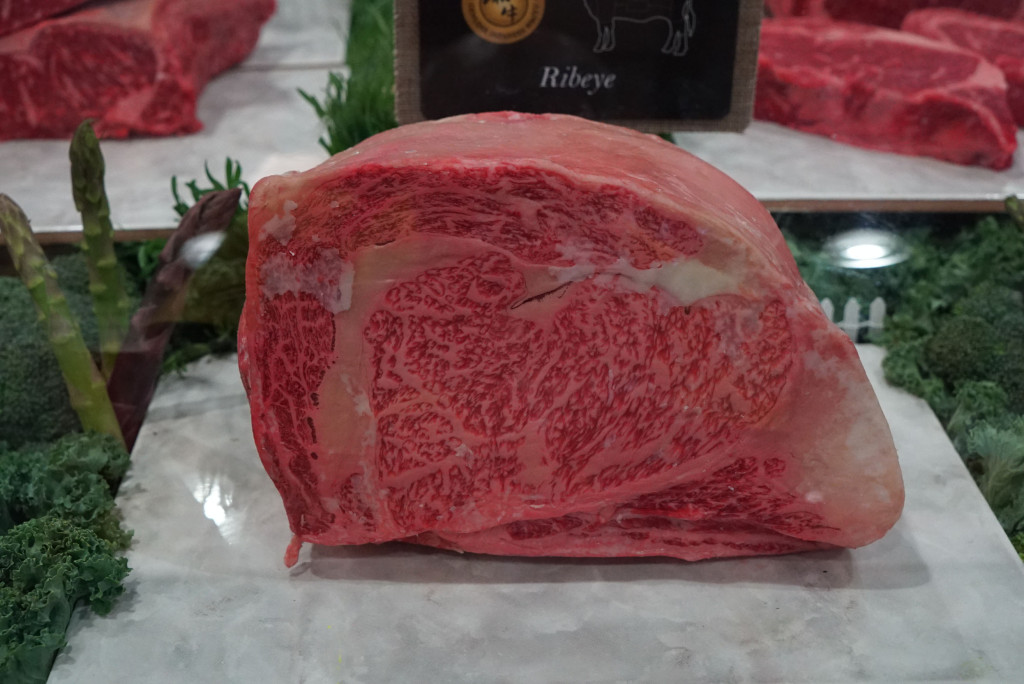
DSC02389

Yet another good summary of the history and current state of affairs on Wagyu and Kobe beef can be found HERE.

Sparks

Sparks overall score: 70

This review is based on my third or fourth trip to Sparks. I’ve been here a bunch, but not since I started reviewing steakhouses. See below for the verdict. In 2001 the NY Post called this place the greatest steakhouse in Manhattan. I disagree, vehemently. See below:

Flavor: 6
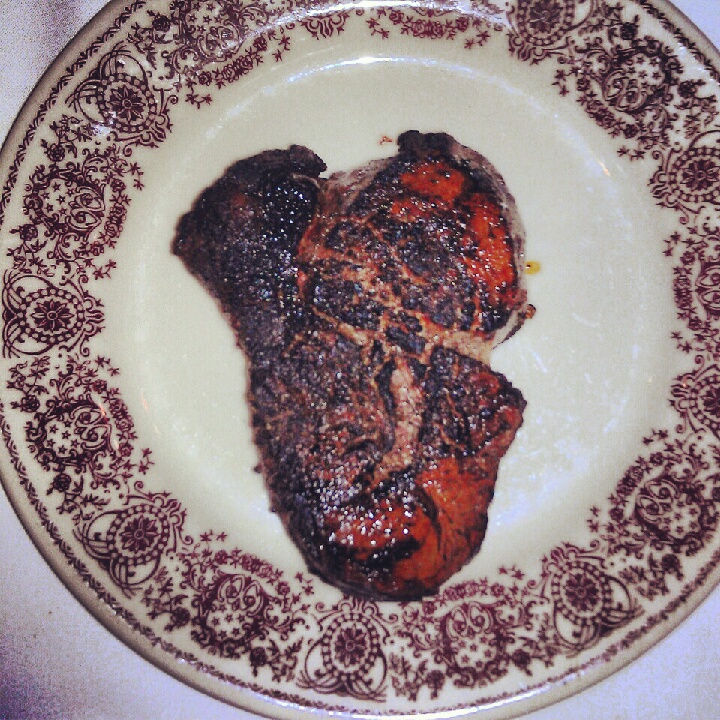
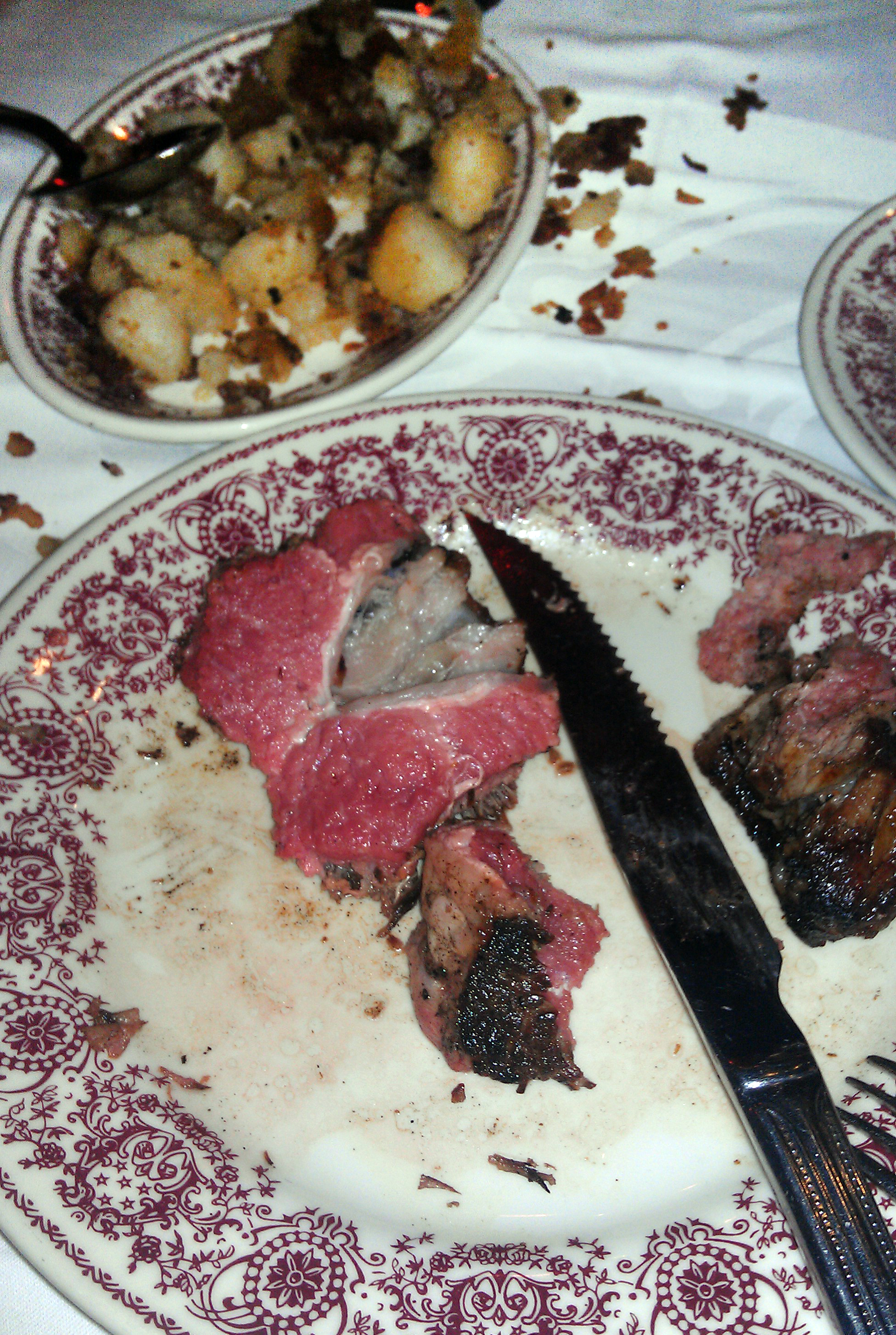
I had the “prime sirloin” on the recommendation of the waiter; their “signature steak.” I asked for medium rare, but what I received was a jumble of medium rare, rare and flat out RAW.  I had to ask the guy to re-fire it as I got into the center of the cut, and even then it was under cooked when it came back – still raw and rare in parts. My buddy ordered his filet medium, and his too came back mostly medium rare, rare and RAW. This is unacceptable, and the taste was lacking big time (4/10). The filet bite that I did have was good, however (8/10).  My “prime sirloin” was good around the edges, where it was cooked, but otherwise the inside had all the tell-tale signs of NOT being a true strip; so I was lied to. Not all Sirloin is strip. There were stringy, uncooked white ribbons of connective tissue, some chewy, dense areas, and lots of under cooked portions. If you are dead set on eating here, do yourself a favor and stick to the somewhat safe filet (it’s fine – just a slight bit under seasoned), and order it a step or two past what you normally like in terms of done-ness. On a subsequent trip, we did a filet and a lobster – no complaints, but I did know to order it medium if I wanted a steak somewhere in the “rare to medium rare” range.
still rare after the second firing

Choice of Cuts & Quality Available: 5

Another steakhouse without a ribeye on the menu; but no porterhouse here either!?!!?? What the fuck is going on? This “lacking certain basic cuts” trend needs to stop, otherwise JP will become very pissed. I could swear I had a ribeye here in the past… but maybe not. Sparks has all aged prime beef, but I think they may be using lesser cuts – in other words – they offer a prime aged sirloin instead of a real strip that is cut from a porterhouse. Or they use the “strip” side of a lesser quality t-bone (not a porterhouse). I saw shell steak on the menu here masquerading as a real cut of beef. Are you fucking serious? I don’t care if it is prime shell steak; it’s still a fucking piece of trash shell steak and not one of the four main cuts! I know places that serve CHOICE beef that scored higher, because they prepare them correctly and they actually ARE real steakhouse cuts like porterhouse, strip and ribeye. Is Sparks freaking joking with this? I suspected other places of doing it as well, and gave the benefit of the doubt, but I am not letting is slide anymore. Nope. They say “aged prime sirloin” instead of strip. Technically they are not from the same area in the anatomy of a cow! Go get some porterhouses, some real strips, and some fucking ribeyes for fuck’s sake! Like I said, EVEN IF THEY ARE CHOICE it is better! These people are acting like “prime beef” is the same as Kobe or some shit. I can understand a “Kobe” t-bone, or a “Kobe” sirloin, or a “Kobe” shell steak on a menu. Doing this is good because it is offering really great meat from a lesser cut so that the non-wealthy masses can try what really amazing meat tastes like. Kobe is special (even the faux versions), so offering a lesser cut is a great idea (otherwise something like a Kobe ribeye would be around $50-$100 an ounce). Listen – anyone can age a choice cut of meat to taste like prime in their garage or basement; but prime is not that big of a deal! I hope people understand what I am saying in this really long rant here, because this is a really dubious, evil, manipulative trend that is happening at very pricey steakhouses. Unless you know beef like I do, you might not comprehend what is happening (see my steak basics and cuts/anatomy blog posts from way back for a refresher). Anyway… Sparks also does a lot of “sliced steaks” on their menu. No good. Keep it simple, and keep it whole. I’m a big boy. I can cut my own meat.

Portion Size & Plating: 8

Sizes here are good – you will be full if you can eat your cut of beef, assuming they cook it properly when you go. I left about 4oz of beef on my plate because it was raw, even after the second firing of my steak. The filet, however, was a good size, and very tasty on my next visit. Keep it safe.
filet

Price: 7

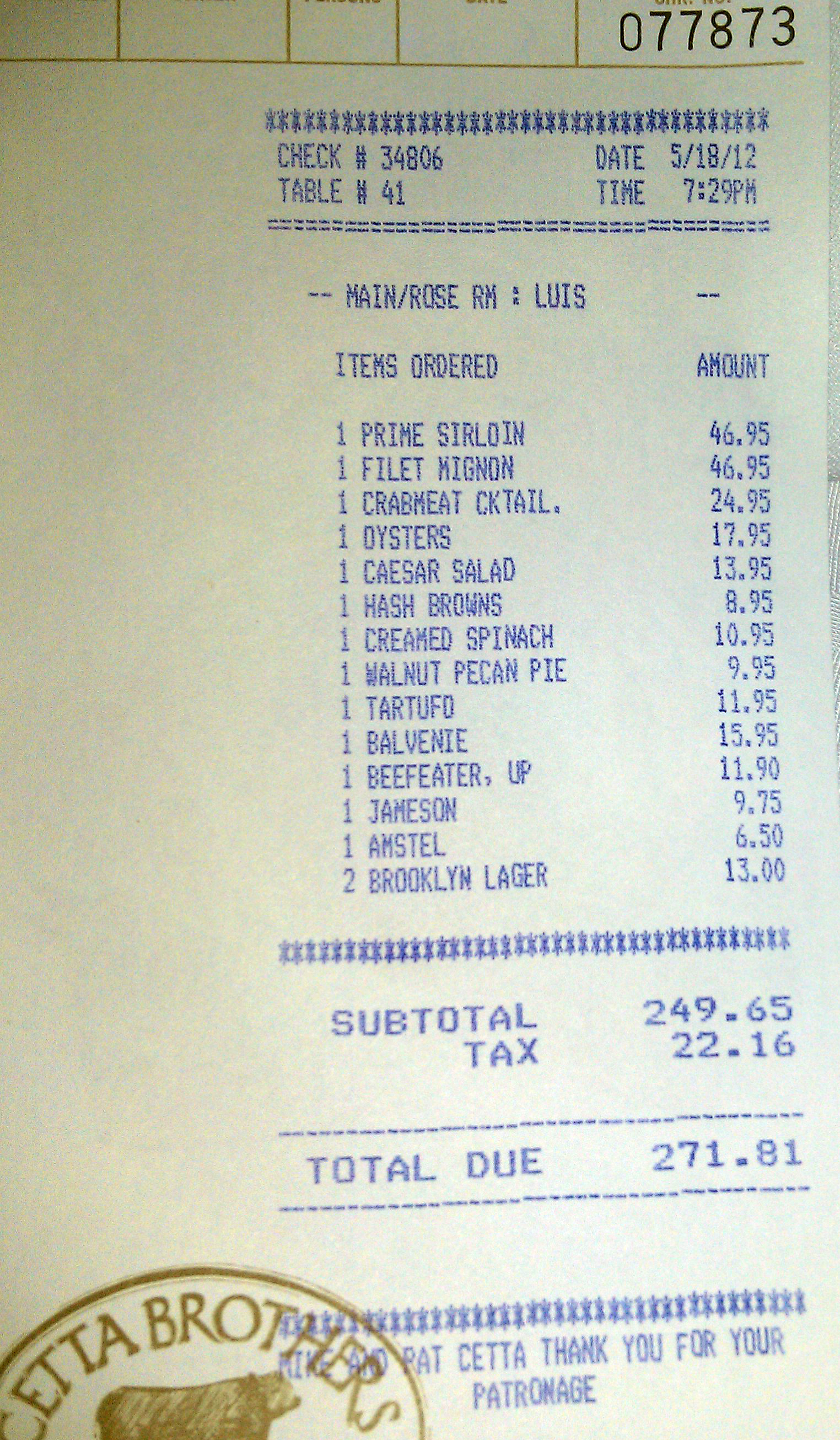
The price is good for NYC at $40 to $47 for the steaks, but the trade off is you are getting lesser quality meat cuts. We had a Bloomspot deal that cost $115 for $200 worth of food and drinks (excluding tax/tip), so that helped a lot. Otherwise I wouldn’t go here again on a dare. We were out of pocket $235, but it was really a $320 meal. For that price it should have been perfect, and they didn’t know we were using a coupon/gift certificate until after we ate dessert.

Bar: 8

The bar at Sparks is okay. I prefer the bar at Keens; it has a similar look, though here it is tucked away from the windows and in the center of the restaurant. The martini was made perfectly, and there is a great selection of rare booze. Down side – they don’t offer beer on tap, and the beer they did have in bottles was slightly skunked.
top view of my martini
Specials and Other Meats: 6
On special Sparks had NOTHING. For alternative meat selection they had veal and lamb. NO CHICKEN – I love it. Ballsy. But they should consider adding some real steaks to their menu, instead of shell and sirloin, even if they have to charge $10 more for each.

Apps, Sides & Desserts: 7

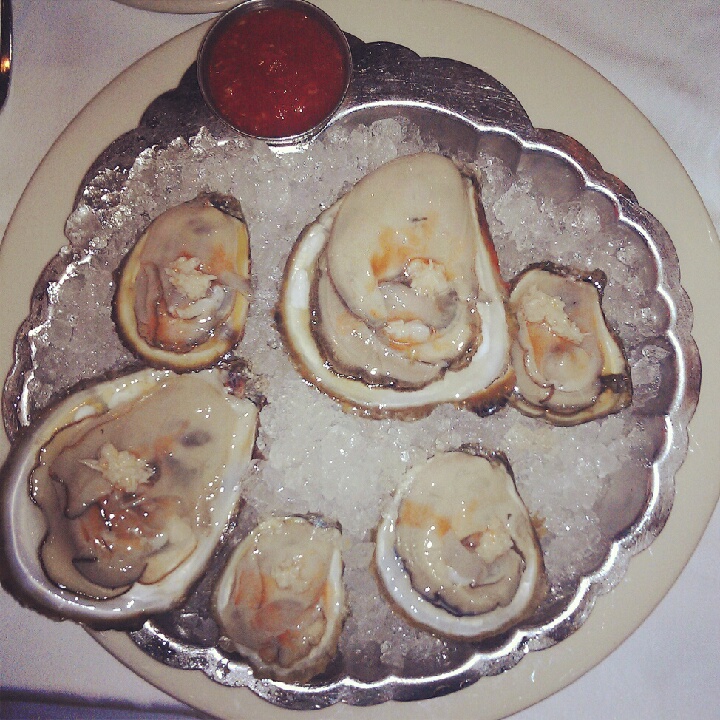
When I came here in the past, the lump crab meat cocktail had bits of flaky shells in it, twice (original order and replacement order). The same was true this time around. The hash browns were very small in size for $9, though they were good. The creamed spinach ABSOLUTELY SUCKED. It was watery, not creamy, unseasoned, had a horrible texture, and just all around tasted like dog shit (because we all know what that tastes like, right?). The Caesar salad was delicious and a great size to share for two. The oysters ($3 each) were creamy, fresh and delicious. The best part of the meal though, besides getting up and leaving, was the pecan walnut pie for dessert. VERY good. On another visit I tried the sauteed spinach (garlic & oil). It was good, but lacked salt & pepper (Seasoning 101).
oyster app (gigantoysters)

Seafood Selection: 10

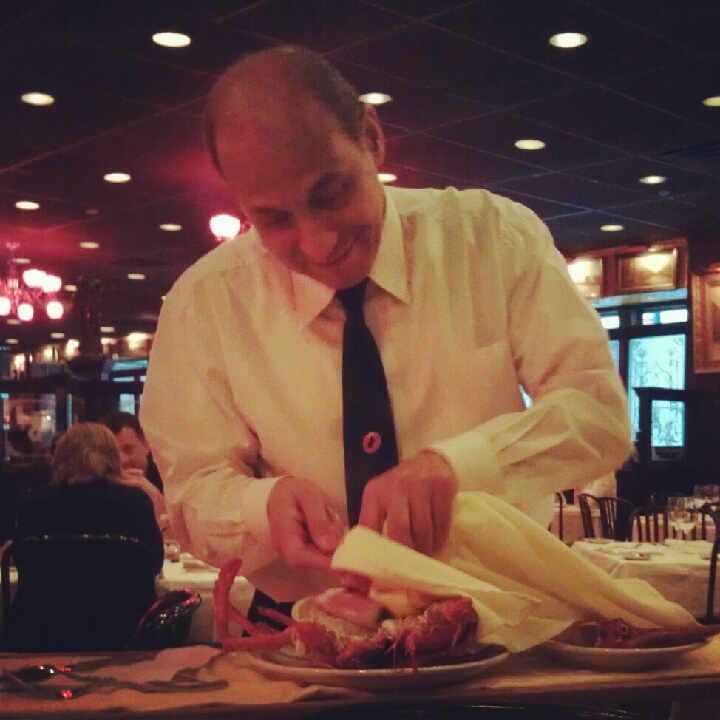
Sparks has a ton of seafood to choose from. On the menu there is sole, seabass, red snapper, and shrimp for entrees, but they also have a smattering of items featured at the top of the menu for some reason as well. These include halibut, salmon, tuna, swordfish, trout, lobster (three size/price categories, up to 5.5lbs – $90), crab, and scallops. Perhaps Sparks should change their name to “Sparks Fish House” instead of “Sparks Steakhouse,” because there are way more REAL CUTS to choose from in the seafood department than the meat department. Oh well. As far as apps go, they have all the shellfish basics, and as I said above, the oysters were legit. The lobster is good as well.
lobster man

Service: 6

The waiter was nice and attentive, but no one wished me happy birthday (as mentioned on the reservation note), and he also flat out lied to me about the “prime sirloin” being the same as a strip steak. I call bullshit. Sorry buddy. You were nice, but when we drop $235 on a meal, I expect to be treated with honesty and served good food that I will remember for days to come (for the right reasons). The table bread was hot and crispy, but the butter was cold. Not a big deal in the grand scheme of things in this meal. Also… Halfway through my glass of water I noticed that the INSIDE was disgusting. A yellowish crud-crust was clinging to one side up the entire length of the glass. God knows what I put into my body by drinking that shit.

Ambiance: 7

Sparks is known for its infamous mafia hit, which occurred right outside the restaurant… and it is decorated with the expected mafioso look. Dark musty interior, gaudy patterned rugs, wide open dining space. It could almost be in Little Italy if it weren’t for its immense size. It is nice and traditional inside, with all the waiters being male and wearing white tops with ties of some kind.

SPARK’S
210 E. 46th St.
New York, NY 10017

Bobby Van’s (Bridgehampton)

Bobby Van’s overall score: 84

A trip to Bobby Van’s was a long time in the making. It has been on my never-ending short list for quite some time. I went with my family in a group of six to the Bridgehampton location on a Saturday. Check it out assholes:
Flavor: 8
I had the porterhouse since they didn’t have a ribeye on the menu (WTF???!?). It was good!  The waiter suggested that the two of us ordering it go with a porterhouse for two rather than two single steaks because the cut would be thicker. It was nicely cooked, even throughout, a good char on the outside with a nice buttery flavor. They probably could have seasoned it a bit more, but otherwise it was a good meal. One negative is in the preparation. Like many steakhouses serving the porterhouse, they pre-slice the meat and serve it on a hot plate. It’s nice for sharing that way, but there was a pool of oil, butter and juices at the bottom of the plate. When you cut meat while still hot, you can dry it out. At the same time, after you cut it, the meat sits in a pool of liquids and makes the bottom of the steak sog the fuck up, which just got a nice char in the broiler or on the grill. So while the meat becomes dry in the central parts, it also gets soggy and ruins the char on one side. I’ve griped about the way porterhouses are ruined many times. Next time that there isn’t a ribeye on the menu, I might just have to stick with a strip or filet on their own, since porterhouses are inevitably destroyed on a regular basis at steakhouses. The server here at least had the sense to tip the plate up so that the juices didn’t soak the char and make the bottom of the steak soggy. Side note – it is sort of a world of difference to go from ribeye to porterhouse, in terms of flavor. The ribeye just packs so much more of a punch. It’s a shame they don’t offer one regularly. I know they have them on special on occasion though (lollipop steak). I also had a taste of the lamb, which was very nice as well.
 
Choice of Cuts & Quality Available: 7
One thing I noticed right away when checking the menu online was that they didn’t offer a ribeye (as I annoyingly mentioned several times above). That means instant points come off. Three to be exact. Not only is it my personal favorite cut, but it is THE steak. Keen’s commits this treachery too, but they make up one point with all the other kinds of meats they have (the amazing mutton). Aside from that issue, Bobby Van’s is good. They have all three of the other mainstay cuts (filet, porterhouse, and strip), and everything is top quality.
 
Portion Size & Plating: 8
Sizes here are pretty good. The lamb chops were a healthy size, and the porterhouse was about 40oz for two people. At $45 per cut, this isn’t too bad at all. My brother had a filet, and it looked around 12 or 14oz, which is on the upper end of the range. The apps and sides were all generous, as well as the desserts. The baked potato, for example, can feed a small village… for a week.
 
Price: 8
The price is about right for Long Island steakhouses. All the cuts are $45. All the sides are $9. The bill for six people came to $565. With tips included it was about $110 a head. Not too bad, especially when you take into account that the portion sizes were all large.
Bar: 9
The bar is nice and big, and attracts a good crowd. The restaurant is located on a nice little strip of town, and it just so happened that we were there for the Kentucky Derby, so the place was packed out with people wearing fancy hats and cheering for the horses (I’ll Have Another – the one who flaked out of Belmont soon afterwards when it was in line for the Triple Crown). My sister said the place is packed all the time. I can see why – it seems like a fun place to hang. 
Specials and Other Meats: 9
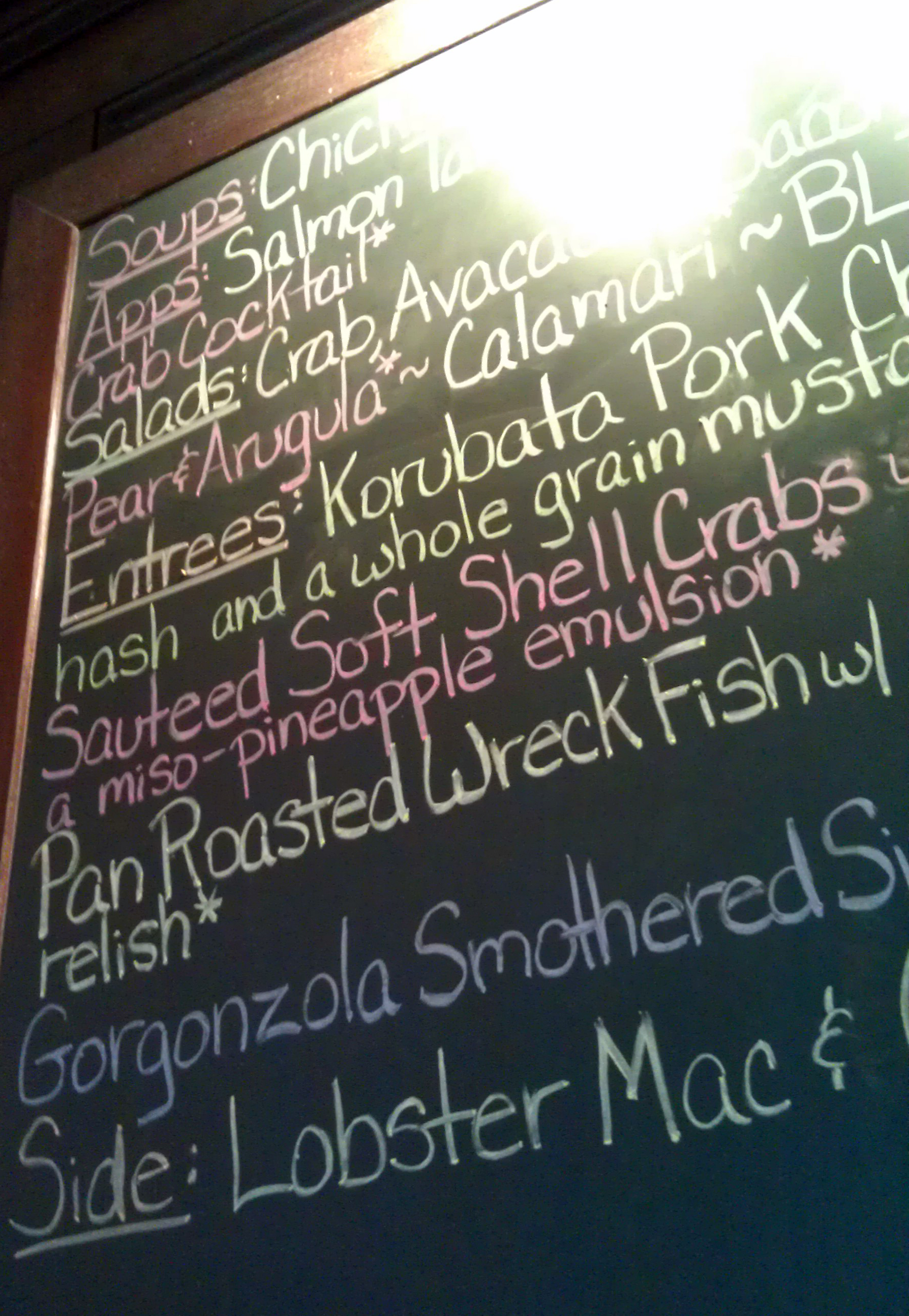
Bobby Van’s had a ton of stuff on special. I would have loved to see some more beef items on special, like a flank or a skirt (… or a FUCKING RIBEYE!), so I took one point for that. By way of other meats, they have lamb, veal and chicken. A good array of butchery. On special was a pork chop as well, along with several salad, app and fish options. My sister had a duck confit pasta dish, which was awesome. This is a regular menu item, but it is so good and full of meat that I put it here.
specials
Apps, Sides & Desserts: 8
I had smoked salmon for my appetizer. It was a big portion, and it came with several slices of goat cheese and caramelized onions. My wife had the pear and arugula salad, which was on special. The walnuts in the salad were amazing. Honey roasted, crunchy, and delicious. One noteworthy item was my sisters calamari app – I assumed it was a fried item when I saw it on the chalkboard, but it was grilled perfectly, sliced up, and served in a nice Asian slaw. For sides we had a baked potato (freaking HUGE – almost as big as our porterhouse), french fries (skinny, nicely seasoned), and creamed spinach (not overly dairy, seasoned to a nice savory goodness, and just the right amount of liquidity for slathering on a bite of steak). For dessert I tried a bite of my sister in-law’s chocolate cake, and lots of my wife’s delicious mango sorbet.
 
Seafood Selection: 10
There is a healthy amount of seafood on the menu. Appetizers consist of clams and oysters (both cooked and uncooked), mussels, crab cake, lobster, shrimp, fish tacos, and smoked salmon. For entrees they have a rare tuna dish, hamachi, grilled salmon, black sea bass, and a whole pan seared fluke. Note that seafood entrees, at a steakhouse, are for pussies and women. Perhaps they chose to put fluke on the menu instead of a ribeye because they want to attract wimps to the restaurant instead of real men. In any event, they all looked and sounded delicious. My wife has some dietary restrictions, so she went with the hamachi instead of meat. I tried a few bites and it was delicious. Crispy seared edges, a little rare on the inside – perfect. It is such a nice fish. On special they had soft shell crabs and wreck fish as well.
Service: 8
The waiter was a little difficult to understand, but that might have been due in part to having a seat closer to the end of the bar. There was nothing wrong with the service at all – it was average. On the plus column he did suggest we do a steak for two rather than two steaks for one, so that we got a thicker cut of beef. On the table there was warm bread and semi-soft butter waiting for our ravenous appetites to devour before the meal, with a little plate of olive oil to go with.
Ambiance: 9
When we first were seated, the temperature seemed a little aggressive and hot. As the meal went on it cooled down, which was good. The wicker/bamboo seats were a little narrow and uncomfortable for my fat ass, but the decor was classy and worthy of fine steakhouses. Dark wood floors, dark wood-paneled bar area, nice paintings of east end stuff and horses, etc.

BOBBY VAN’S
2393 Montauk Hwy.
Bridgehampton, NY 11932