This is a relatively recent addition to the smaller scale steakhouse scene. The cuisine here is Latin American/South American style, but with a focus on steak, being a steakhouse and all.
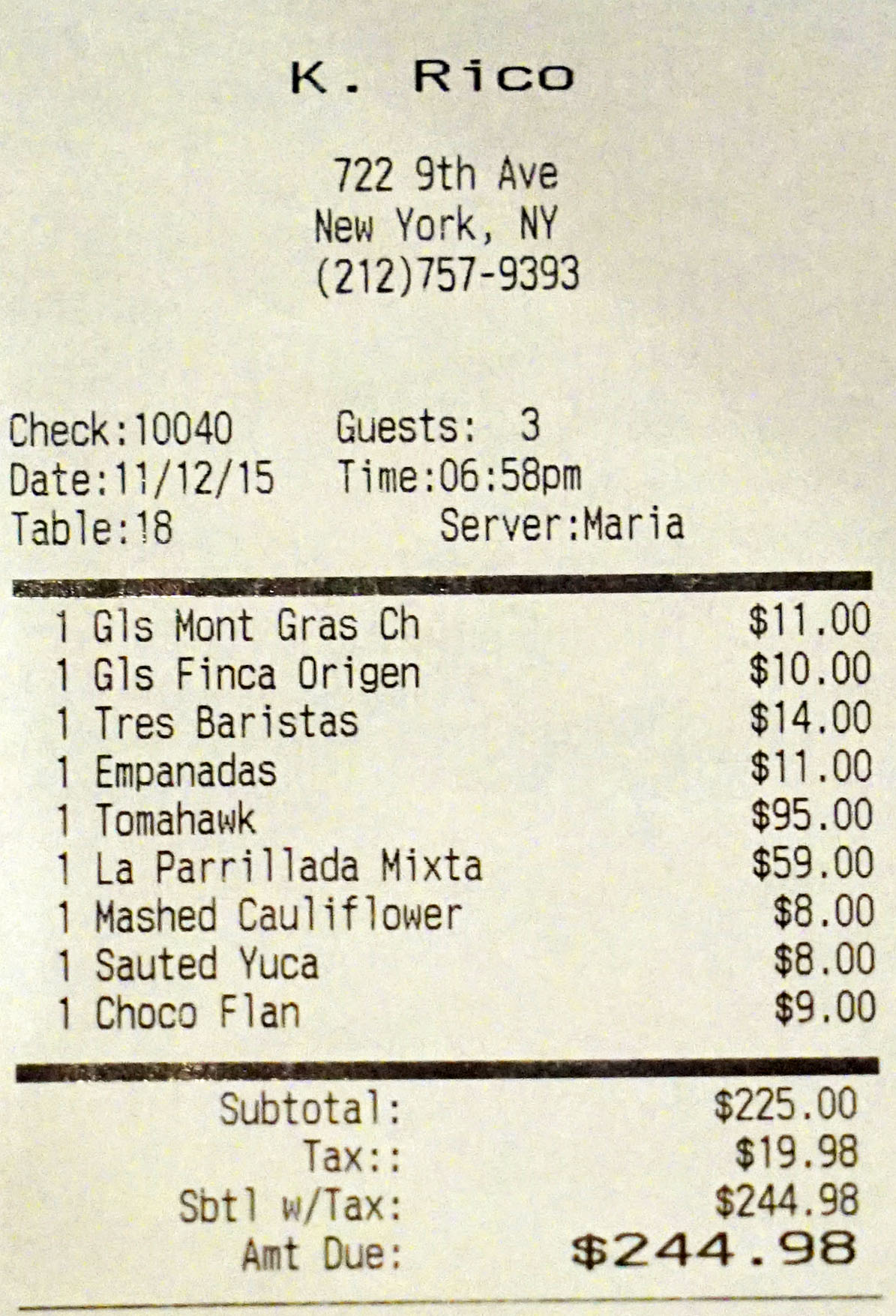
This time we had three people dining, so we were able to sample a bit more than usual. Here’s the breakdown:
Flavor: 9
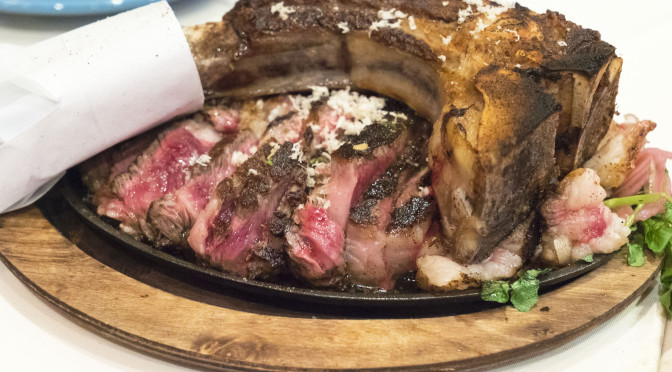
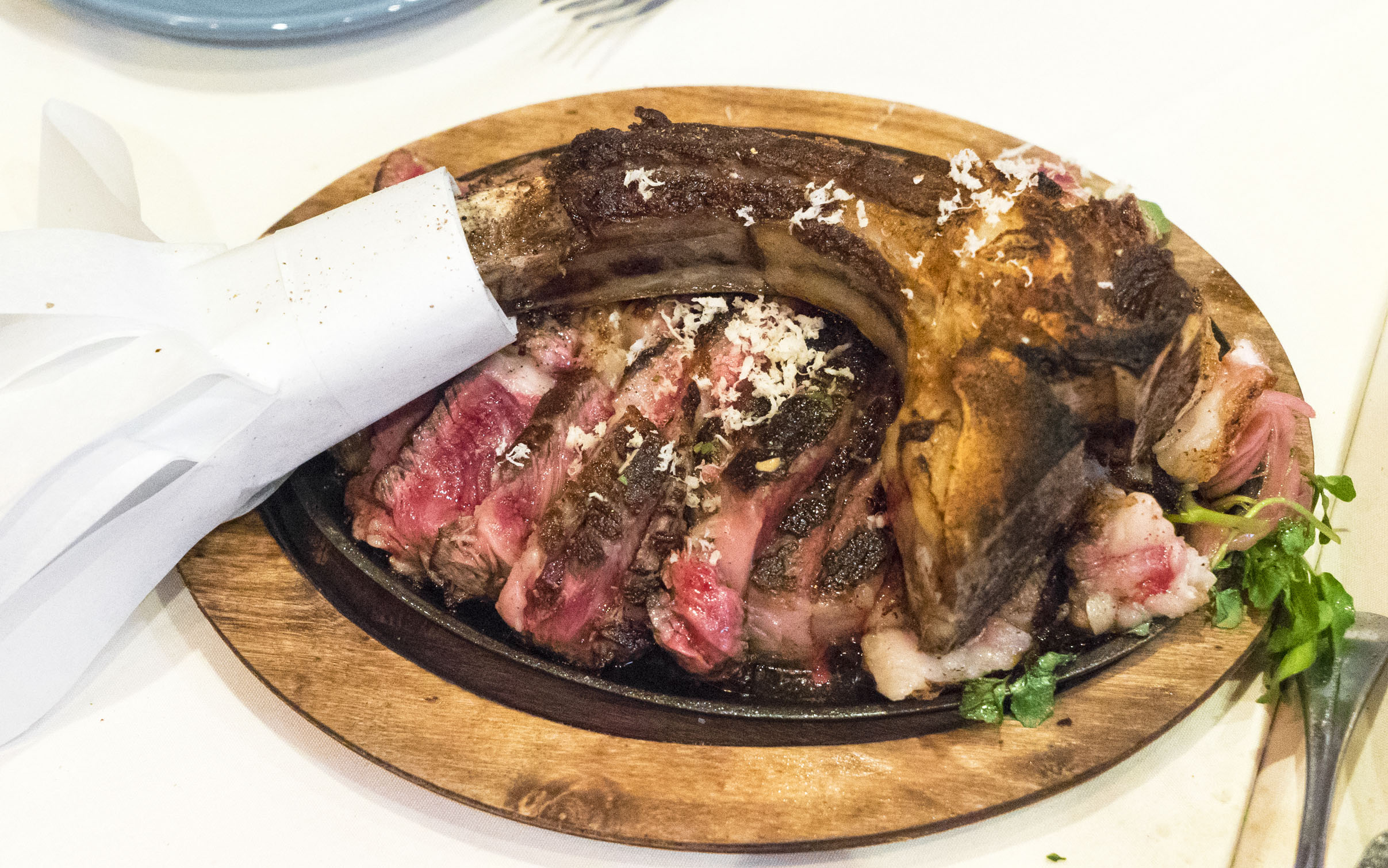
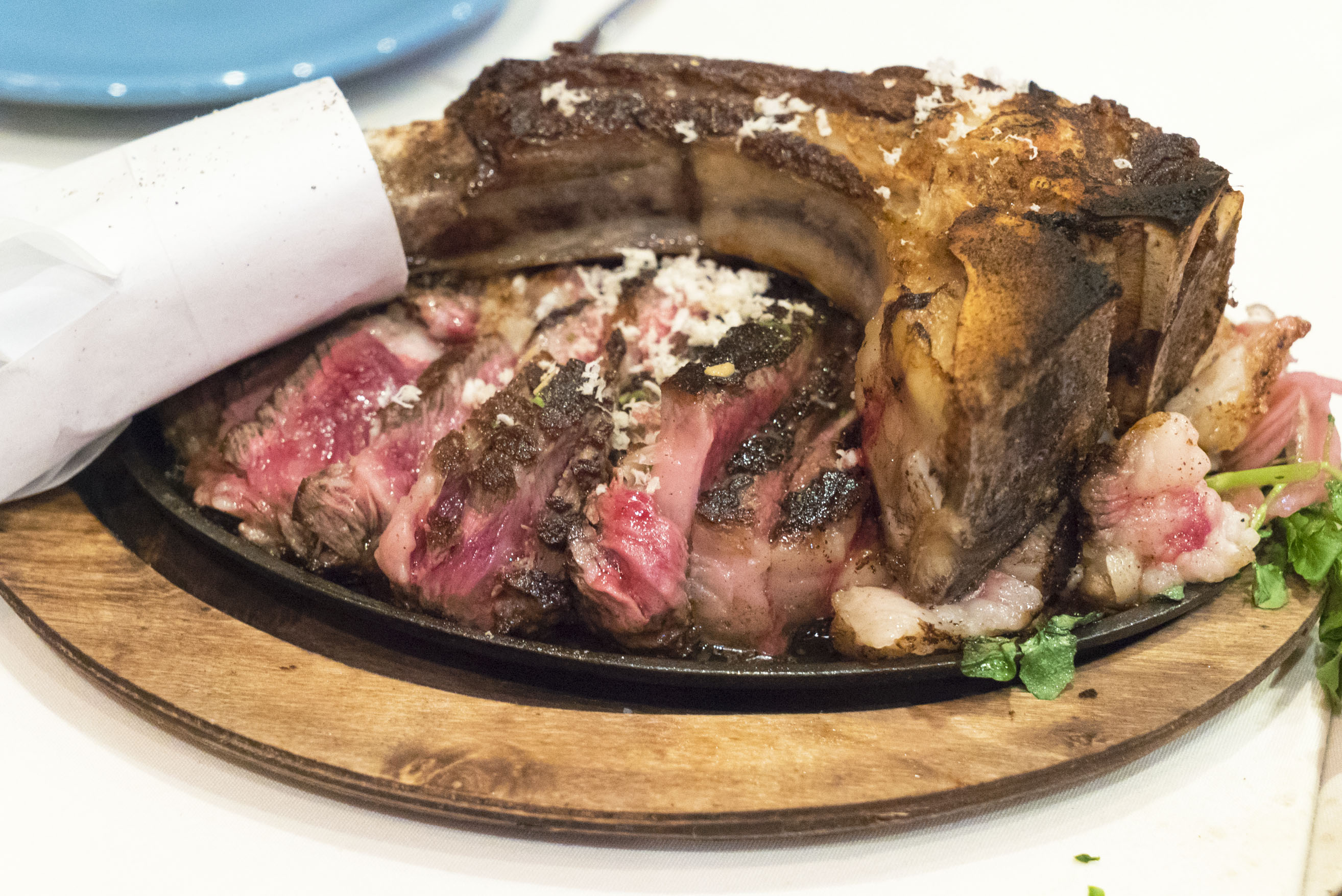
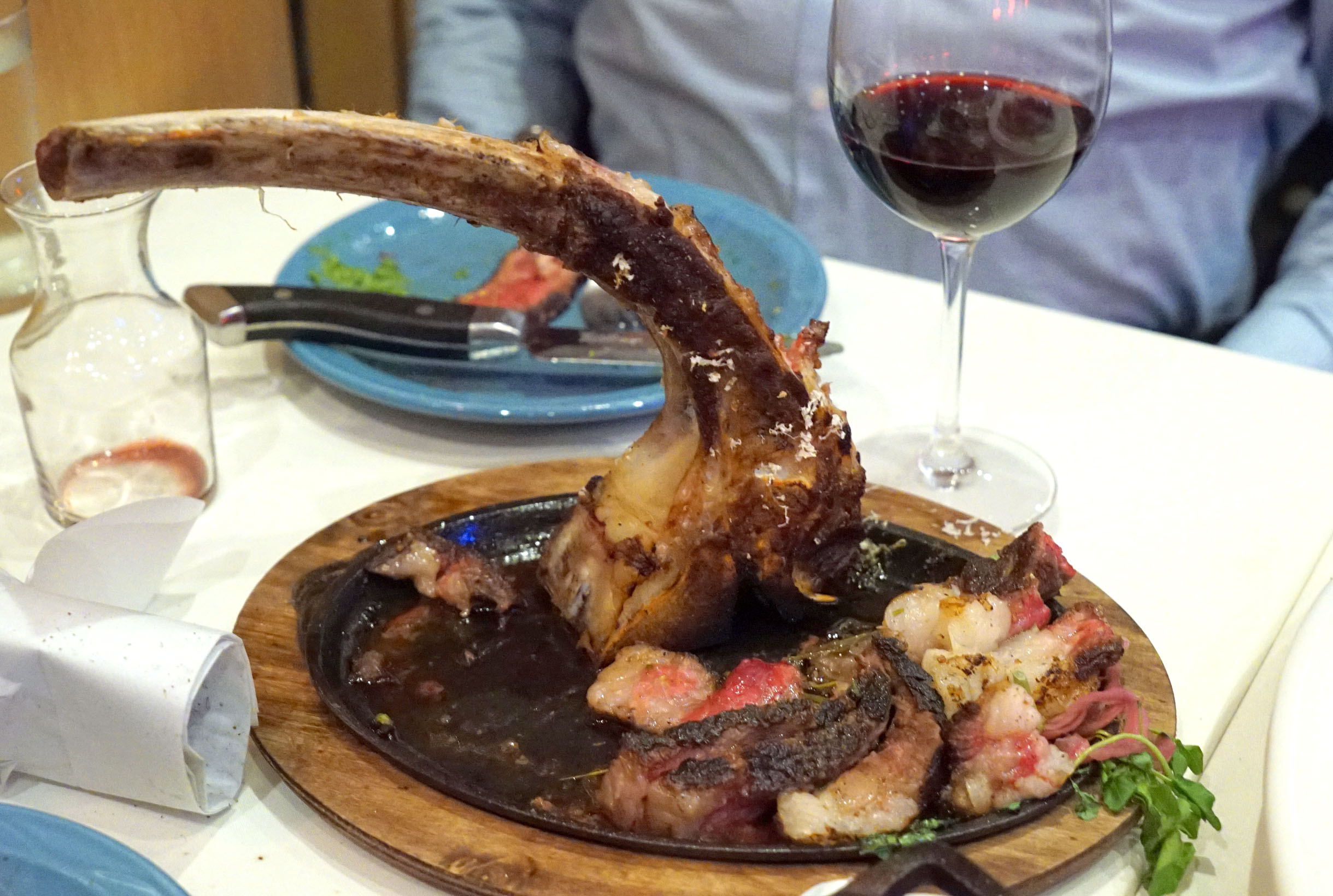
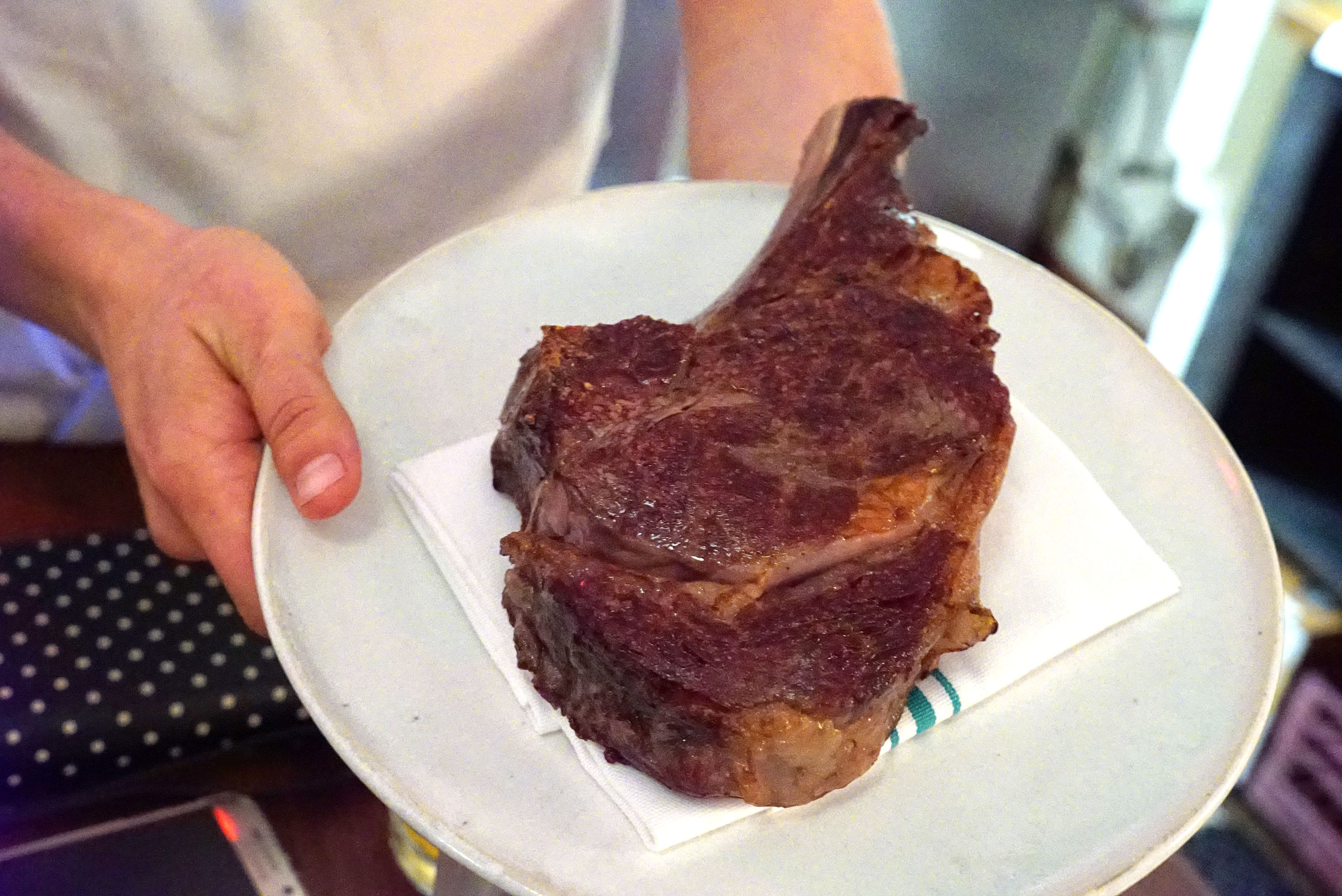
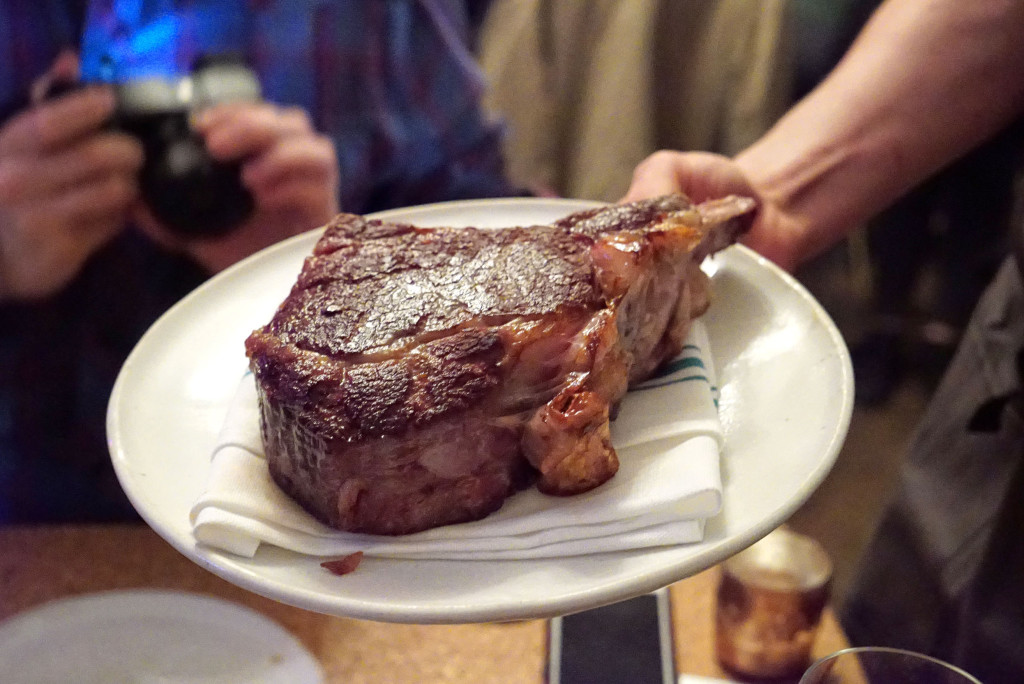
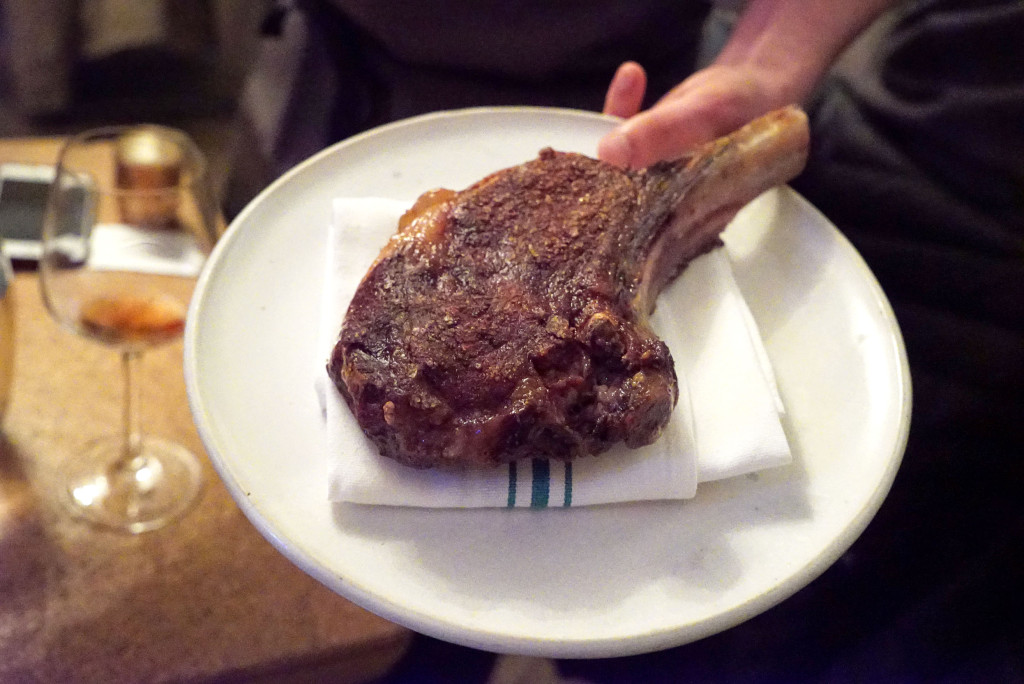
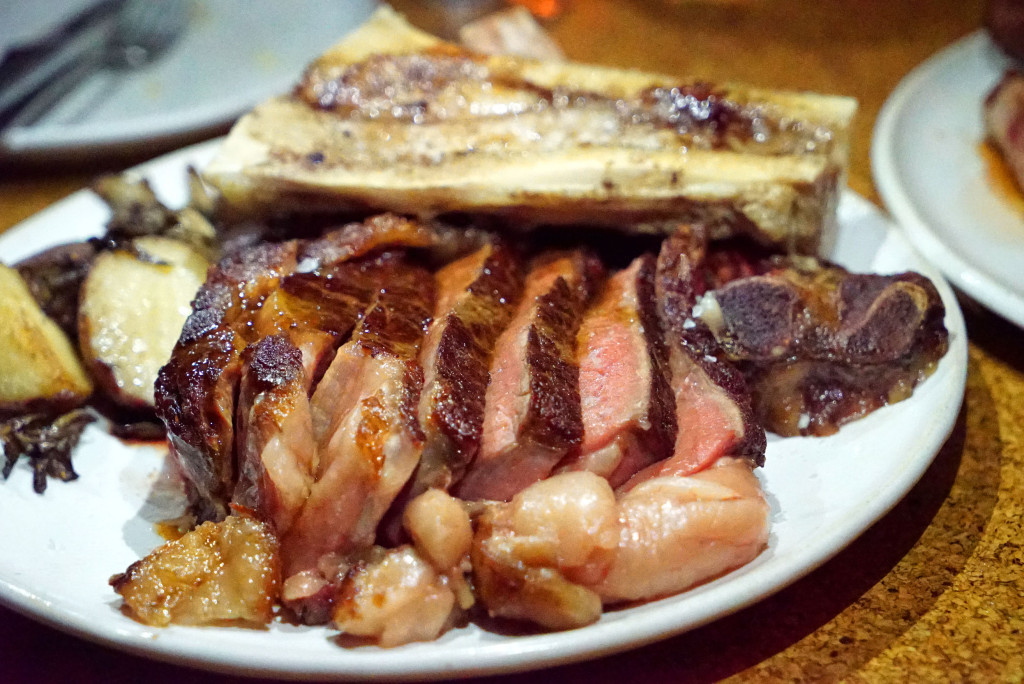
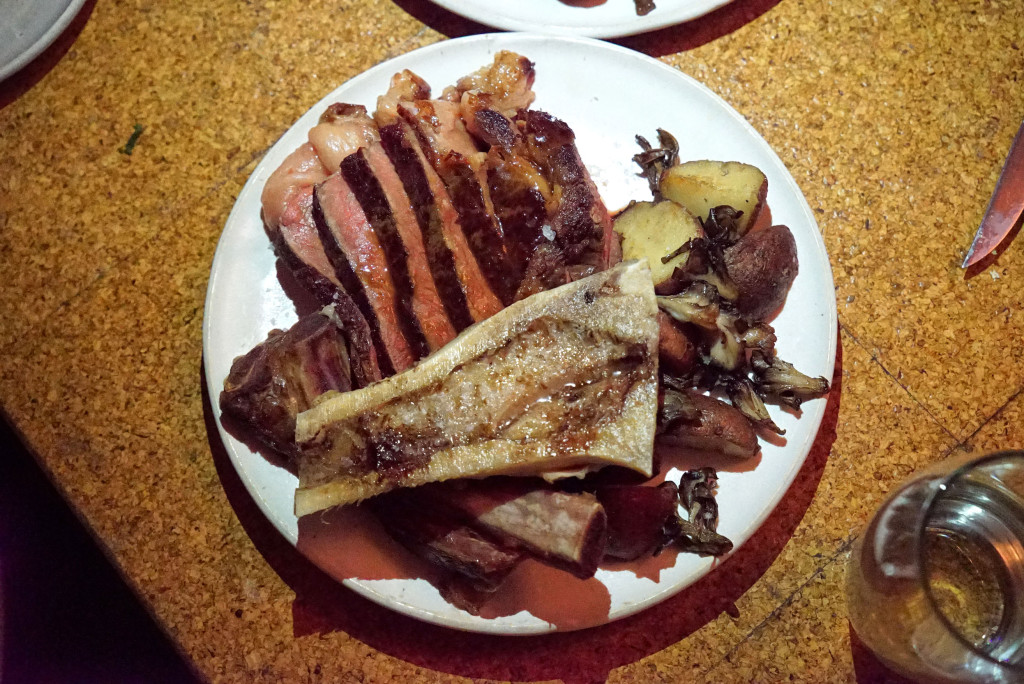
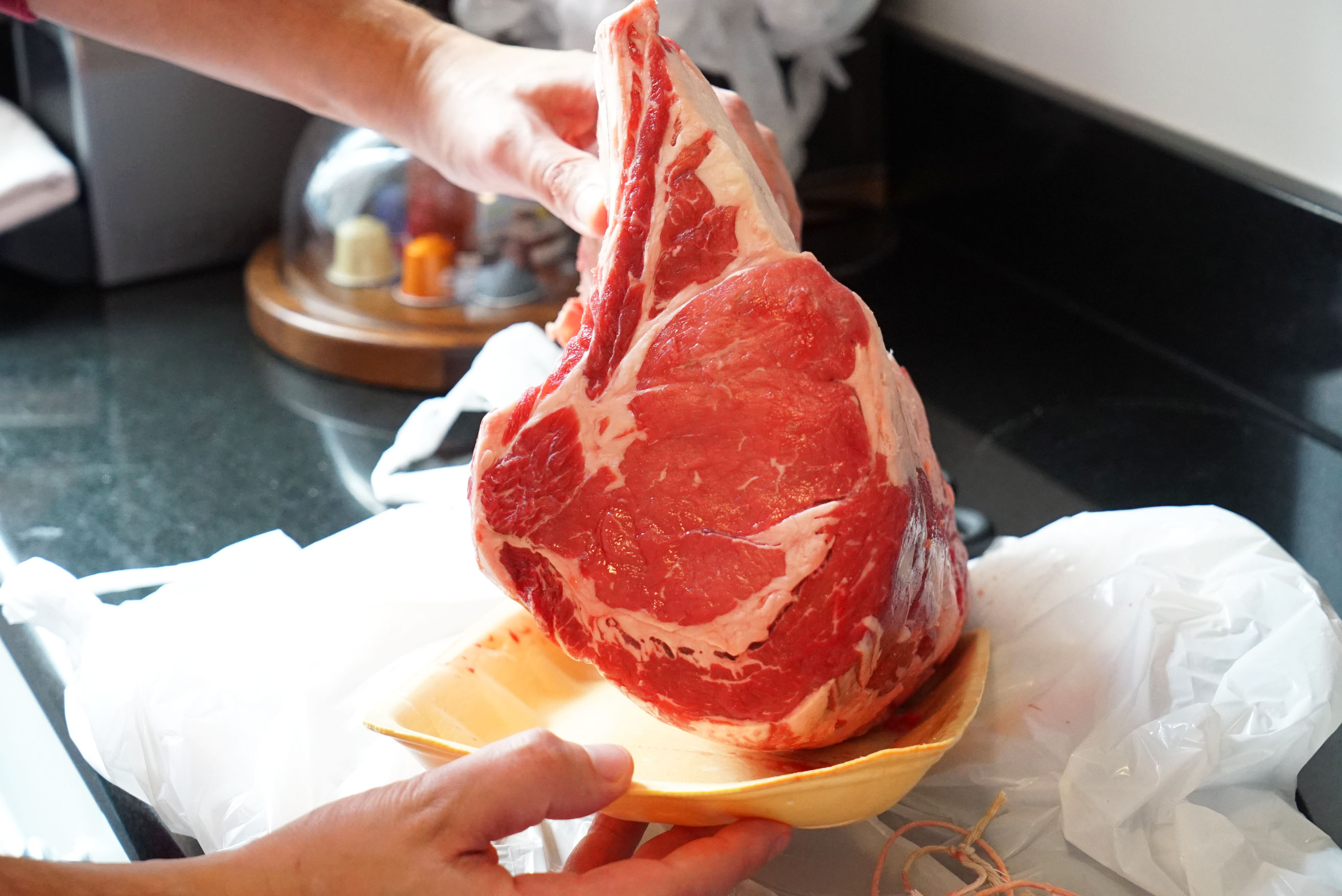
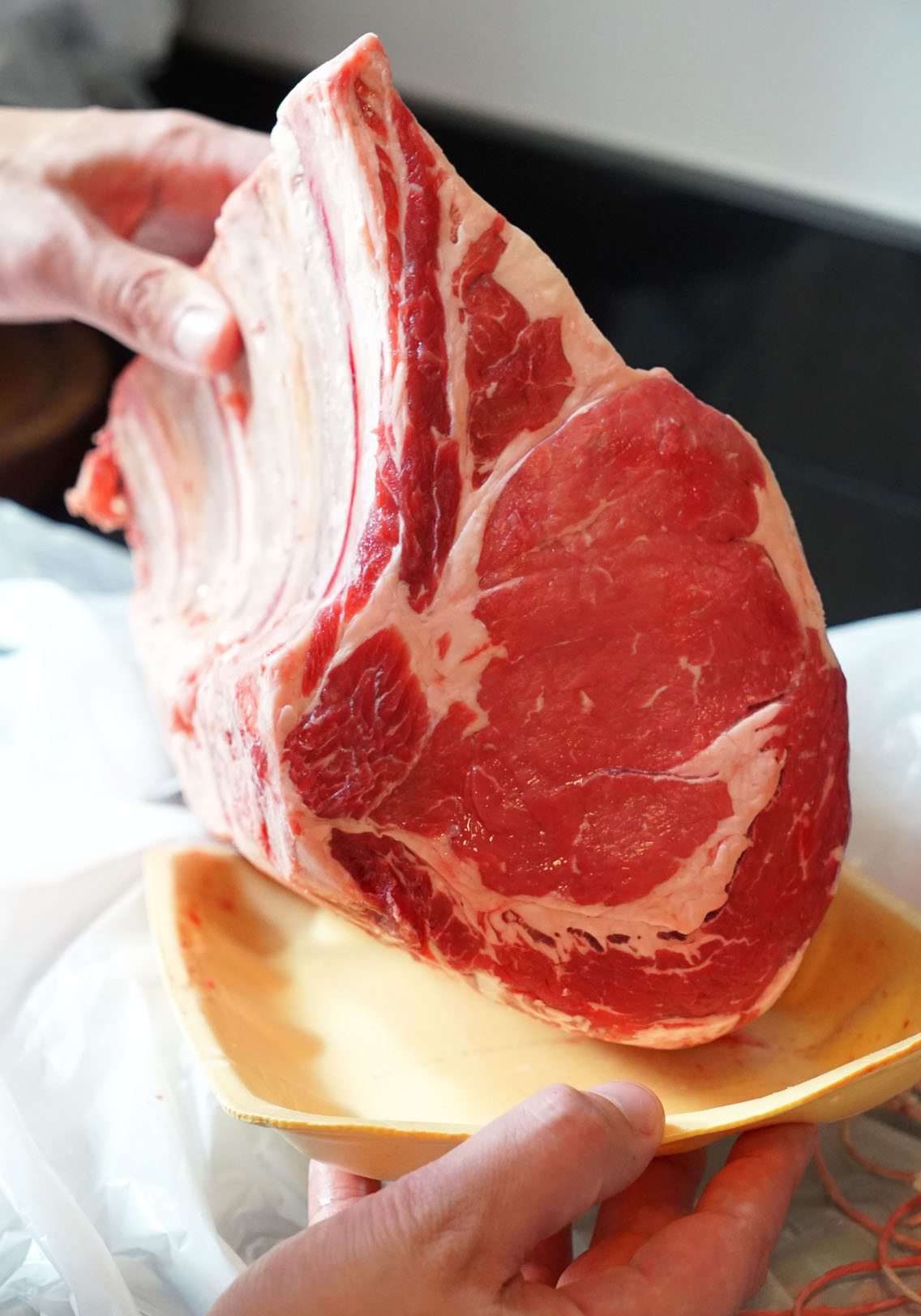
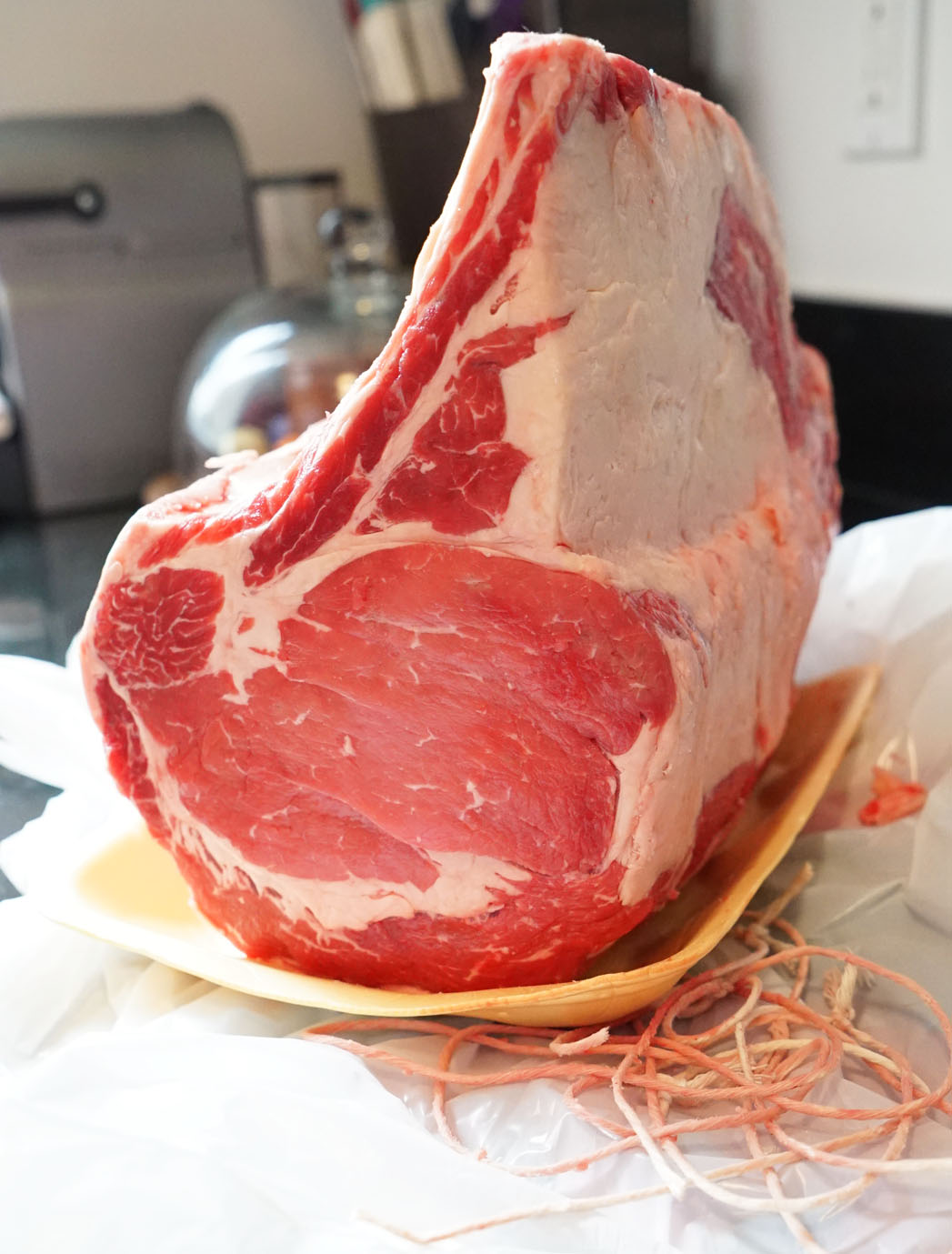
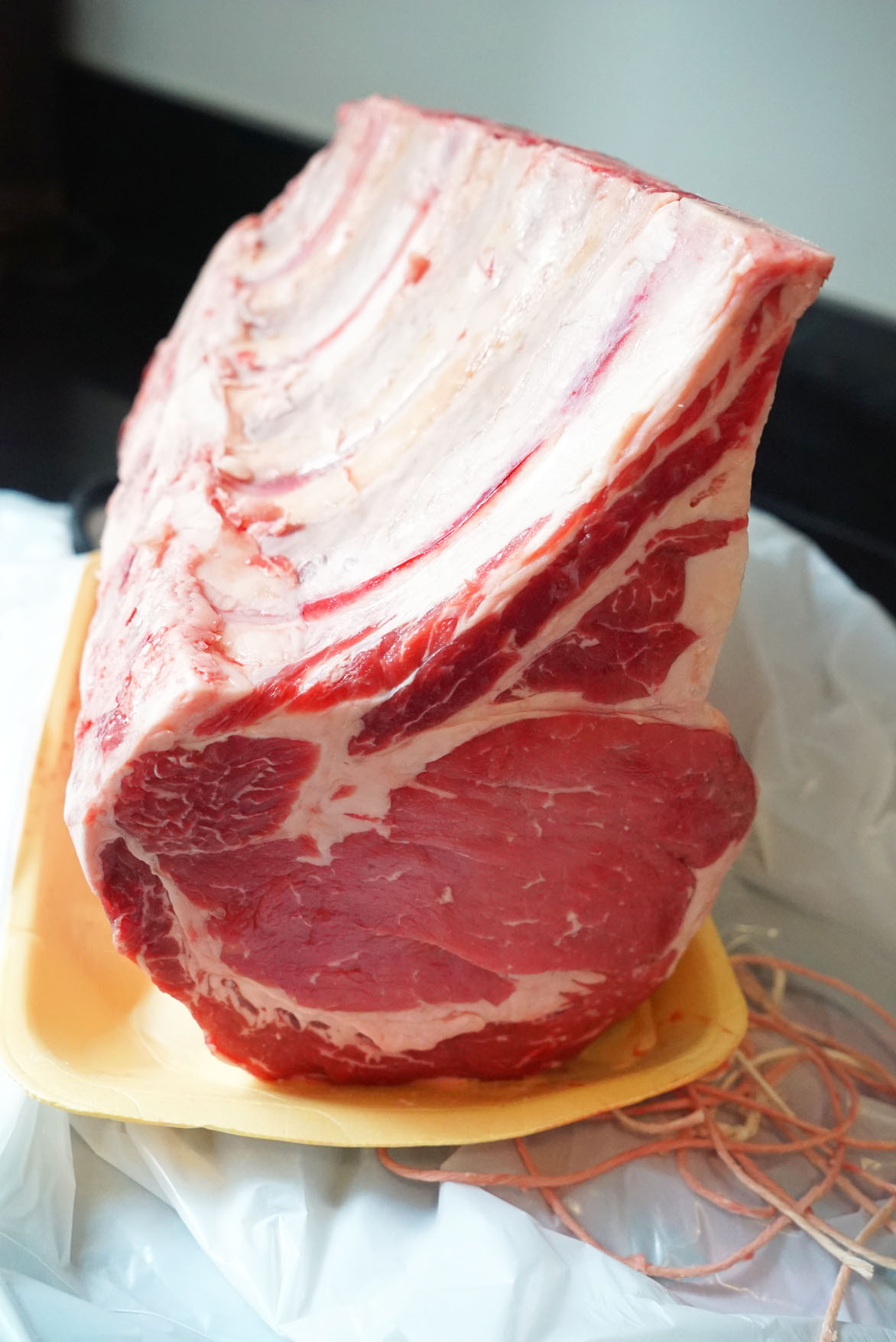
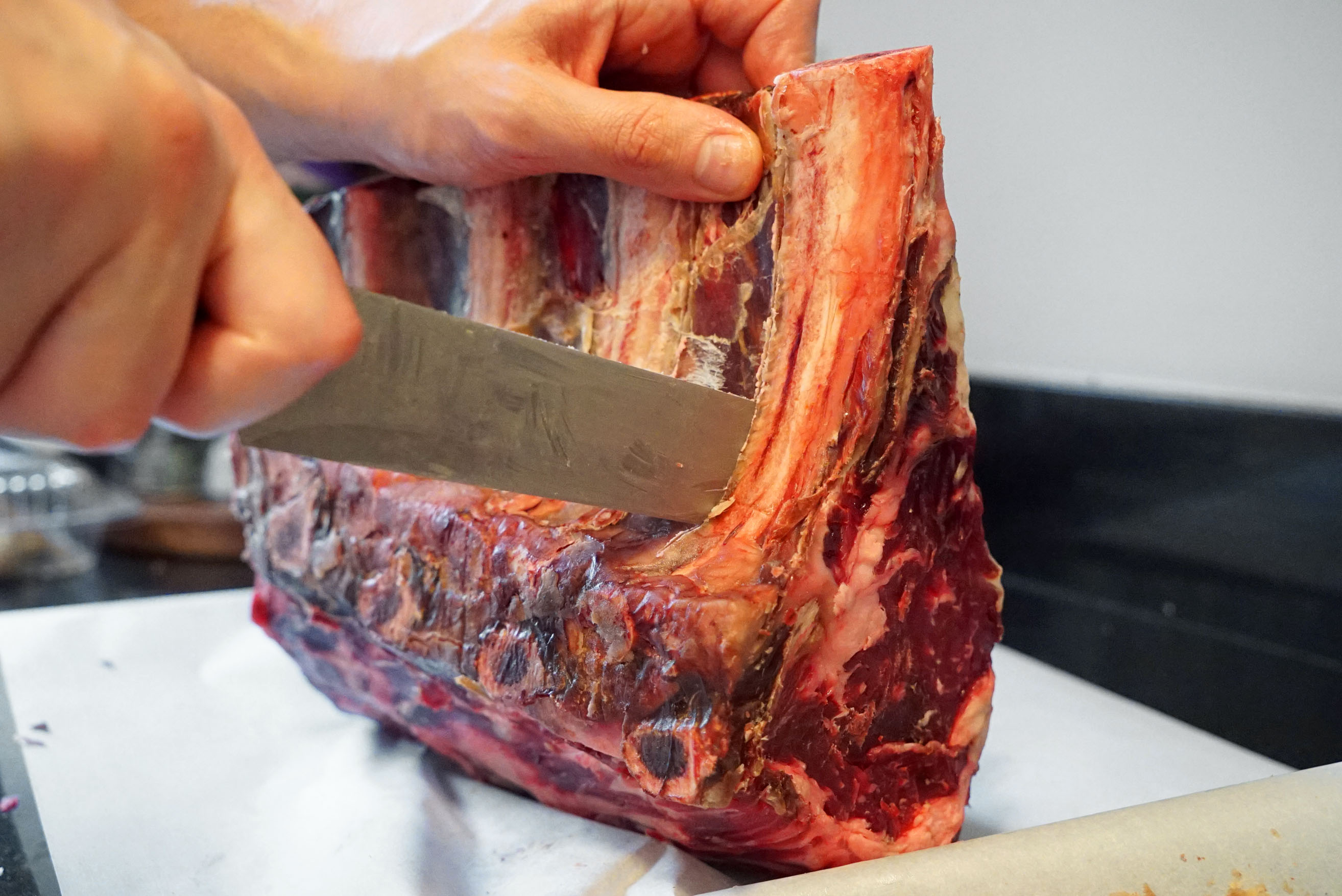
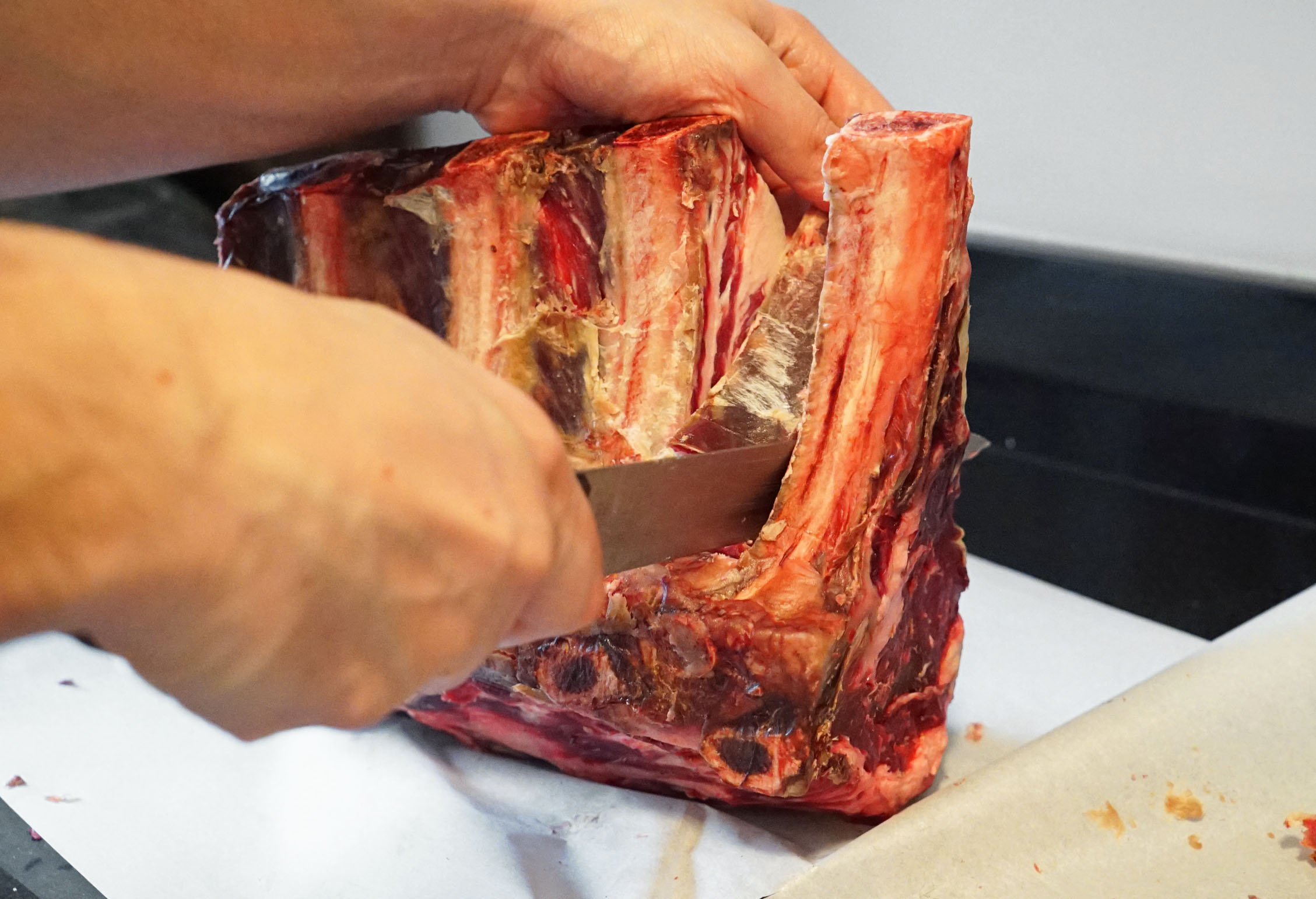
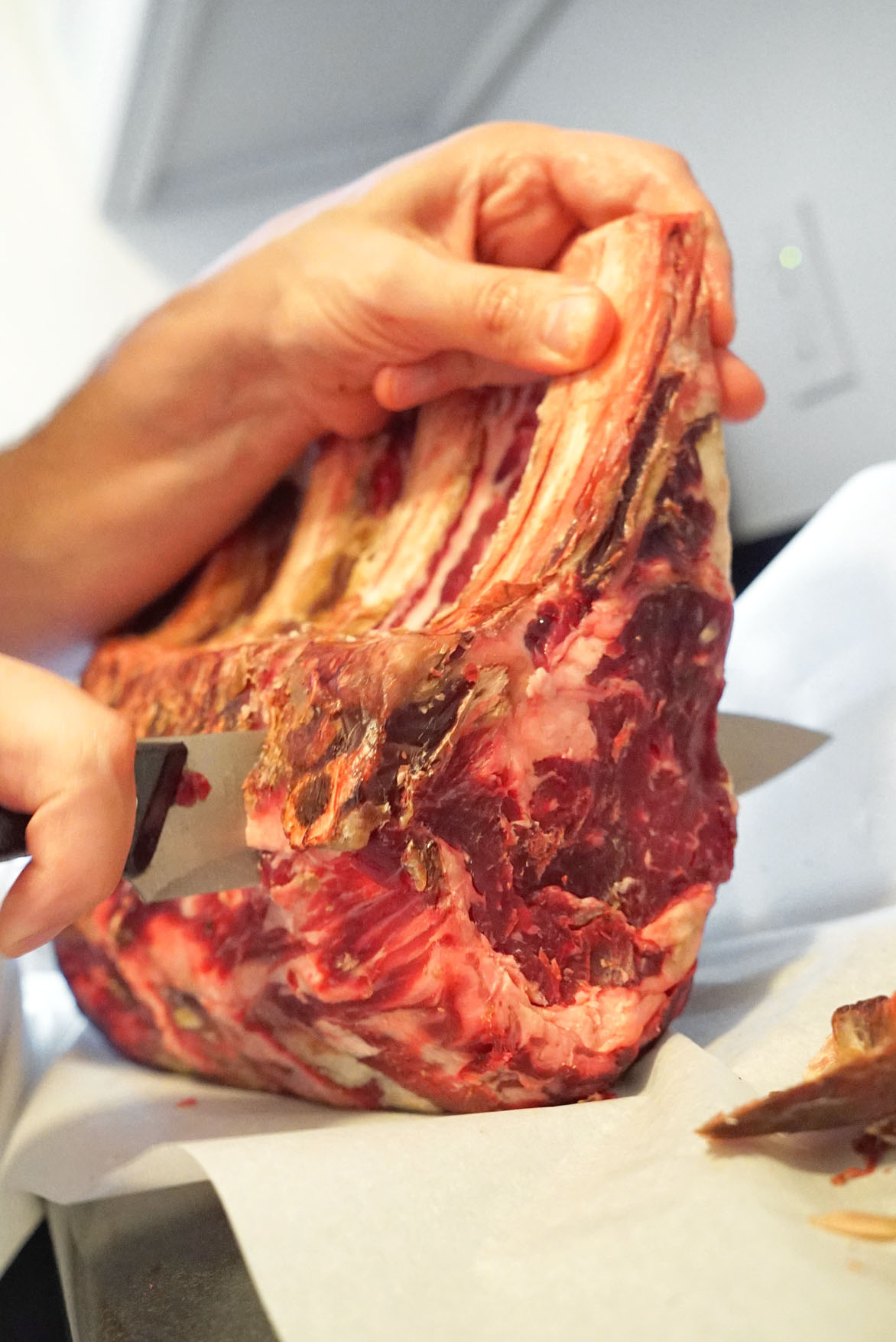
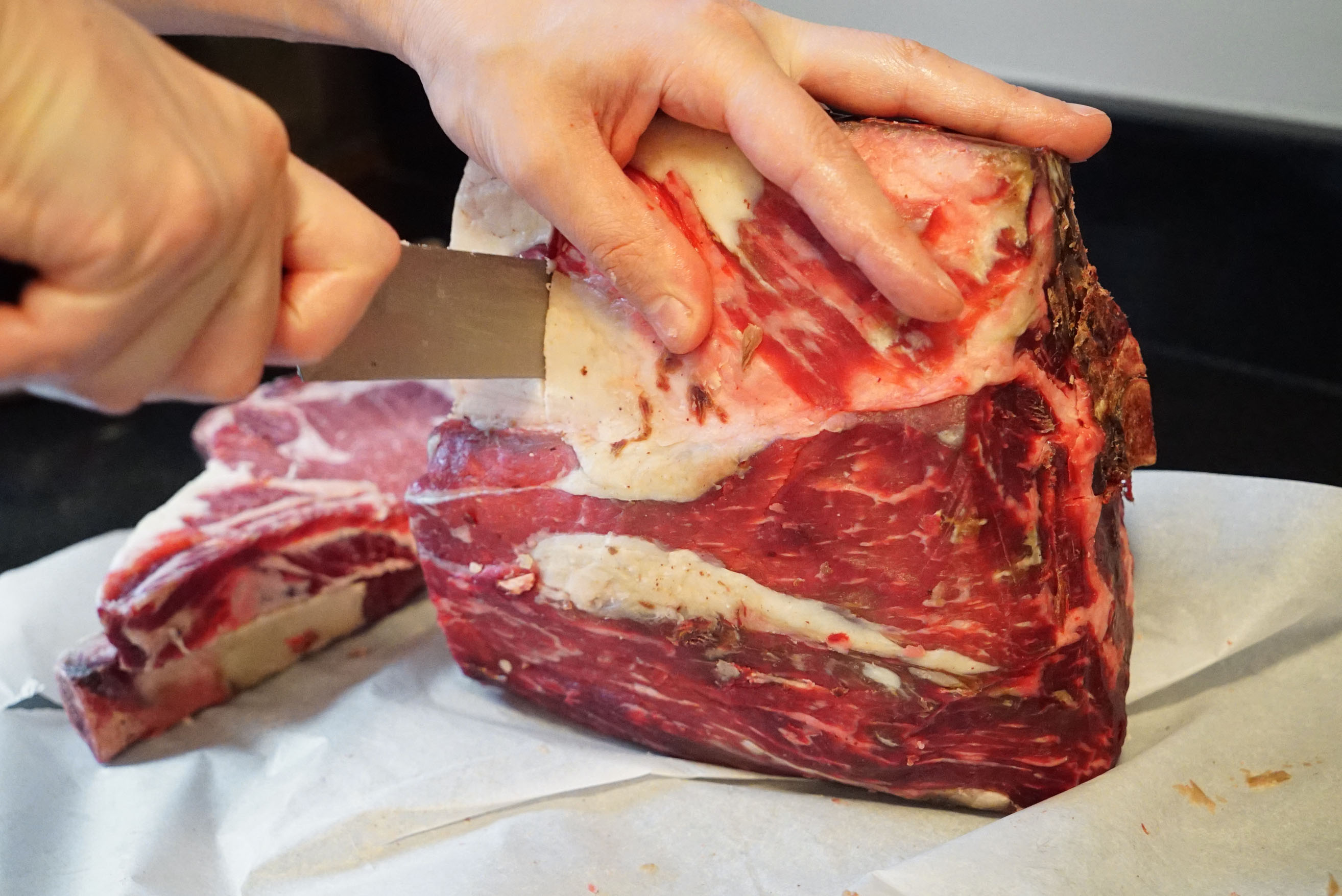
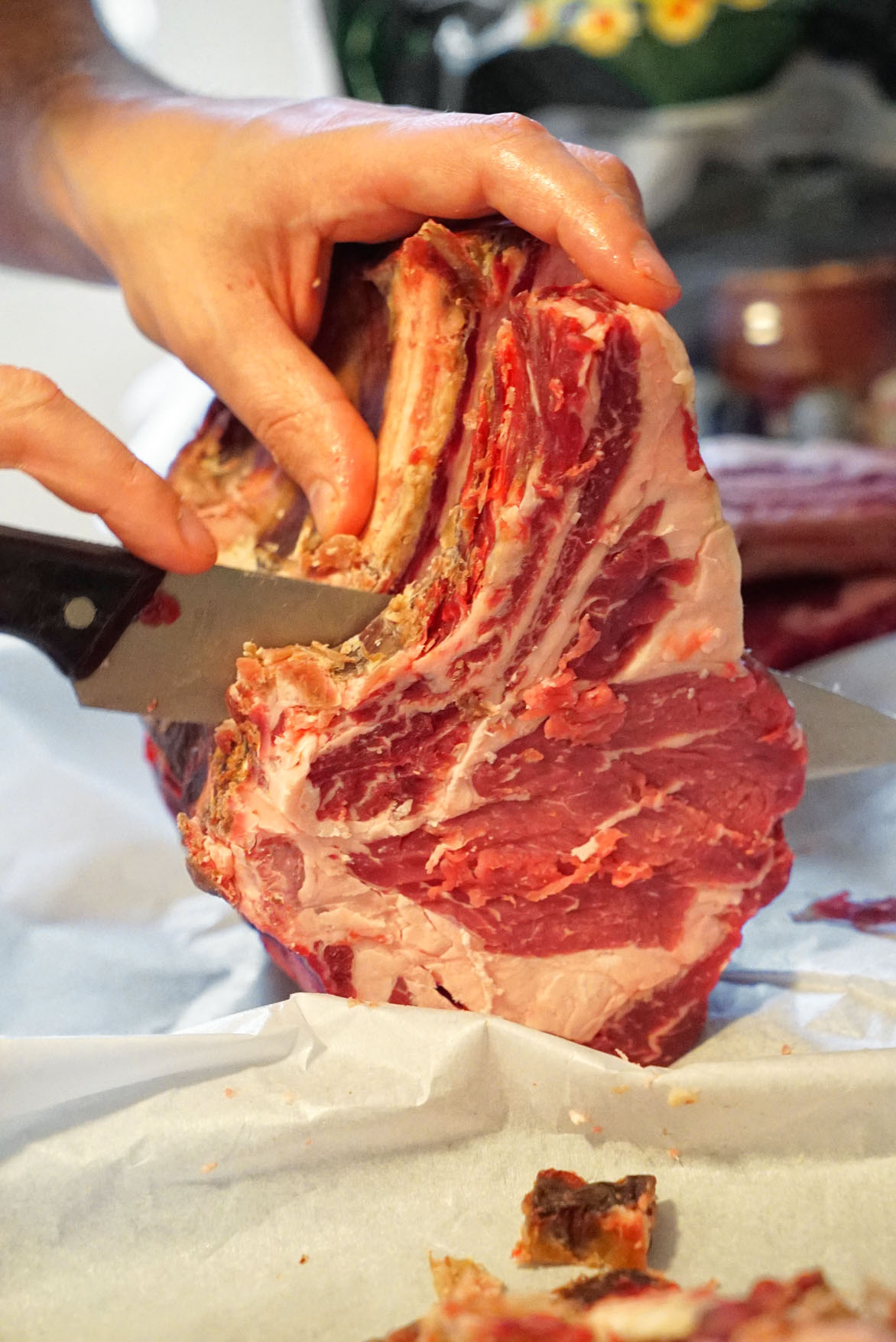
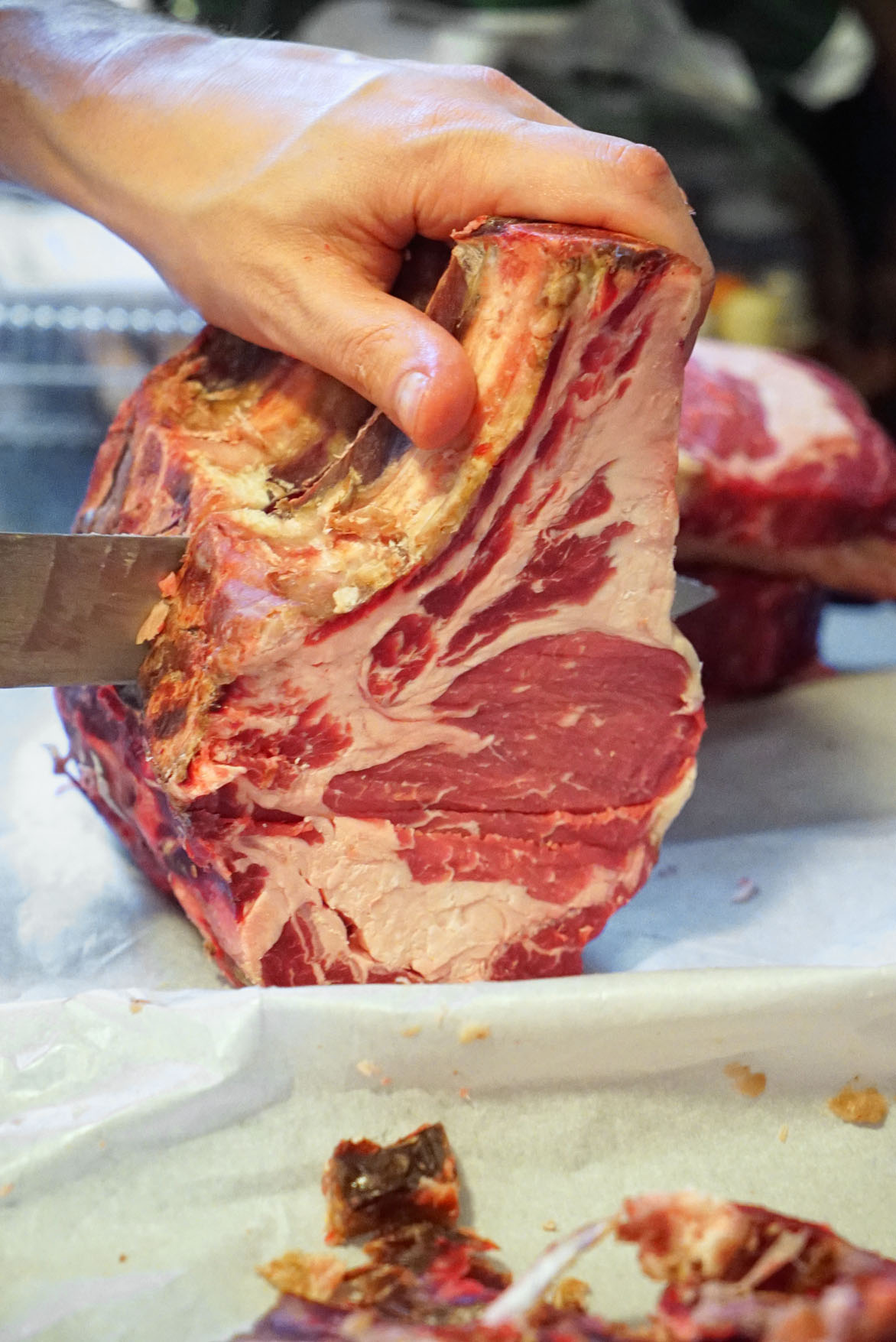
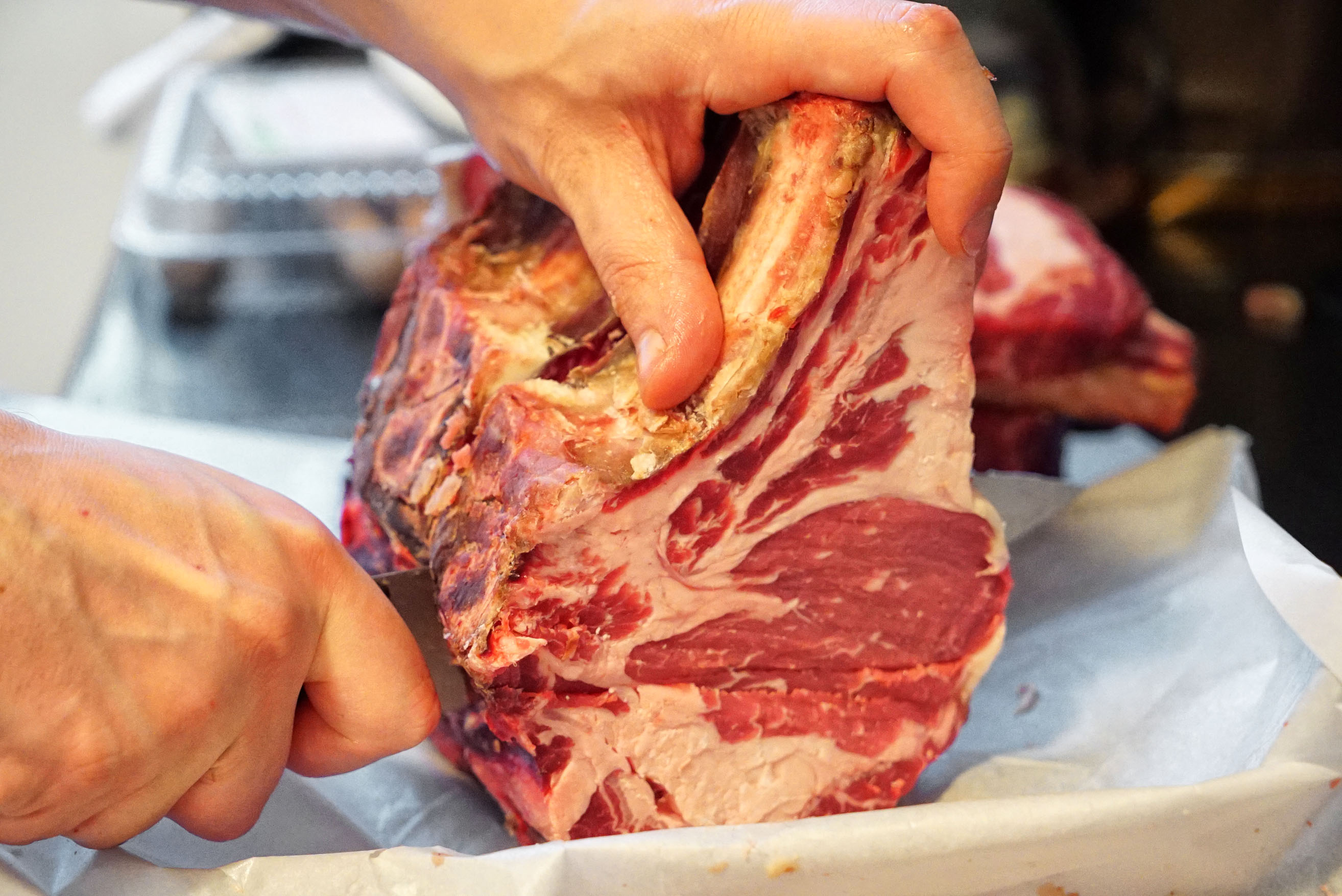
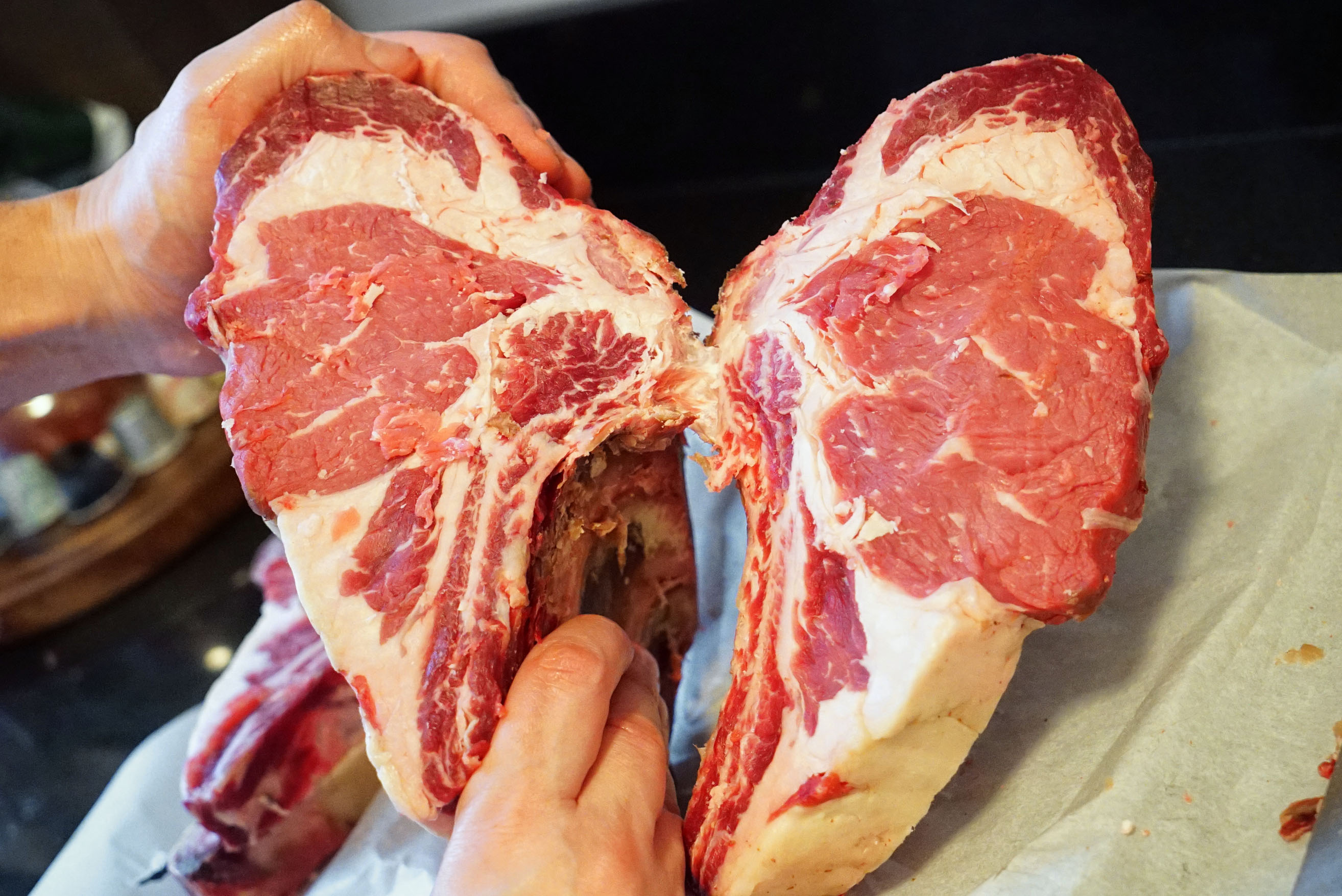
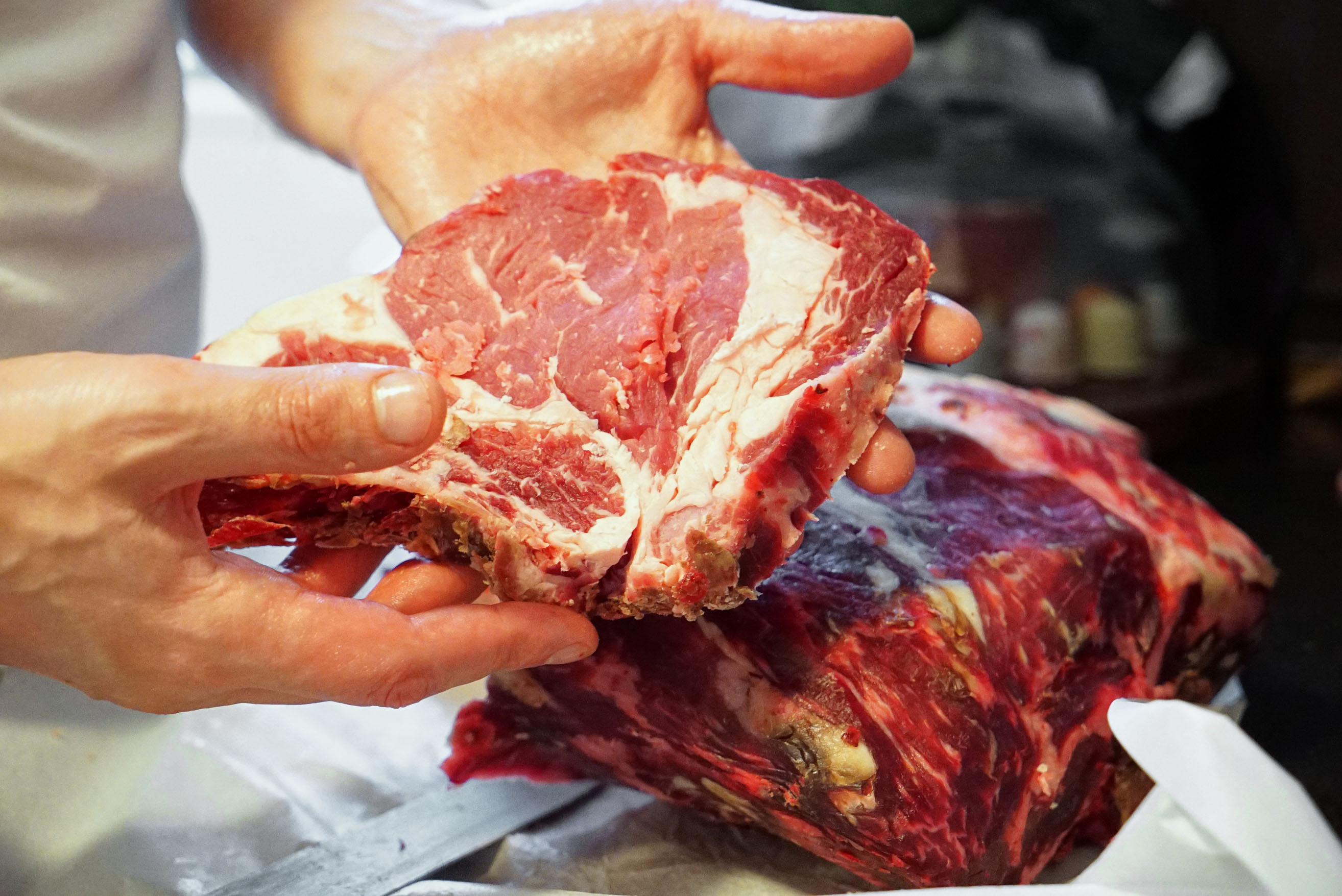
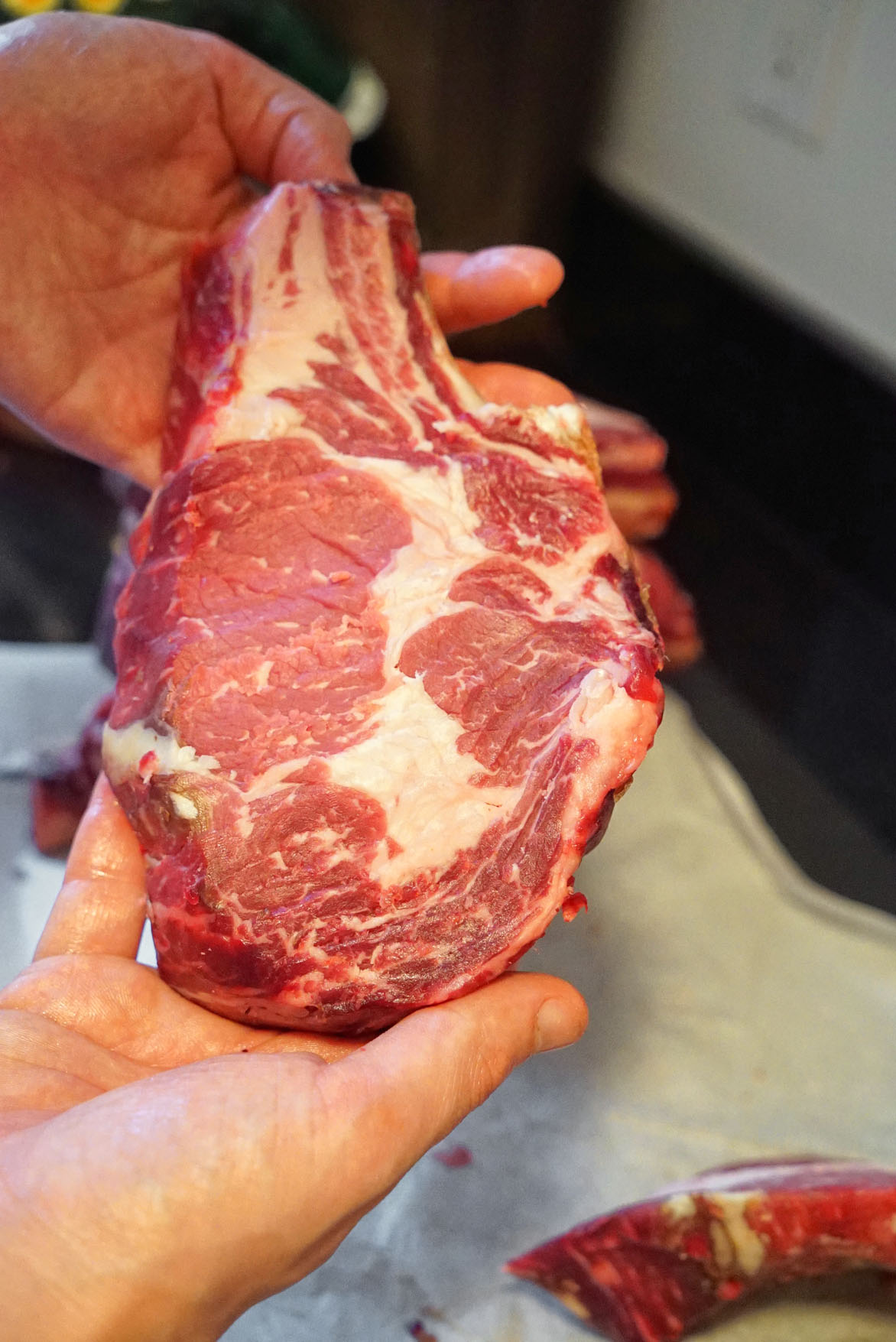
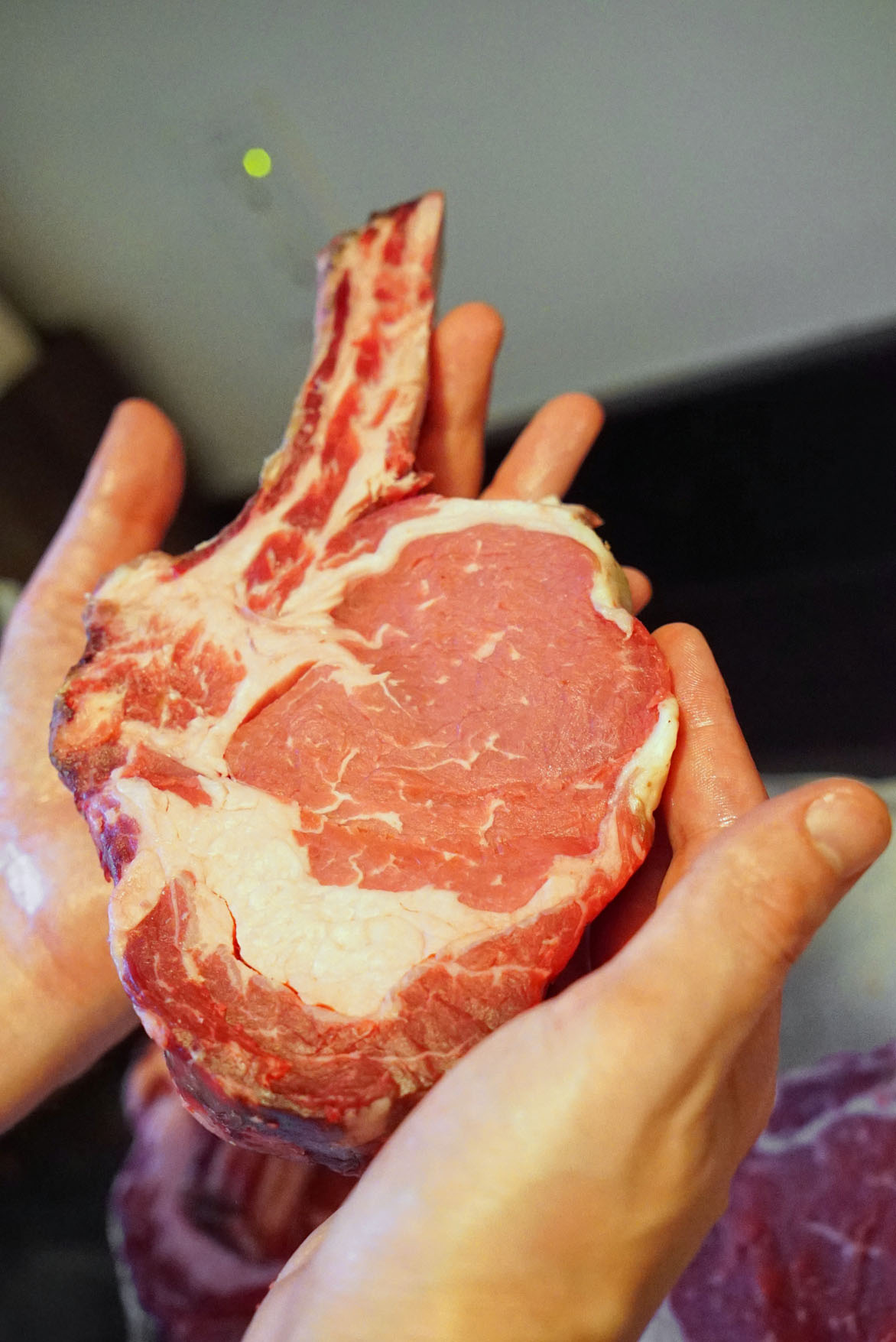
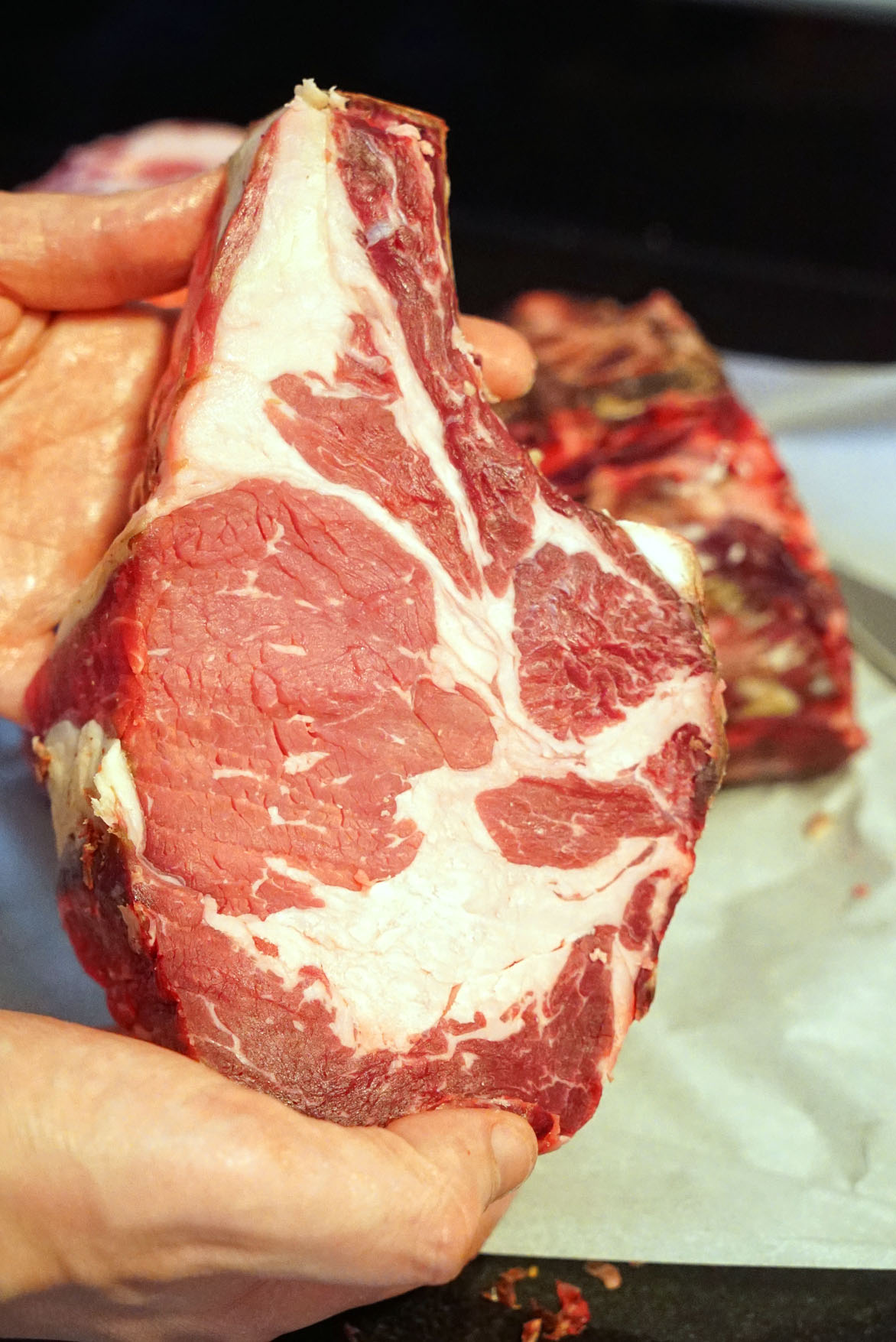
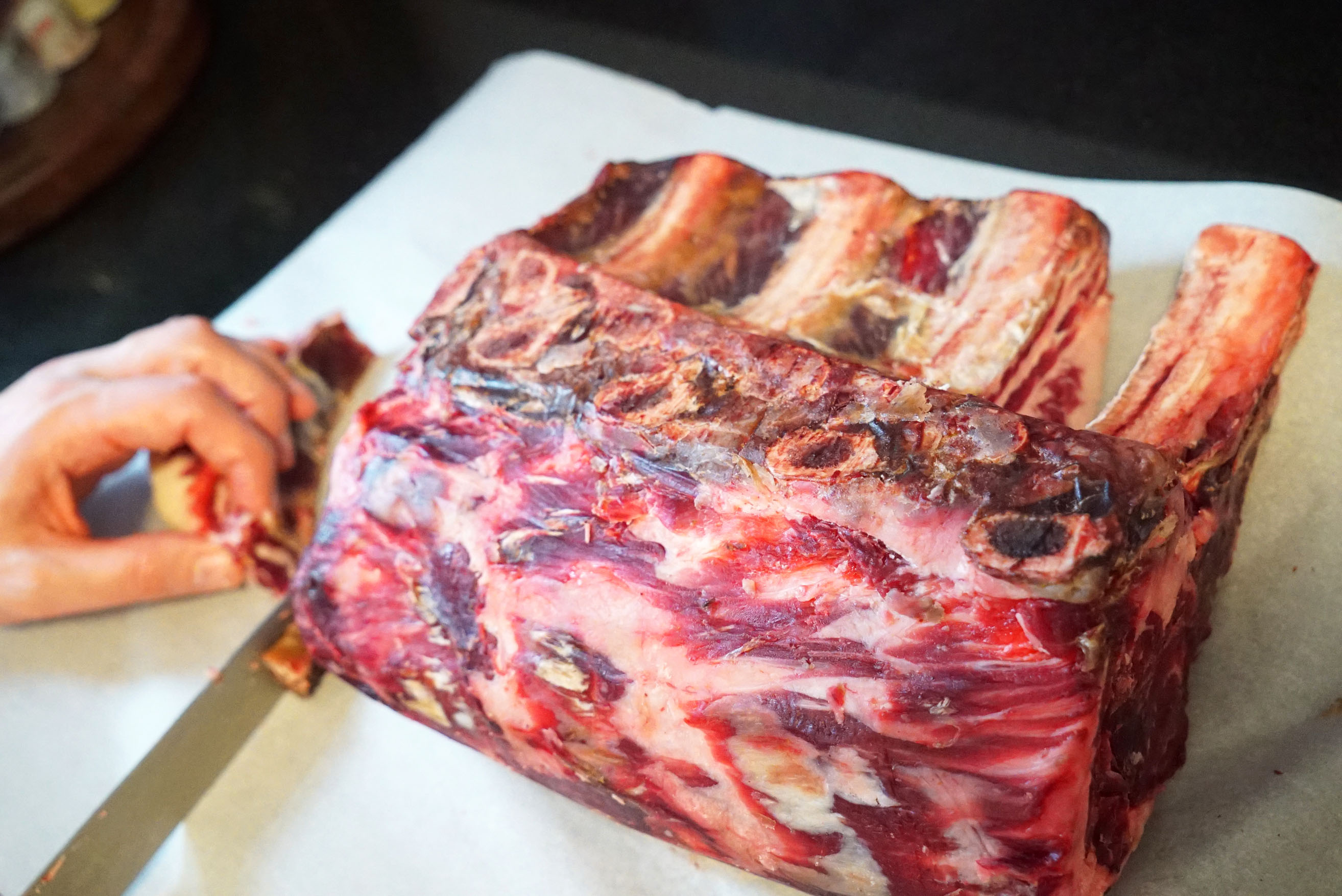
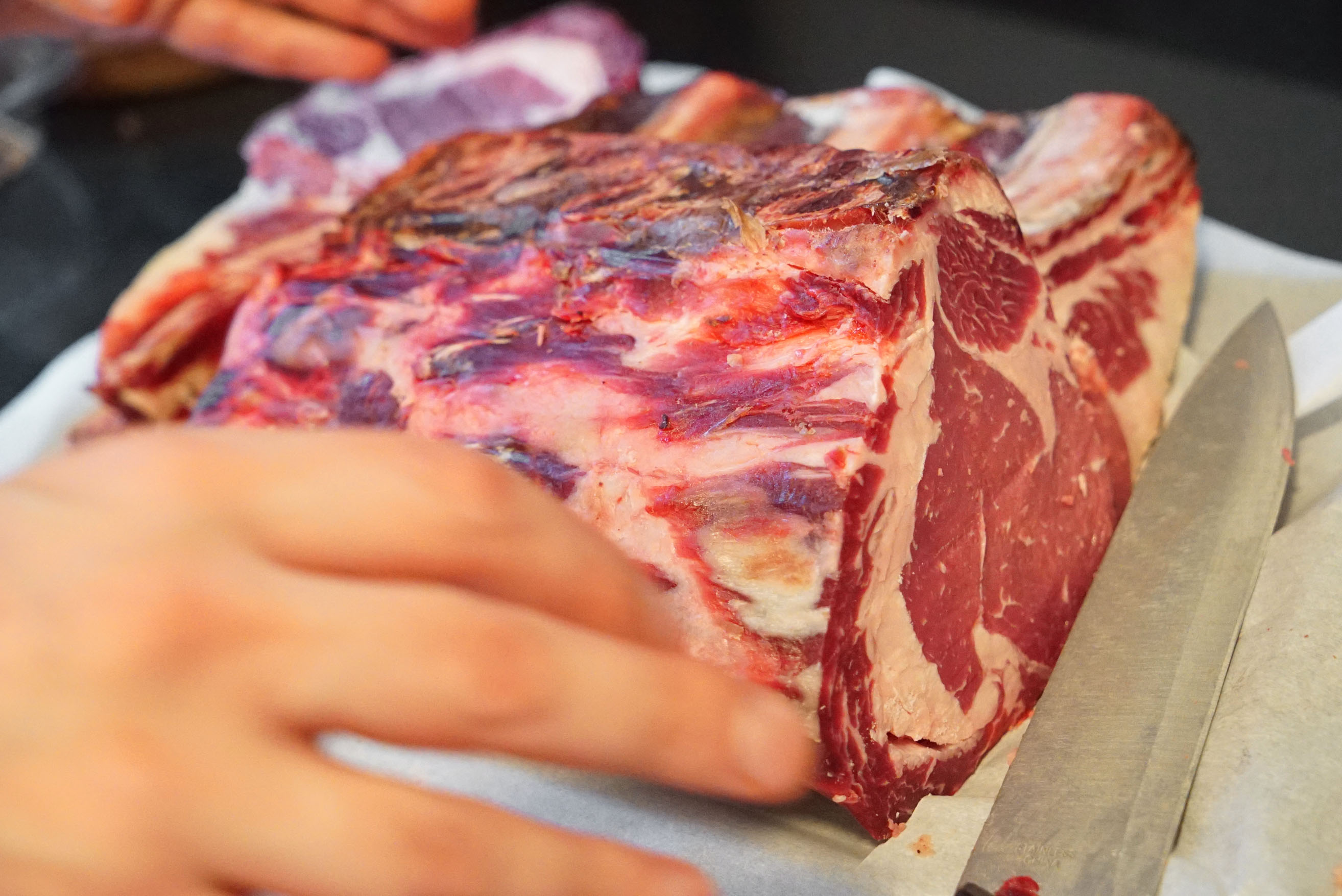
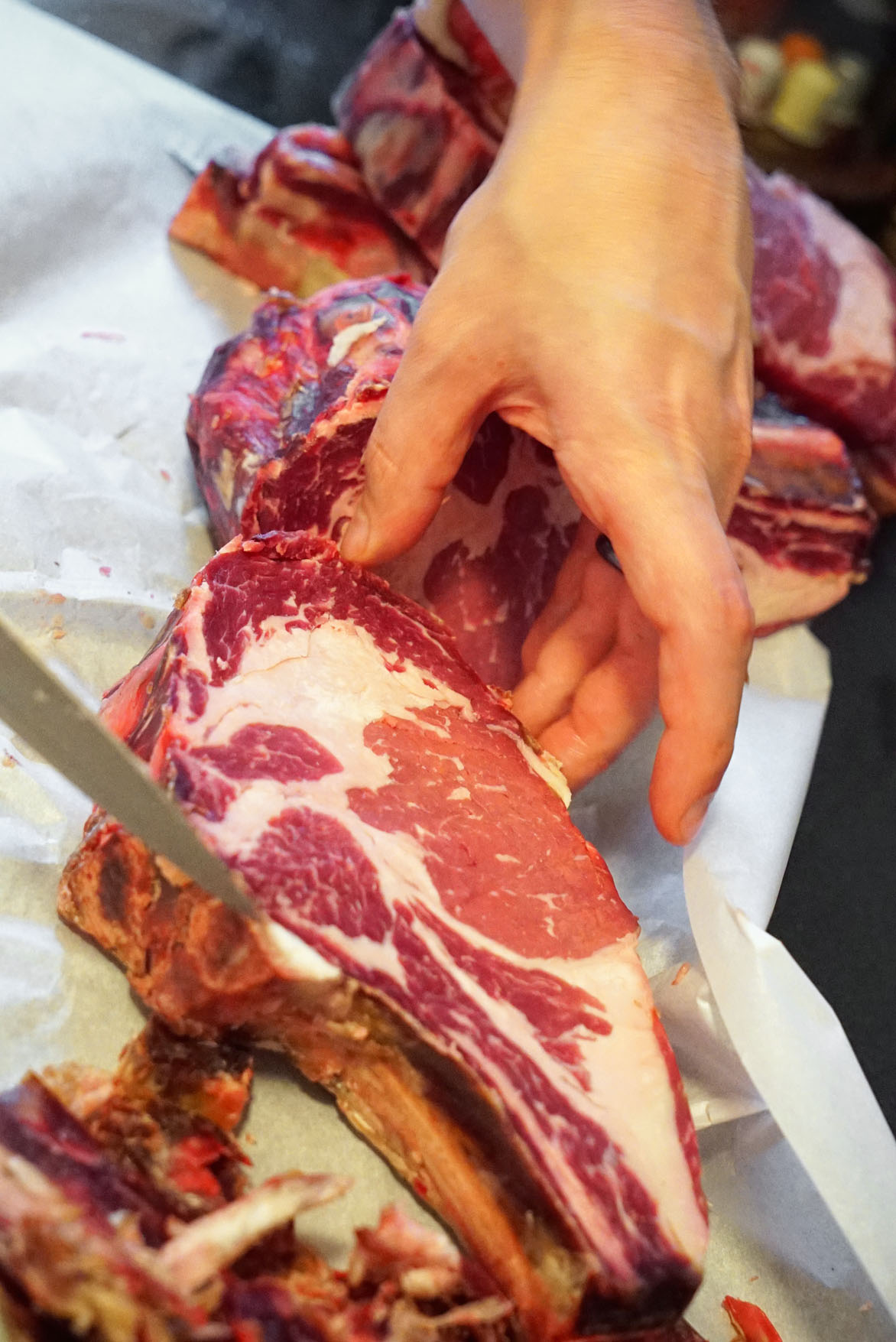
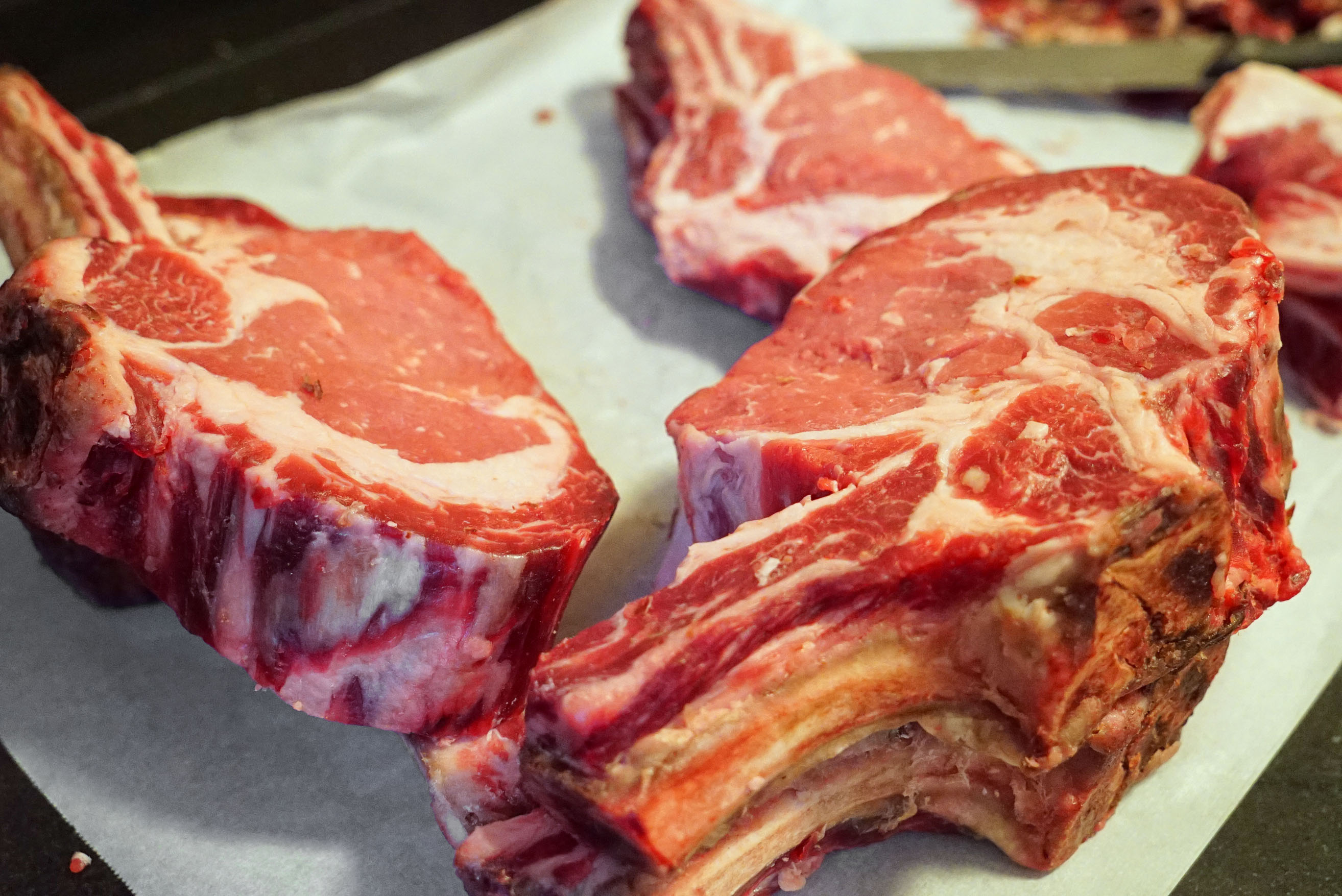
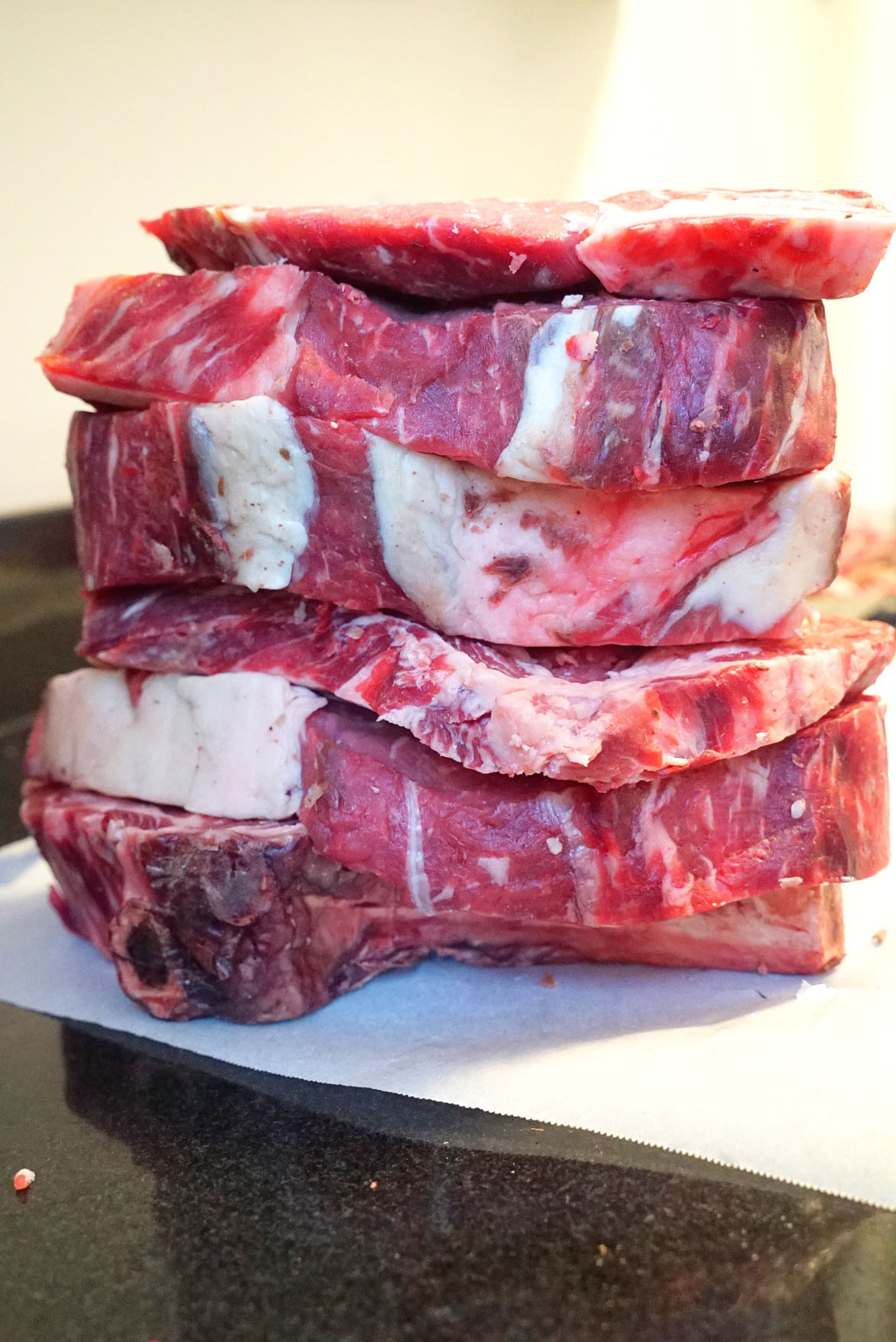
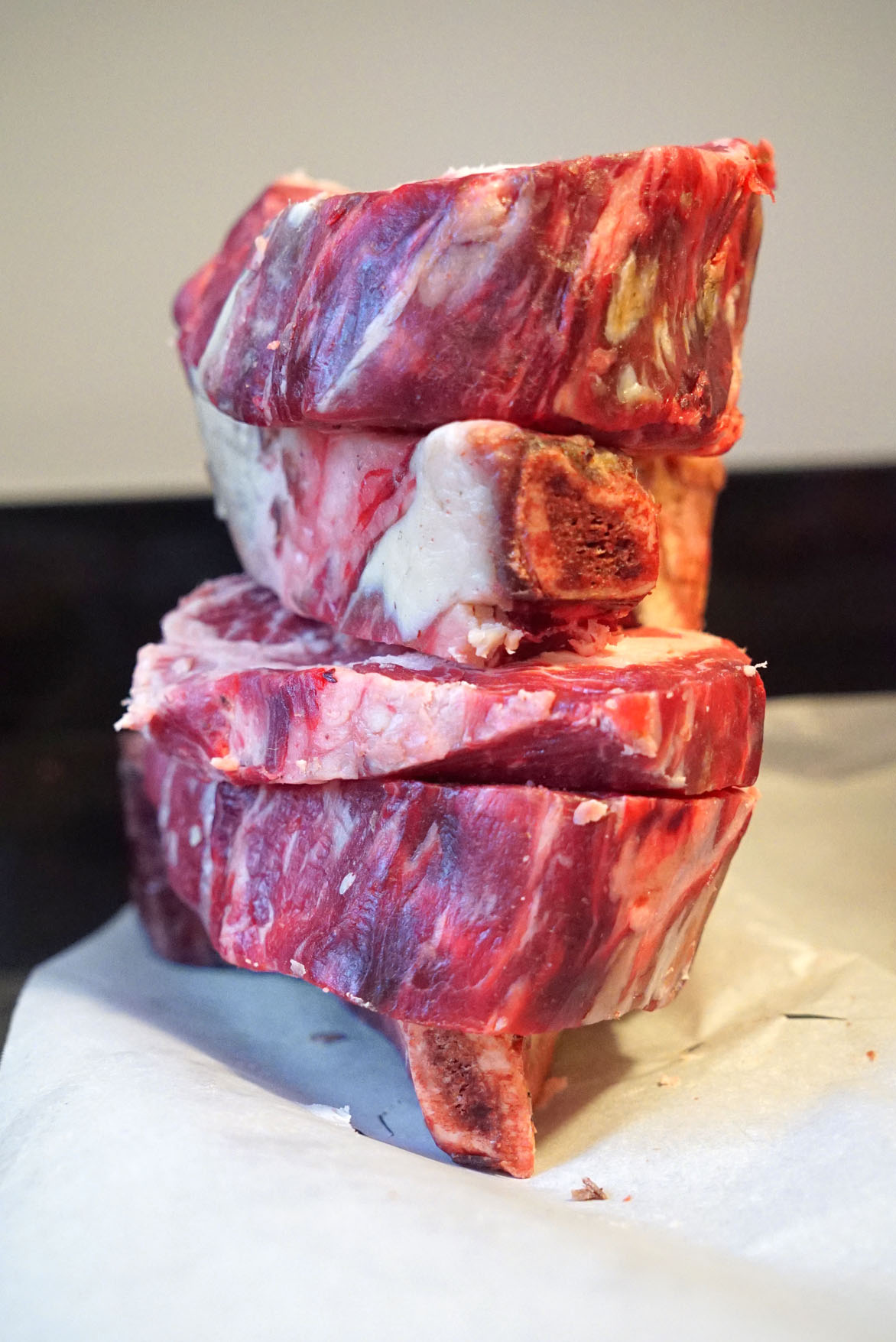
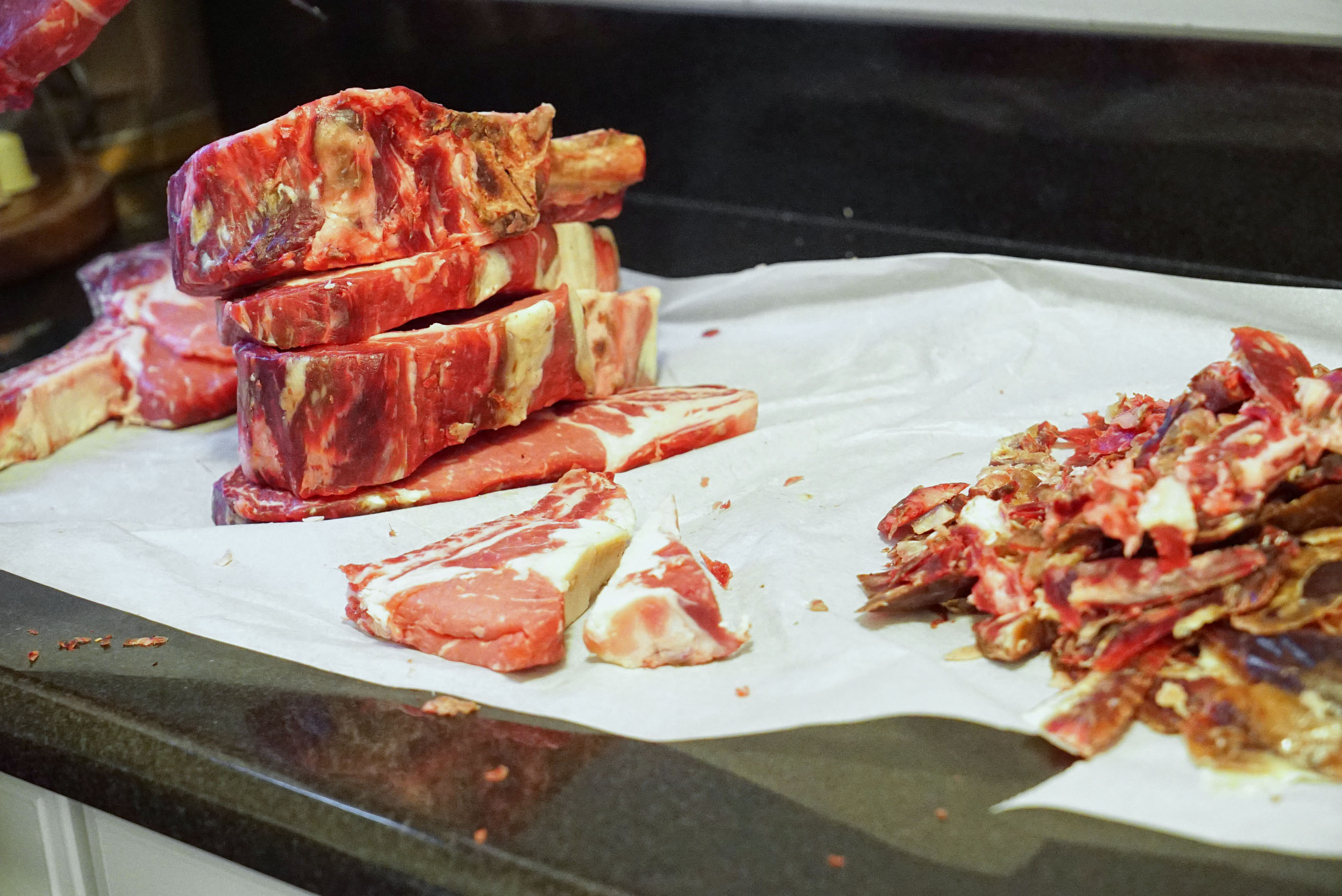
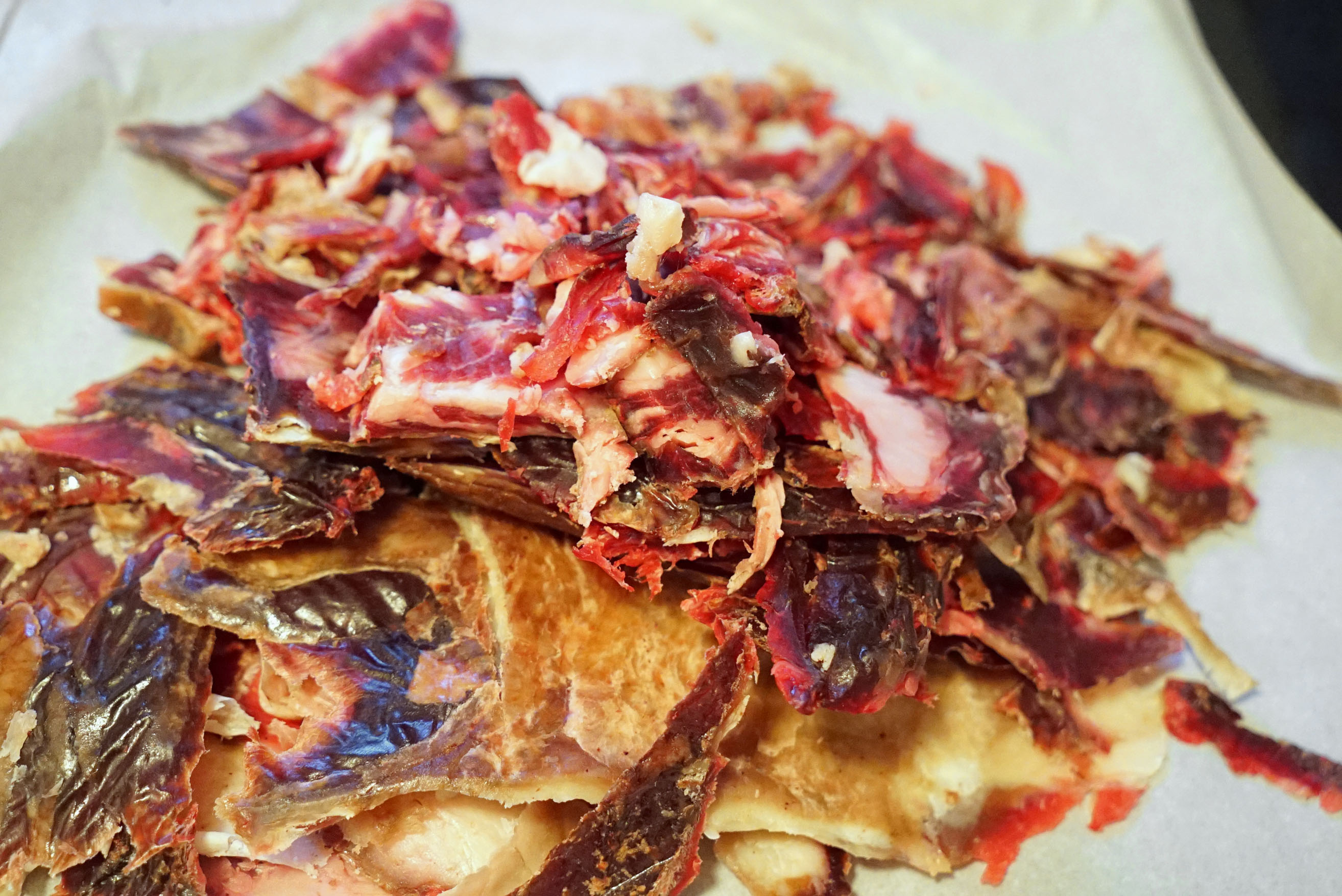
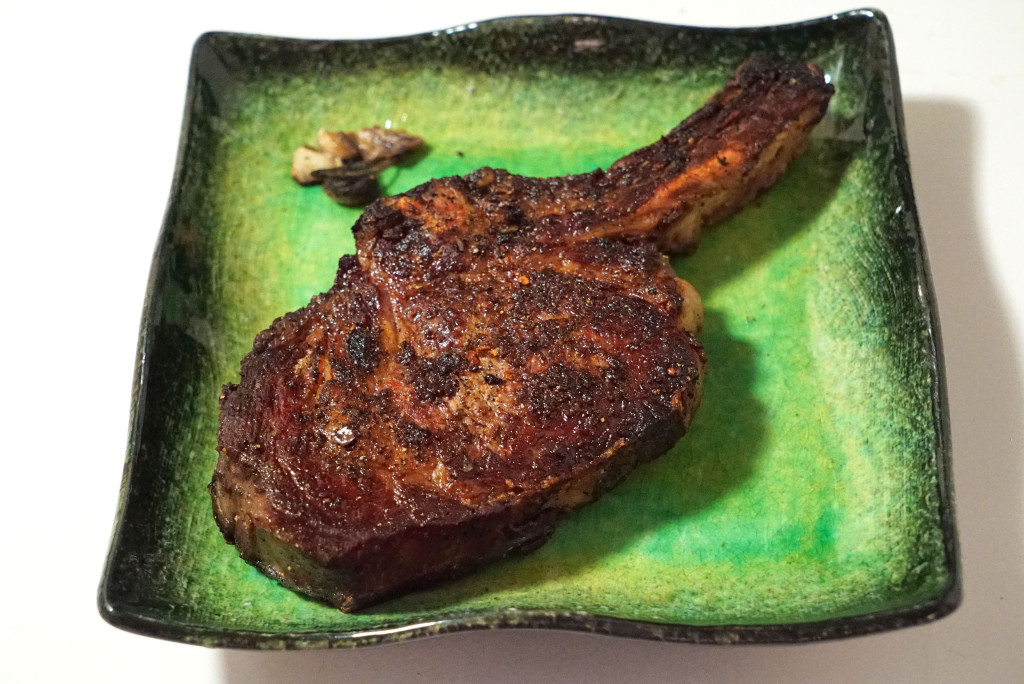
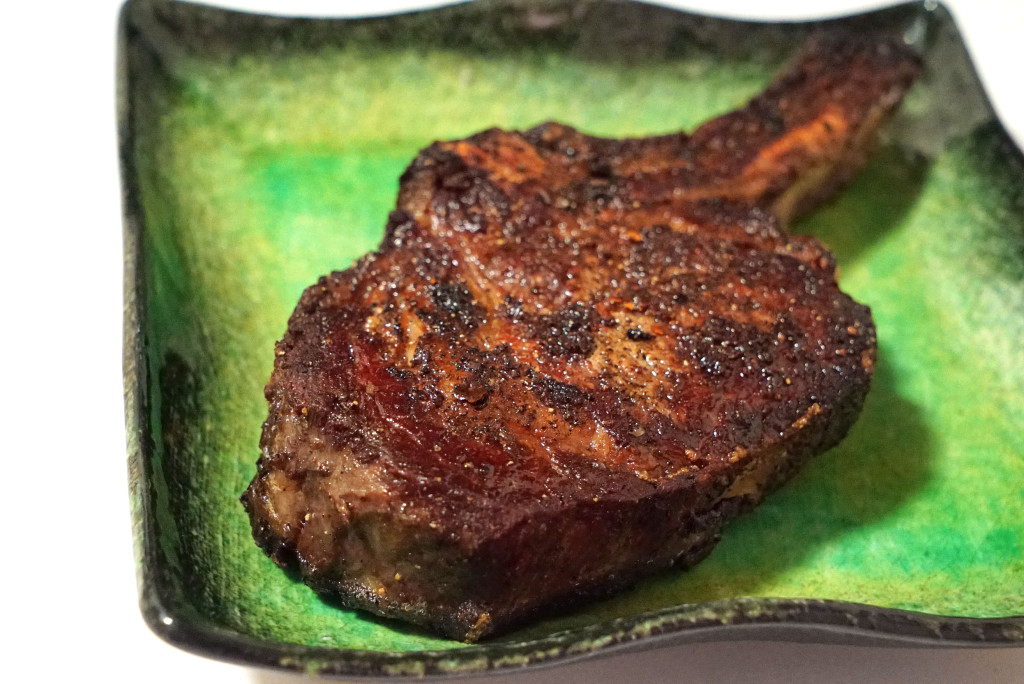
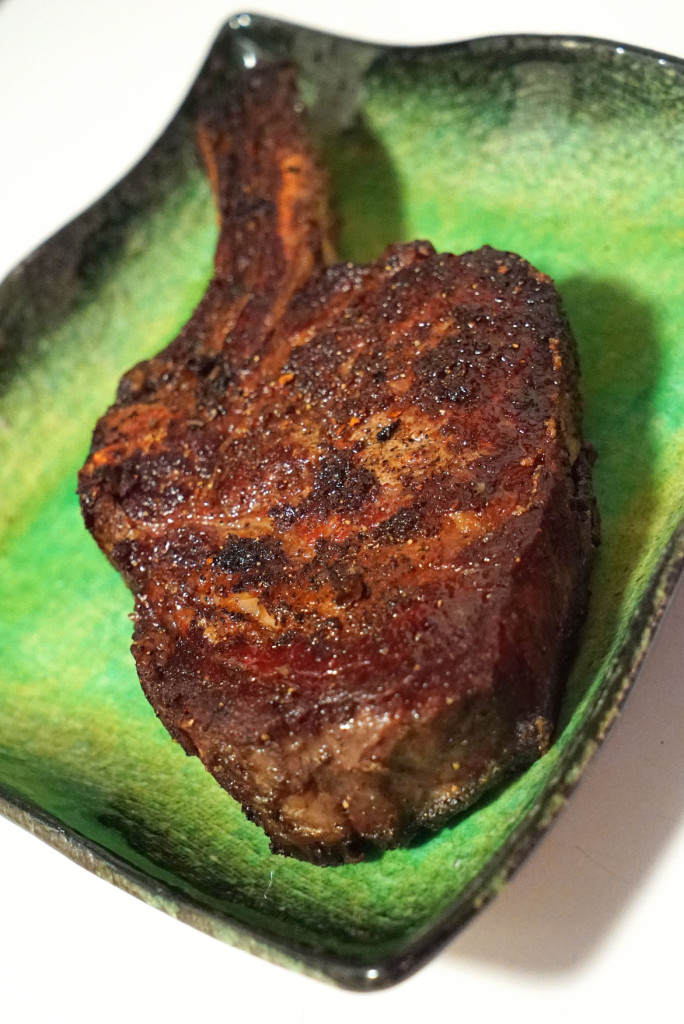
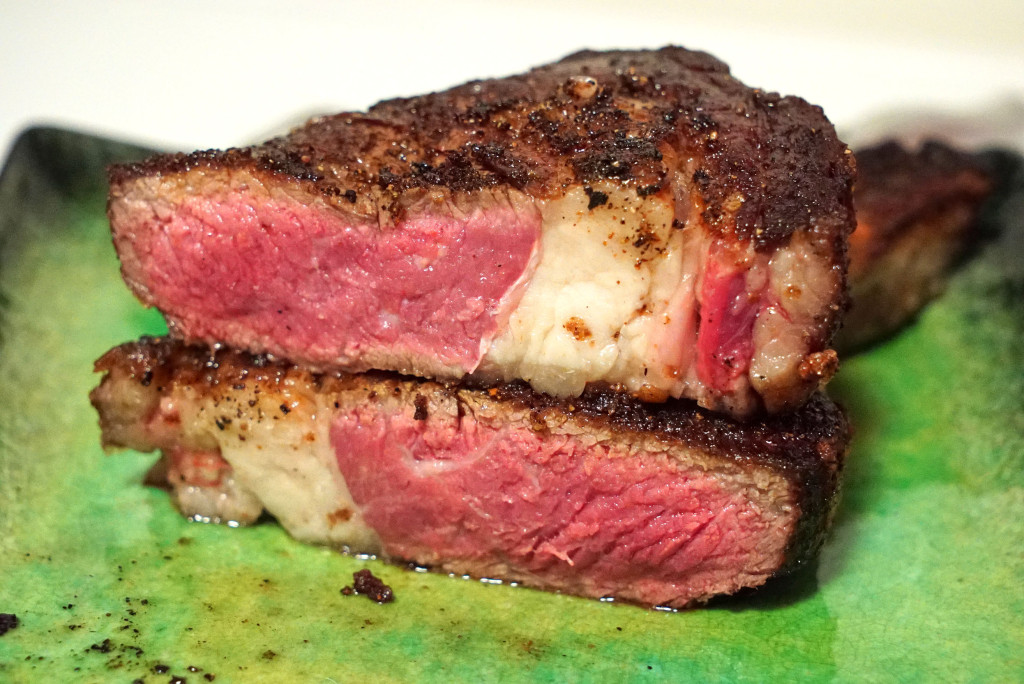
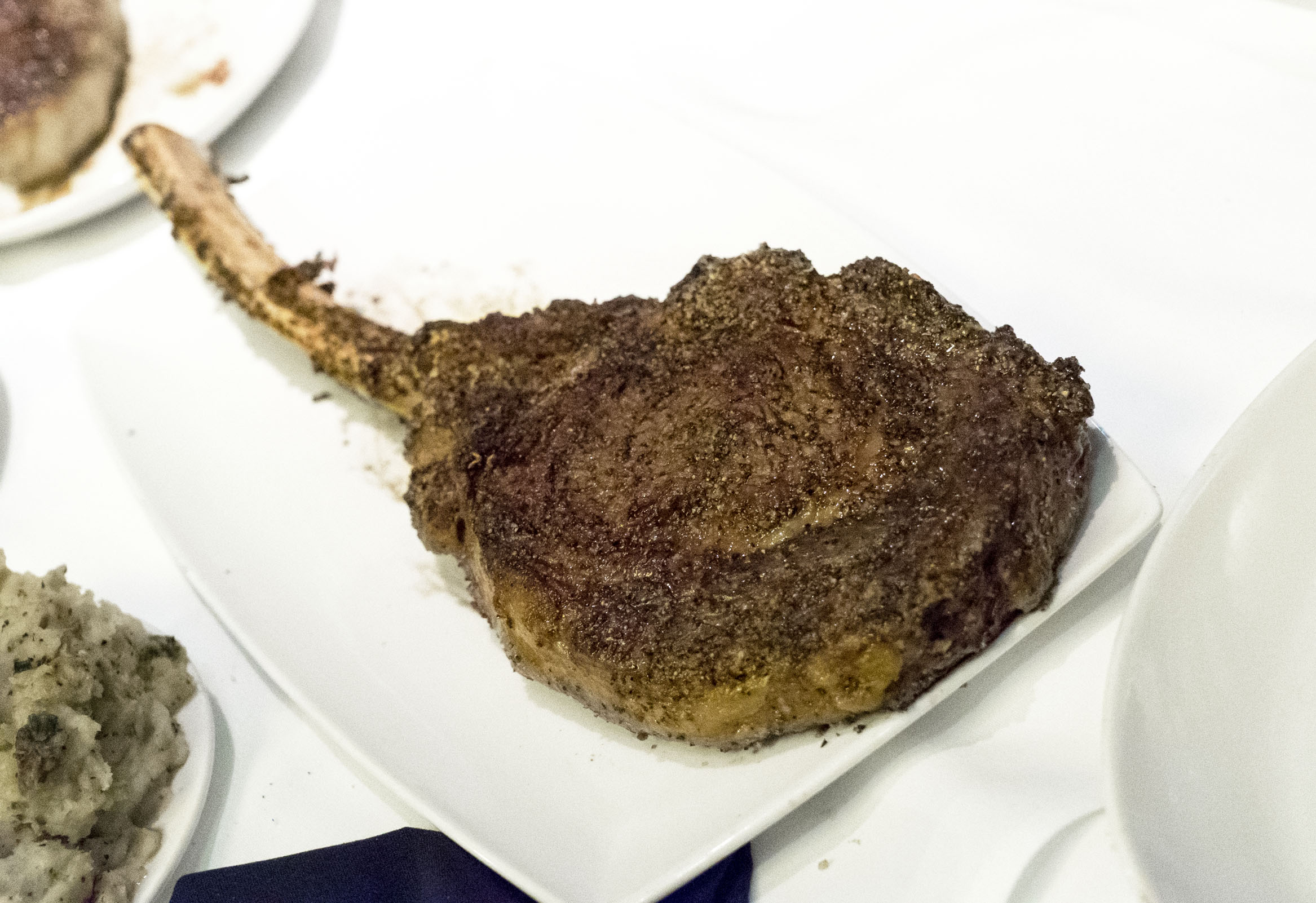
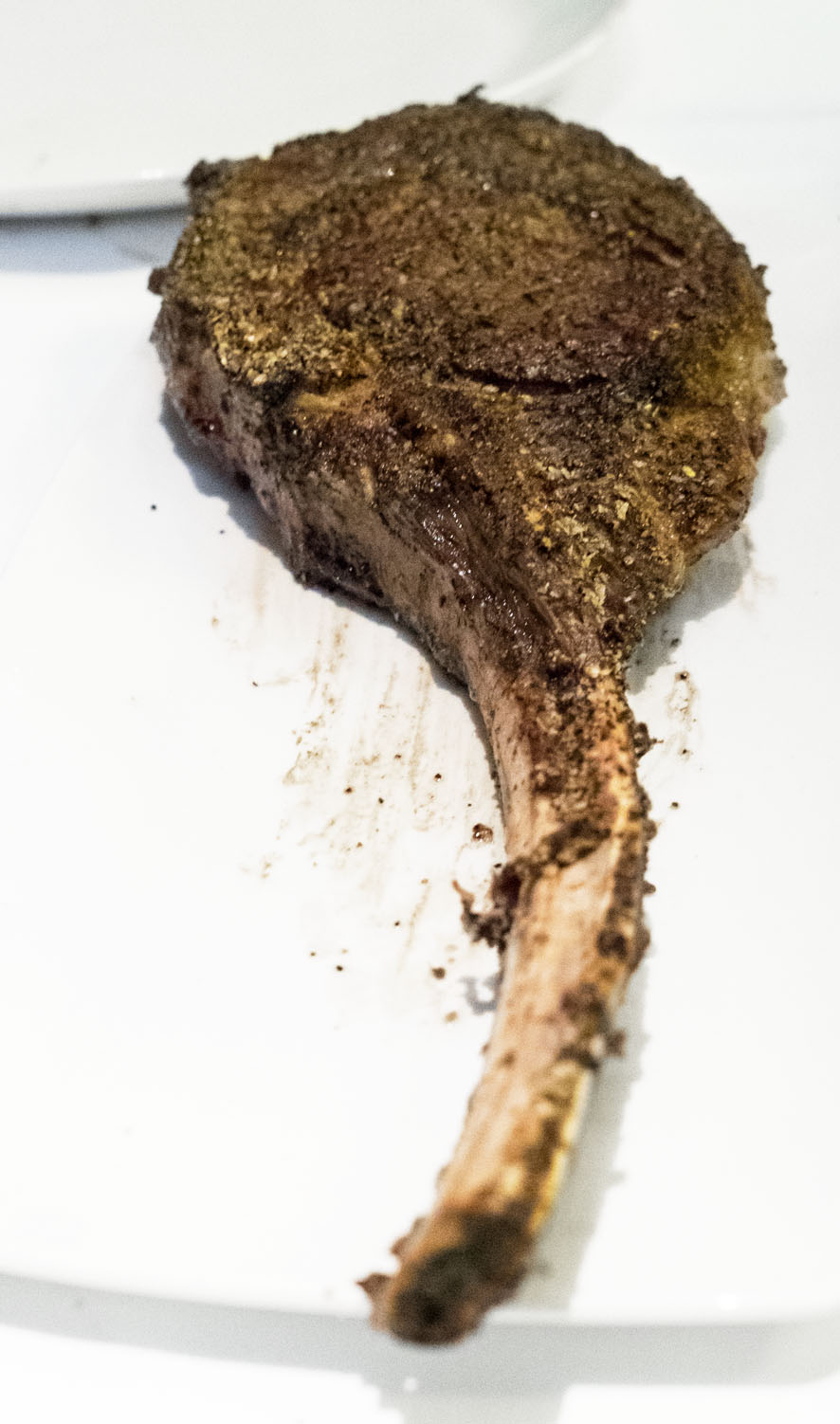
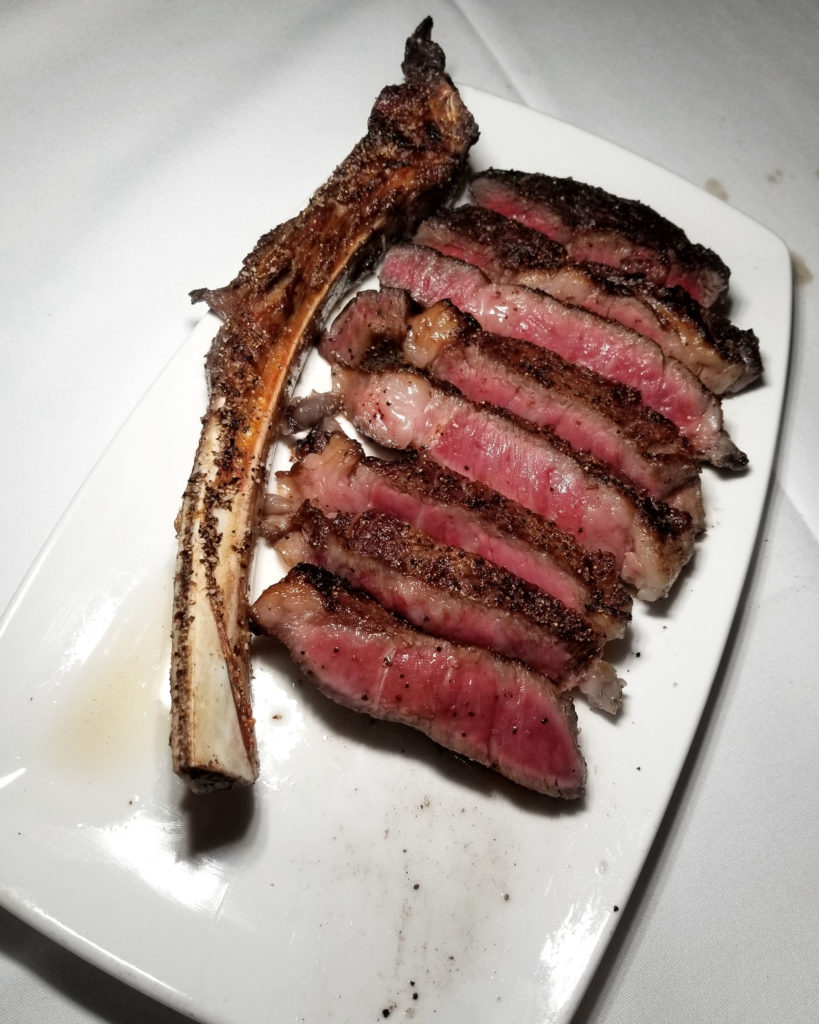
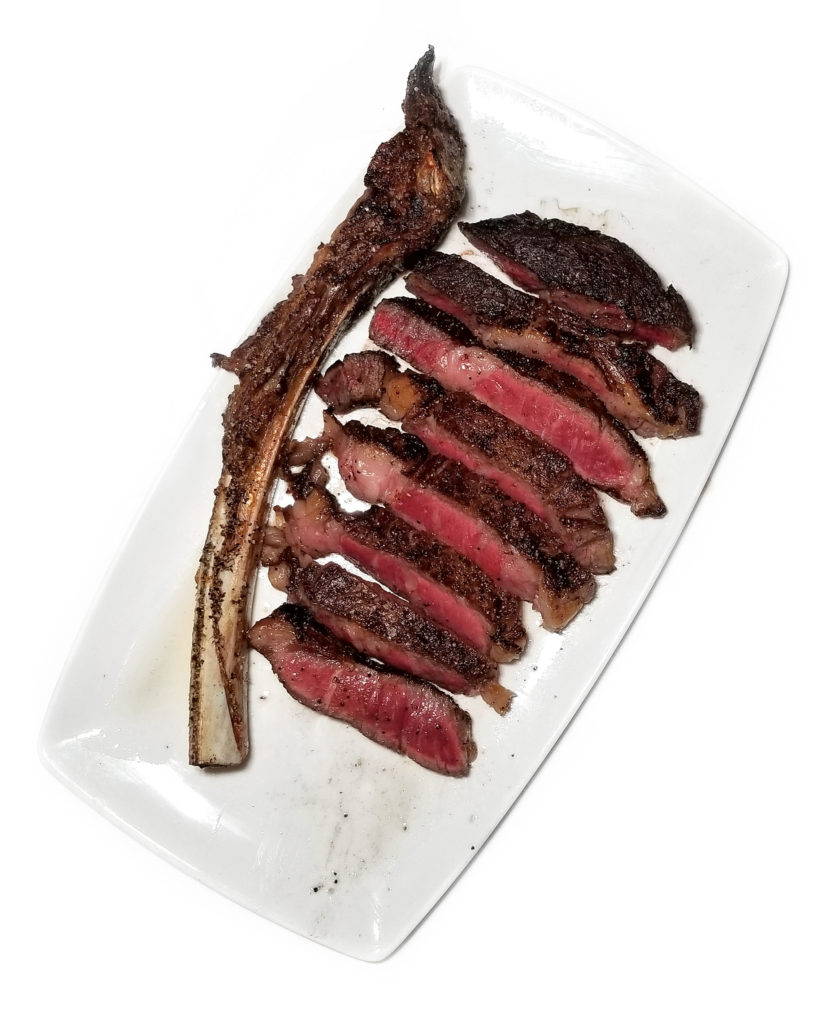
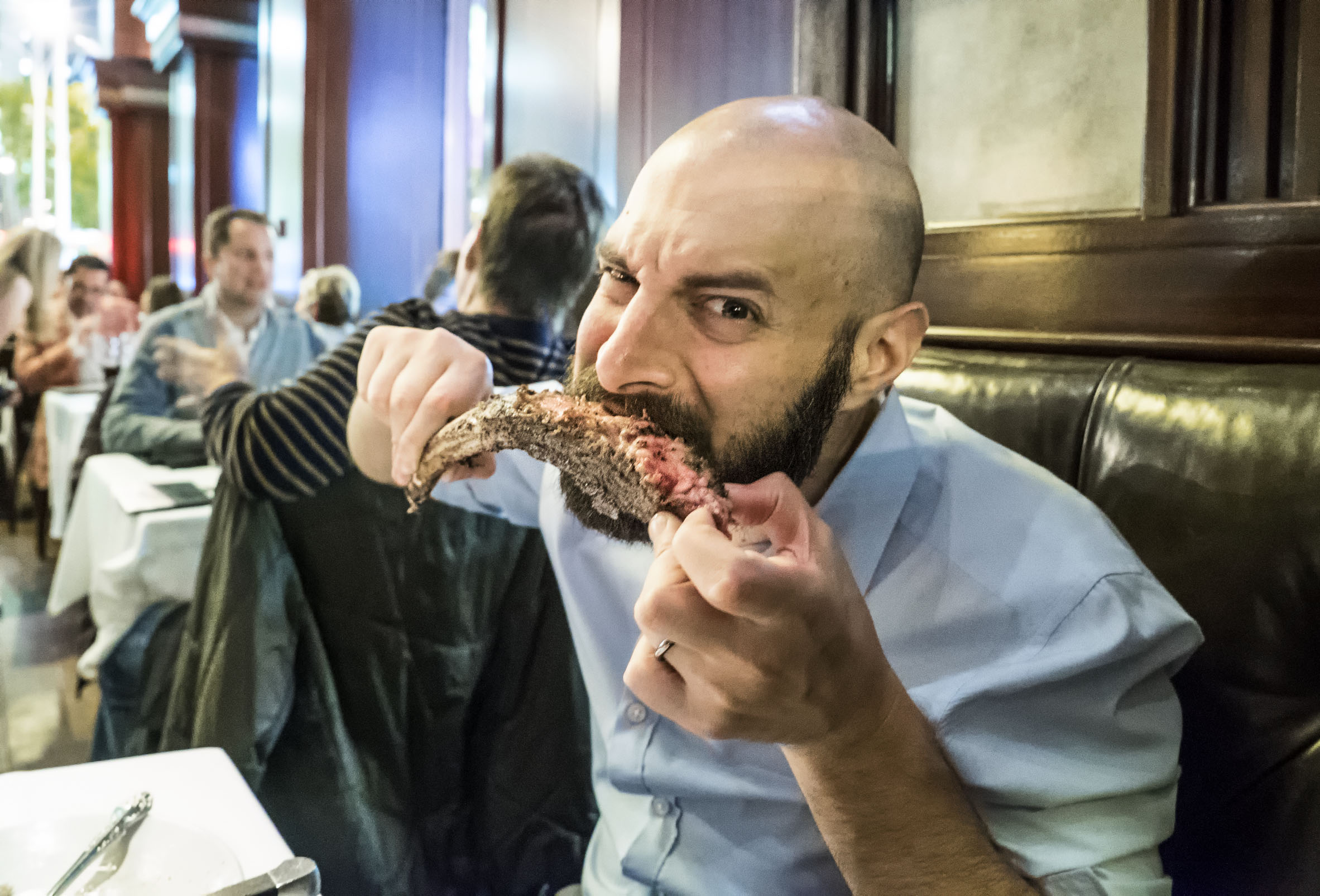
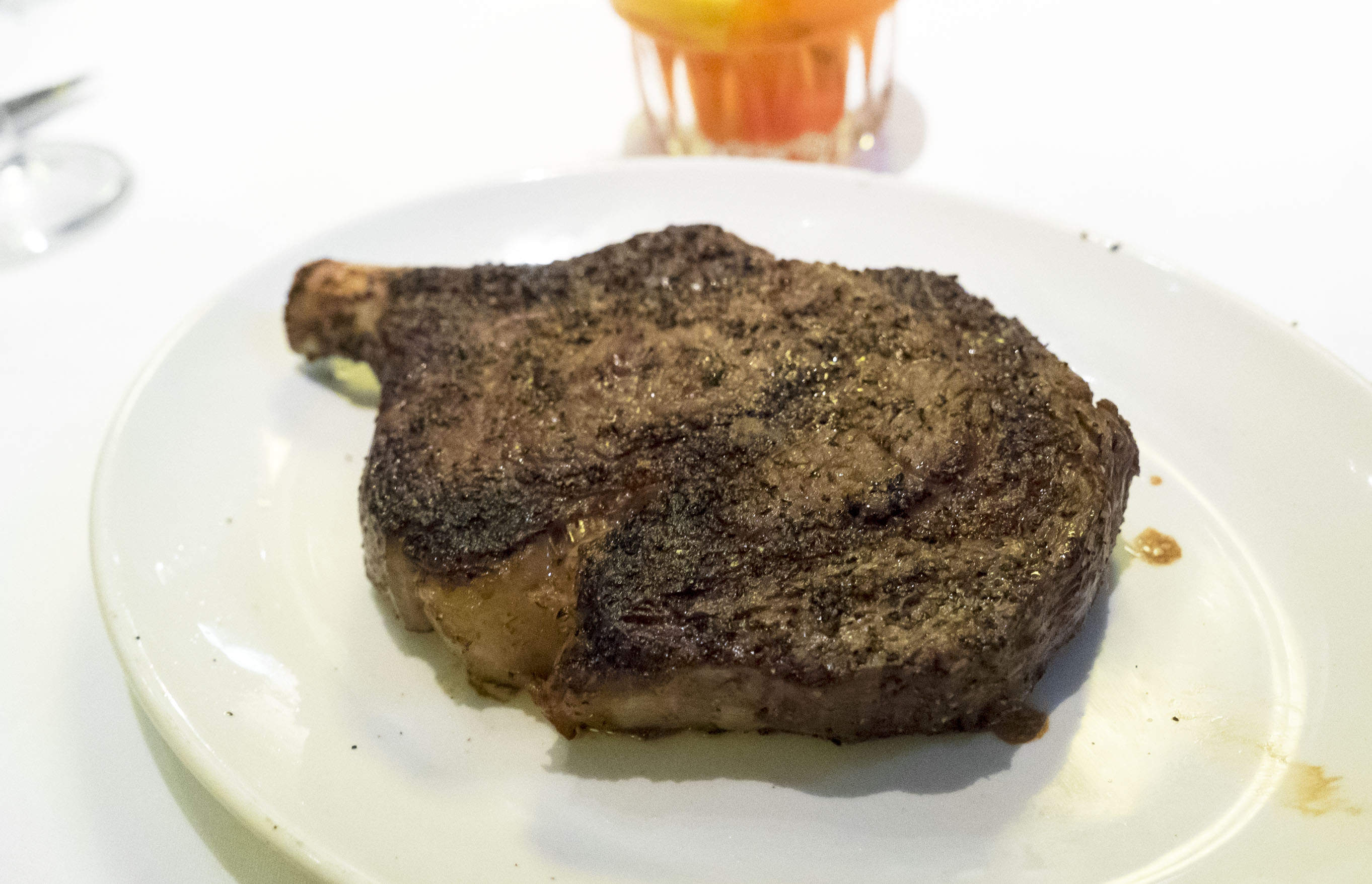
We had this massive 40oz tomahawk rib eye that was dry aged for 70 days. This is on special right now for $95, so if you like what you see, go get it while supplies last!
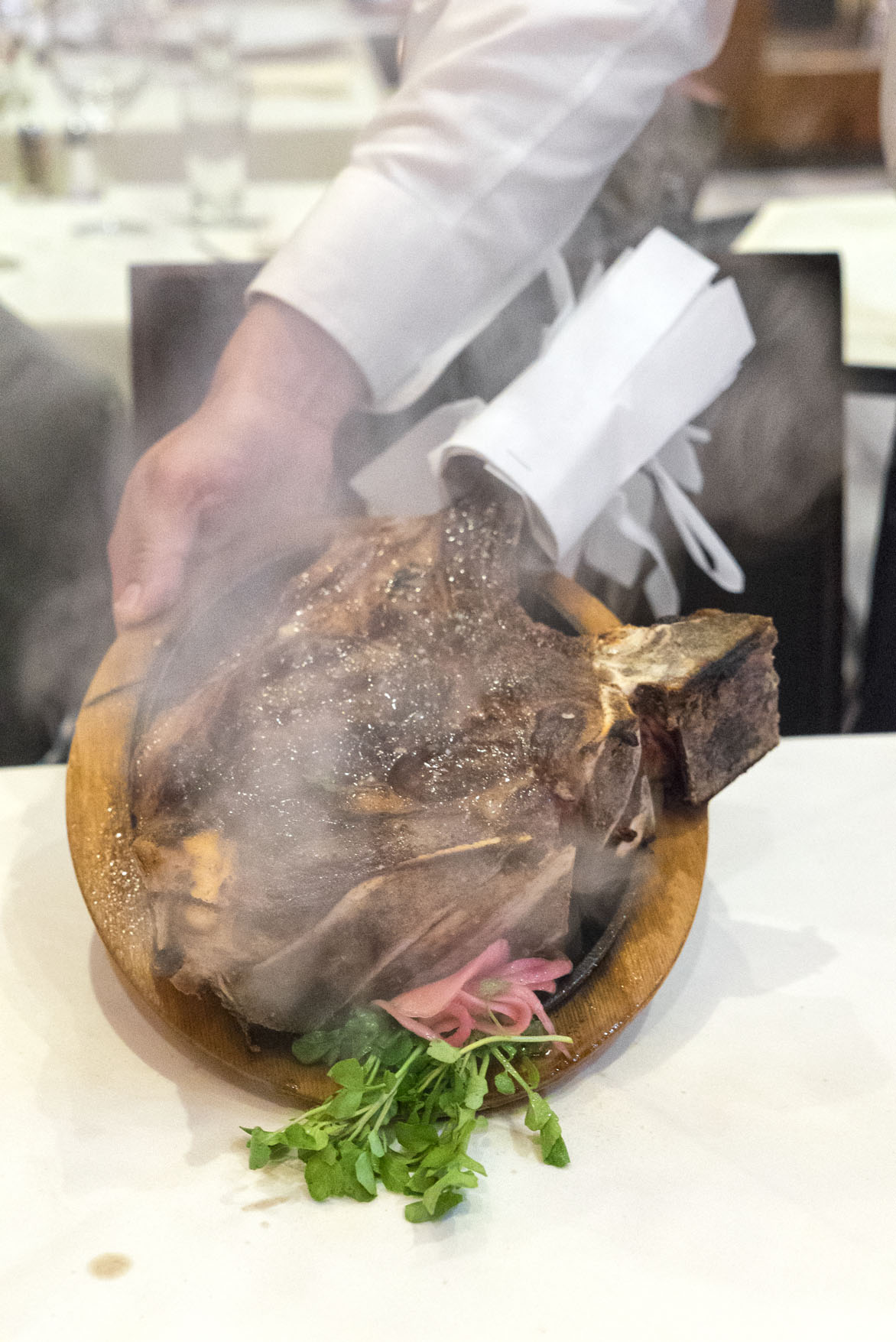
They bring it out to the table while it’s still sizzling hot. Then they take it back and let it rest before slicing and plating.
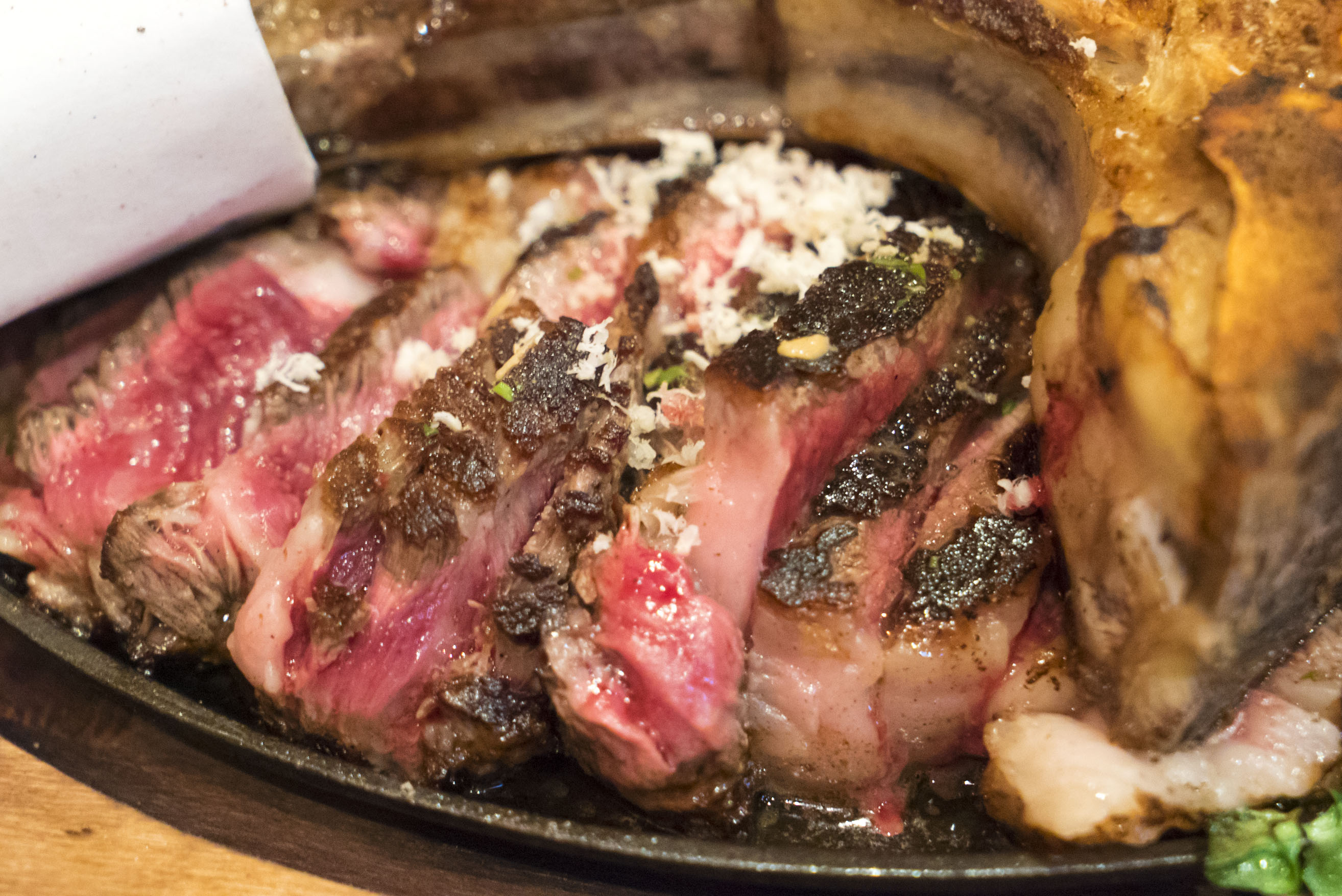
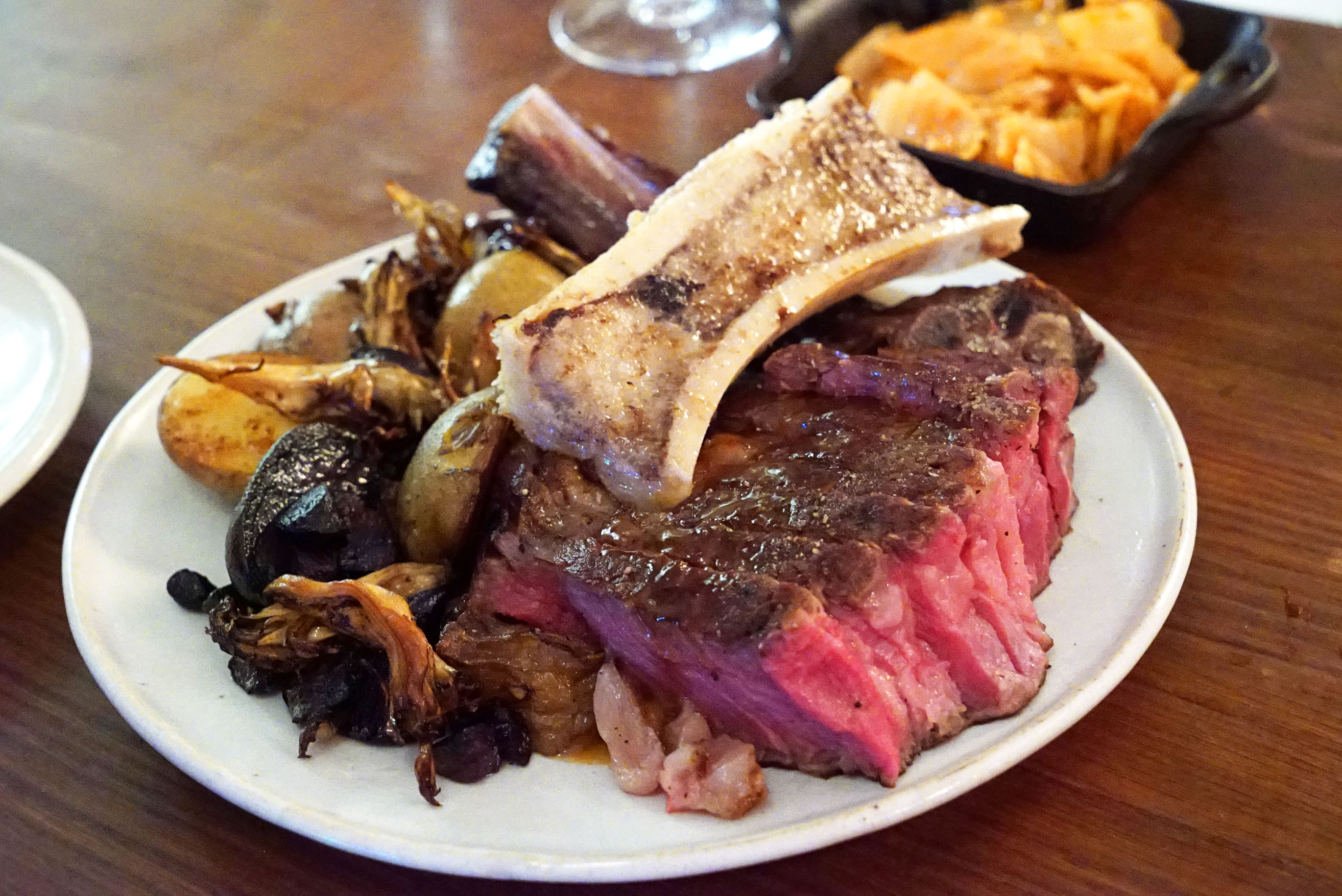
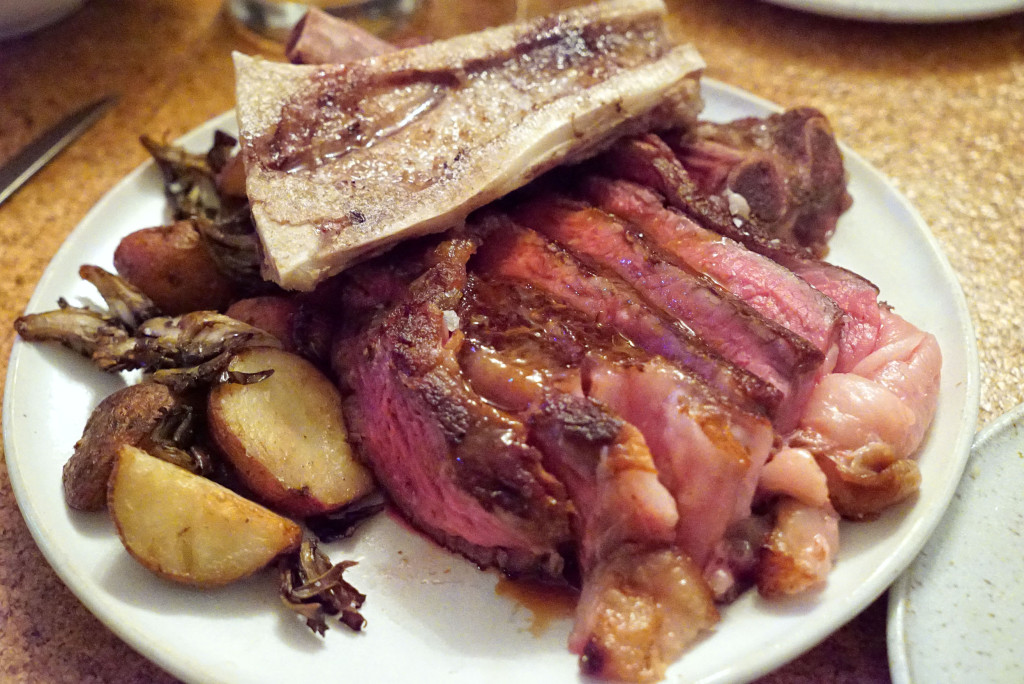
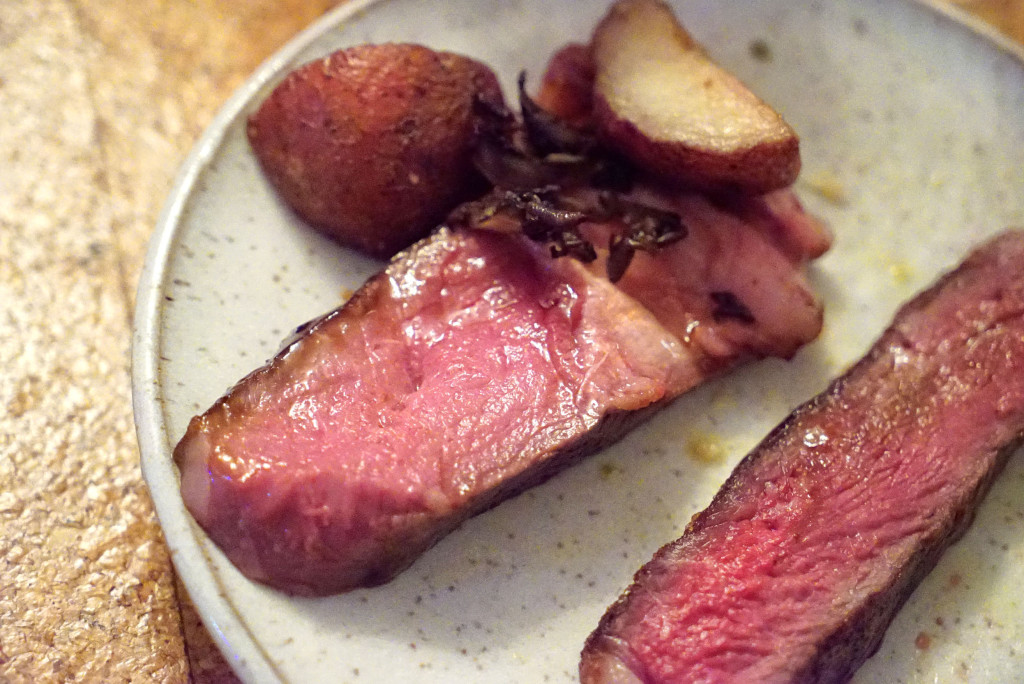
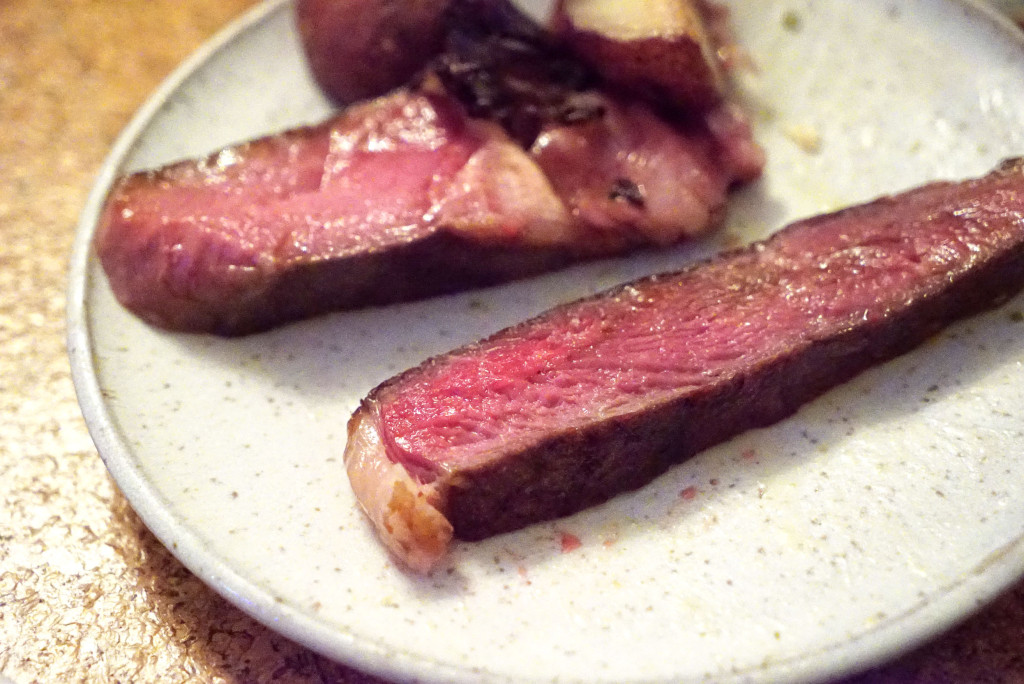
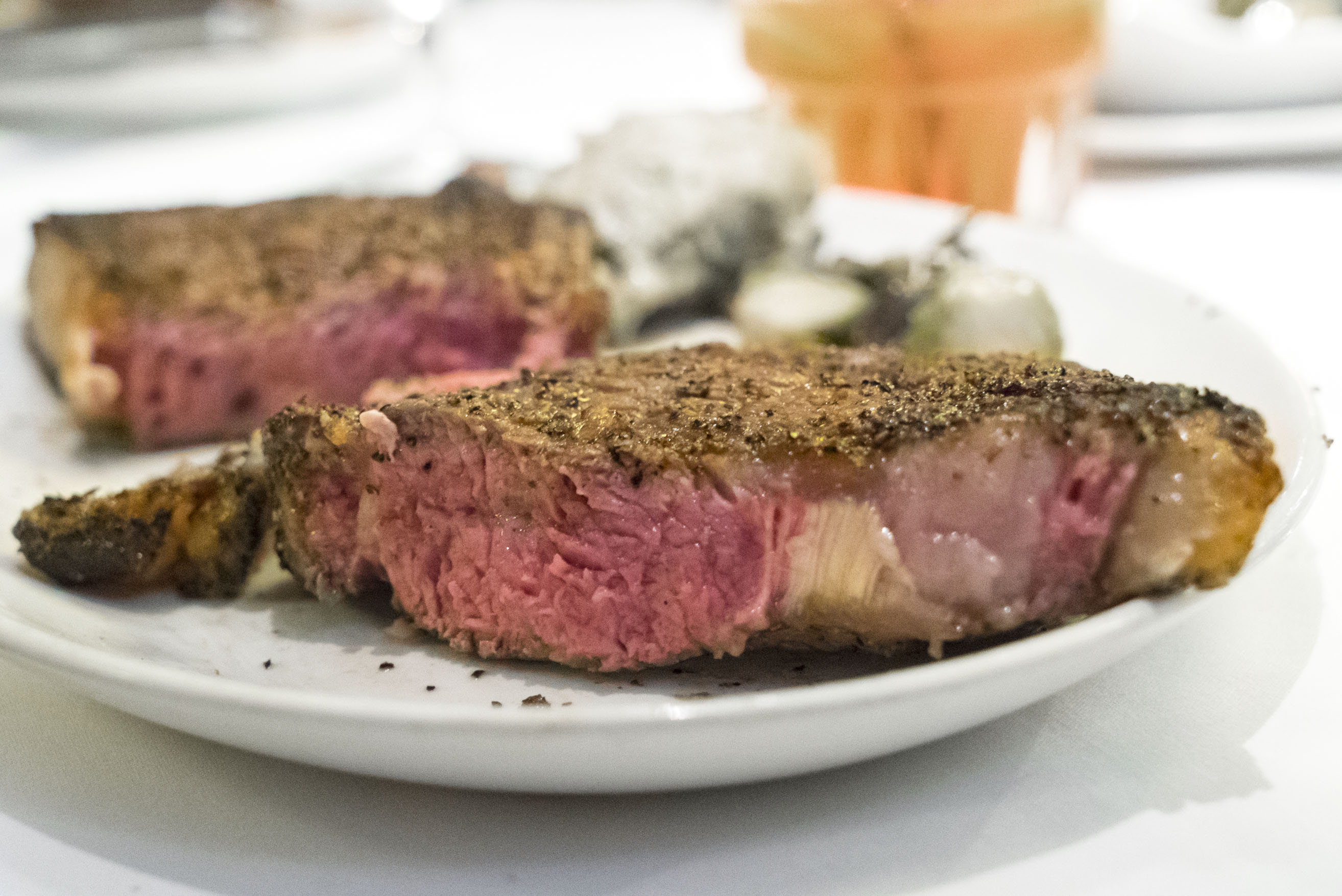
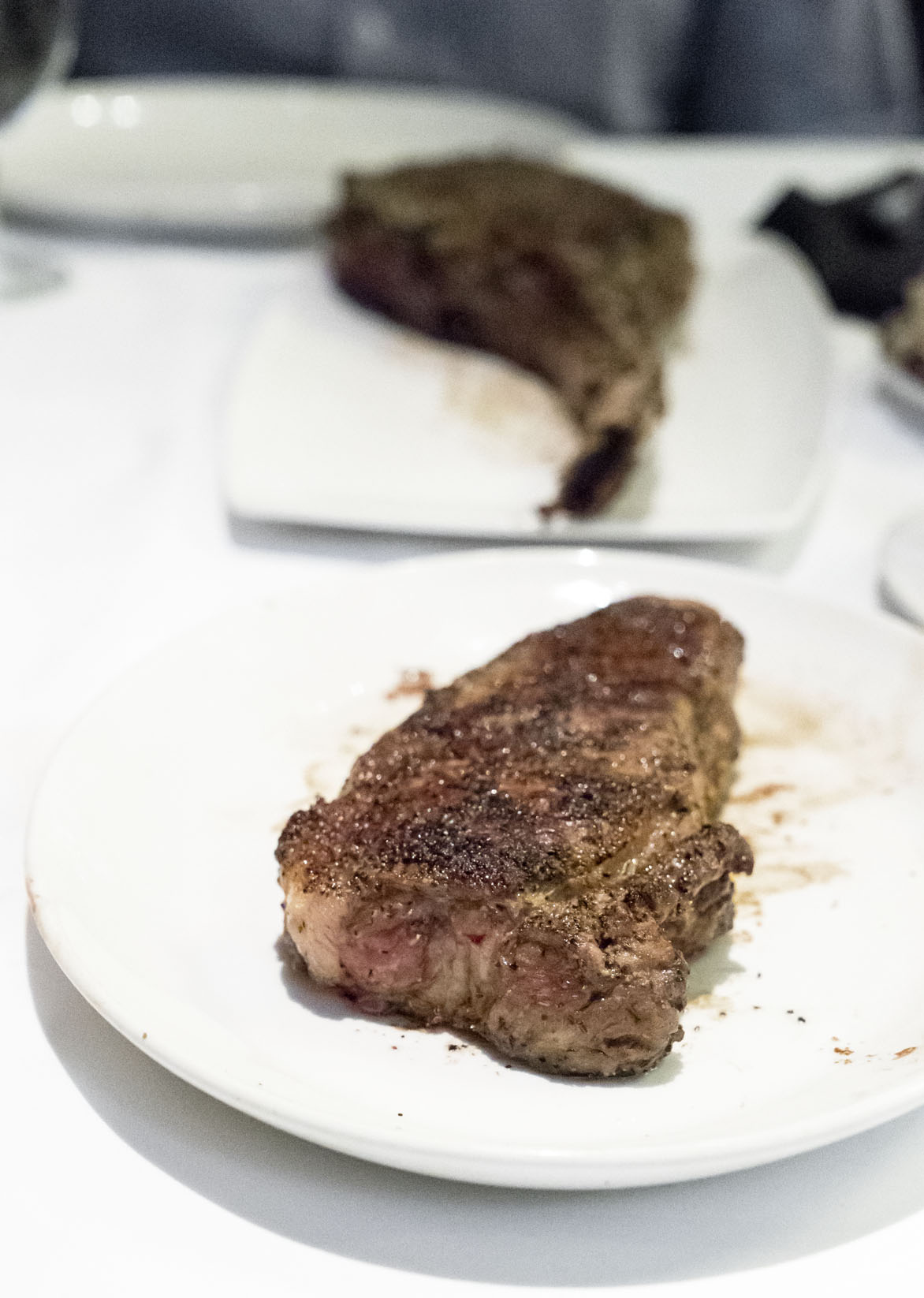
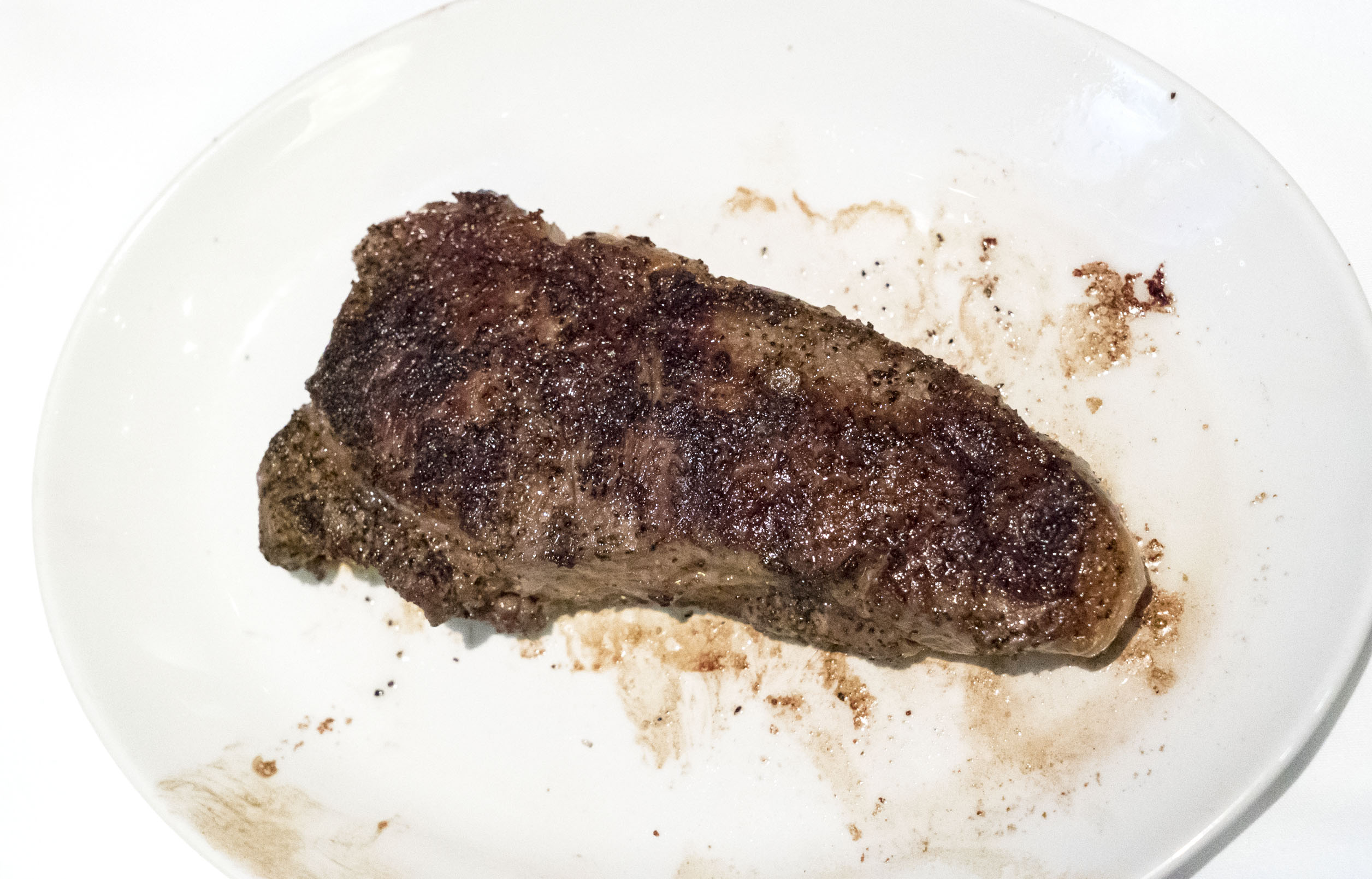
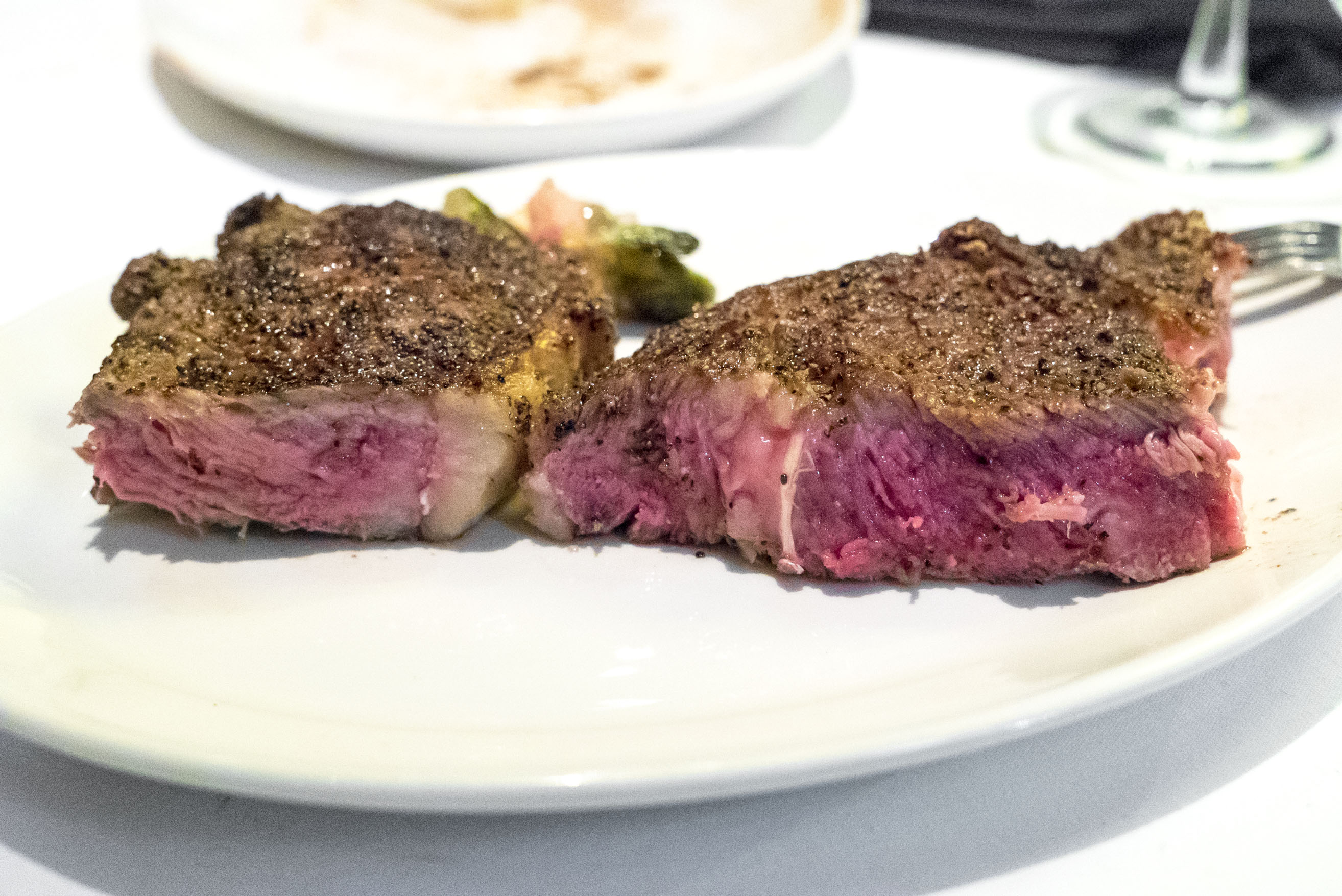
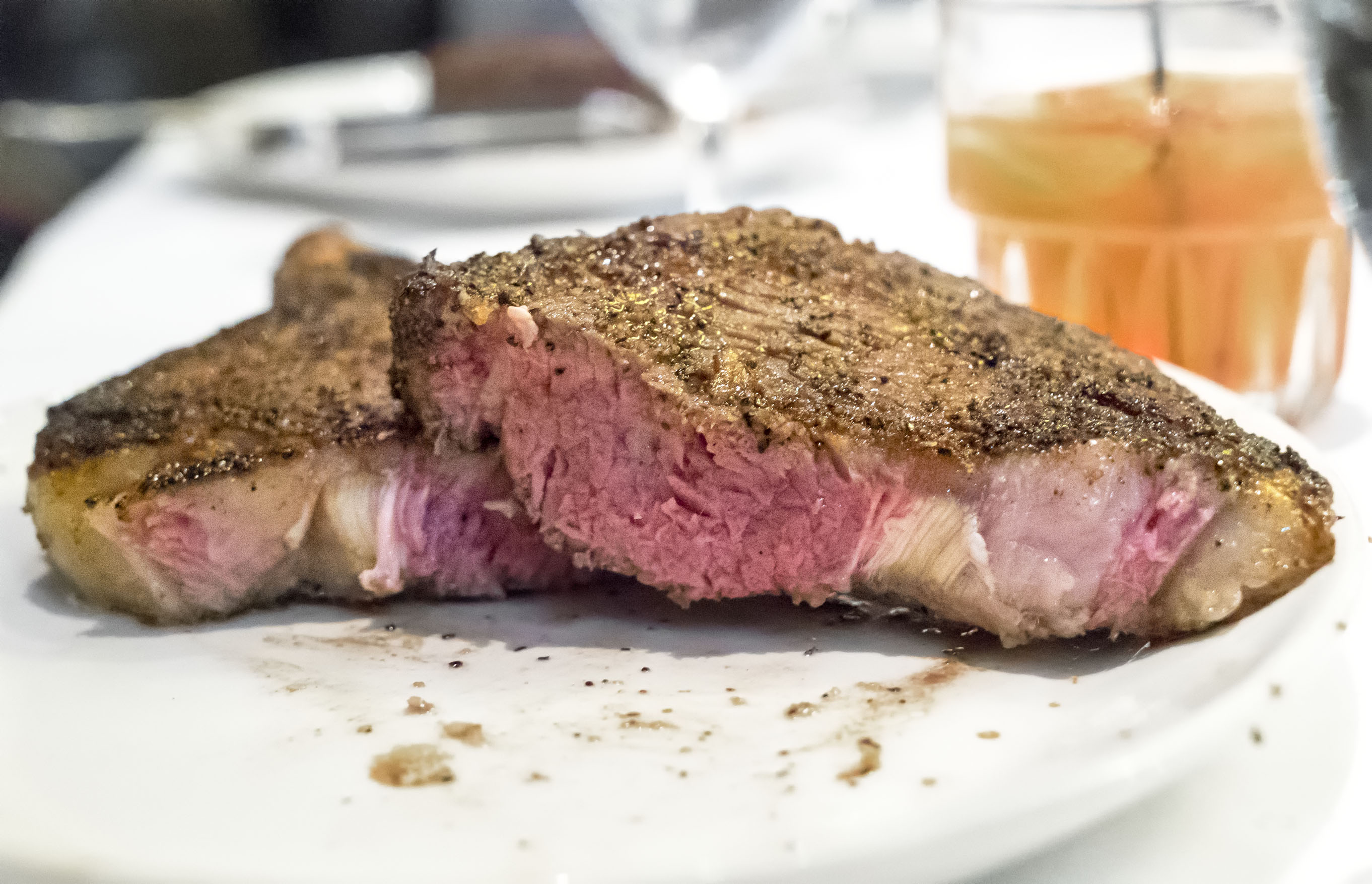
The meat was incredibly tender and flavorful. I held back from full points only because I think it needed a little bit more seasoning.
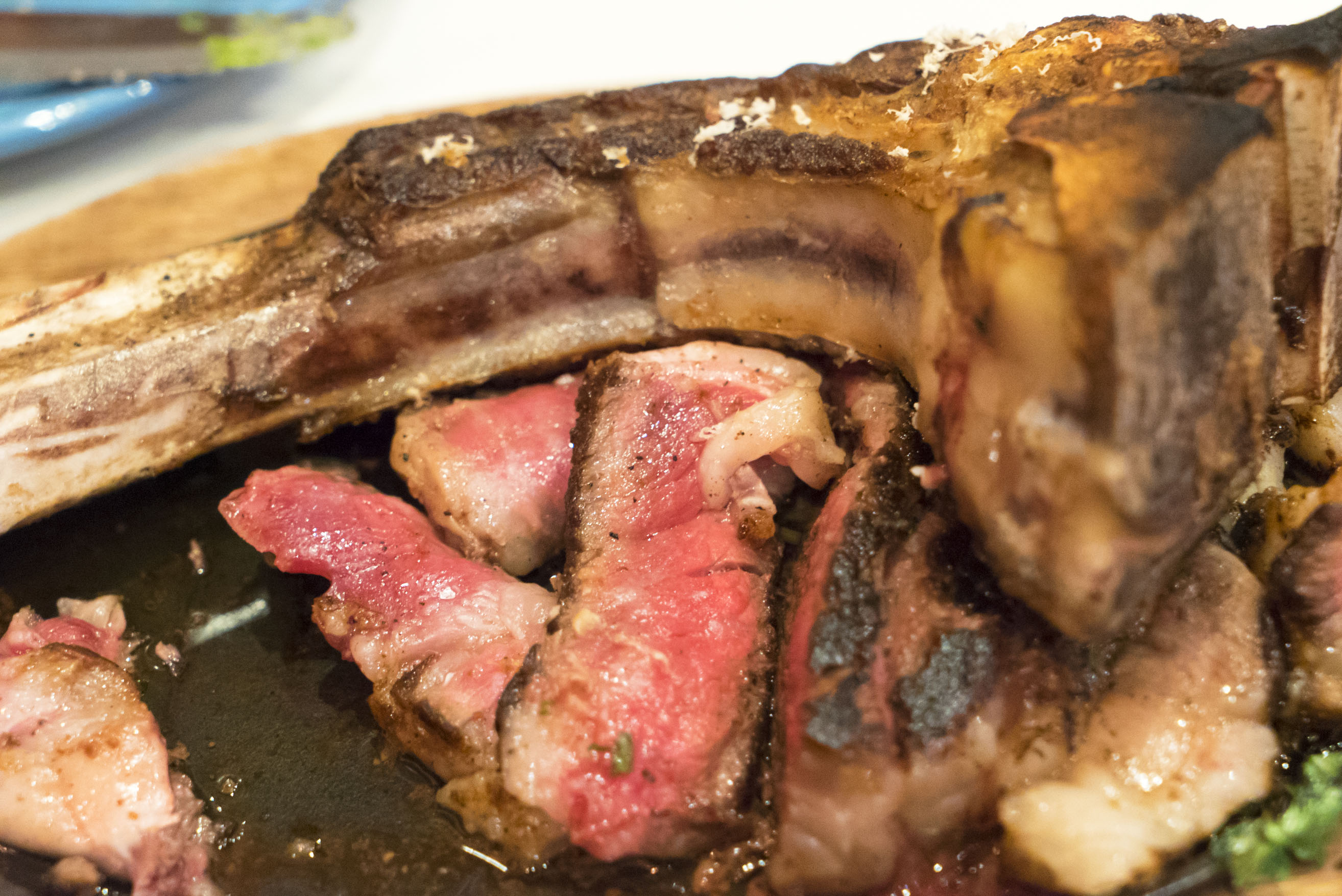
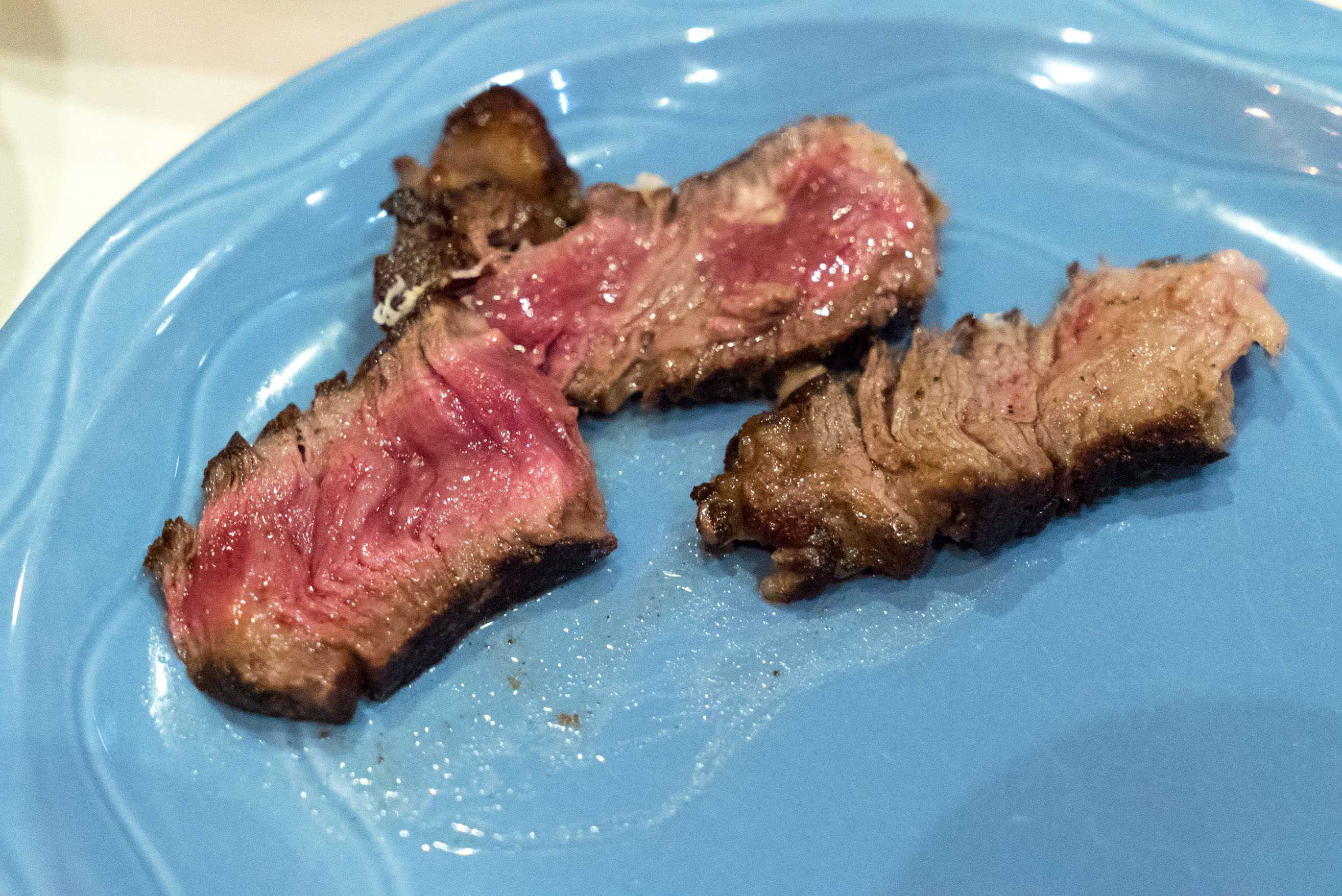
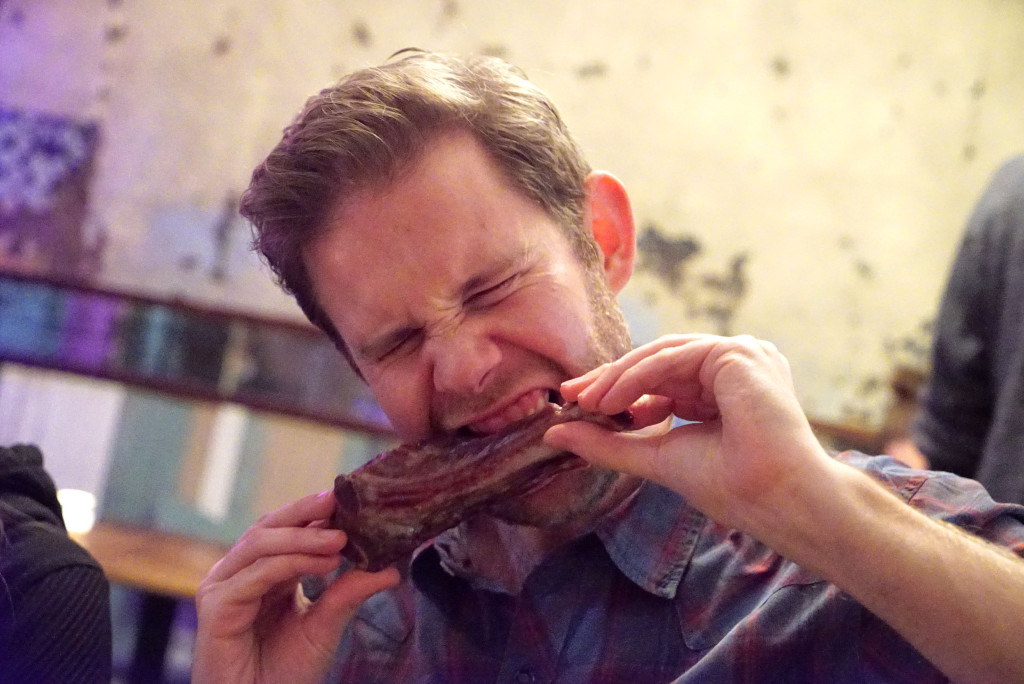
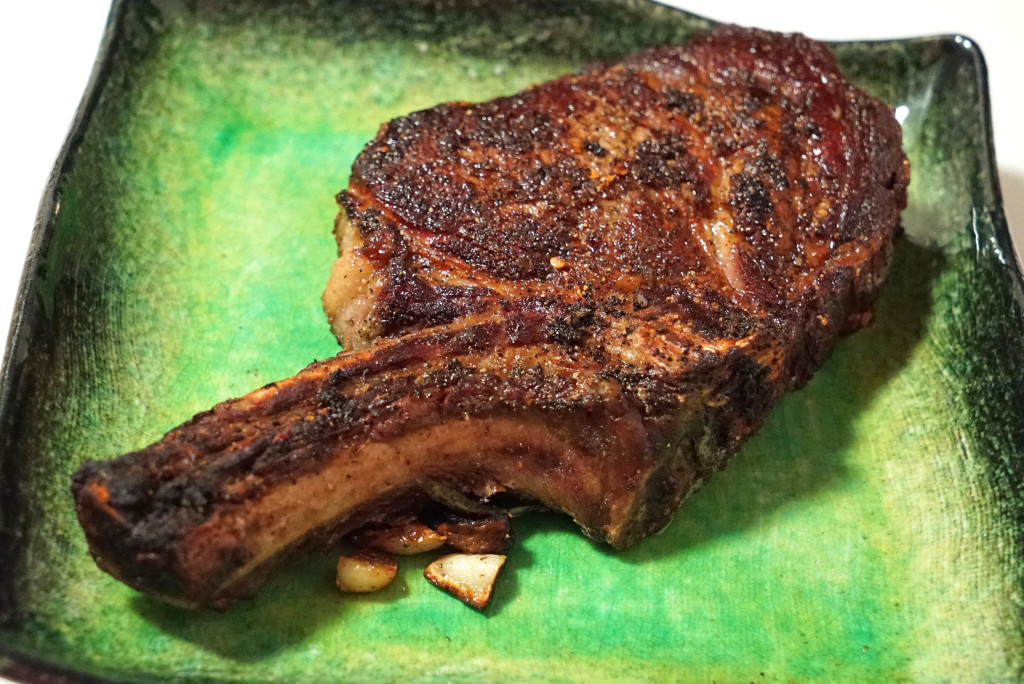
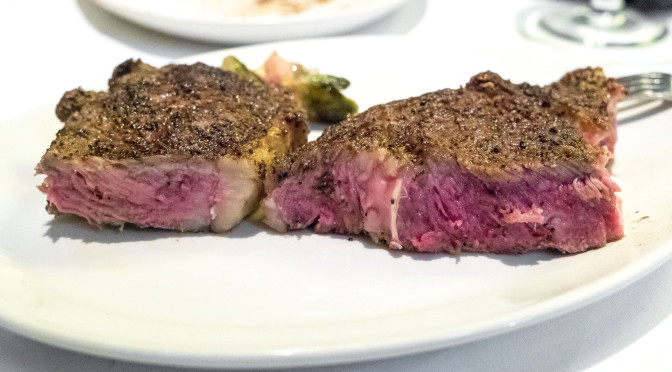
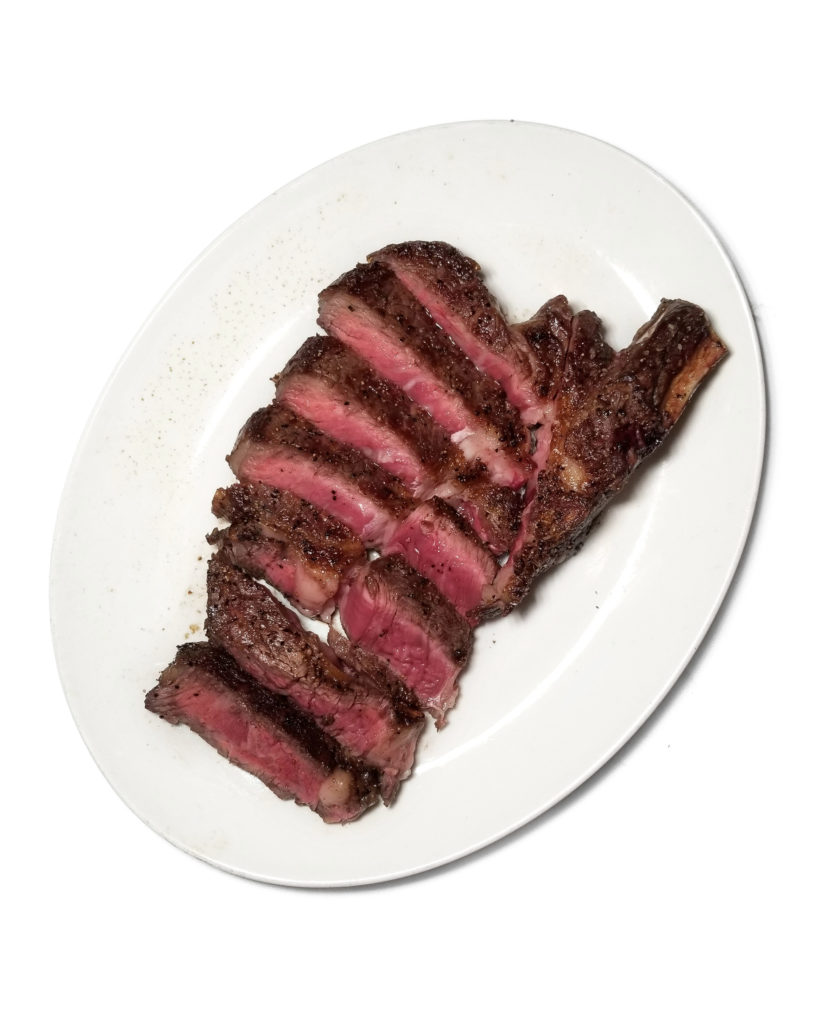
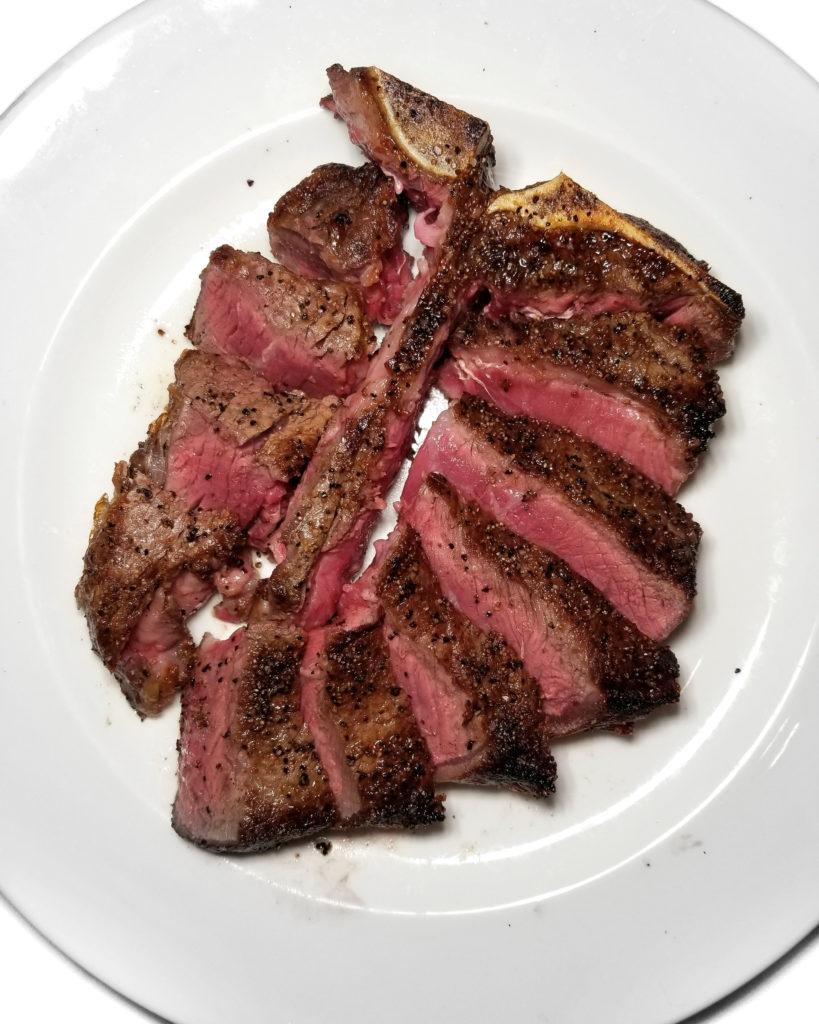
Both the cap and the eye were delicious and cooked perfectly to medium rare. Here’s a shot of the remaining hunk of bone:
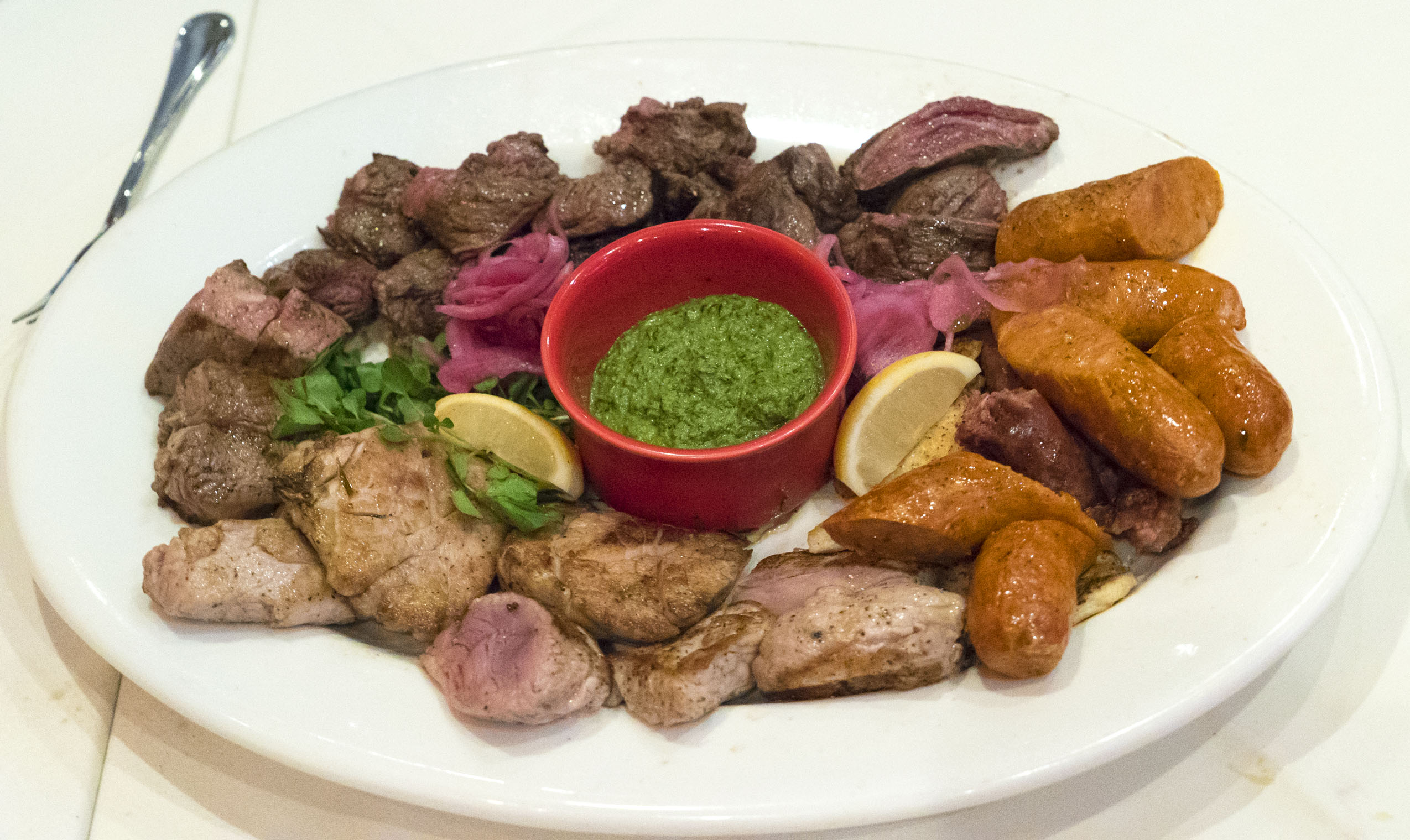
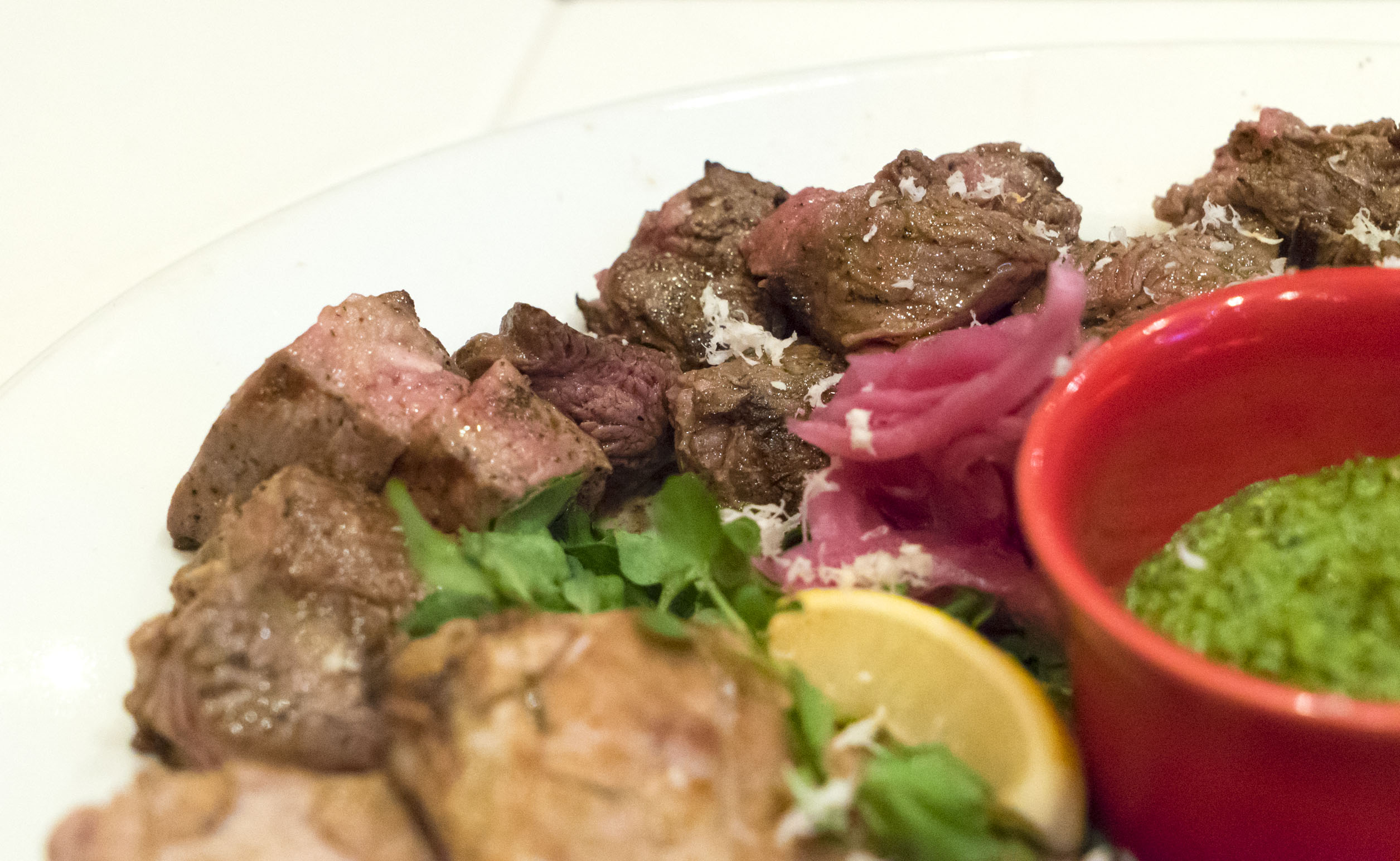
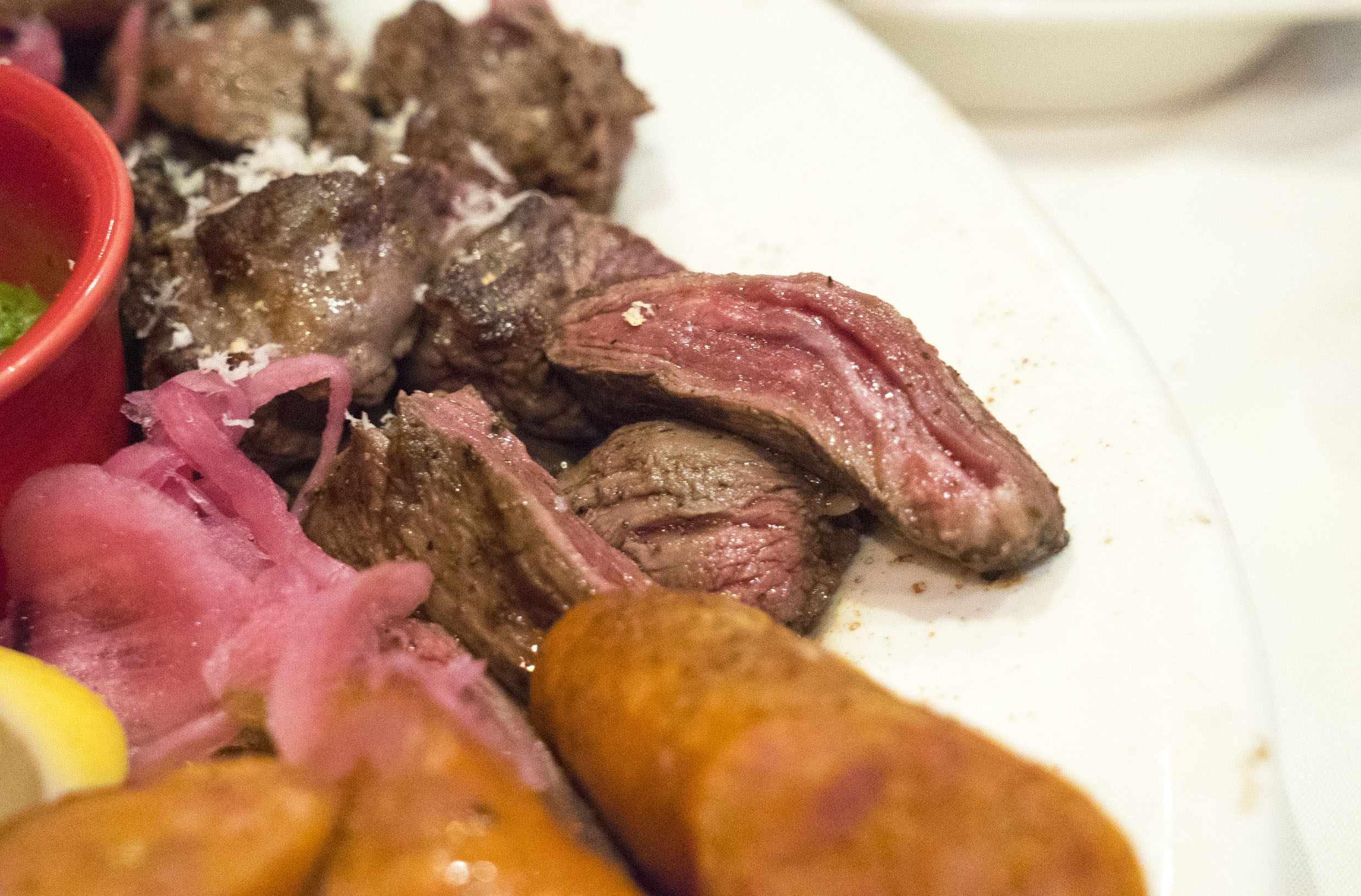
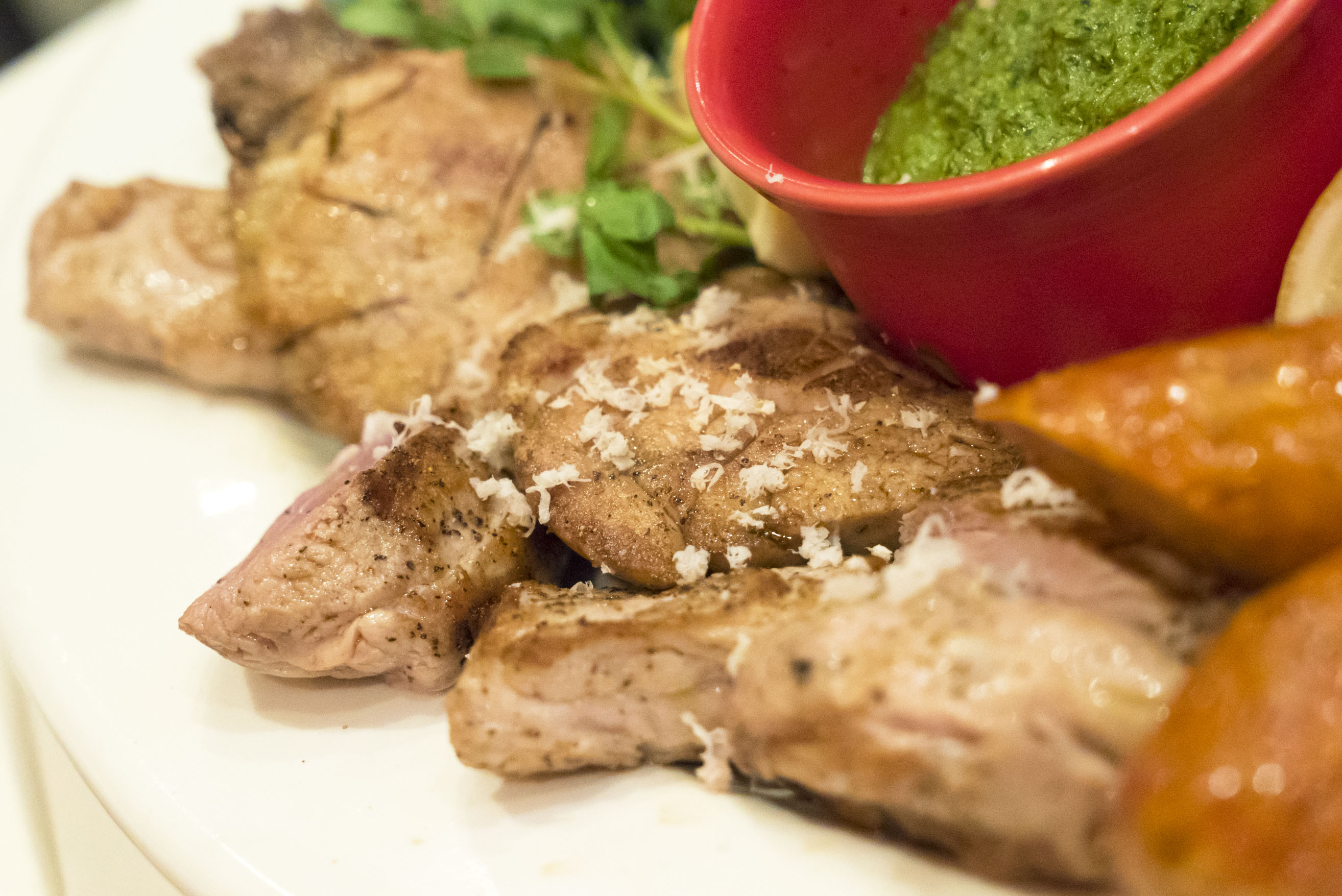
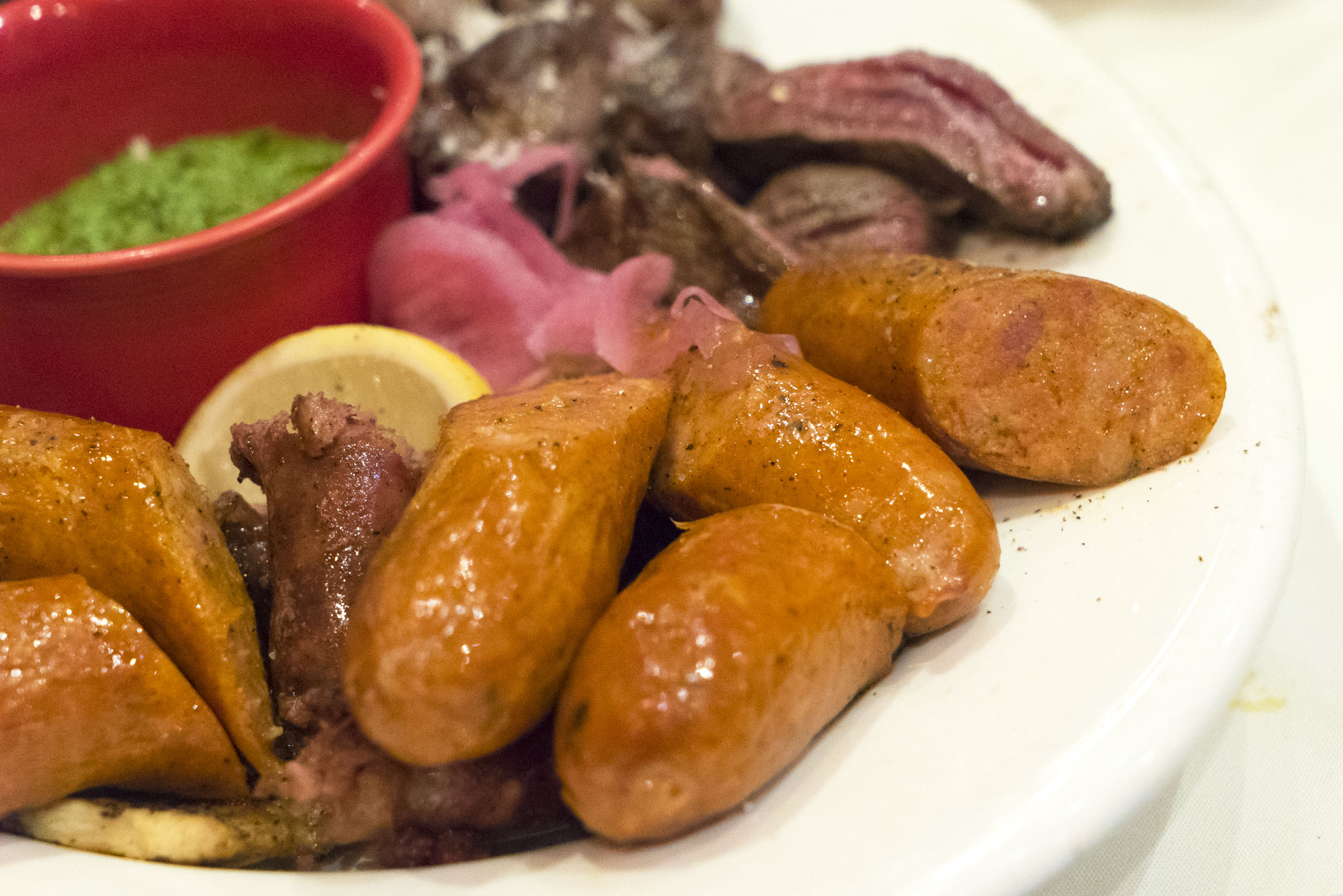
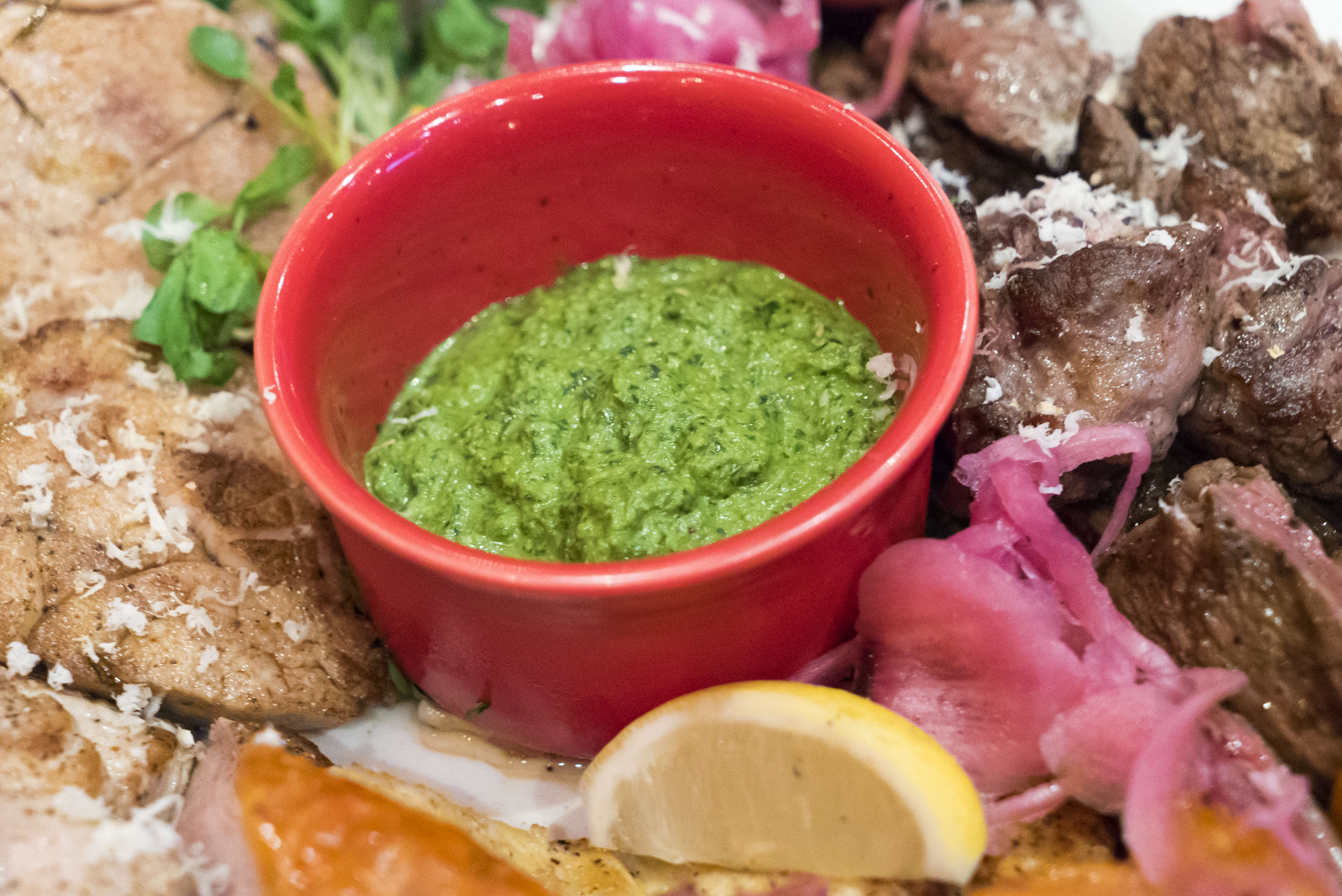
We also did a mixed grill item (parrillada mixta) for $59, which came with skirt steak, languica (sausage), sirloin, pork belly, pork tenderloin, chicken and blood sausage. For non-discriminating meat lovers, this is totally the way to go.
That green sauce is a cilantro based spread that specifically goes well with the pork and chicken.
Choice of Cuts & Quality Available: 10
This place regularly offers skirt, two strips (48oz bone in, and a 16oz), rib eye (22oz), two filets (8oz and 14oz), porterhouse for two, and a mixed grill for two. In addition, they also offer daily specials from the meat department. That’s a full blown 10. Plus all steaks are prime and grilled on an authentic plancha.
Portion Size & Plating: 10
Portions are large for the price. As you can see above, presentation is very nice as well. They’ve elevated the traditional steakhouse minimalist plating concept to something that pops.
Price: 10
Prices are really fair here, though slightly different in the restaurant than they are online (not by much). Most porterhouses for two are coming in at around $100 now, but here it is listed at $79. Also the massive 48oz sirloin steak for two is under $50, and the 22oz rib eye is listed at just $42. These are great deals if you’re on a budget but still want some good quality meat.
Bar: 9
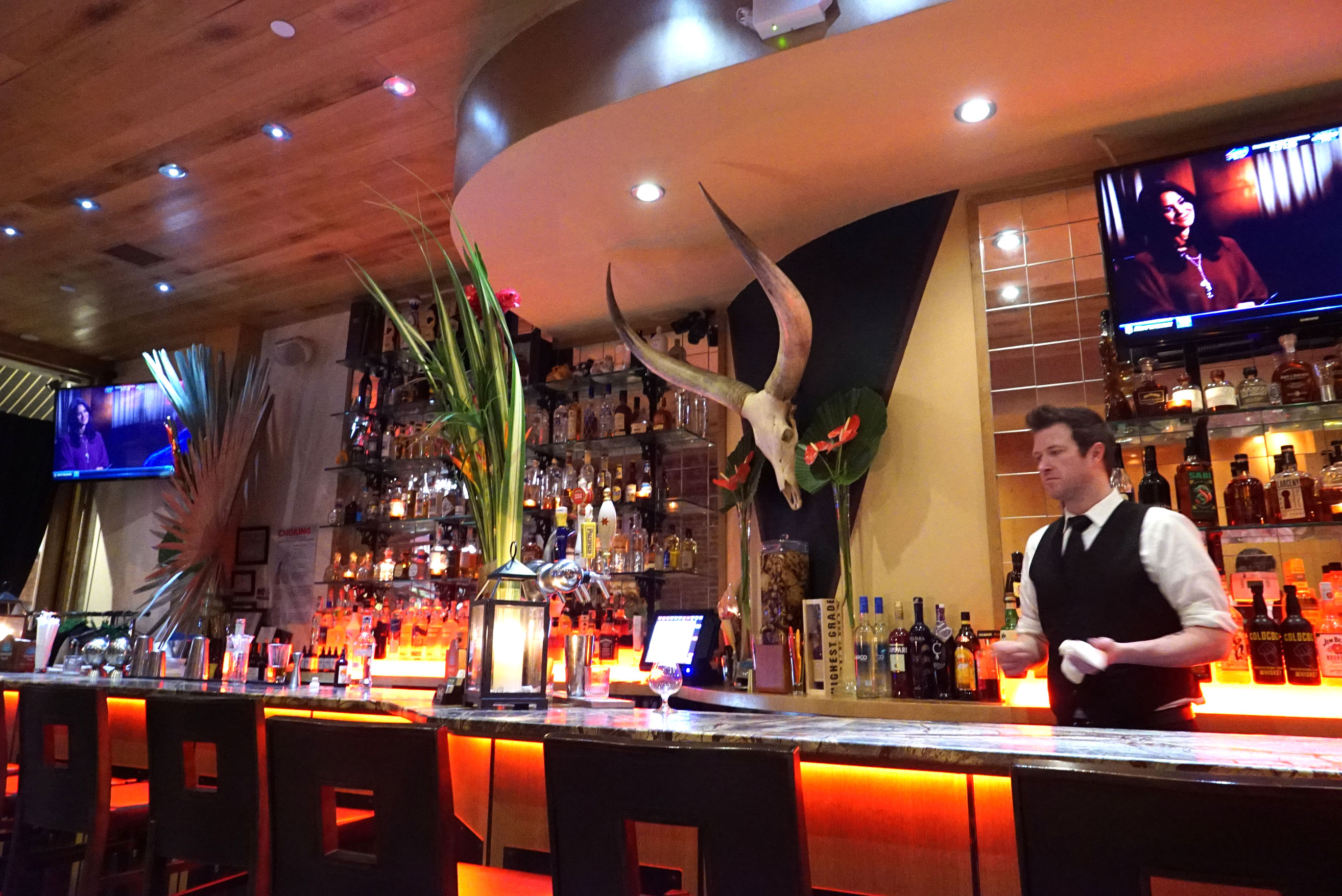
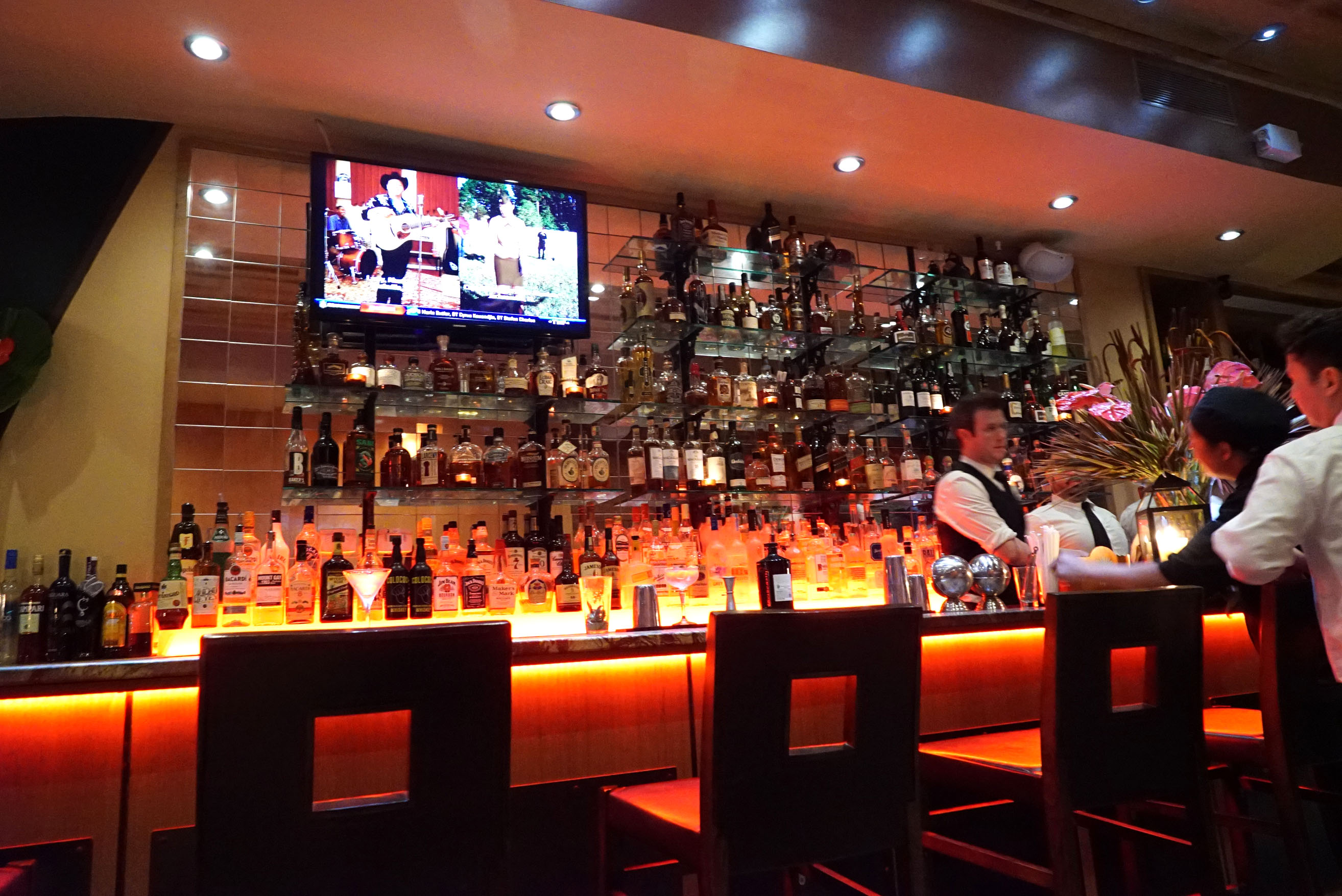
This bar is massive. It stretches almost the full length of the restaurant from front to back. While you do not have window seating, there is ample room and a beautiful decor to take in. Just take a look at that skull and horns center piece!
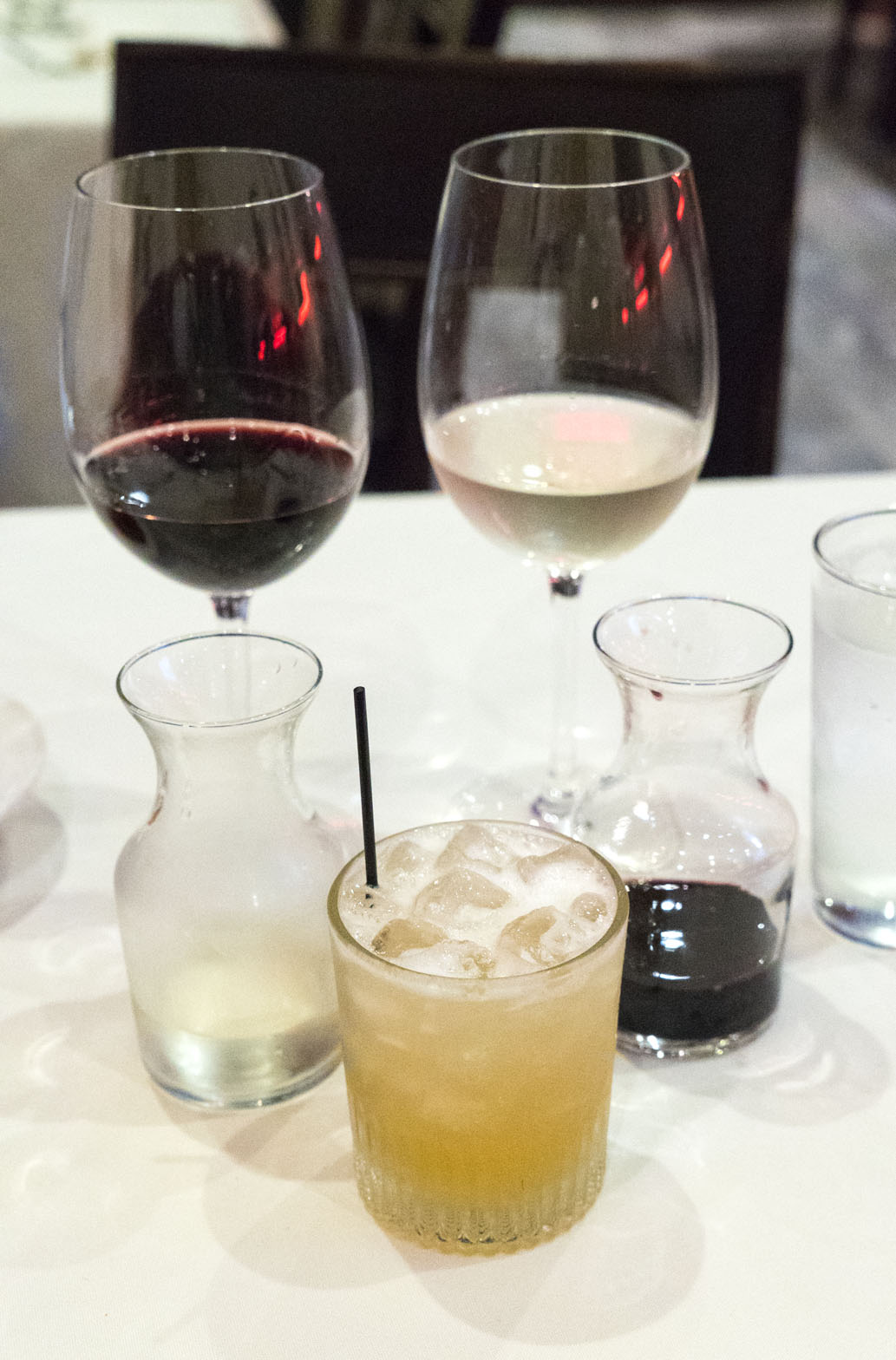
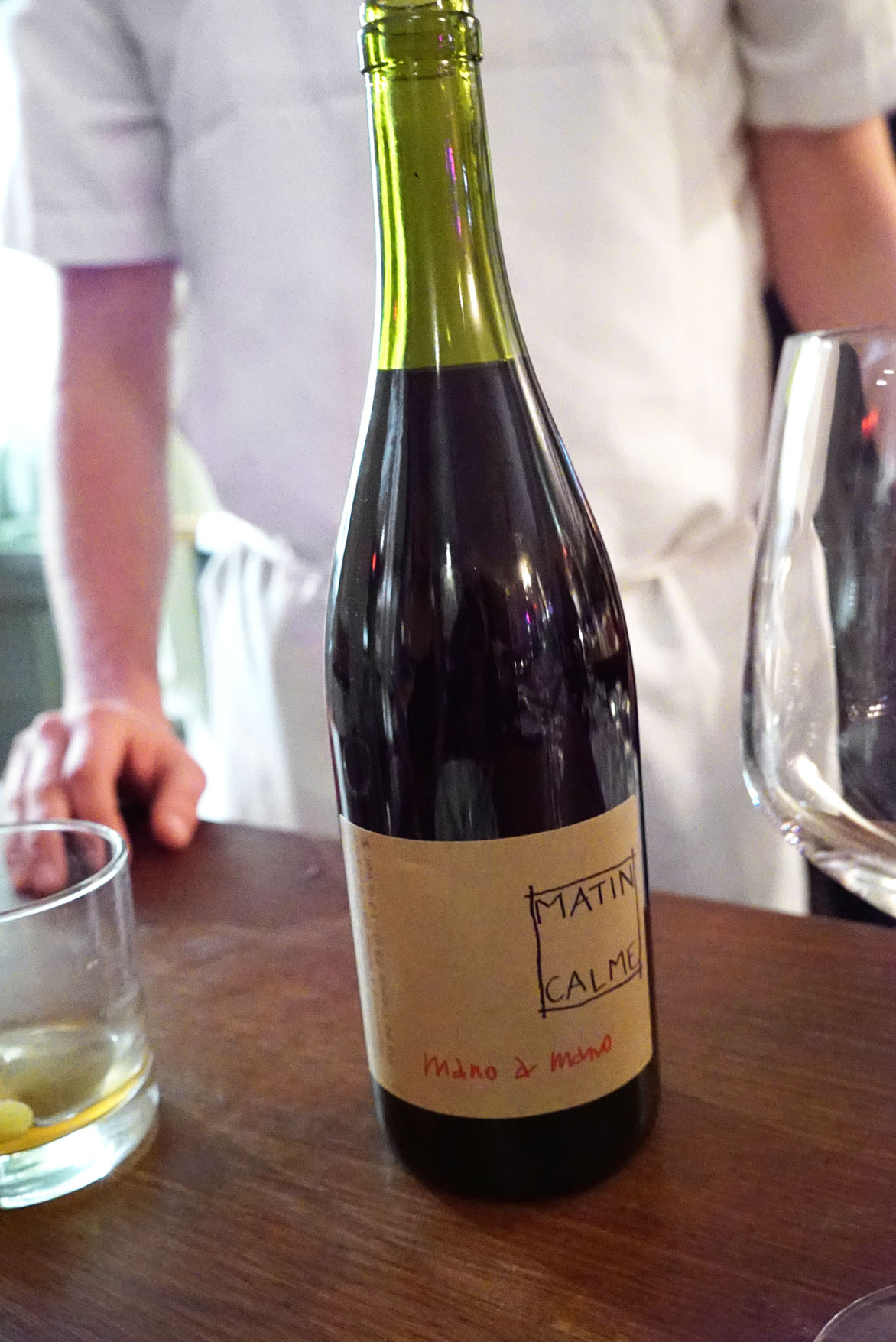
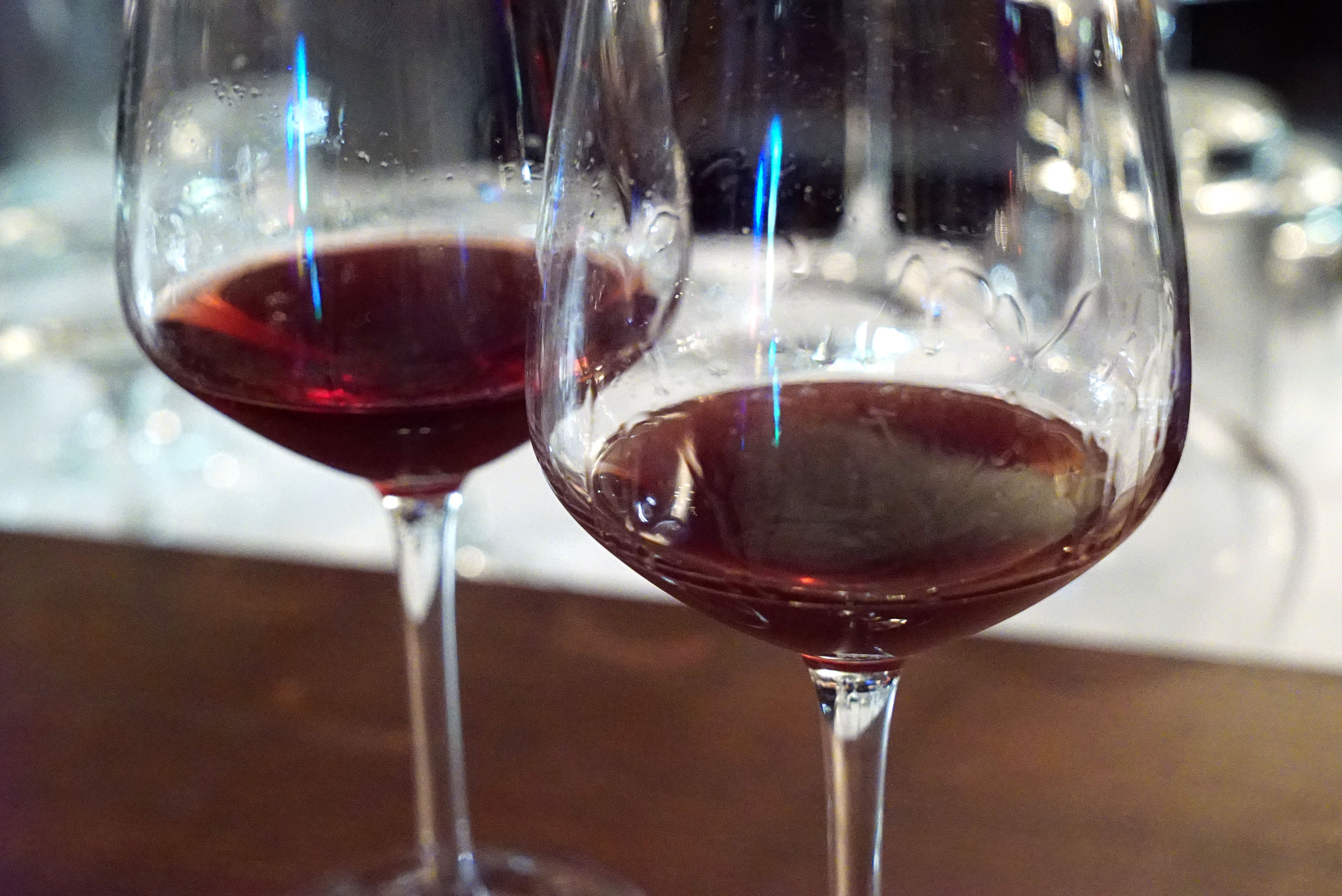
There’s a great selection of Argentinian wines and some really nice cocktails as well.
Specials and Other Meats: 9
There’s a 20oz double cut pork chop, Peruvian roasted chicken, and a mixed grill for two that comes with a host of tasty shit. As mentioned above, we ordered the special tomahawk chop that was offered. Amazing meat-centric place! Just missing lamb and veal.
Apps, Sides & Desserts: 8
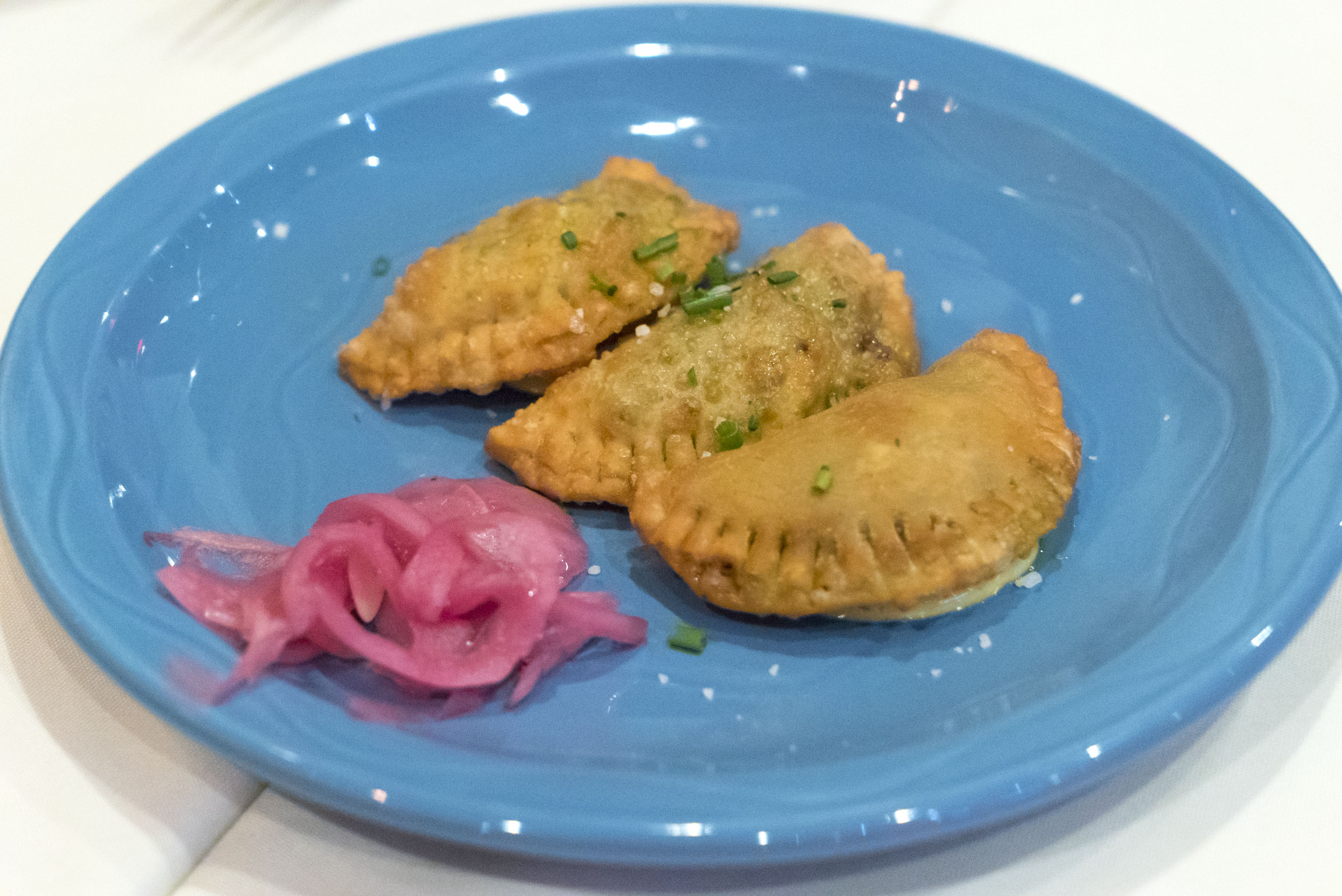
We started with some empanadas, which were filled with prime beef, raisins, cilantro and aji amarillo aioli. These were perfectly crisp on the outside and juicy on the inside. Not too hot where you burn your mouth, and the flavors were really well balanced when eating with some of the pickled red onion.
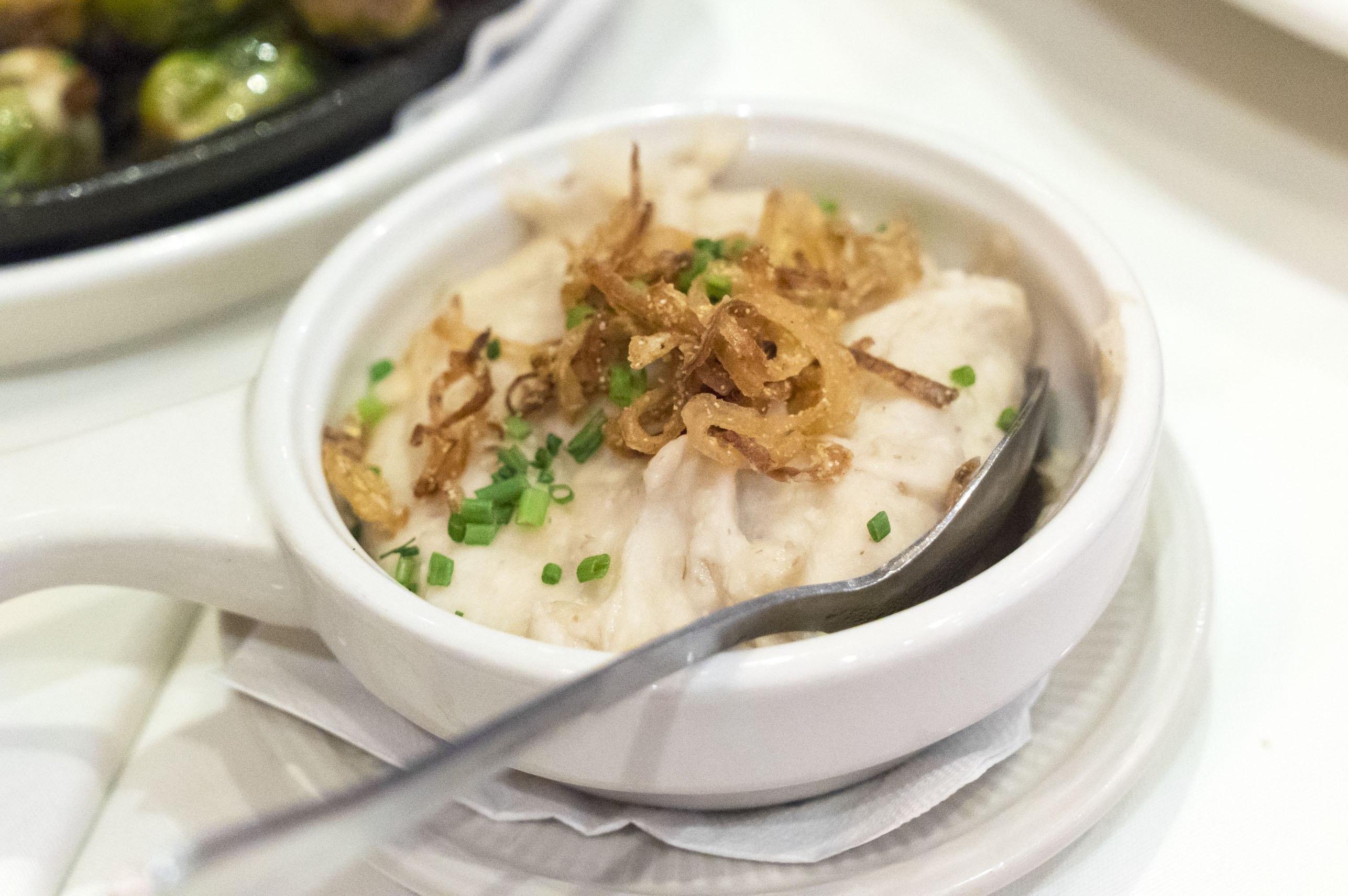
On the side we had the cauliflower mashed potatoes, which were creamy and flavorful. You’d never know you were eating a healthier version of the standard mashed potato dish.
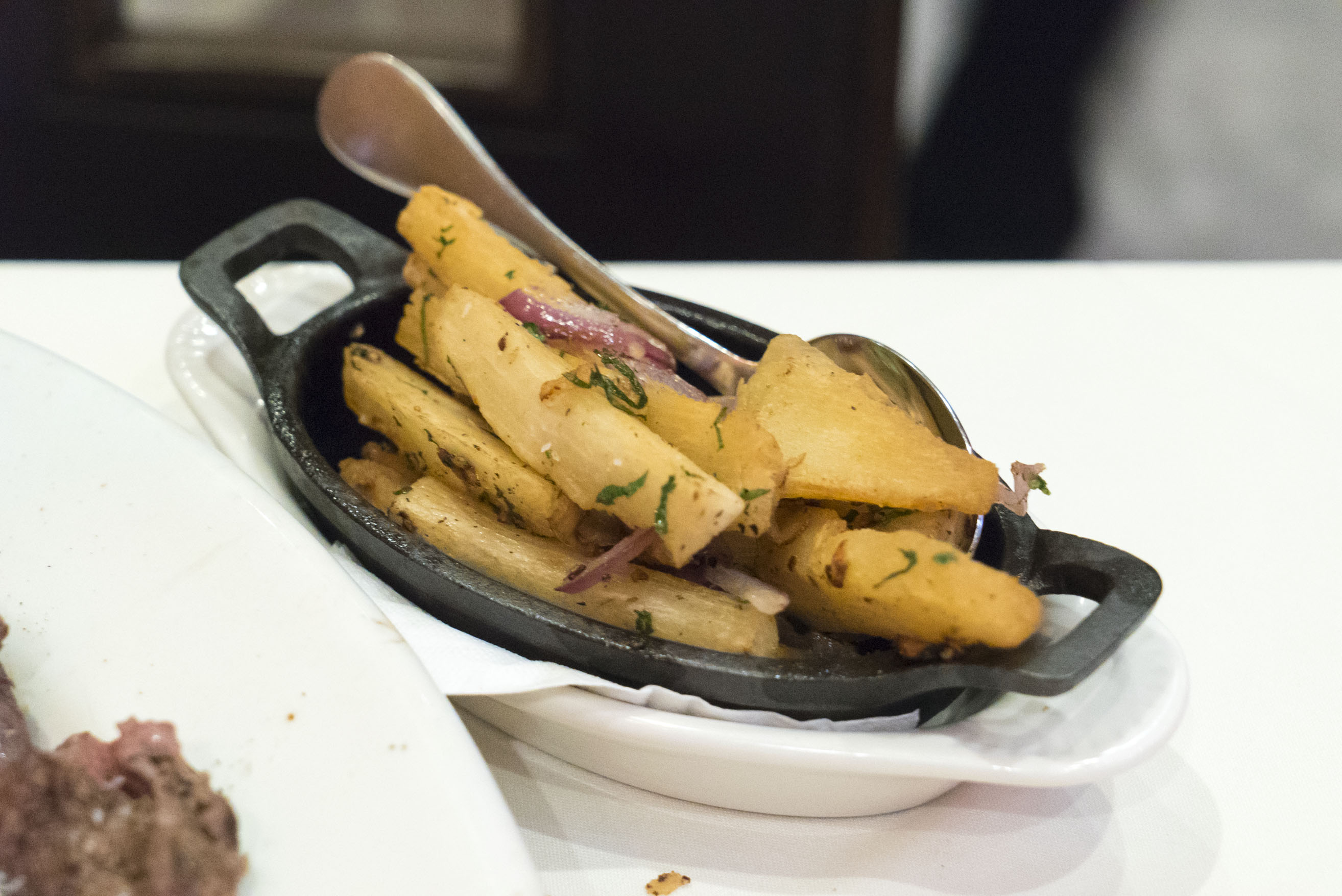
We also tried the sauteed yucca. These were a little dry and under-seasoned, but the crunchy texture was great.
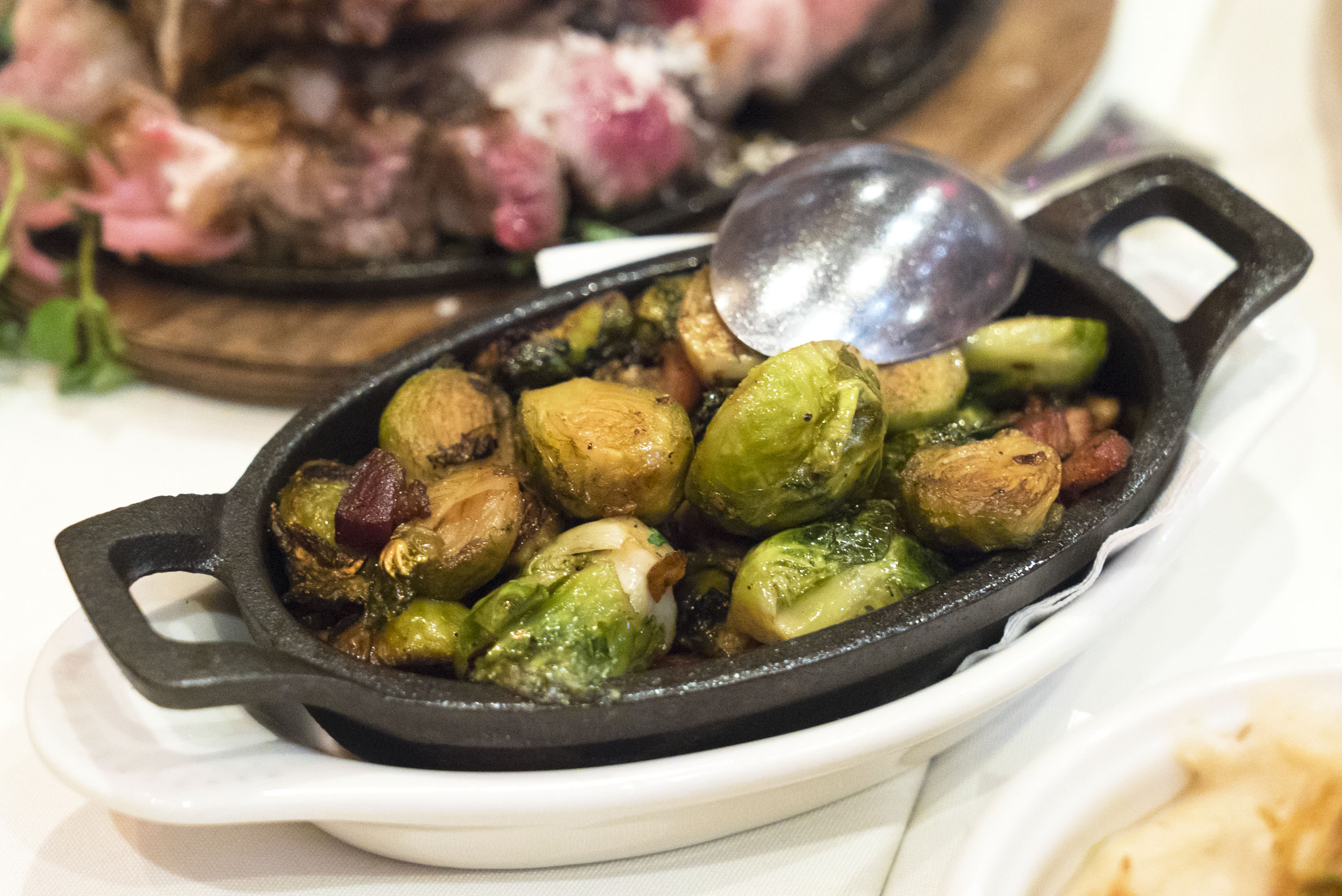
The brussels with bacon were perfect. Great char, good flavor. This is the ideal side for a meat eating extravaganza, because it comes with additional meat in the form of thick bacon. We actually didn’t order this: it was complimentary – nice surprise!
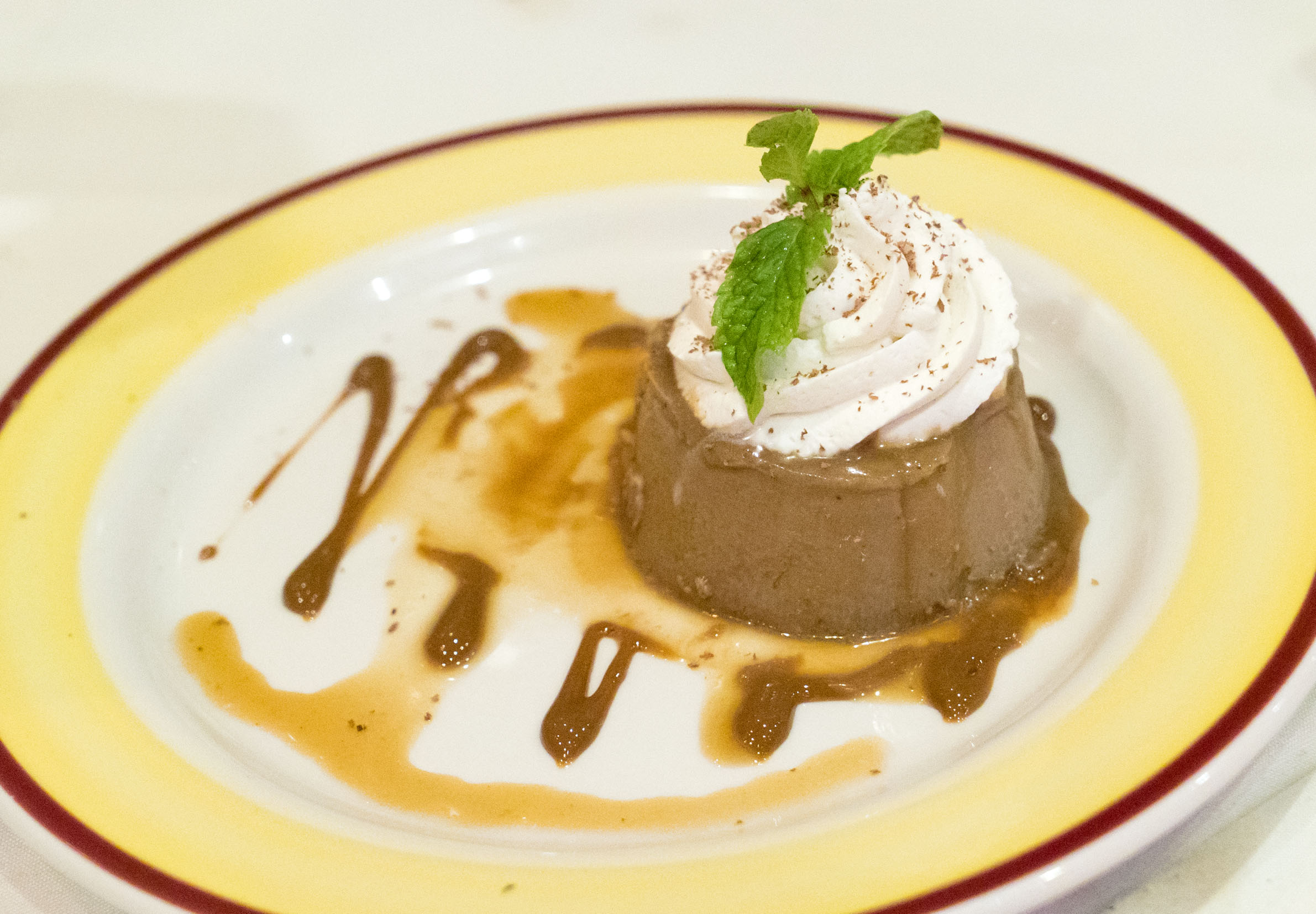
Since we were busting-at-the-seams full, we all shared a dessert. Espresso flan. This had a nice even and smooth texture, with a very nice, not-too-sweet coffee flavor.
Seafood Selection: 8
There’s cod, corvina and seabass in entree form, in addition to the apps of ceviche, grilled octo, calamari, mussels, shrimp and oysters. Really great showing! When I come back for the giant bone-in sirloin, I will be definitely giving the ceviche and octopus a try. Until then, I have to score this with a placeholder of eight. I’m sure it will be a higher score once I sink my teeth in to actually try the seafood.
Service: 10
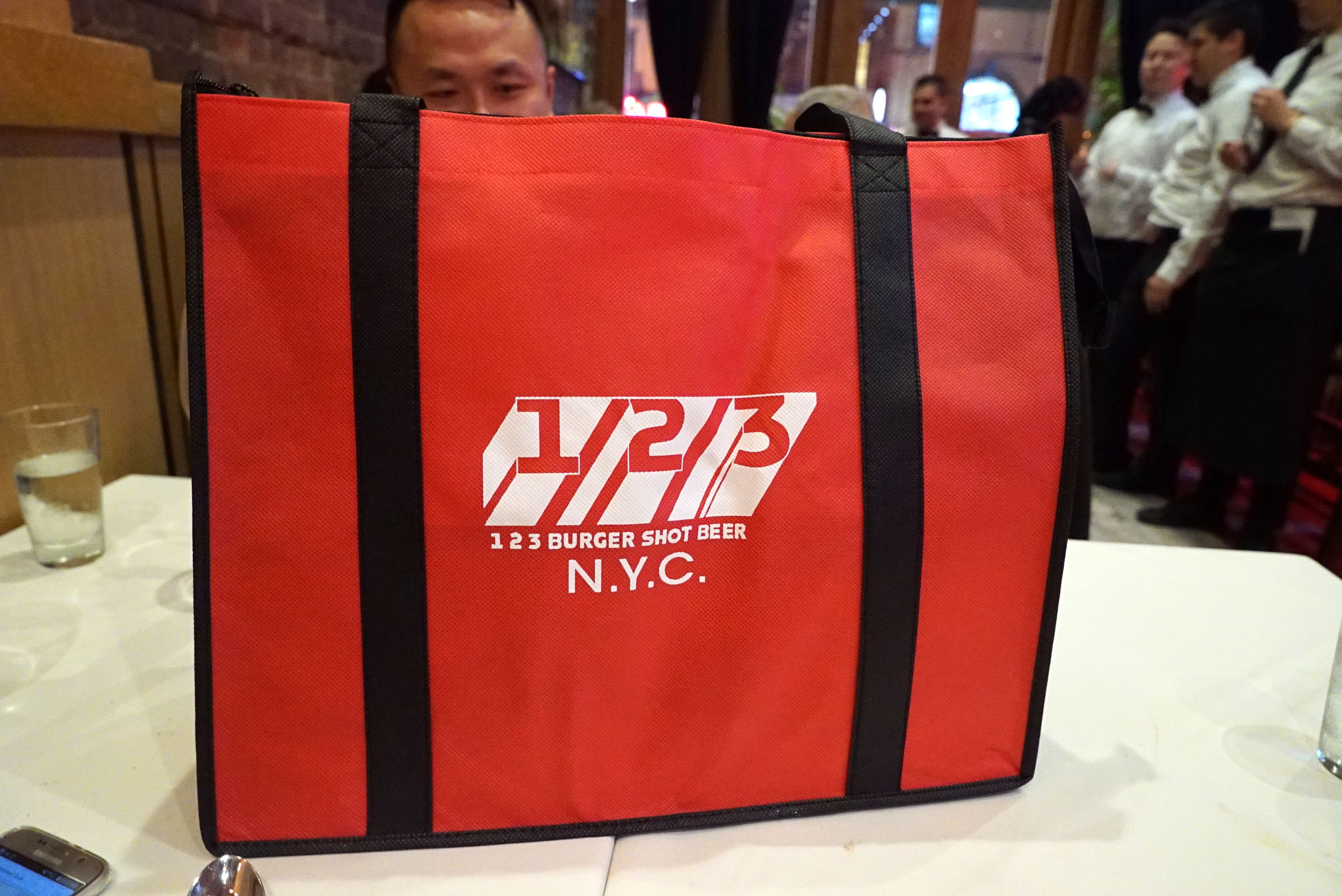
Owner Tommy and waitress Maria were both fantastic. In fact all of the staff was warm and helpful. Maria offered great menu suggestions, and really knew her shit. It was interesting to learn from Tommy that his brother is the chef, and that they also own 1 2 3 Burger Shot Beer, just nearby, as well as a spot downtown. Our “doggie bag” was from there:
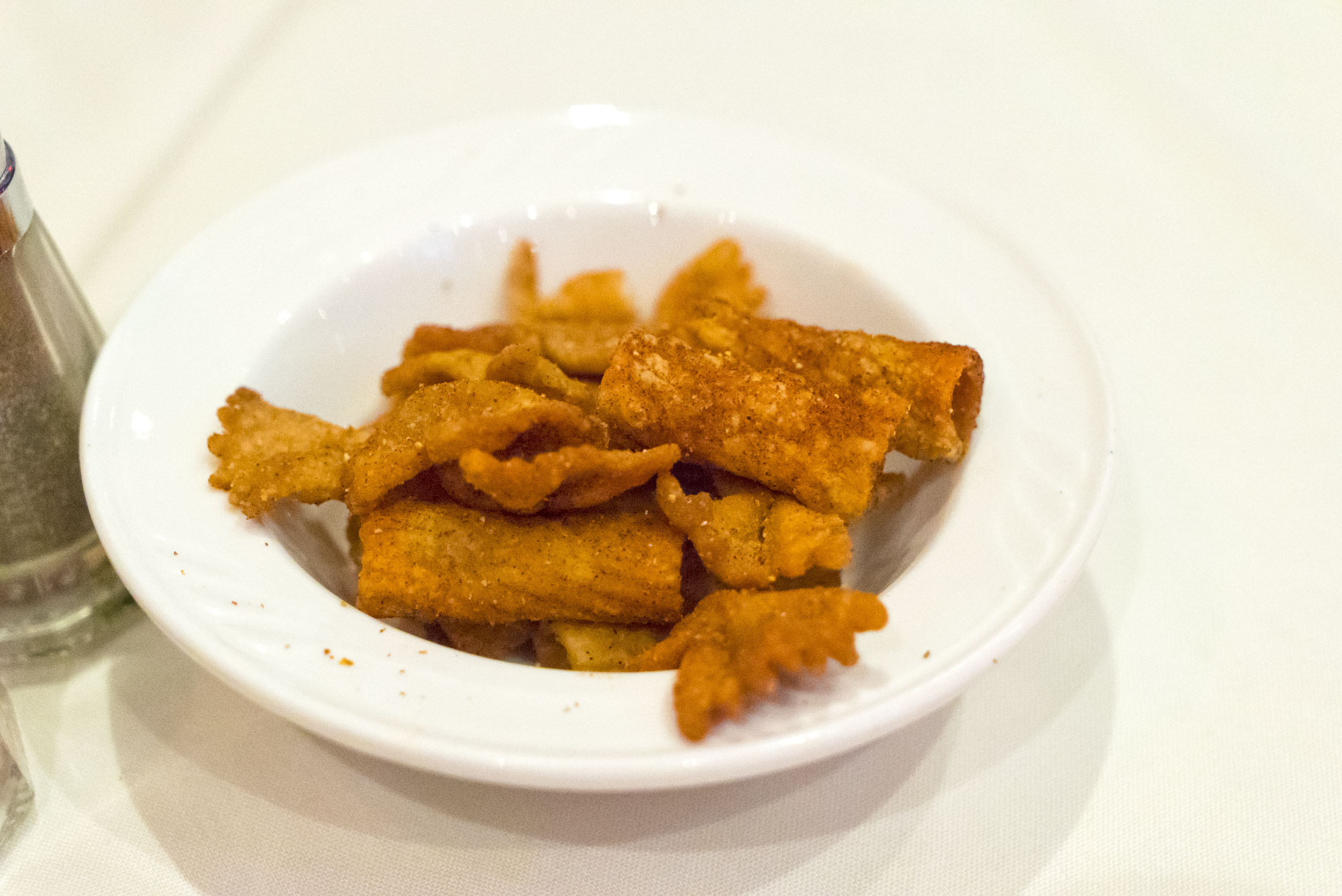
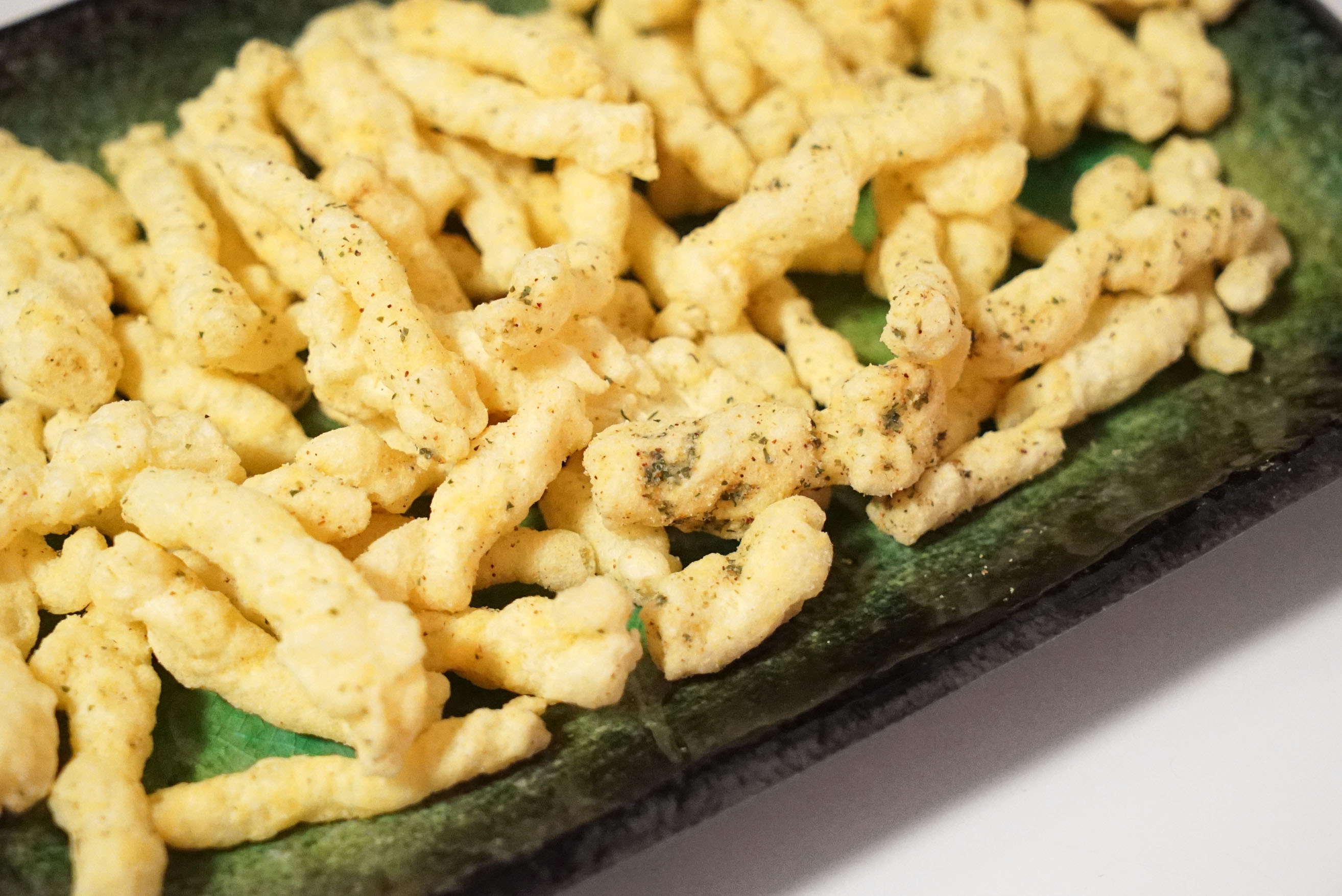
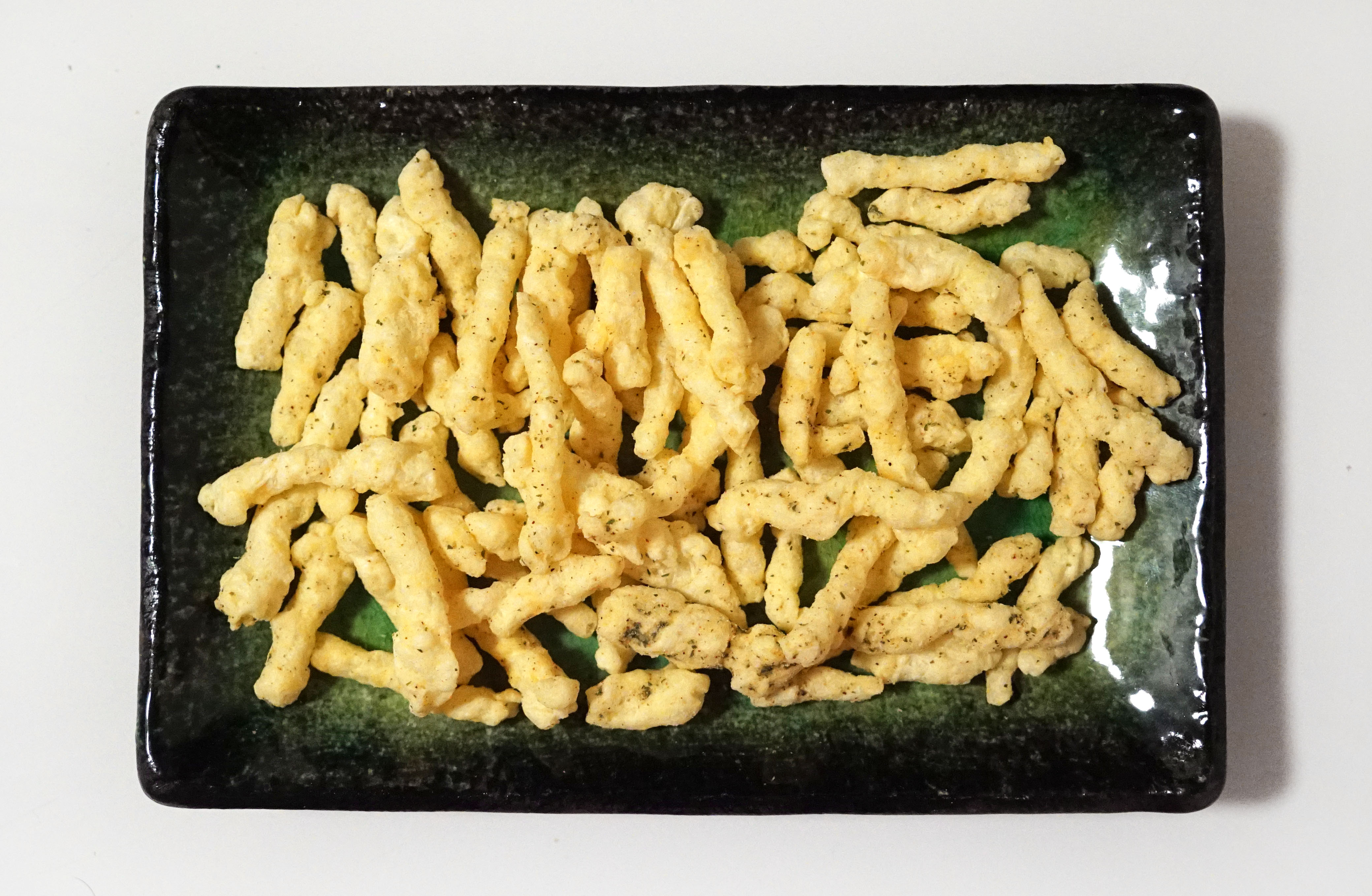
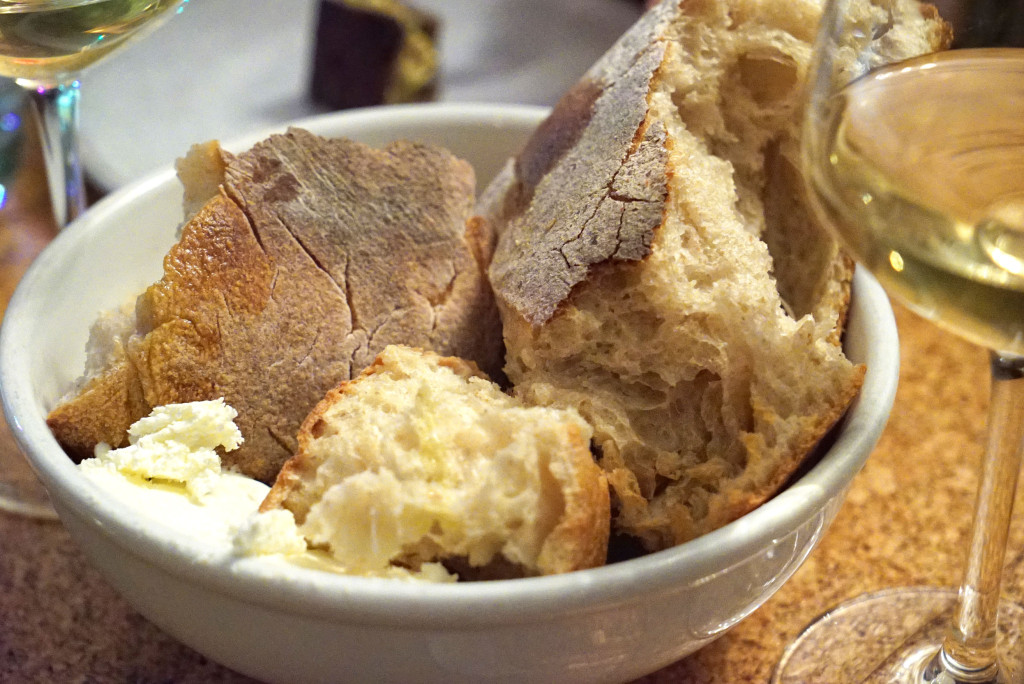
I may as well mention it here: the table bread here is actually fried, flavored pasta! Really crunchy and good.
Ambiance: 9
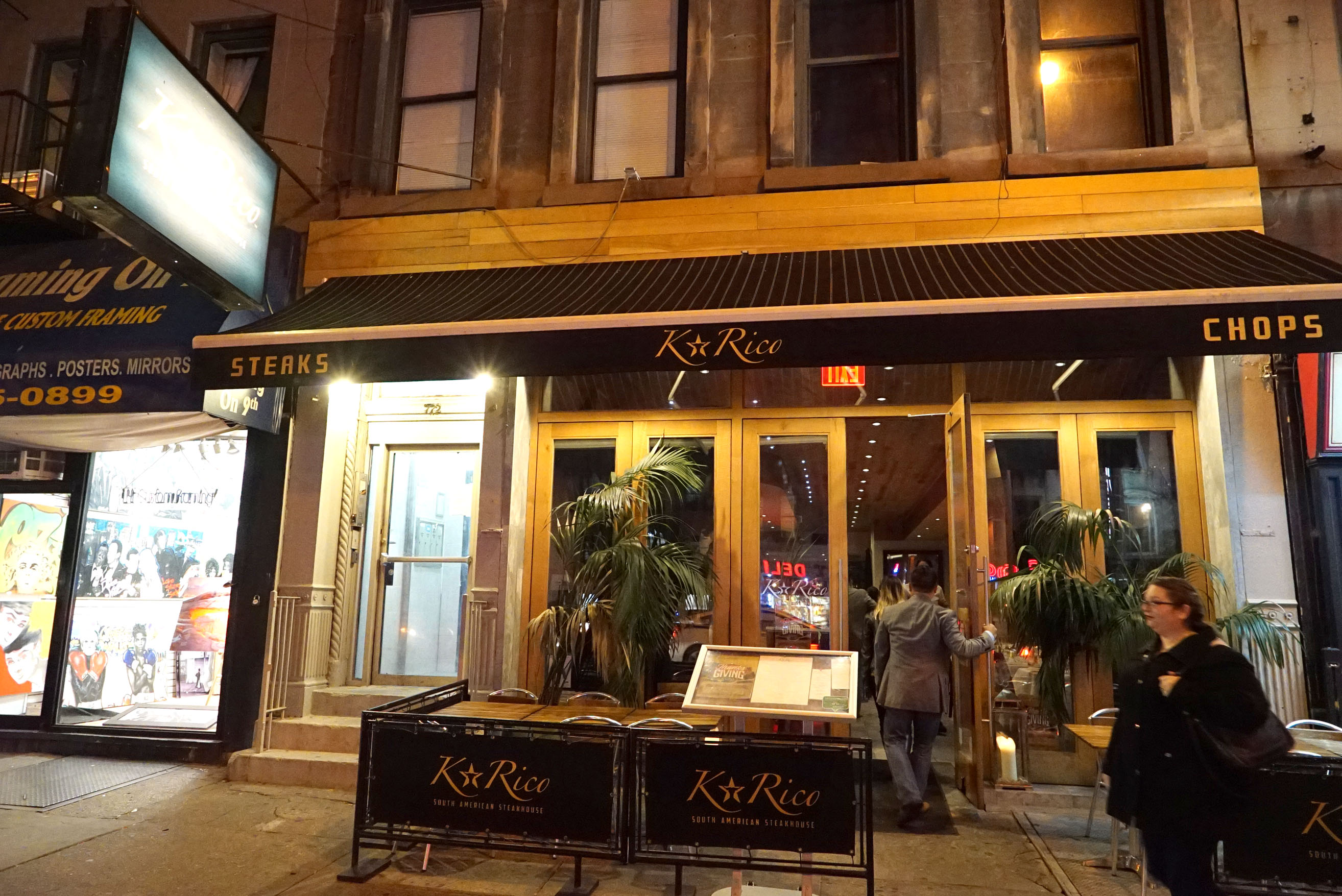
They’ve really made the best out of this typically narrow, storefront/brownstone location on 9th Avenue. They’ve done such a great job that this place easily contends with some of the gigantic, fancy steakhouses in midtown. The decor here is really classy and elegant. It’s Latin American/South American, but it’s not hitting you over the head with that fact. It’s subtle. The smaller size of this joint allows you to enjoy a more intimate or low key experience. However it’s great for dates as well as large groups, because once you get beyond the bar, the restaurant opens up to a wider dining space. Since the kitchen is a massive expanse down at the basement level, K*Rico takes full advantage of every square foot of space on the main dining floor. Very smart use of space.
In addition to its jerky products, Trader Joe’s makes some great and wallet-friendly snacks. I’ve chosen to highlight three of them here in one review.
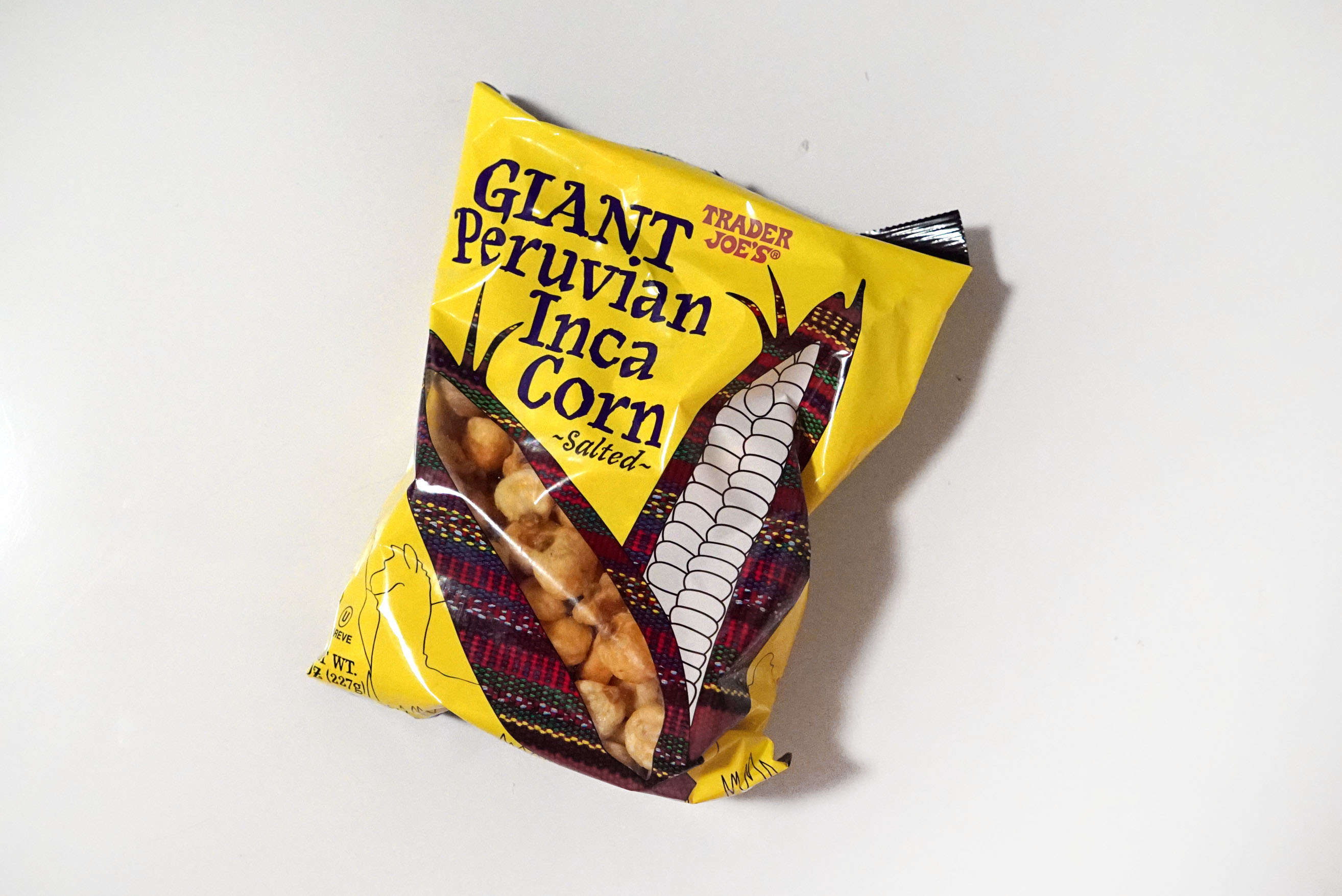
First is the Giant Peruvian Inca Corn.
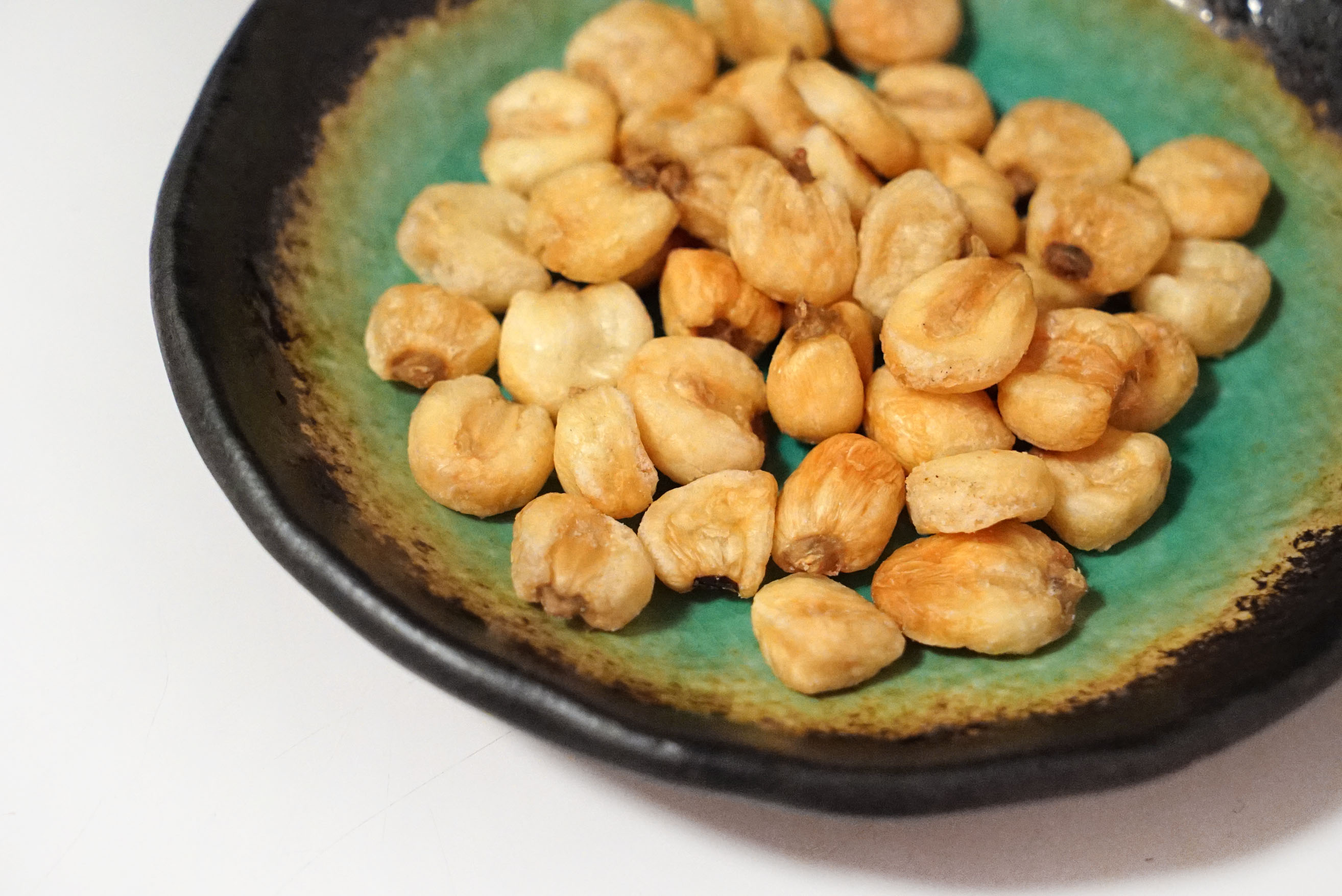
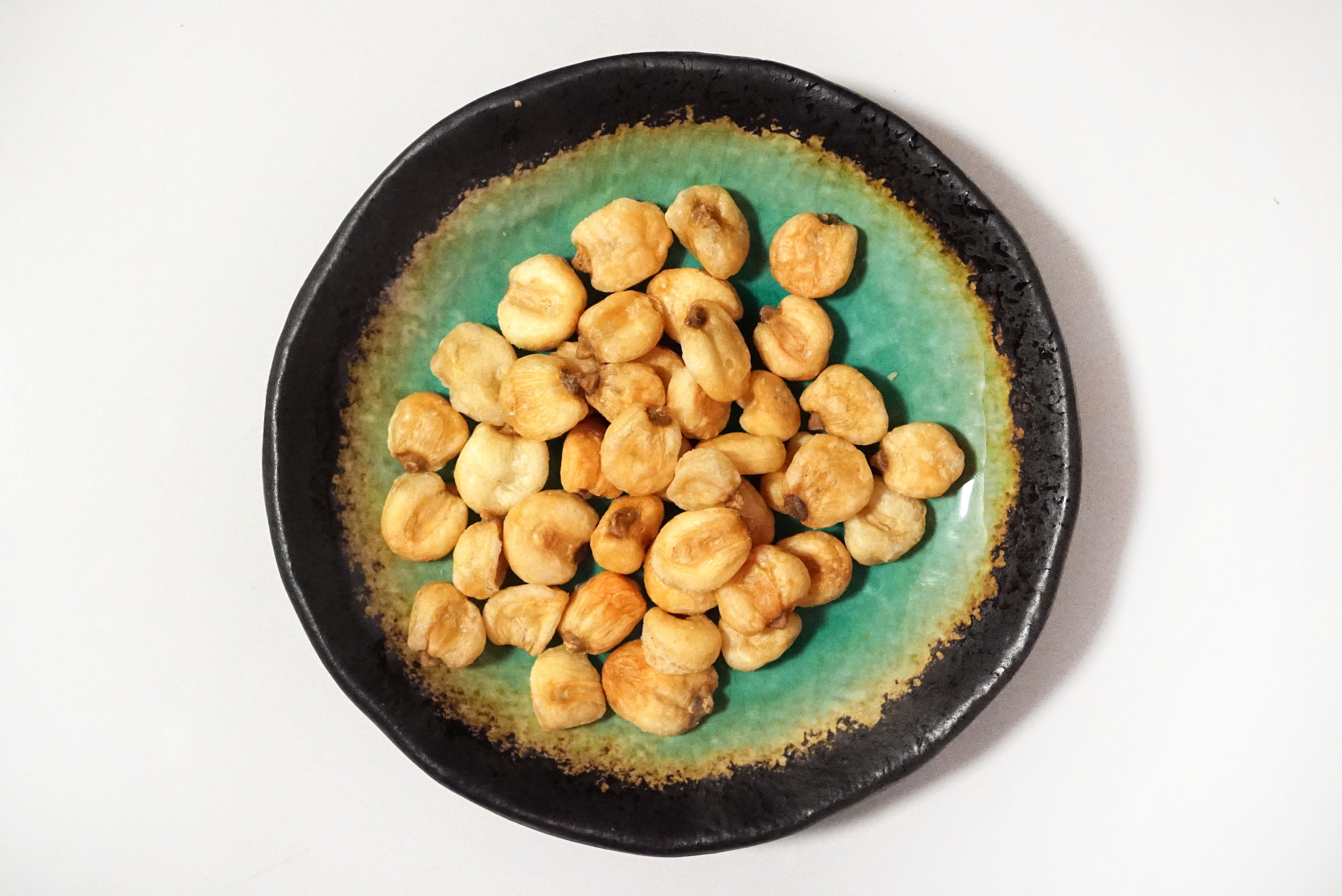
These are under $2 a bag, and are essentially giant corn nuts that are lightly salted.
They’re light, and fulfilling. Very easy to just keep popping one after another, all night long.
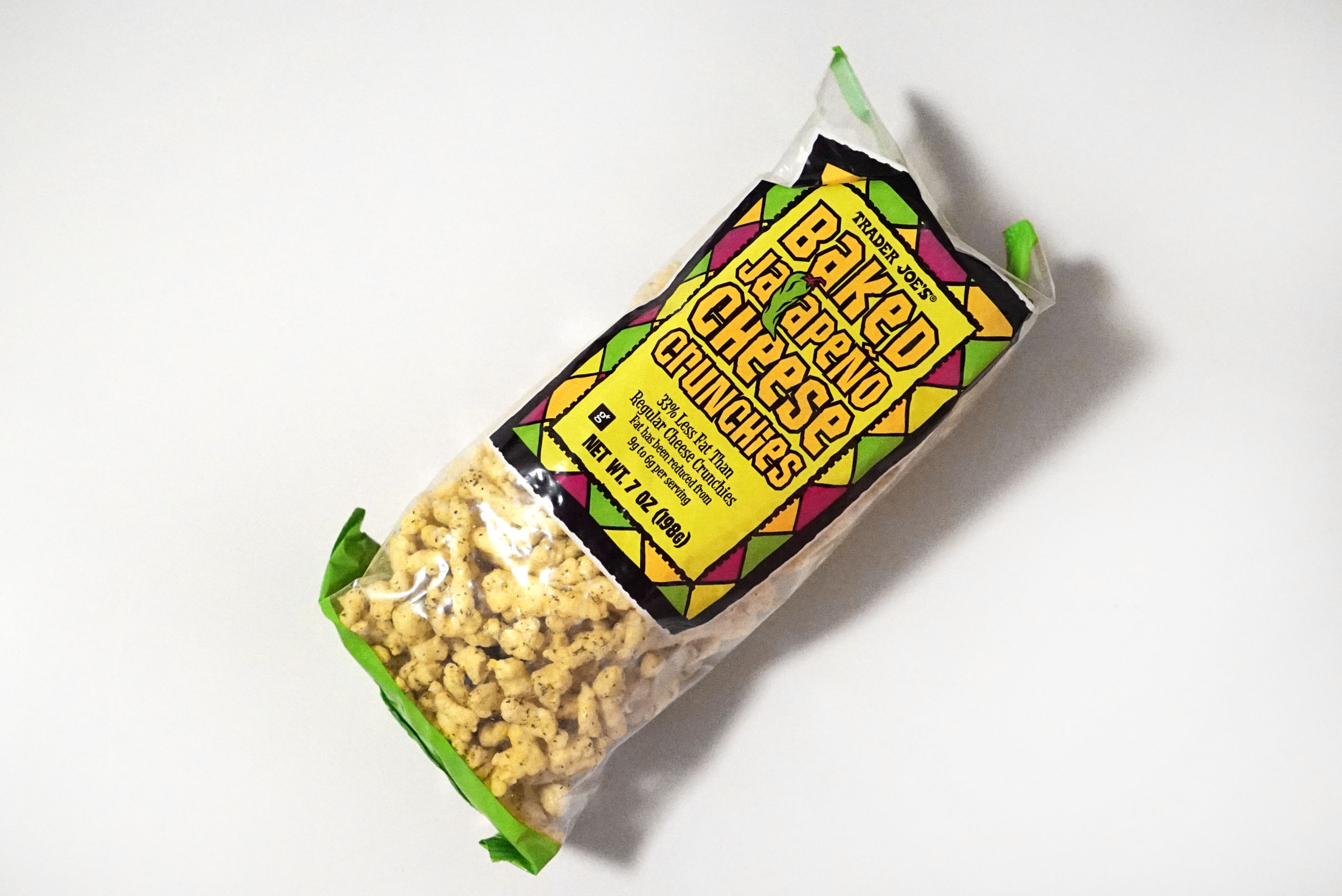
Next is the Baked Jalapeño Cheese Crunchies.
These come regular style too, orange colored, but the jalapeño gives it a mildly spicy kick that’s just a bit nicer overall. These are also under $2 per bag.
The flavor is light, not overly cheesy. There’s utterly no grease, since these are baked instead of fried. Great snack.
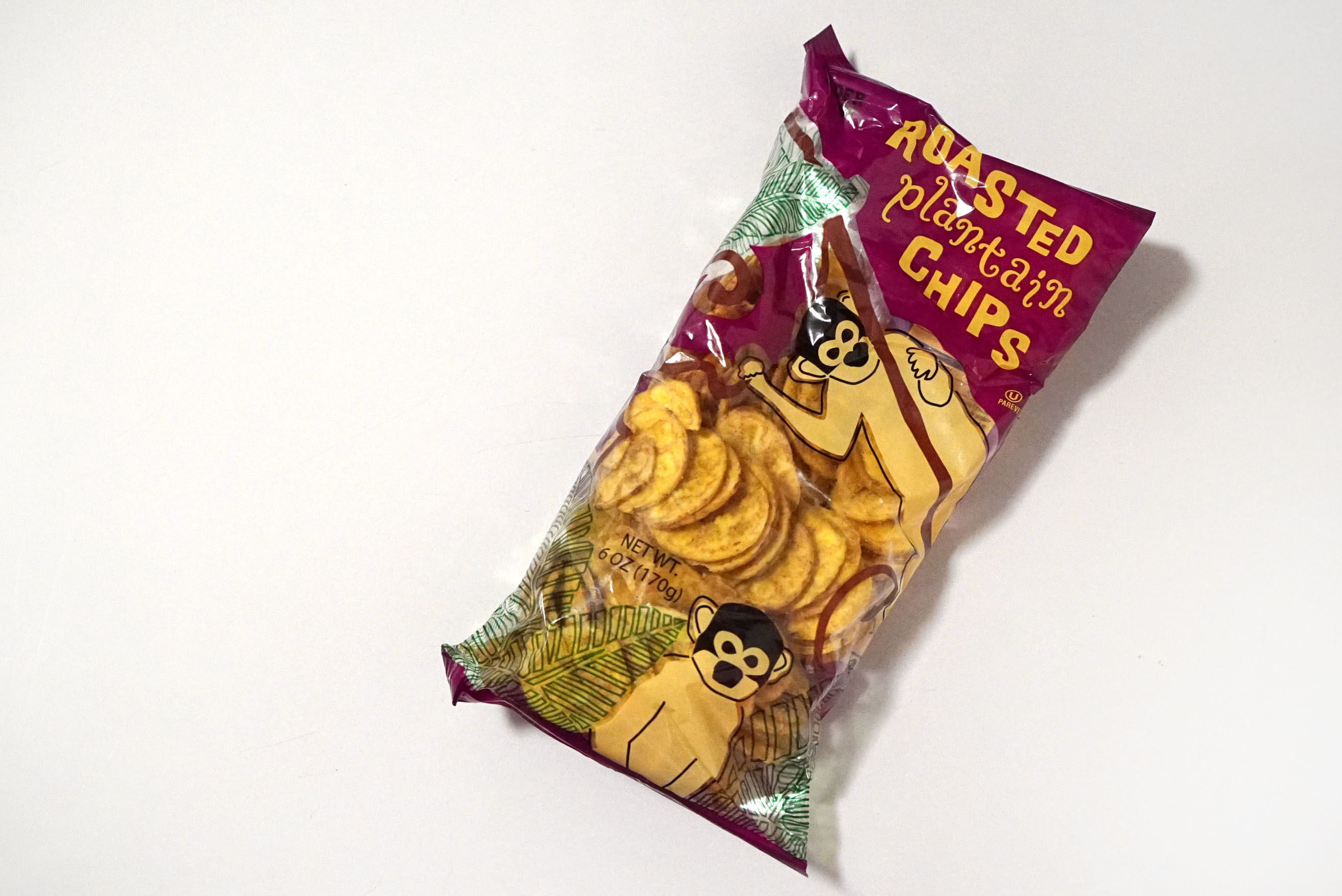
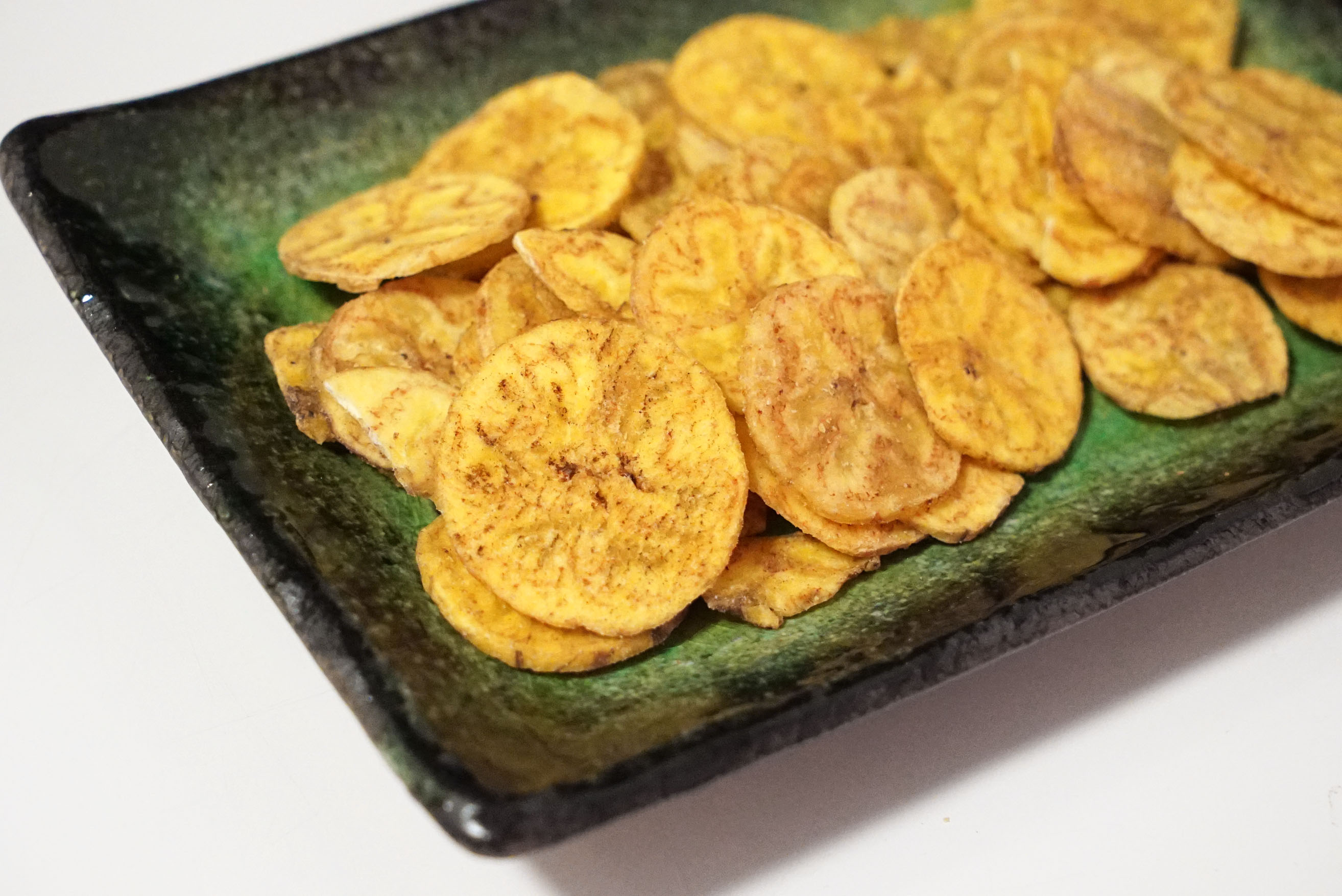
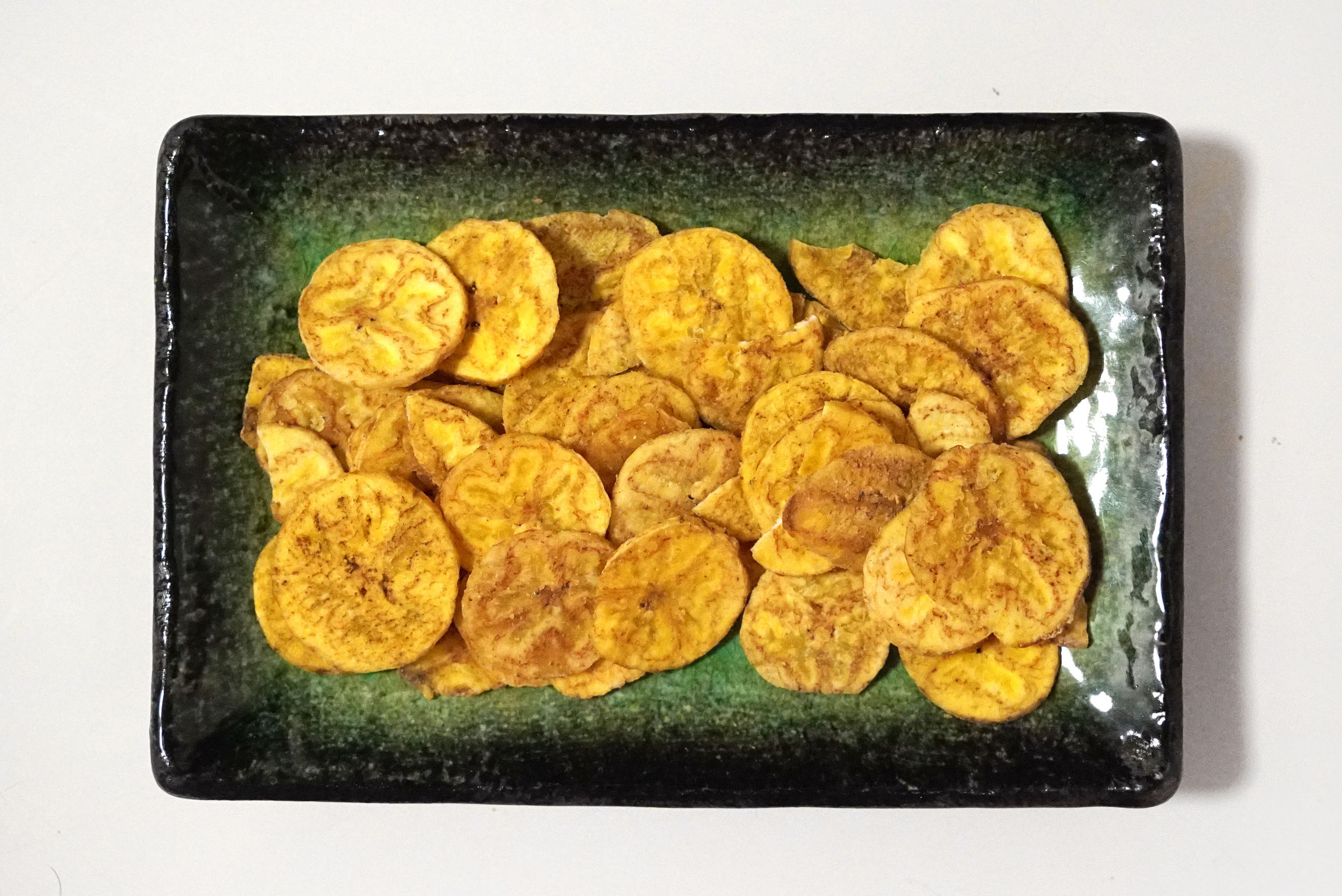
Finally, these Roasted Plantain Chips are amazing.
The light dusting of salt on them cuts their natural sweetness. They’re thick cut too, so you feel like you’re eating a kettle cooked potato chip, only much healthier.
These are only about $1 or $1.20 a bag, so get a bunch of them to stock up. Trust me; you’ll go through them like crazy, and they’re way better and cheaper than the plastic tubs that sell for about $8 for a similar amount at Whole Foods.
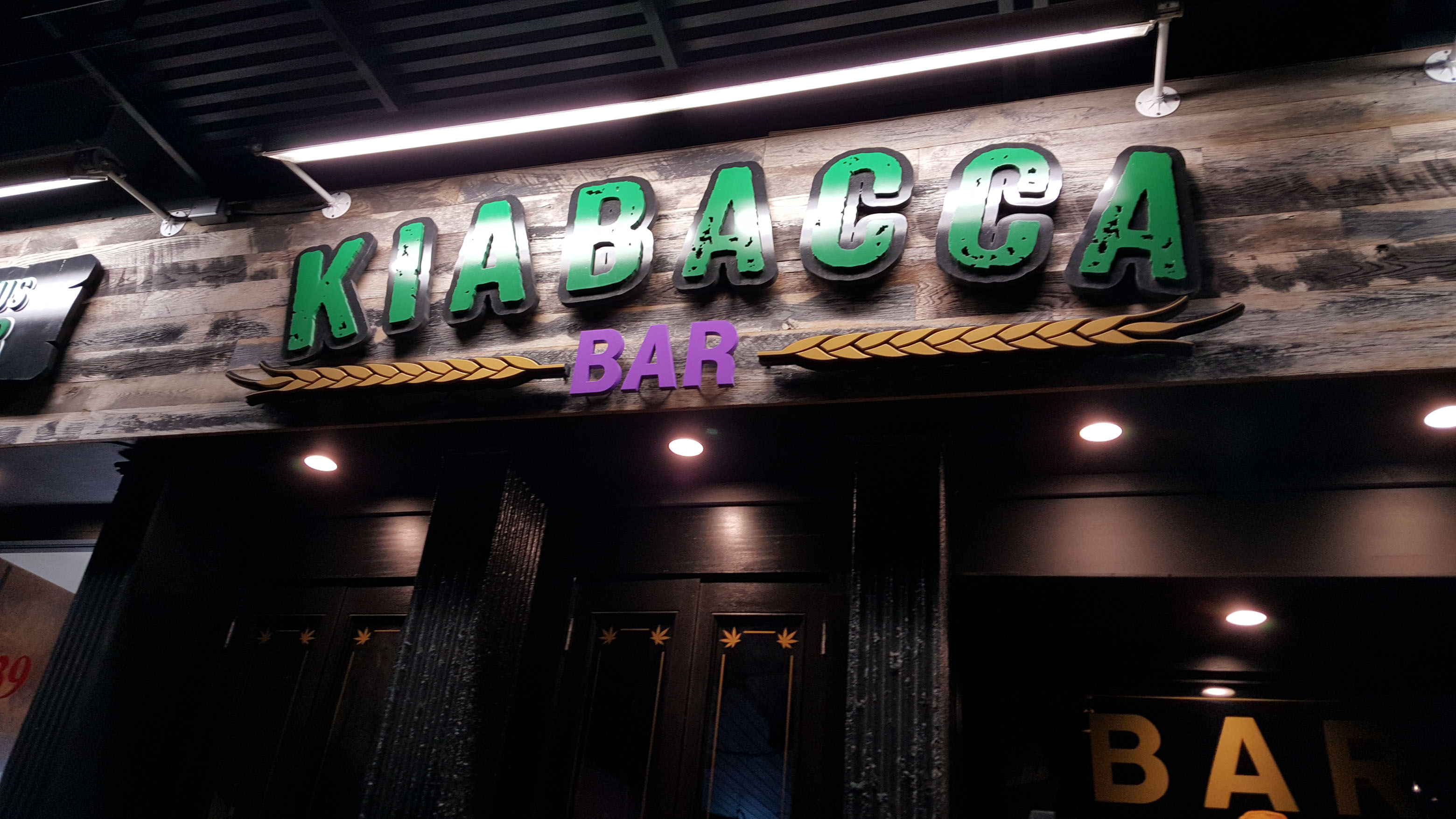
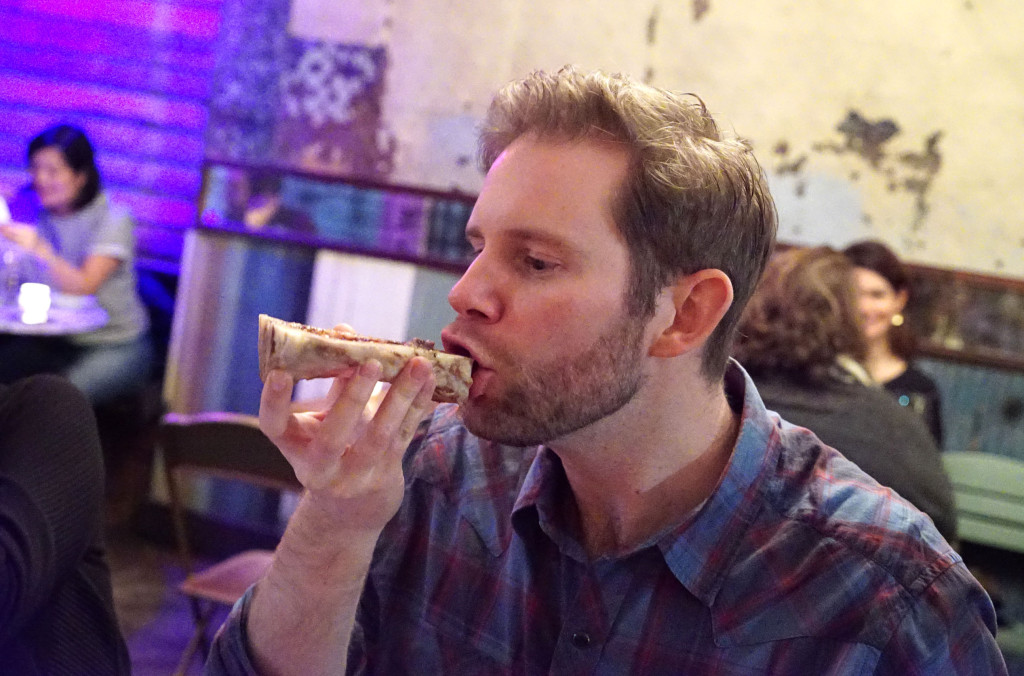
This Hell’s Kitchen pot-head pizza bar recently opened on 10th Ave and is owned by the same folks who run Pony Bar.
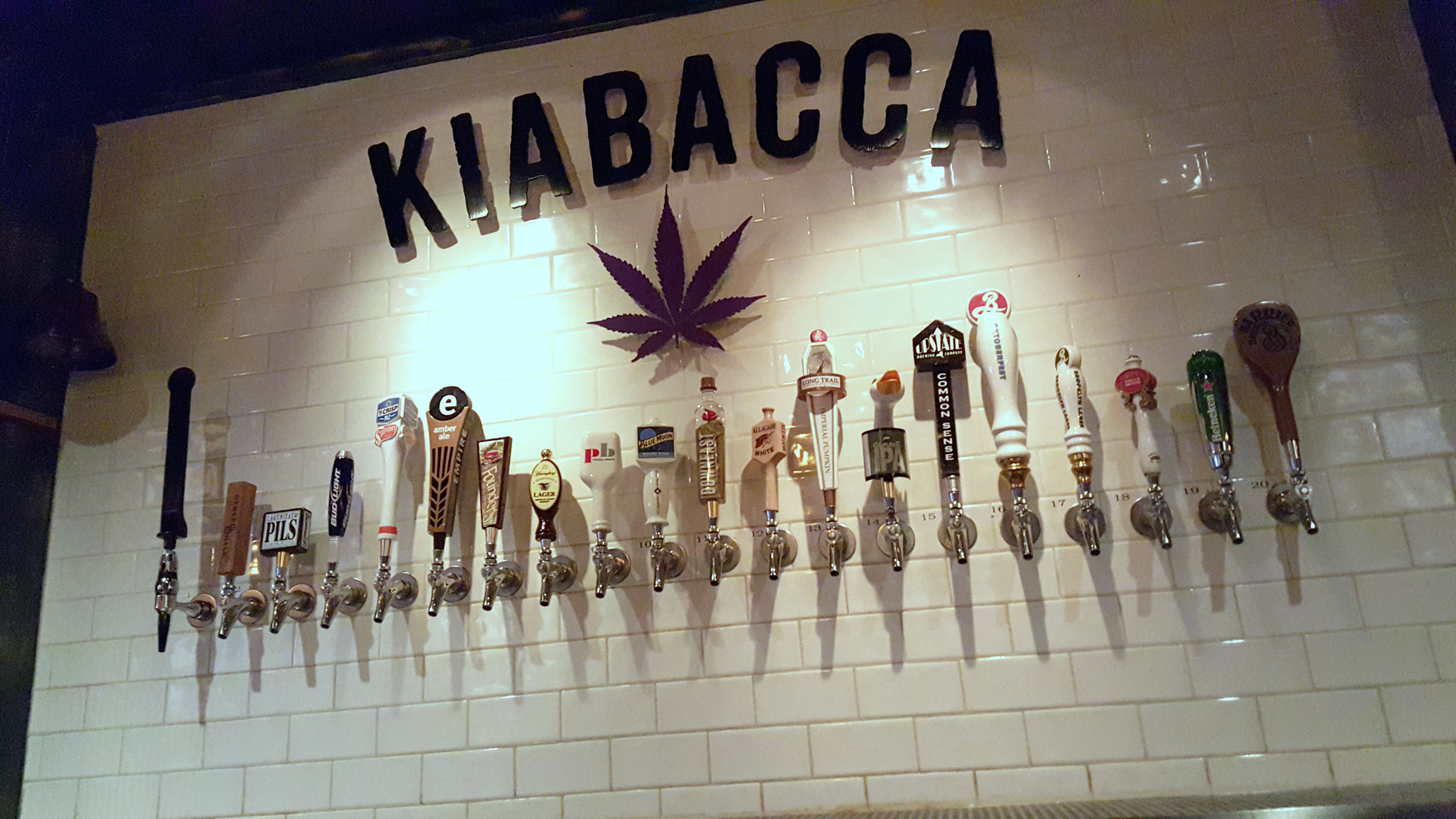
The beer selection is good, and they have a happy hour deal until 7pm where every draft beer is only $4 per pint.
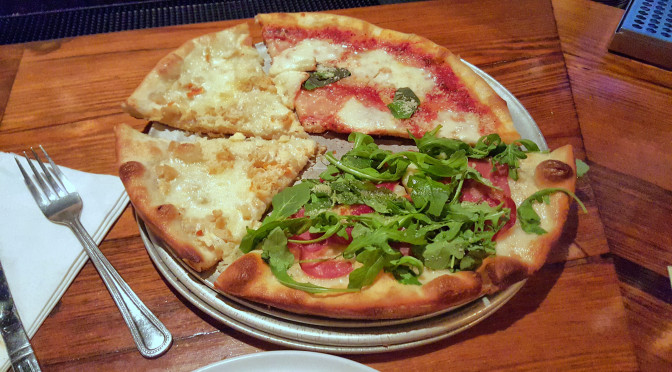
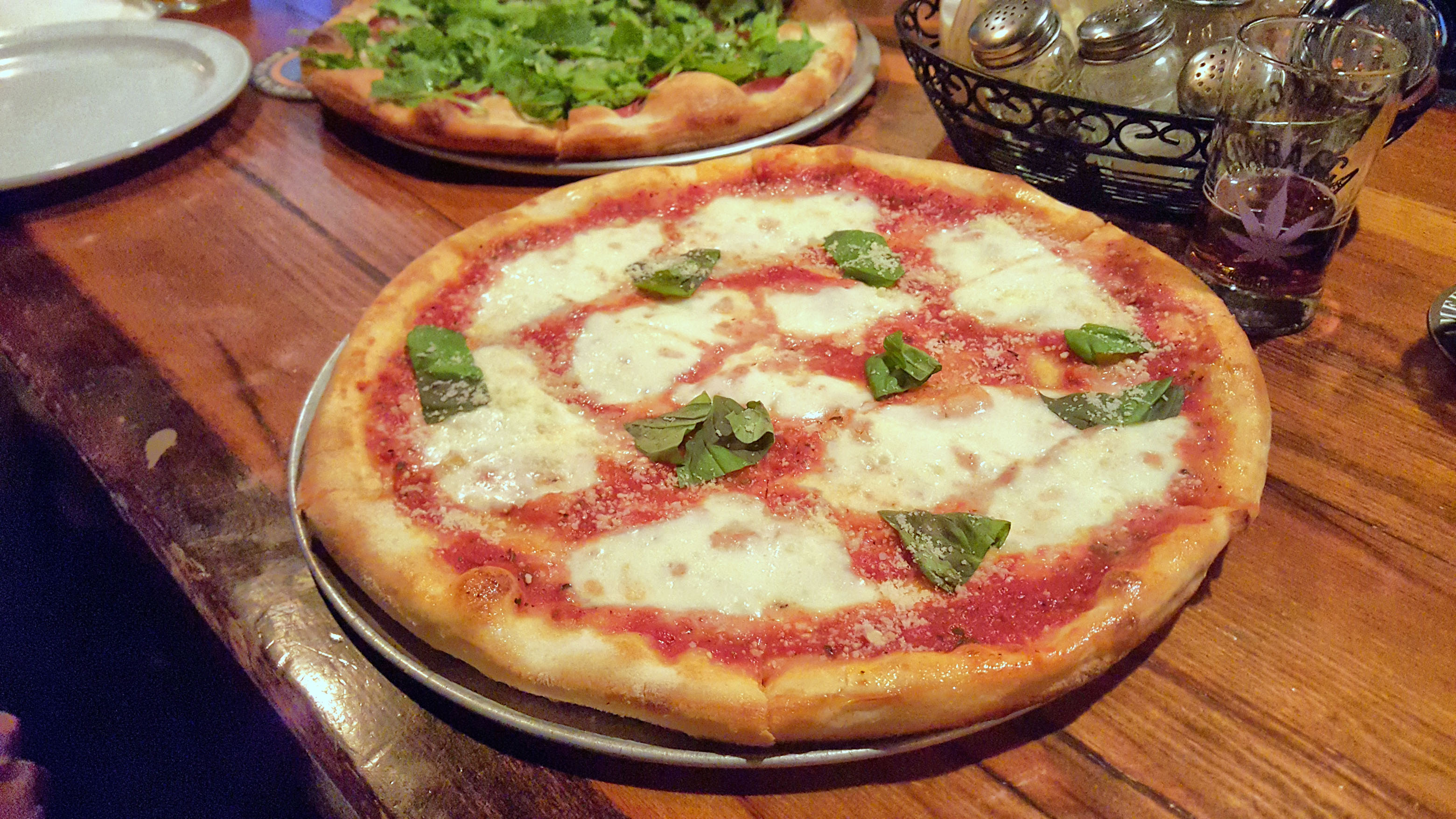
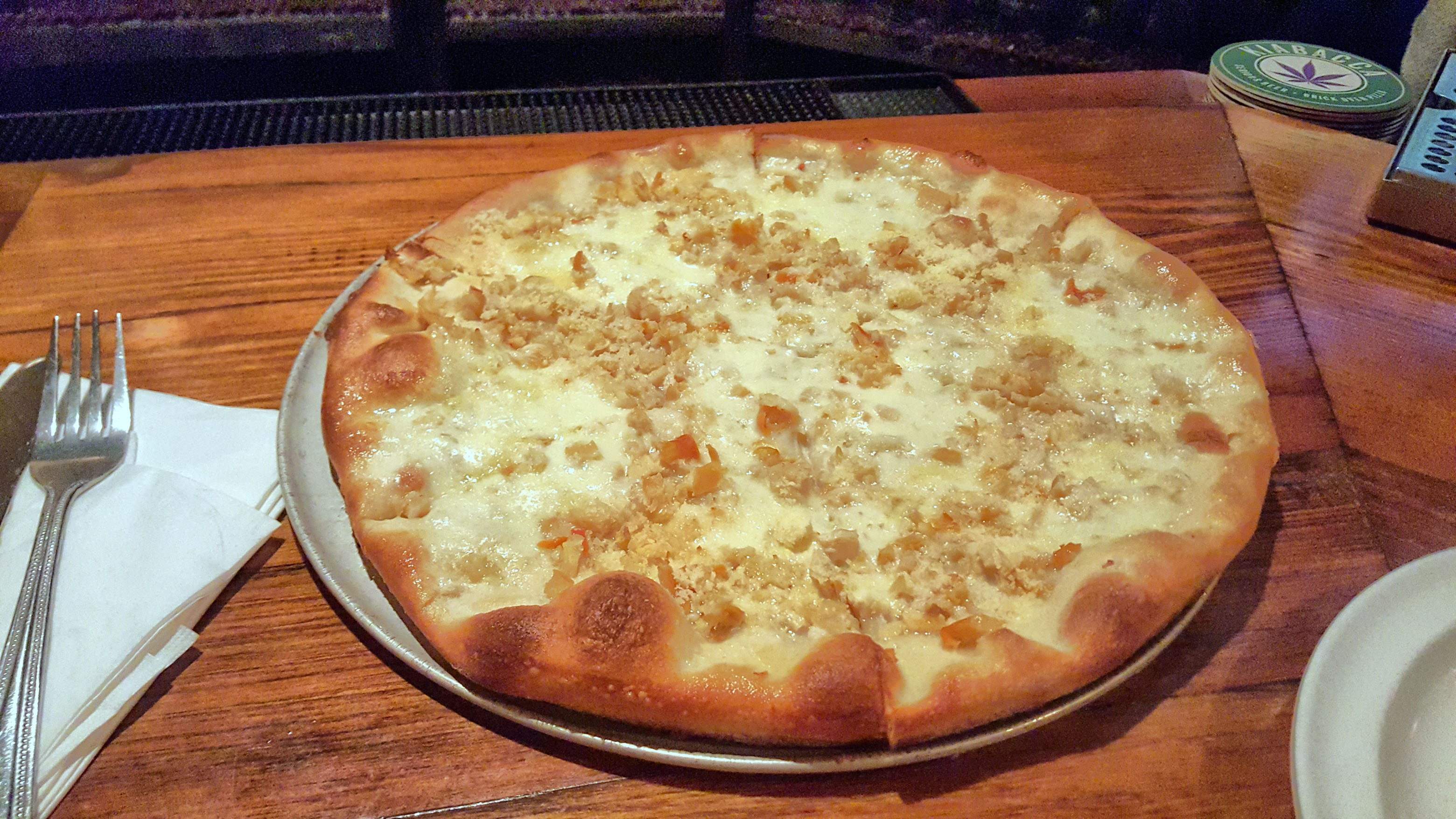
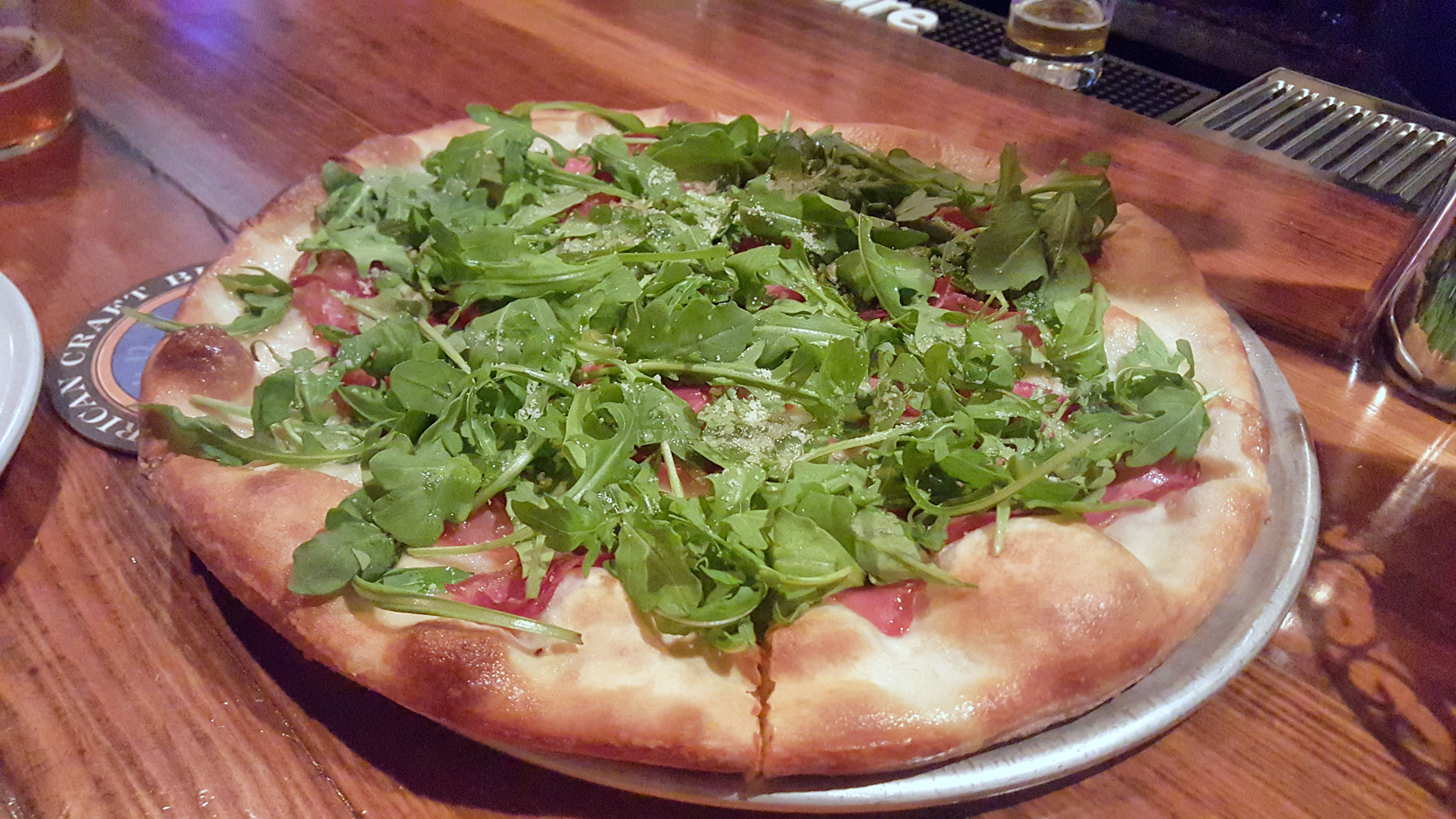
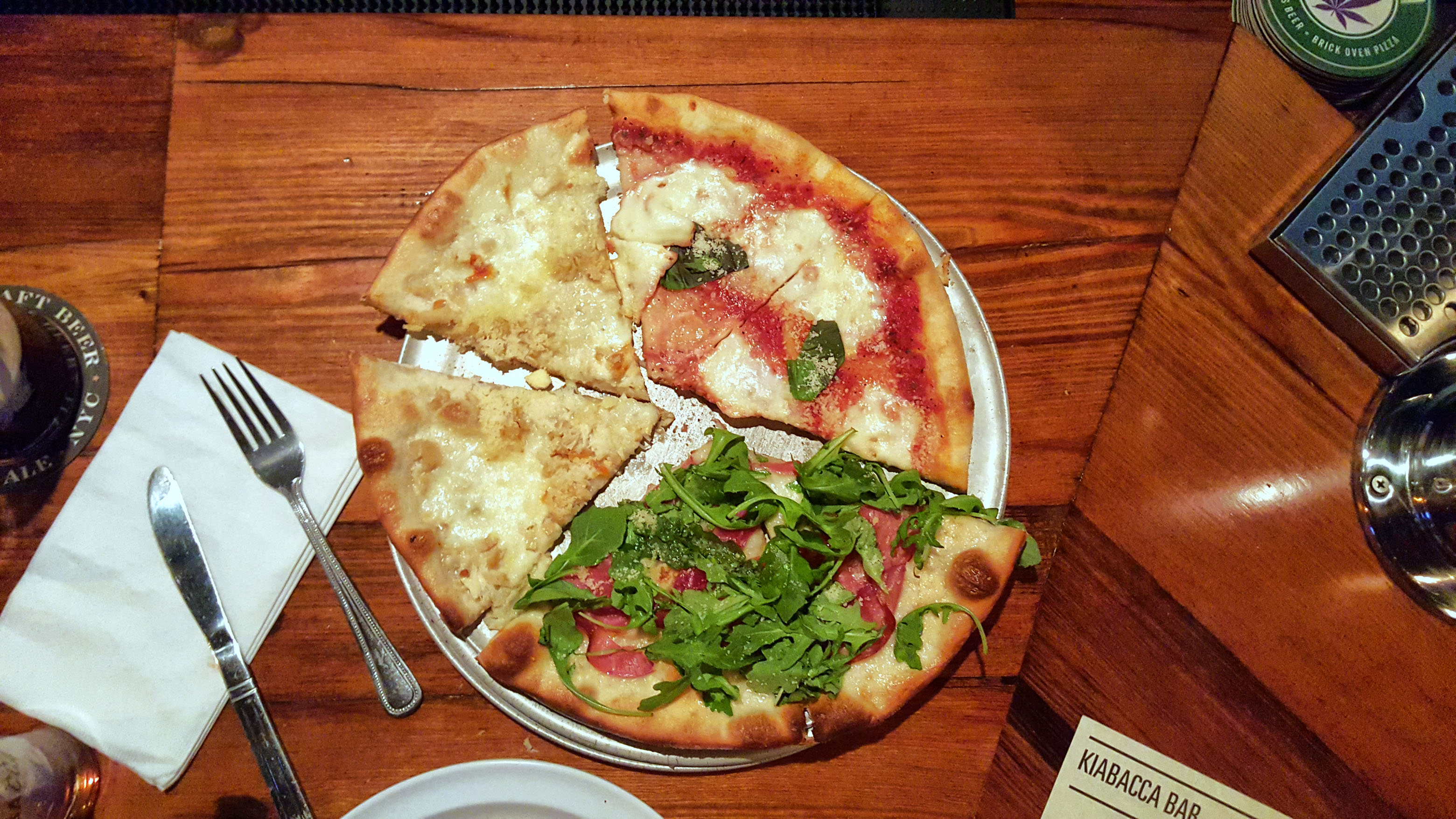
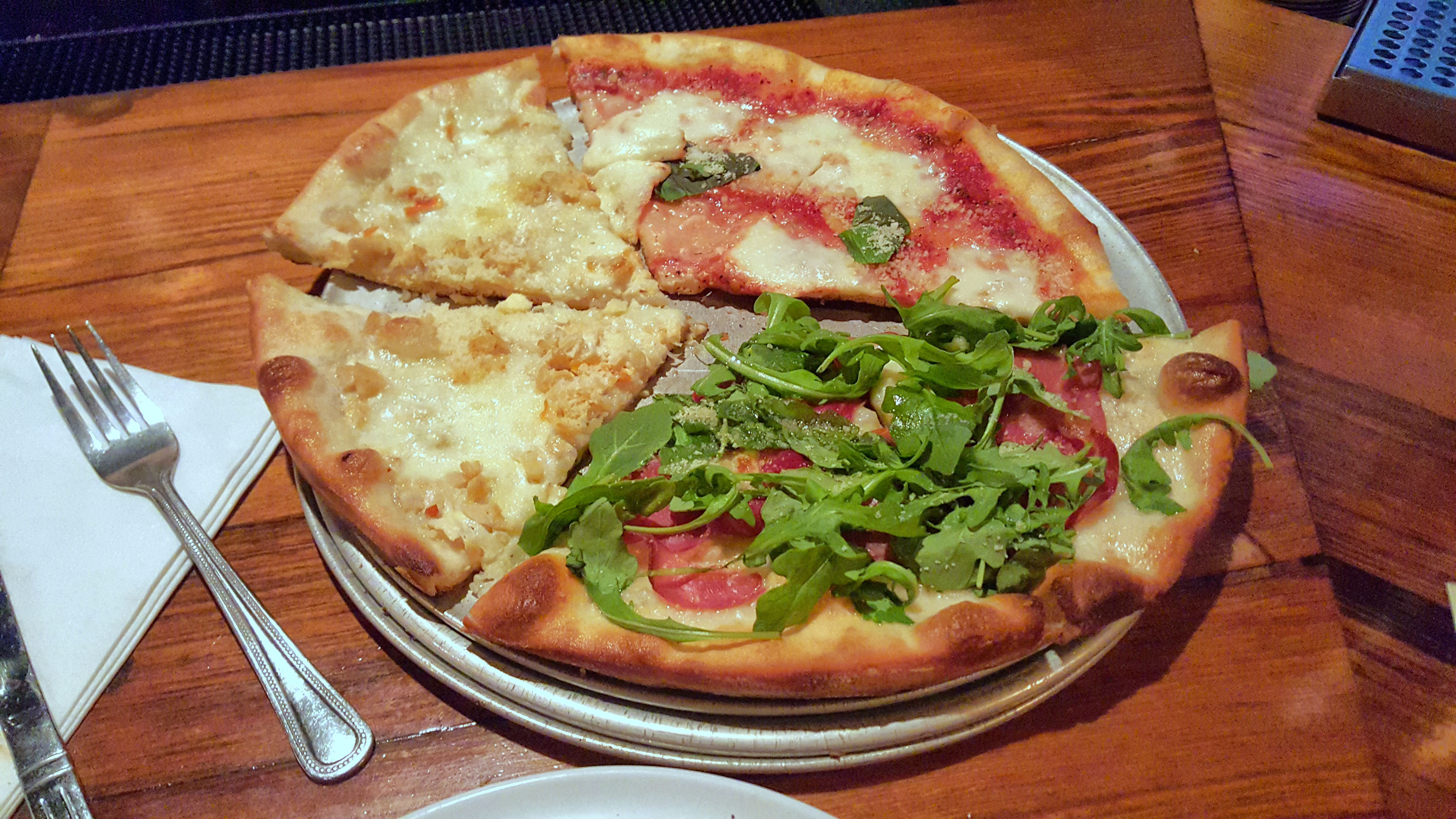
On Mondays they run a special where all 12″ specialty pizzas are $9. Me and a buddy went in to try everything out. We tried three pizzas, to be exact. The margherita, the clam, and the prosciutto and arugula. The crust on all was good and crisp. It had a little bit of chew to it but was executed perfectly. These guys are using a wood fired oven, so the flavor is perfect.
For $9 a pop on Mondays this is a steal. While some of them might be a bit overpriced on other days, you’re at least getting good quality shit. I will definitely be back on another Monday to try out some more pizzas. Plus the happy hour deal is killer.
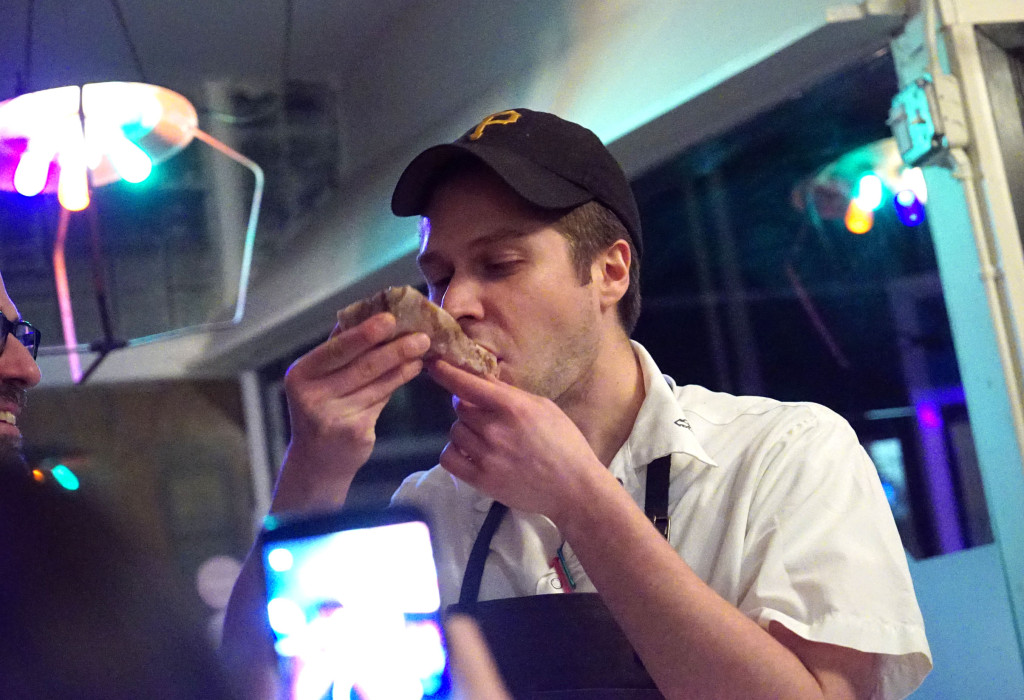
Last month when I was at Meatopia I had the pleasure of meeting John Poiarkoff, the genius chef behind the wheels of steel at The Pines in Brooklyn.
In our inevitable conversation about meat and steak, I discovered that his carnivorous endeavors at the restaurant were not only out of the ordinary and interesting, but exemplified that rare love of beef possessed only by a true connoisseur.
For example, he explained how the blade steak (aka Denver cut, part of the chuck) on the menu was prepared sous vide style. It bathes for several hours in a sealed bag, allowing the tentacle-like marbling to render down, making the steak super tender before it gets seared off in a pan for a nice outer crisp.
He also mentioned that he had some rib eyes in an outdoor walk-in that he converted into a dry-aging room. When he said how long they were in there, 106 days, I nearly lost my shit. I kindly asked him again. “How long did you say?” 106 days!
He went on to say that they would soon be breaking the rack down into portioned cuts and serving them as special menu items. Needless to say, I was all over it. I made sure to follow The Pines on Instagram and to keep my eye out for any news about that steak. Sure enough, just a few weeks later I saw the post announcing that they were going to be serving those rib eyes. The very next day my wife and I headed over.
To my excitement, the menu was chock full of delicious looking meat goodies. We sipped on a pair of nice cocktails while we wrestled with what to order.
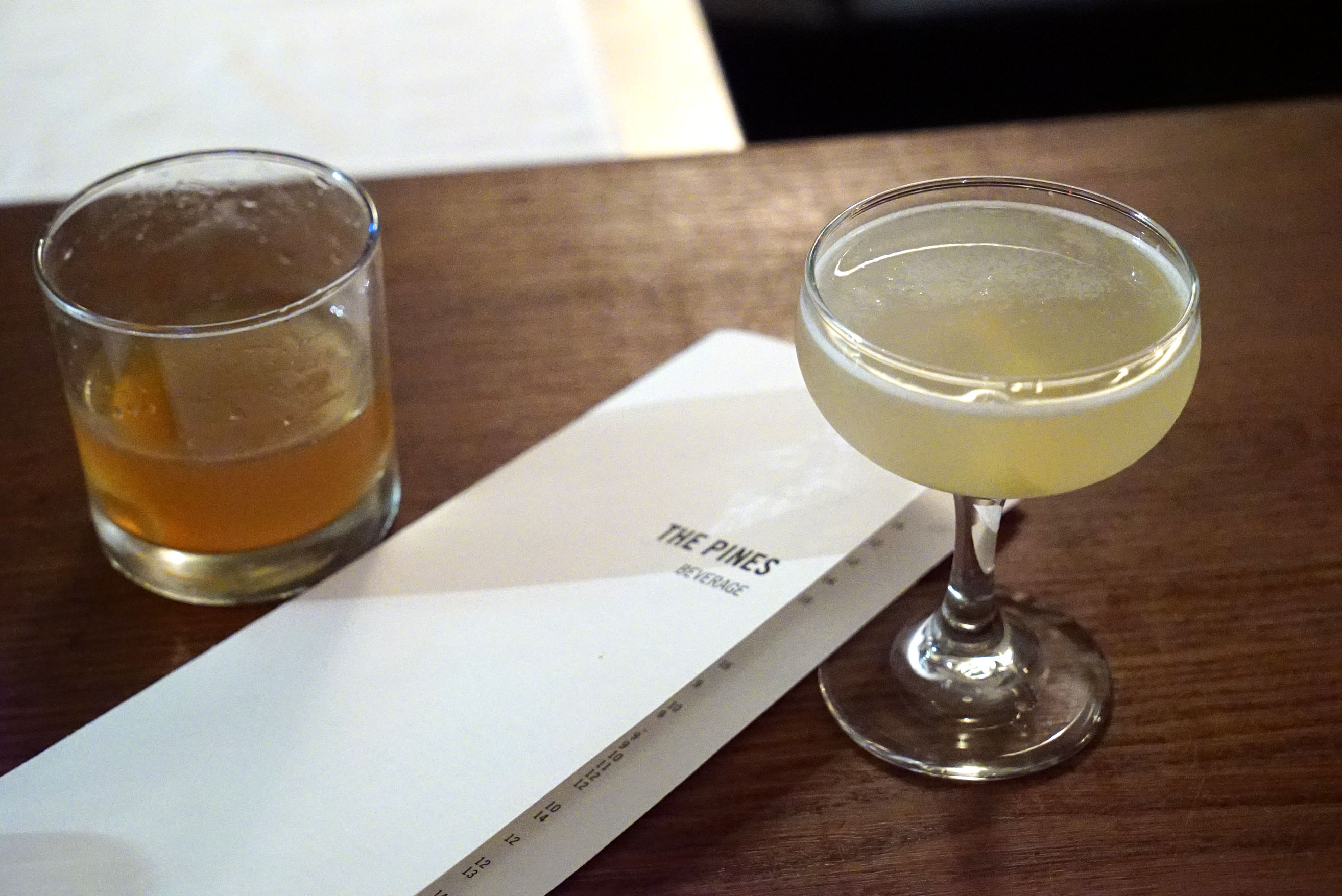
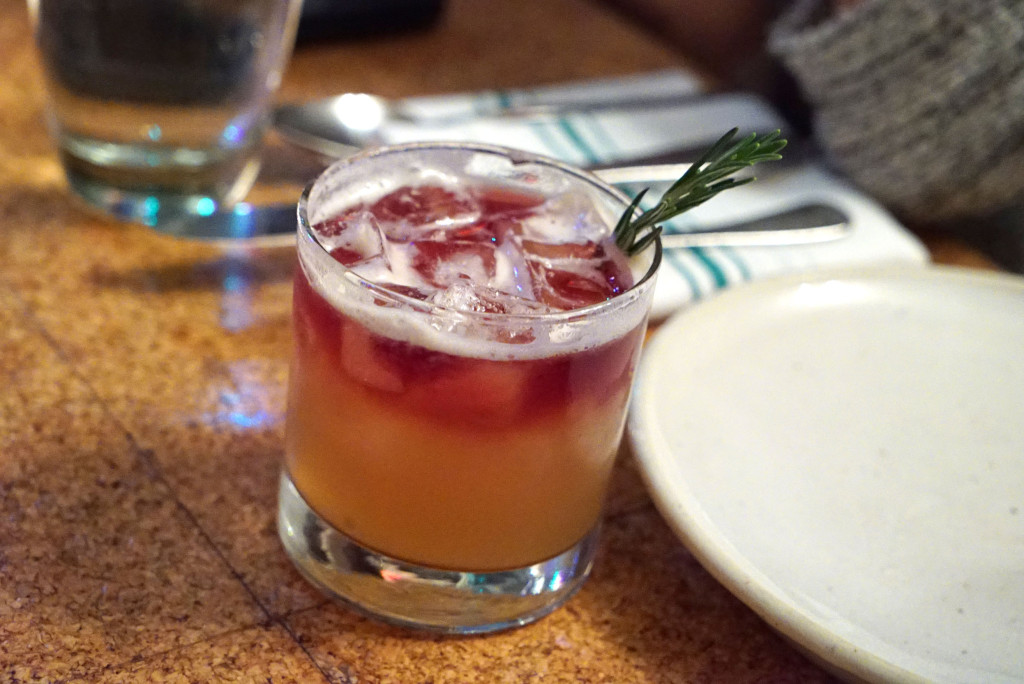
On the left is The Pines, a rye drink with douglas fir (burnt/smoked pine needles for a really nice woodsy, aromatic nose) and yuzu; on the right is the Air & Sea, a gin drink with dulse, lemon and violet.
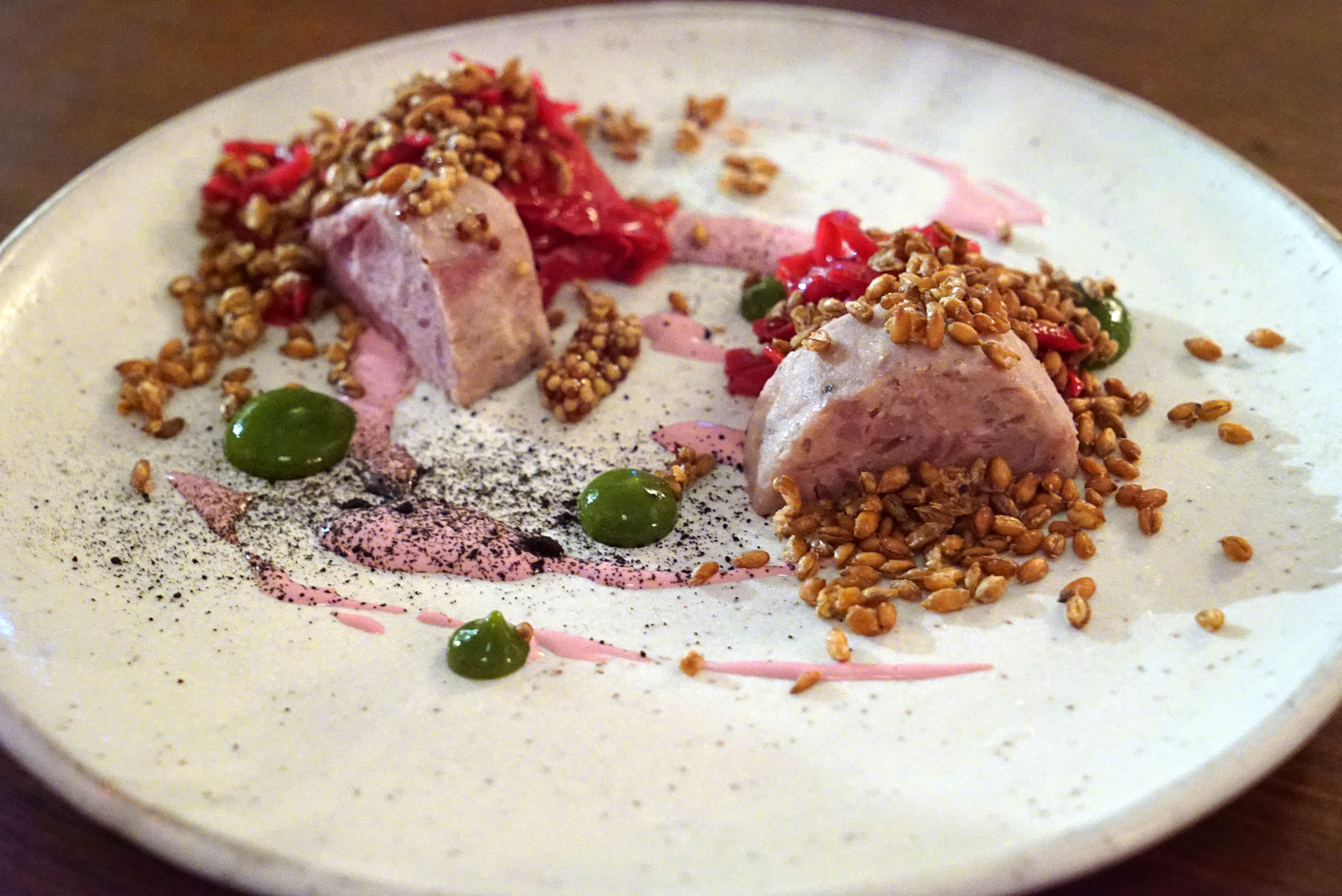
We ended up going for three entrees instead of the traditional apps, sides and entrees routine. But before our first item came out, John sent over an order of duck rillettes. This is aged duck served terrine style with a pastrami sandwich theme: dill sauce (it tasted like pickles), a cabbage kraut, mustard and crunchy puffed rye grains.
This inventive dish threw us for a tasty loop, and it set the tone for what was one of the most fun, innovative and delicious meals we’ve had in a long time.
John paired the duck with this really smooth, clean sake:
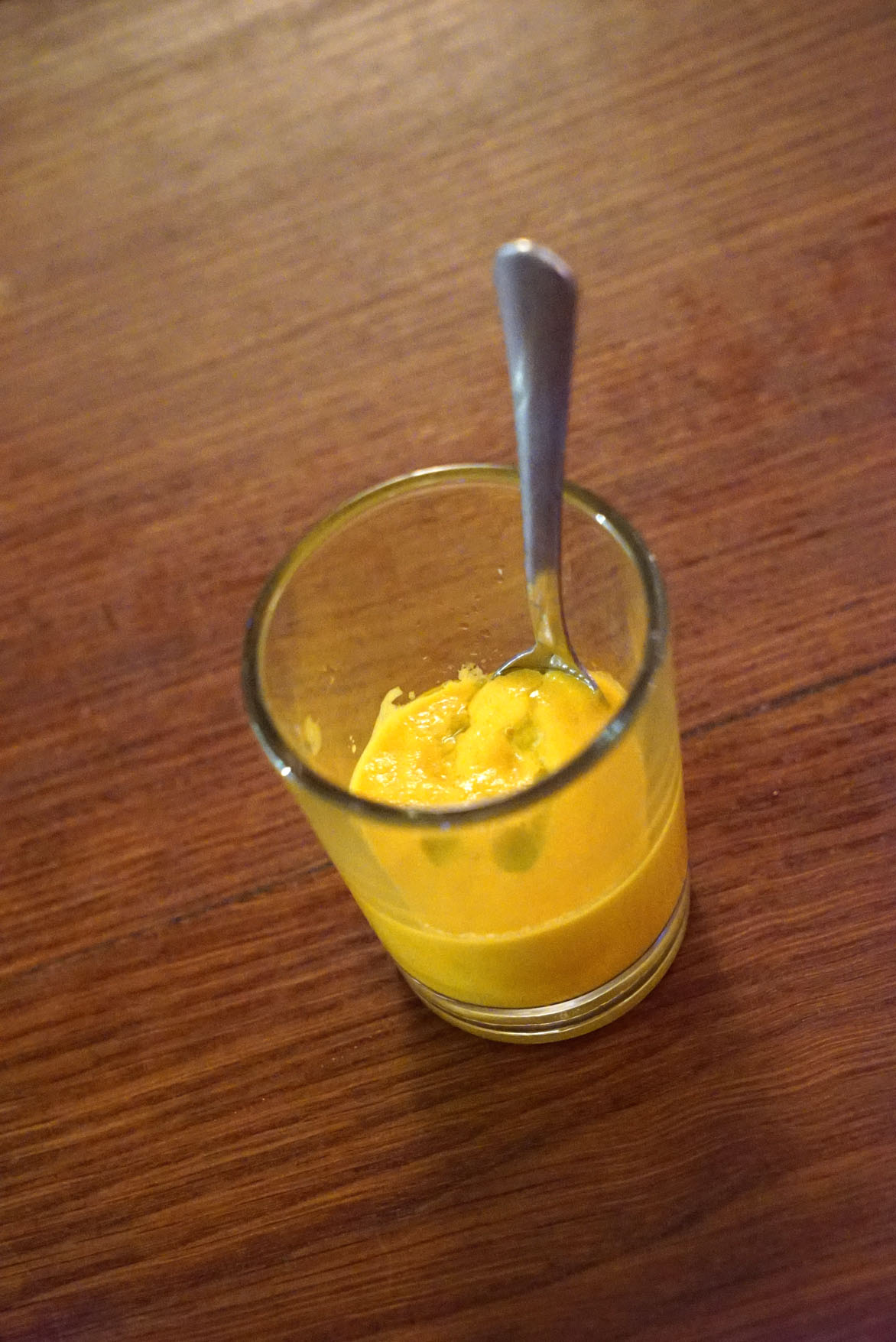
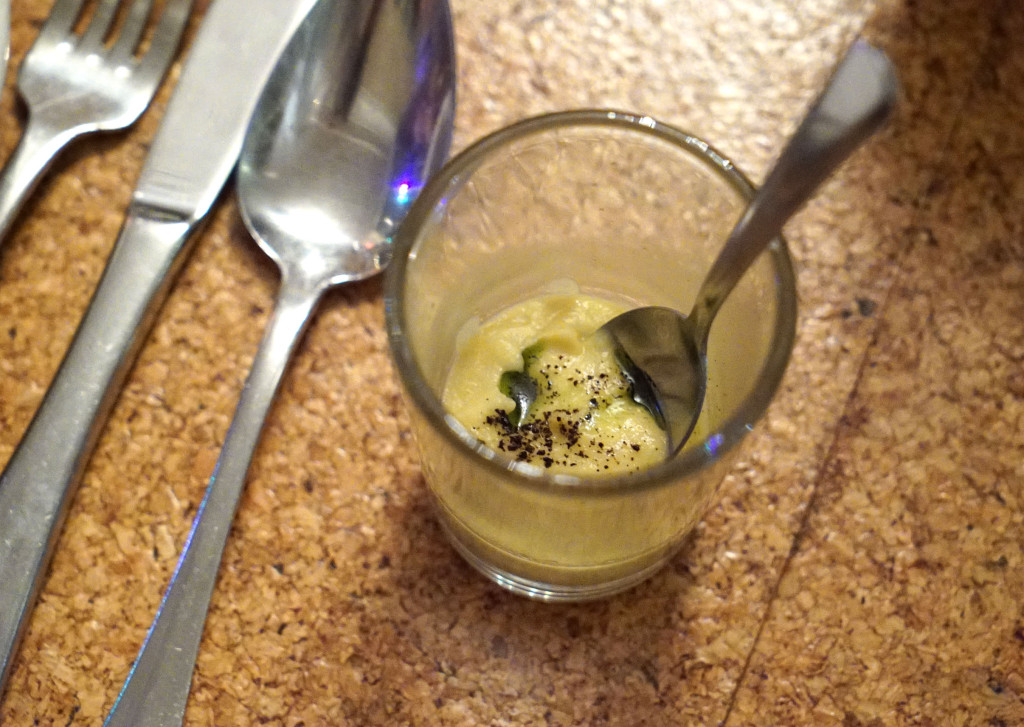
Oh and there was this nice little amuse of carrot soup/puree with sage oil. It had a spicy and smoky kick to it.
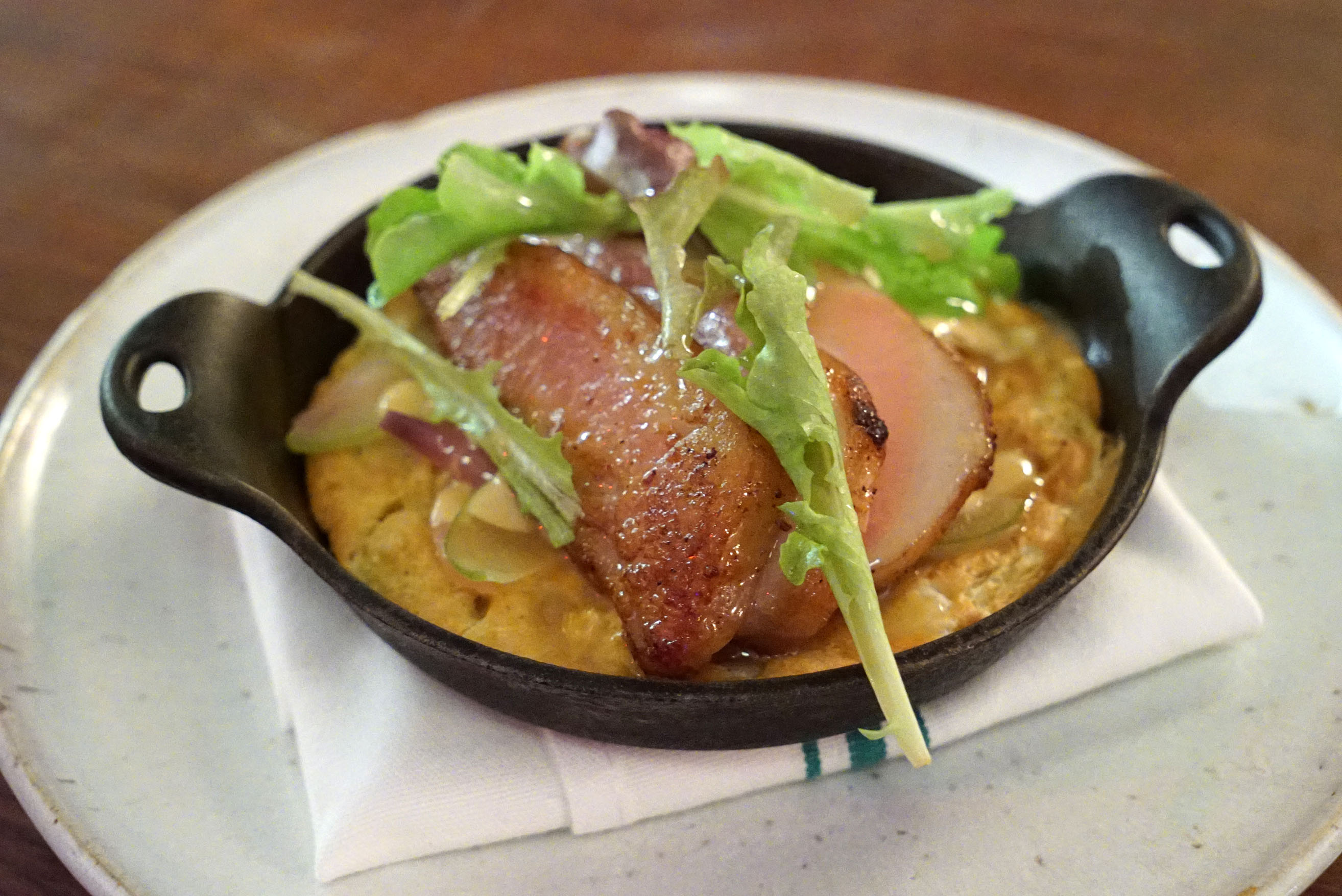
Our first entree was pork jowl. If you’ve never had this, it is essentially bacon from the face of a pig. It’s cured, smoked cheek meat. If you know anything about the cheek meat of an animal, you know that it is some of the most tender and sought after bits of goodness you can find. This tasted like really awesome smoked bacon. It was savory yet slightly sweet, and sat on a pumpkin and cabbage pancake that was somewhat reminiscent of corn bread.
I could very happily eat that shit every morning for breakfast, though I may be tempted to throw a fried egg on top – you know – because breakfast is the perfect time to eat like a savage barbarian. Anyway this dish wasn’t heavy or greasy like you might expect from bacon. The curing and smoking helps in that respect.
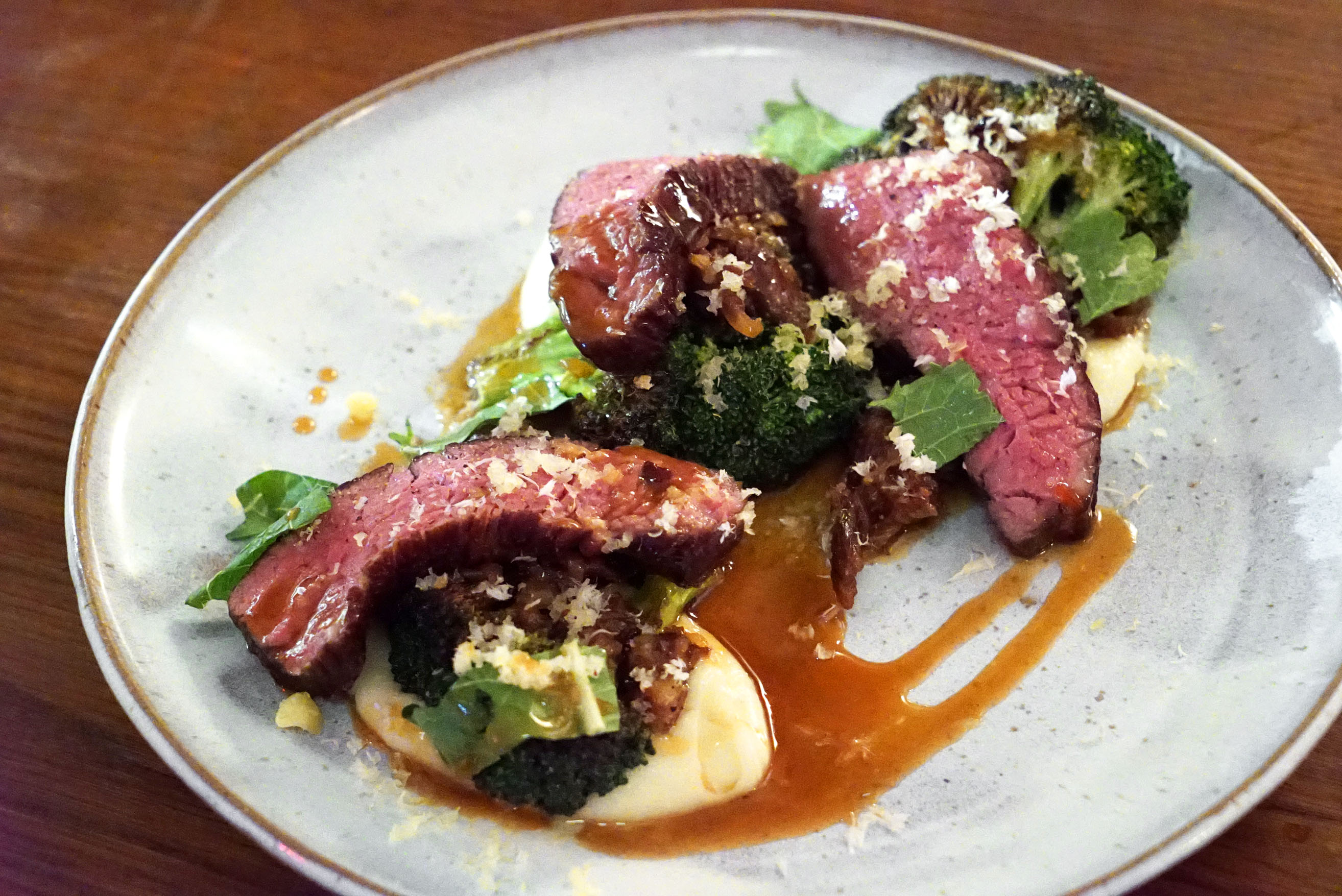
Our first steak dish came out next. After hearing about that blade steak, I couldn’t pass it up.
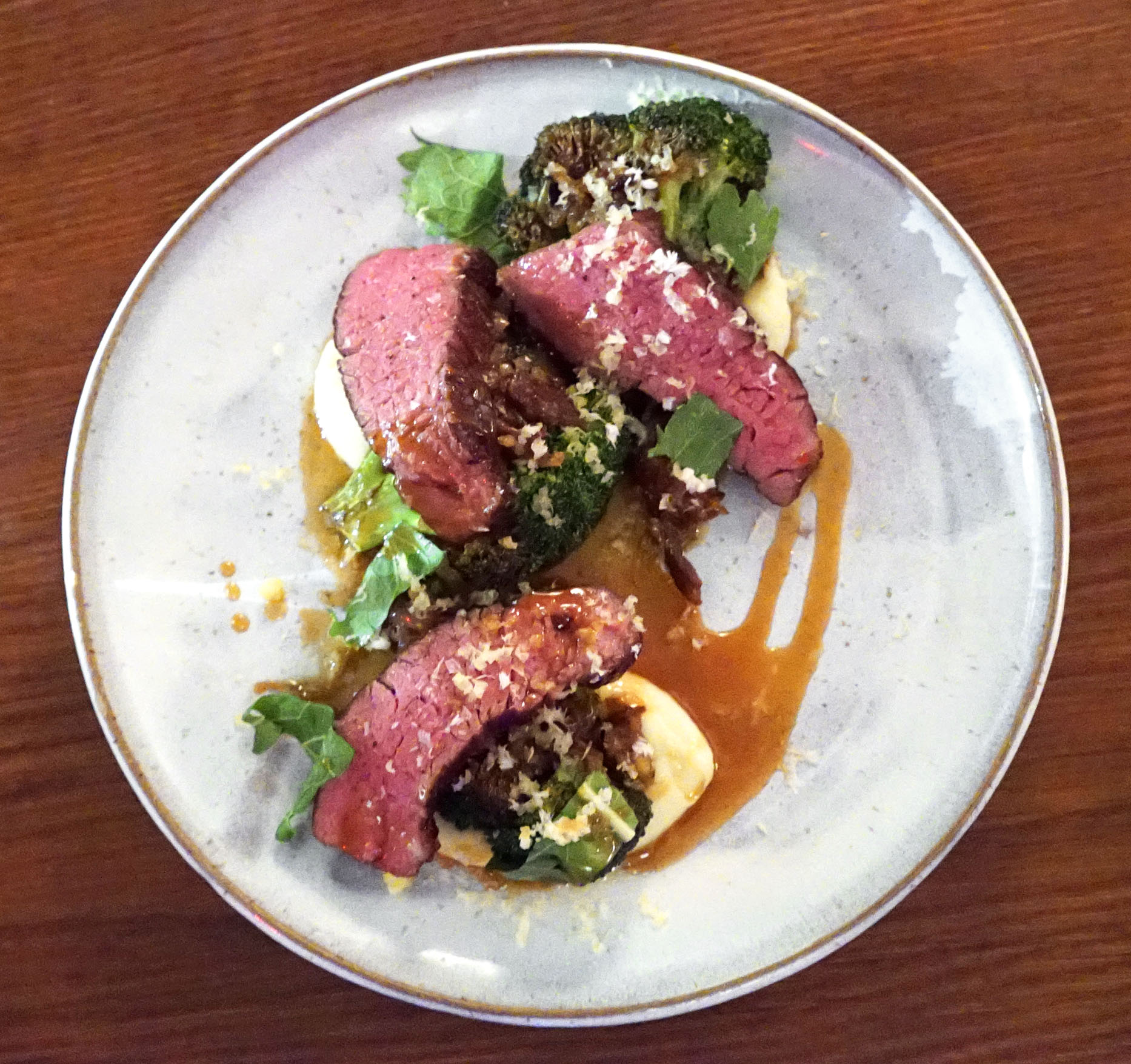
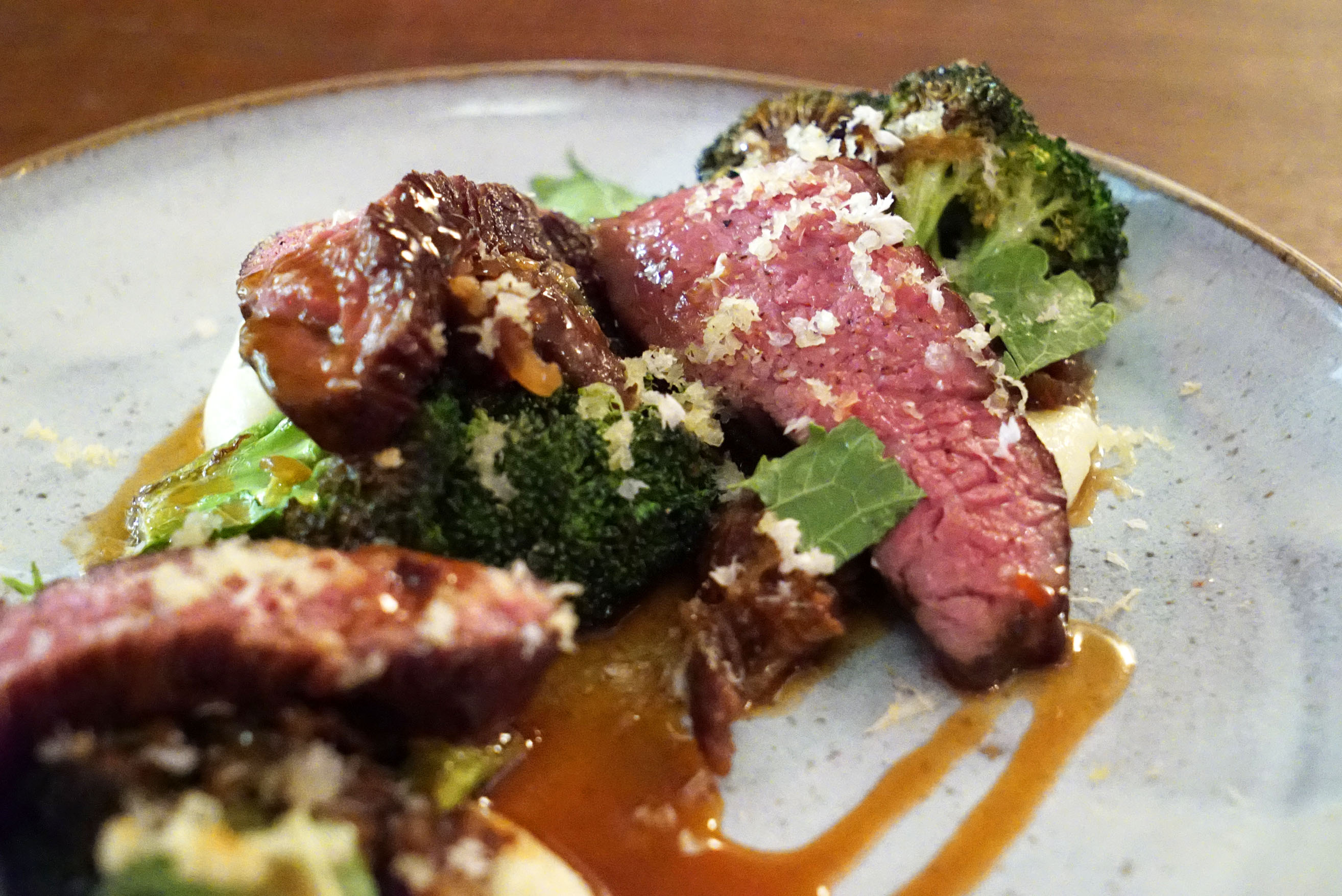
John mixed the normal blade steak plate up a bit and served it with some roasted broccoli, braised oxtail and cheesy potato puree.
As you can see, there’s even a bit of shaved horseradish over the top to punch up the salt and tie the meat in with the potato. Really nice.
This steak is incredibly good. John has taken a lesser known, less desirable and rarely featured cut and showcased it in a way that will have you searching for it in every restaurant. It’s easily 10/10 for flavor. It was so juicy and tender inside. Perfectly cooked, as you can see, and the sear on the outside locked in all that flavor. It was super crispy on the outside without any part of the inside getting cooked beyond medium rare. Just awesome!
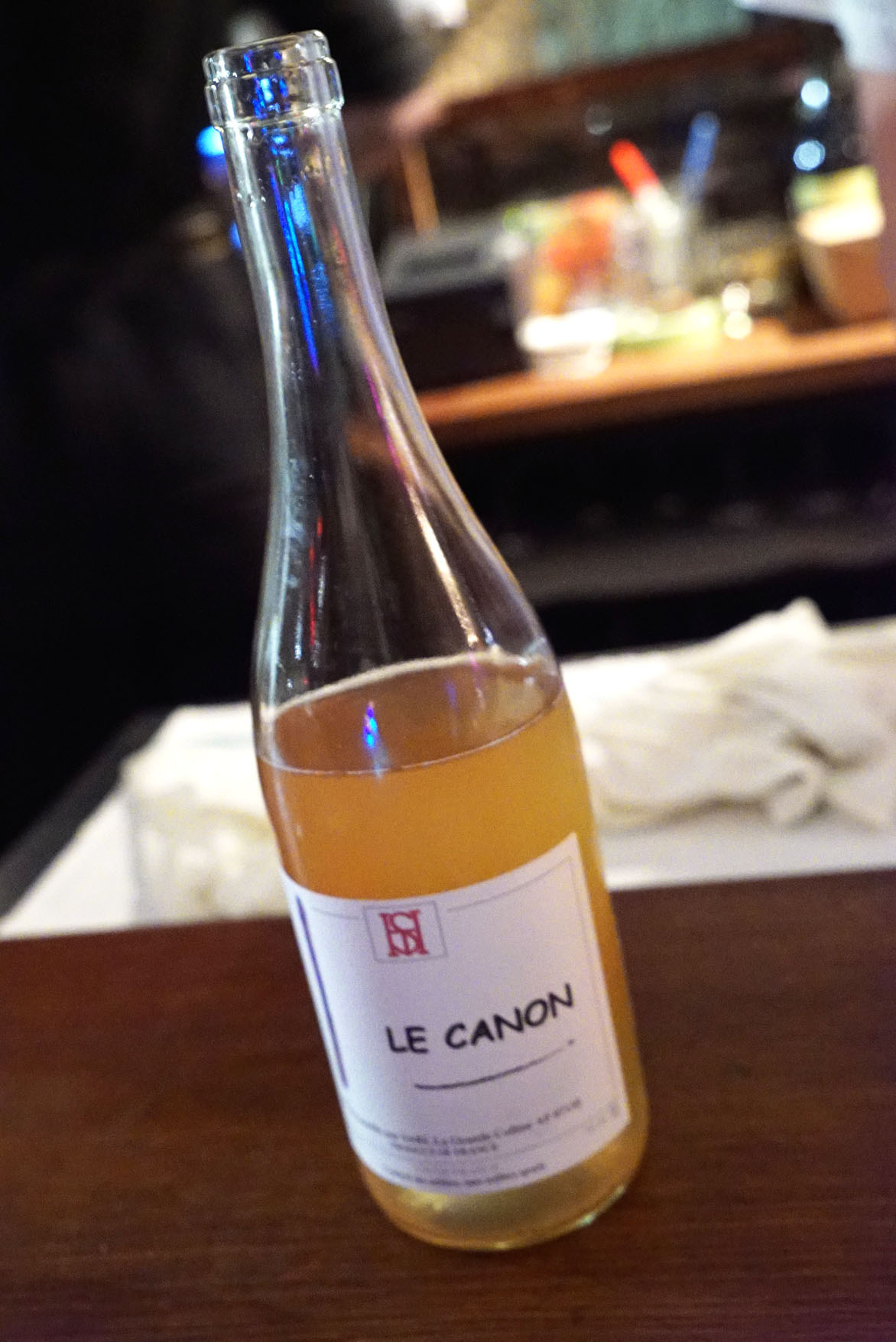
John paired this with a unique and unexpected rose, which had some tartness to it. The cool thing about The Pines is that, if you’re interested, you can learn a lot about the food you’re eating and the stuff you’re drinking. John gets to know all the people who provide his source material. The vintner of this wine, for example, or the farmers and ranchers who provide the meat and produce. He gets to know their stories, and he shares it with diners for a more rich, engaging experience. I dig and appreciate that, and it’s exactly what I was talking about on here recently – that I want to see more of it.
I should probably mention here that The Pines sources all of its beef from Happy Valley Meat Co., which is based out of Central PA. Both John and his sous chef Neel Patil (the creative force behind the duck rillettes dish, featured above) are extremely modest in that they attribute so much credit for the success of their menu to those farmers. While much credit is indeed deserved by the farmers, it is very easy to fuck up good meat if you don’t know what you’re doing. John and Neel clearly deserve as much credit as the farmers, because they knocked the beef dishes out of the park!
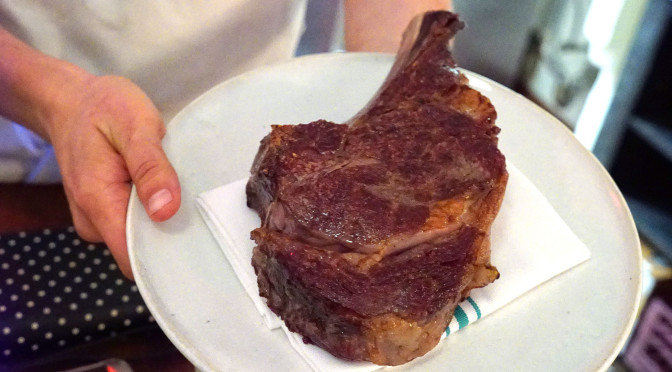
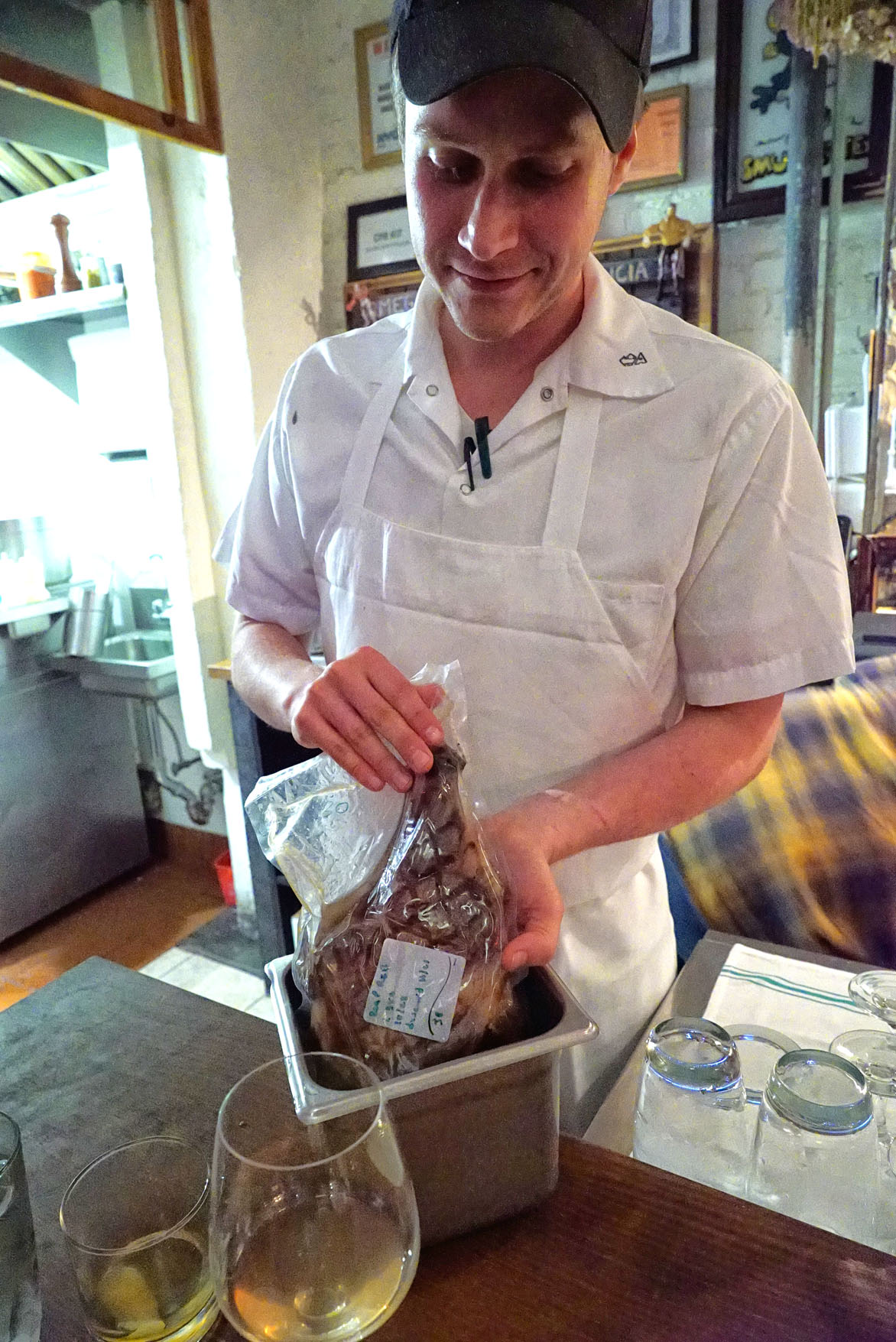
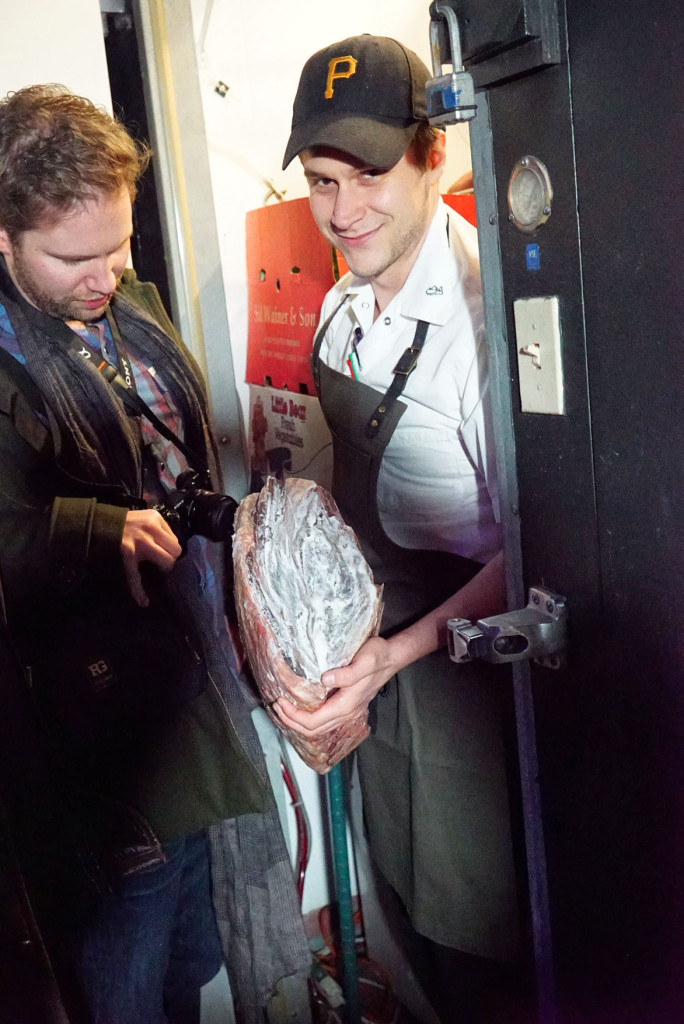
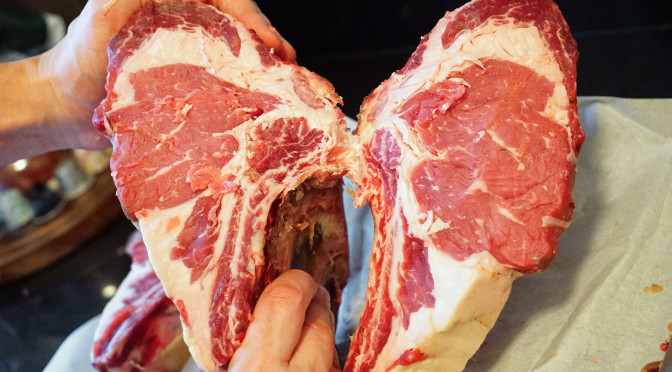
So now comes the big boy – the 106-day, dry-aged rib eye. John explained that the process for these is as follows: First it hits a hot grill for a little smoke and sear, and those lovely grill marks. Then it gets a nice warm sous vide bath. Last, it hits a hot pan to lock in all the juices and get a crispy sear. Thrice cooked rib eye! Here’s a shot of John holding our cut before it hits the pan:
And here it is after the pan, resting, but before serving. Just look at that gorgeous sear!!!
While we waited for it to be sliced and plated, John rolled out another pairing for us.
This wine was truly incredible. He poured us a taste from two different bottles: one that was just opened 30 minutes prior, an another that was already opened for two days.
The difference was astounding. The freshly opened wine was really nice and flavorful, full bodied and robust without being overpowering. It had a nice round, smooth finish. The wine that was opened for two days had all the same characteristics, but the after taste was of dry aged beef or truffled charcuterie. It was incredible! I kept going at it. It was like having a delicious meat snack with each sip, and it reminded me of the awesome Trufa Seca sausage I had with my latest Carnivore Club box. It paired perfectly with the steak.
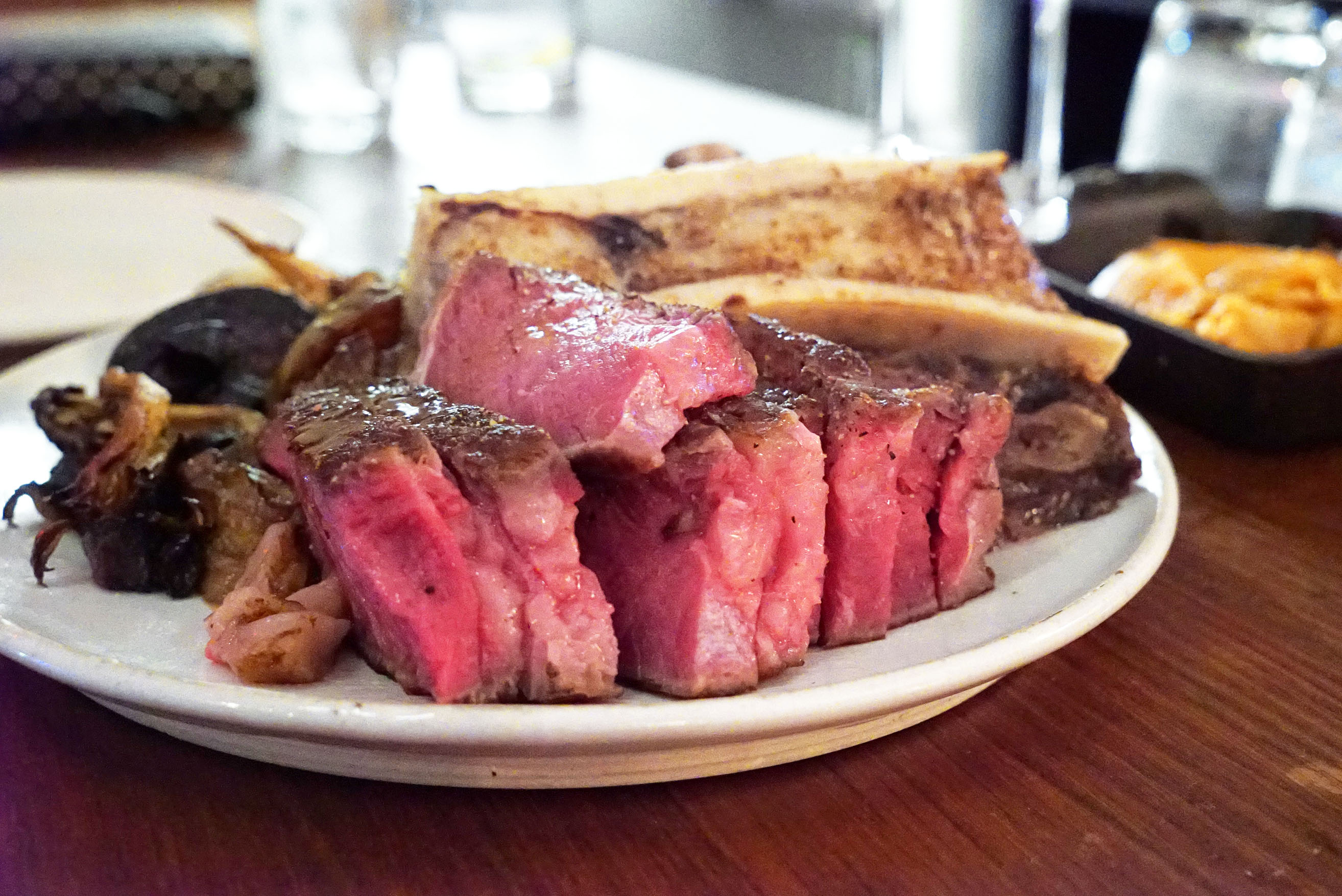
Anyway then the masterpiece came out:
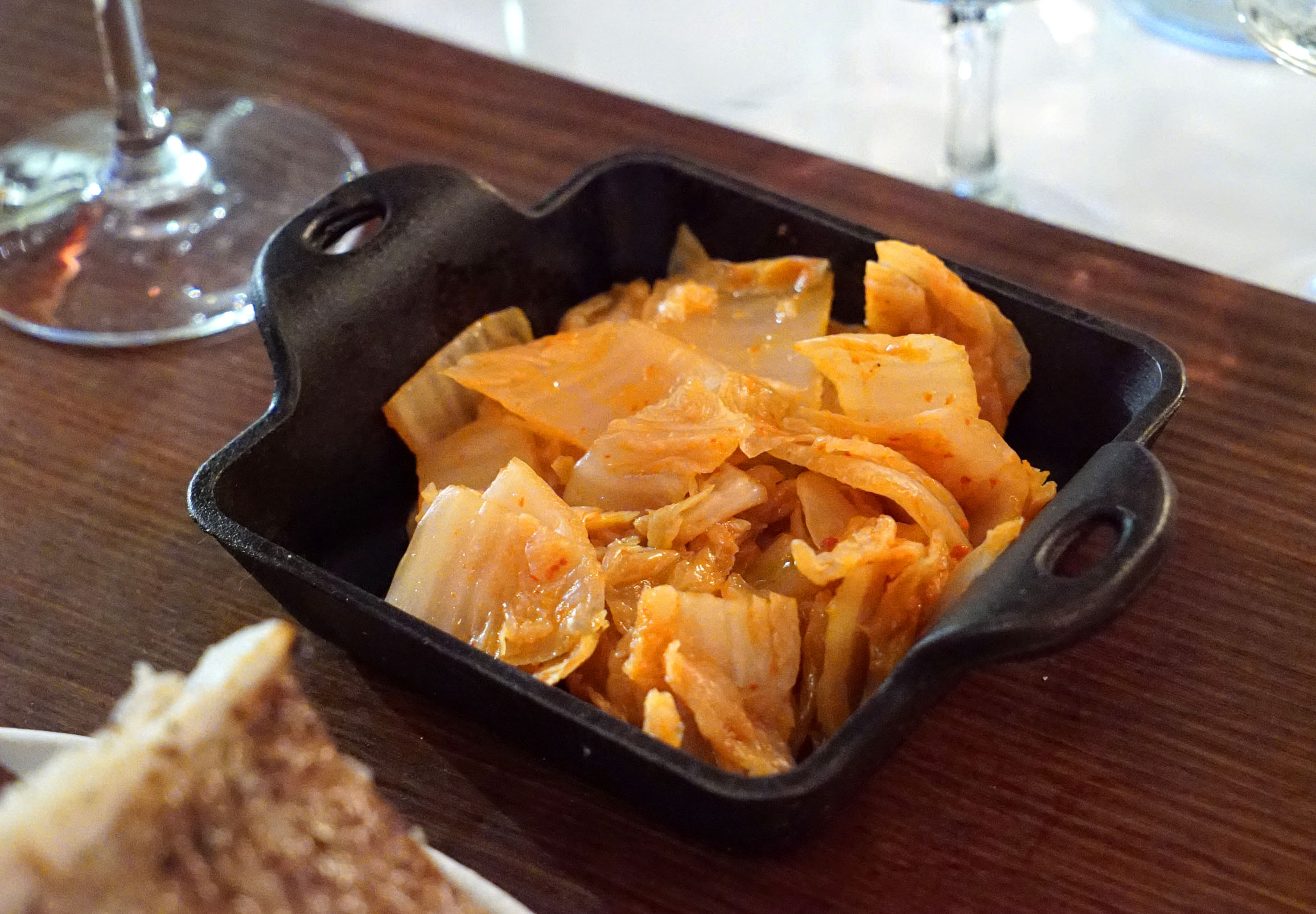
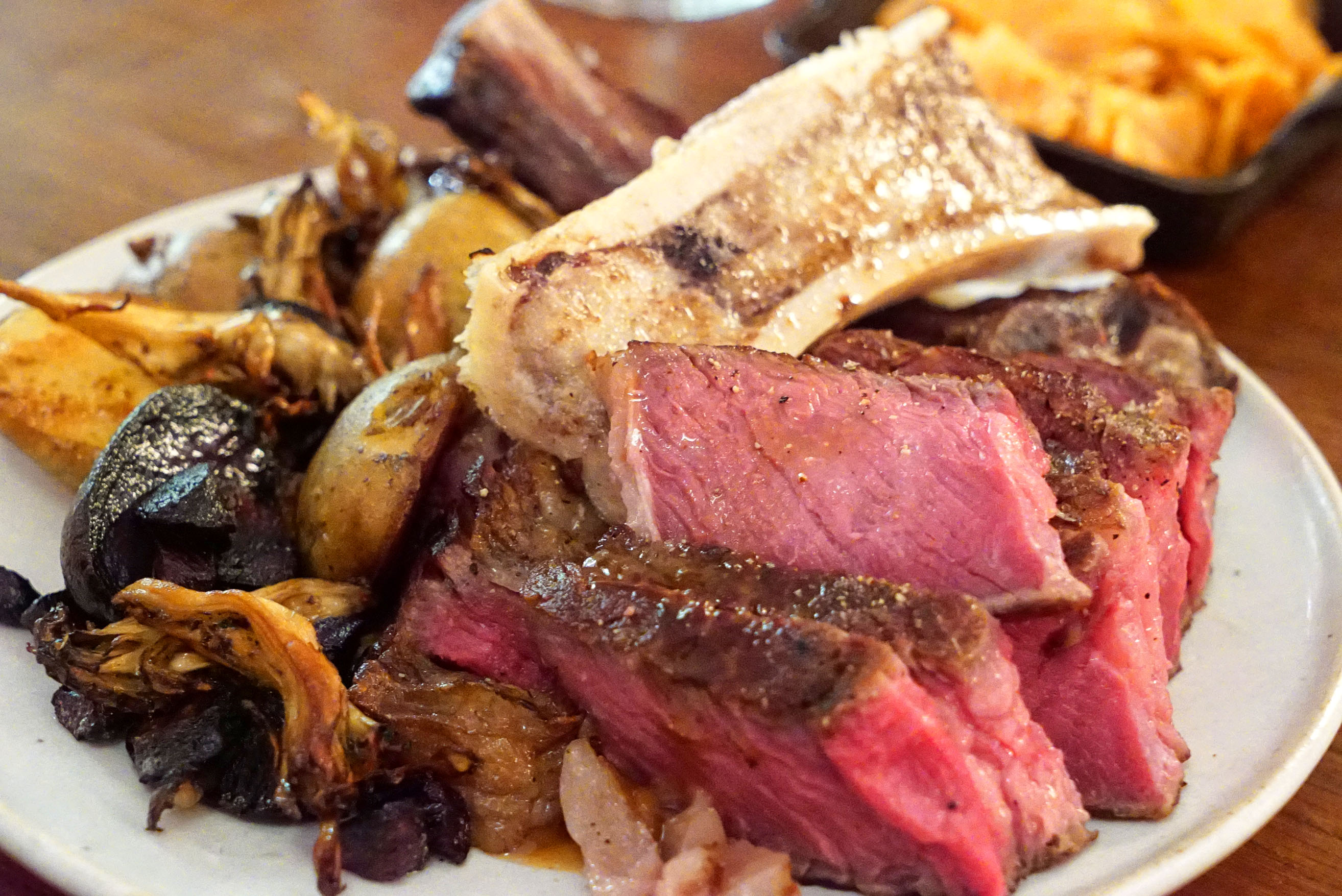
It was plated with grilled Japanese mushrooms, bone marrow, potatoes that were pretty much confit style, and this awesome kimchi cabbage that was finished with rendered beef fat:
This right here is the best steak I’ve ever eaten at a non-steakhouse, and I can tell you it seriously rivals the best steakhouses as well – it may even be better than all of them.
I’m still trying to wrap my mind around how incredible this thing was, and I don’t know if it can really compare to anything I’ve had at a steakhouse other than the long bone wagyu rib eye at Del Frisco’s. This thing is really in that kind of league. And look at how perfectly executed this thing is:
It was so tender and flavorful. Every bite was a “wow,” and the cap was fucking INSANE! I’ve never had anything like it before. I was expecting a lot of game and funk with this meat, but it was just the right subtle amount of “blue cheese” flavor. It came out most when I smeared some marrow onto the slices of eye meat. And the fat around the cap was even softer and more delicious than the marrow.
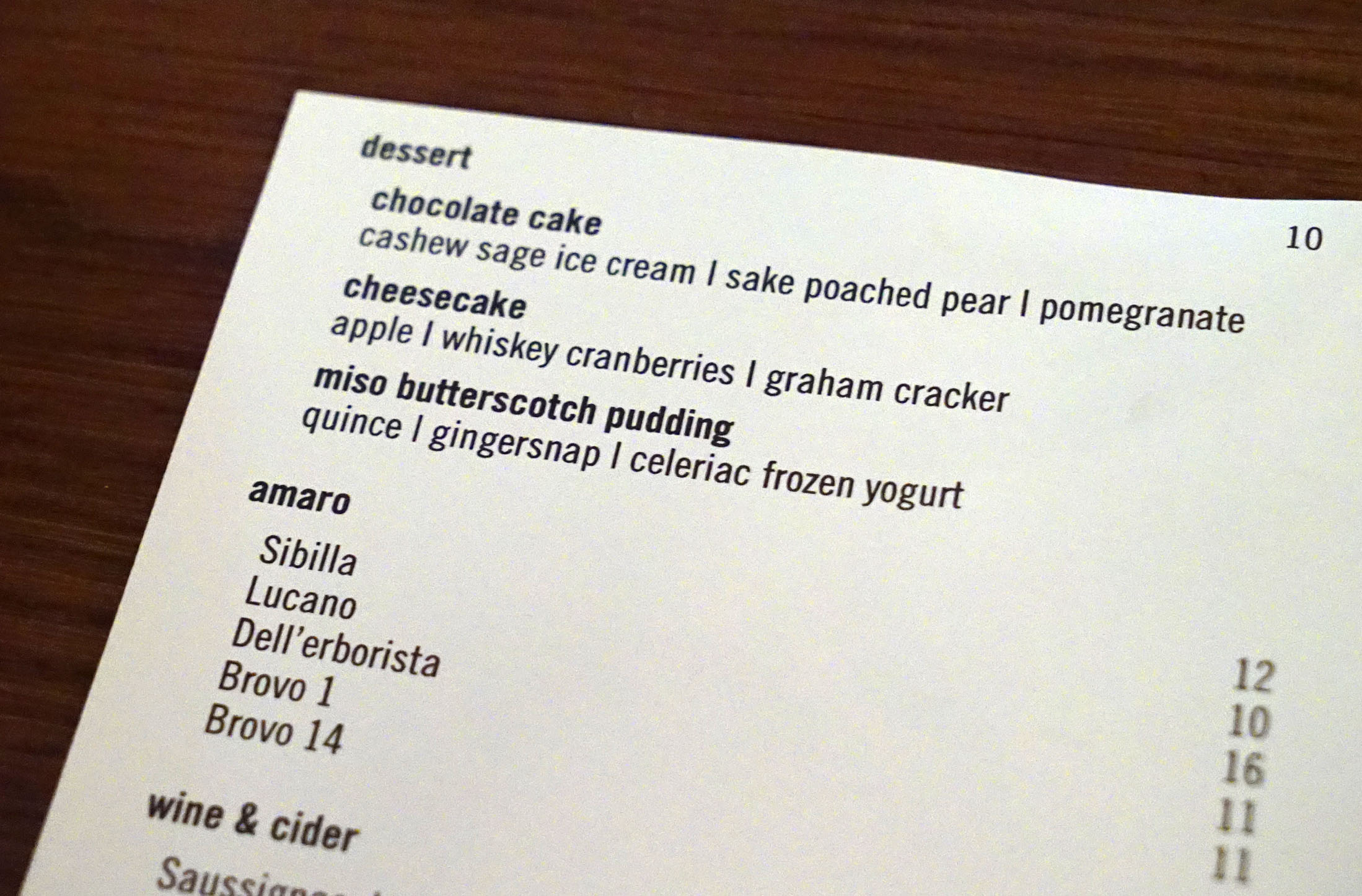
I don’t know how we did it, but we managed to fit dessert into our guts as well. Probably because what we saw on the menu was new and unique. We had to try something.
We went back and forth between two and ultimately left it in John’s hands. He came out with both; the chocolate cake, and the miso butterscotch pudding.
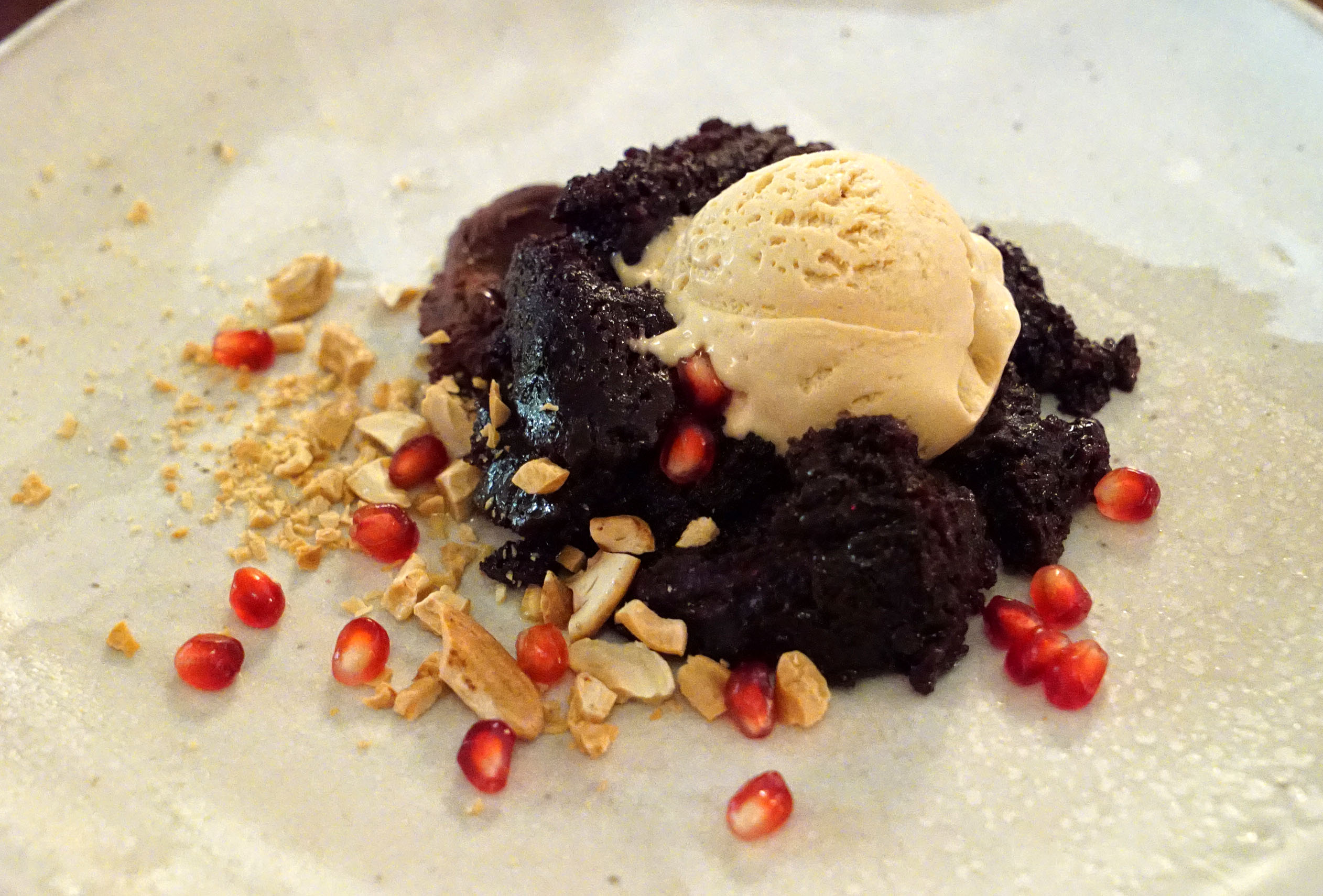
The chocolate cake was mildly sweet because it was expertly cut by the cashew and sage ice cream. The pomegranate balanced the whole thing with a nice acidic and tart zing.
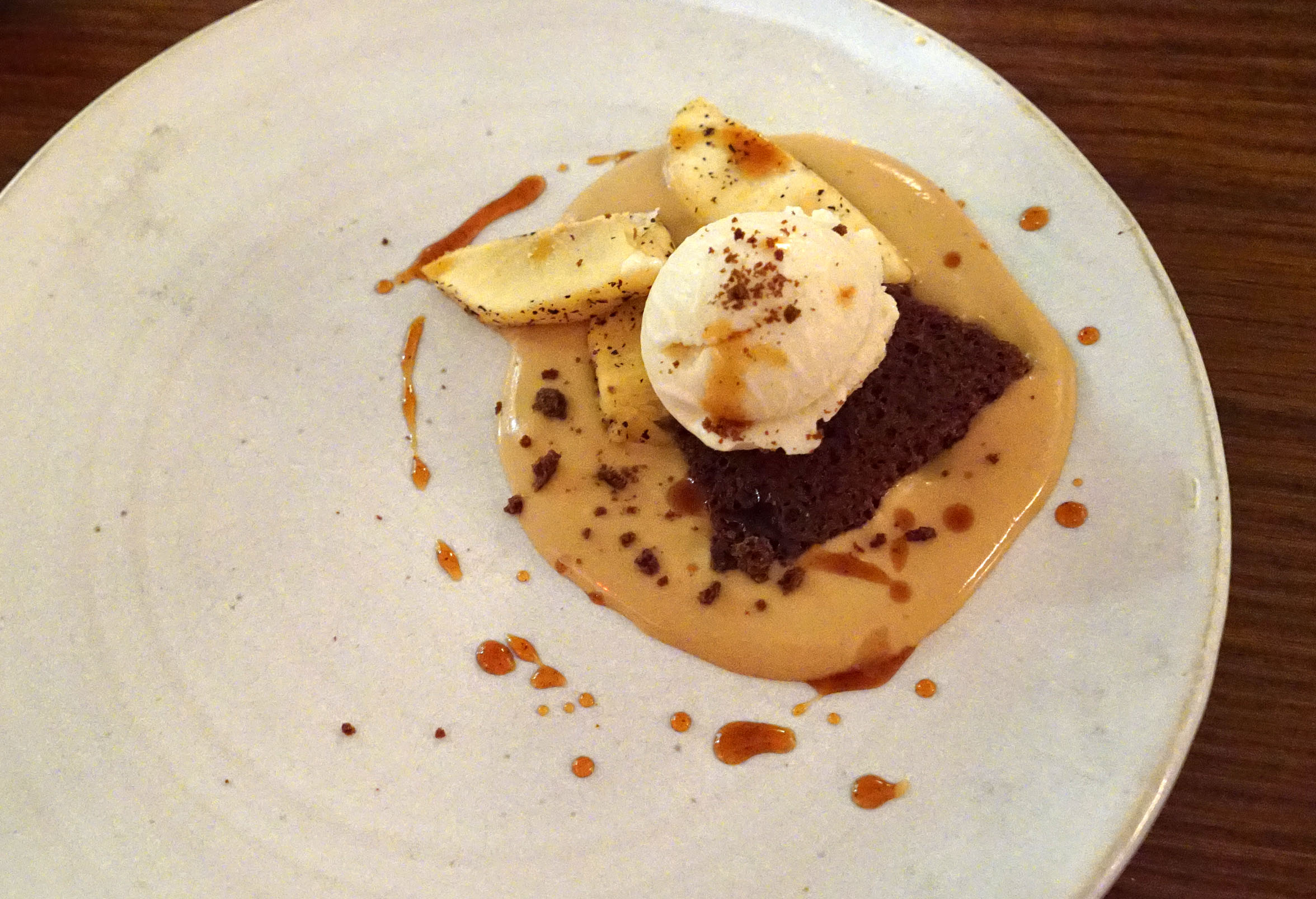
The miso butterscotch pudding is definitely something for the more adventurous dessert person. I seemed to focus my attention more on the celery ice cream than the pudding at first, but that pudding was so freaking good. The ice cream was like a palette cleanser, and the pudding was creamy and velvety – almost like a liquified peanut butter in texture – extremely innovative.
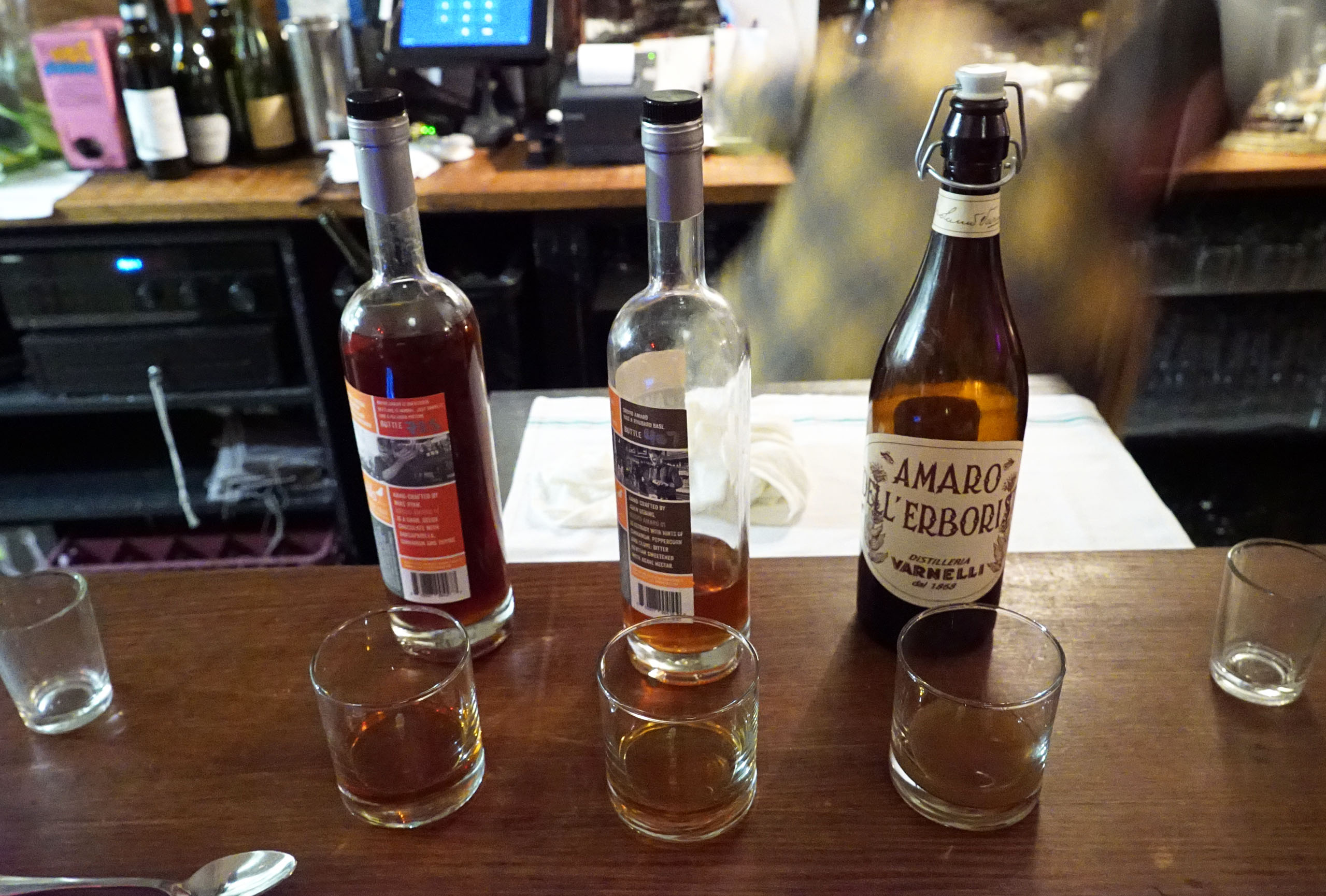
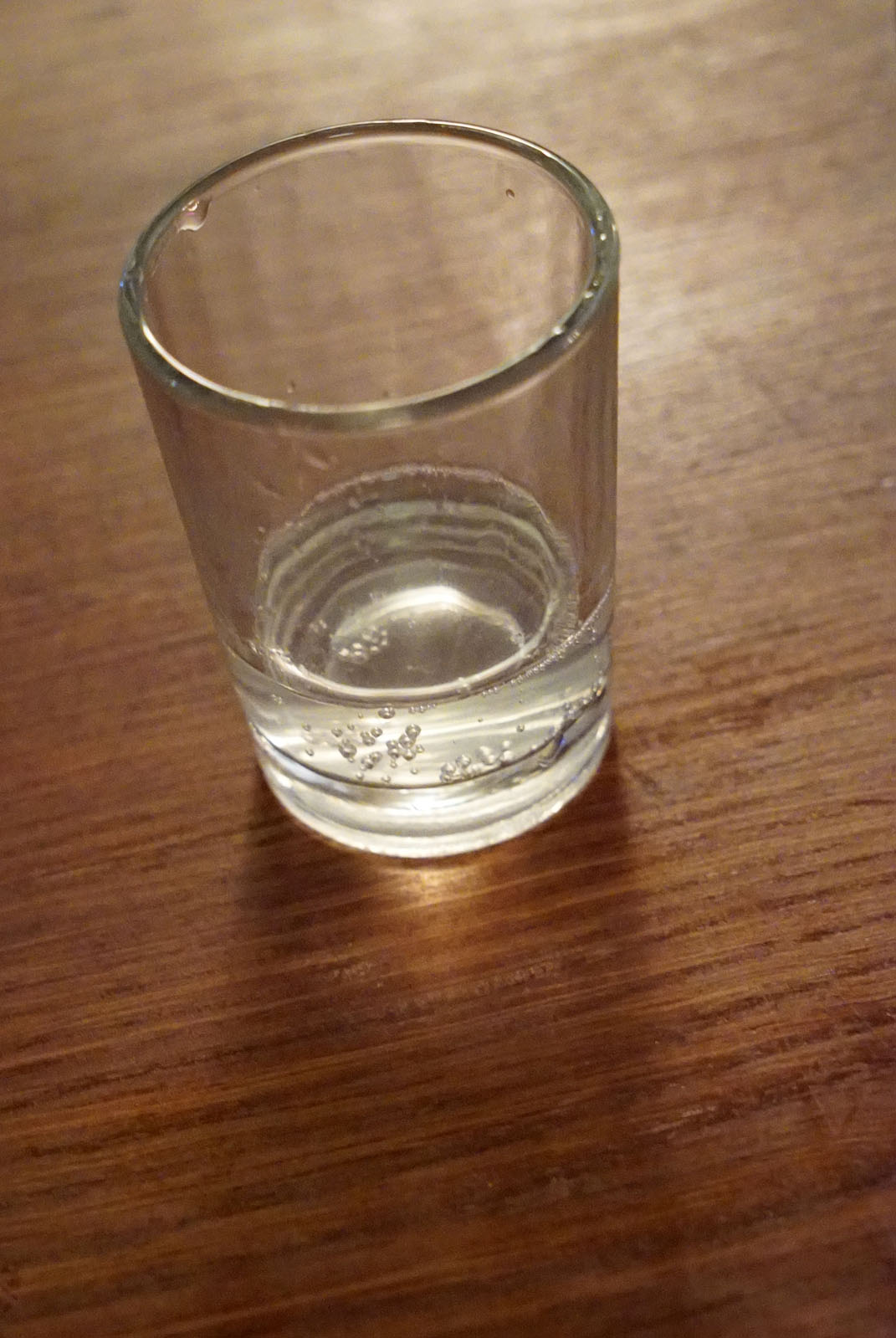
With dessert, we sipped on a trio of amaro selections, as well as a bitter lemon soda digestif that was made in house. Of these, our favorite was the Brovo #1 (center). It had a spicy cinnamon flavor that was easy to drink. And, as is true with the other stuff above, you can learn all about the people who make these spirits as you dine, because John and his staff are happy to share that information with you if you’re interested, like we were.
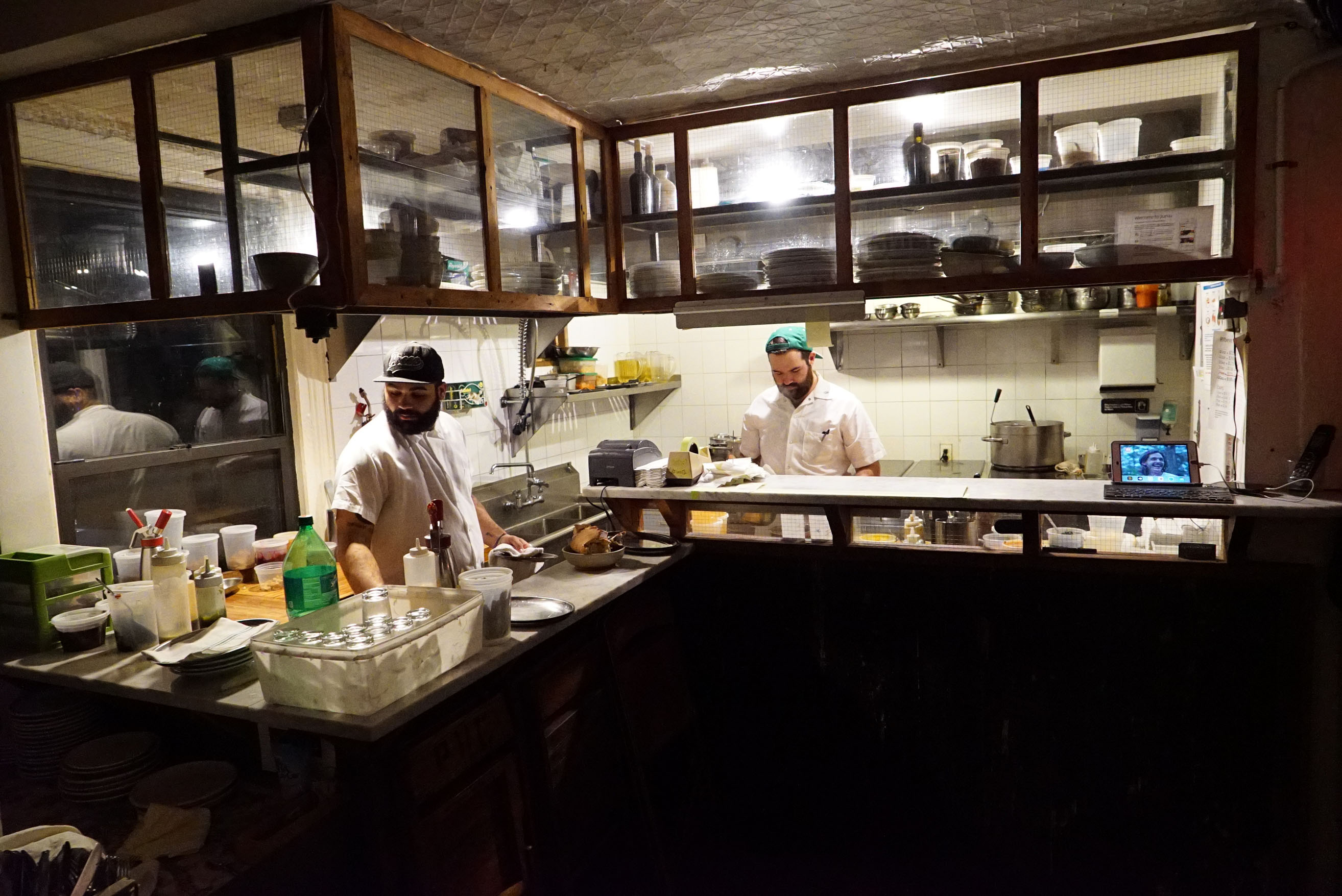
Want to hear something really amazing? This is the kitchen:
So small, yet so powerful. It is run like a well-oiled machine by incredibly skilled mechanics, pumping out what is absolutely some the finest food in NYC.
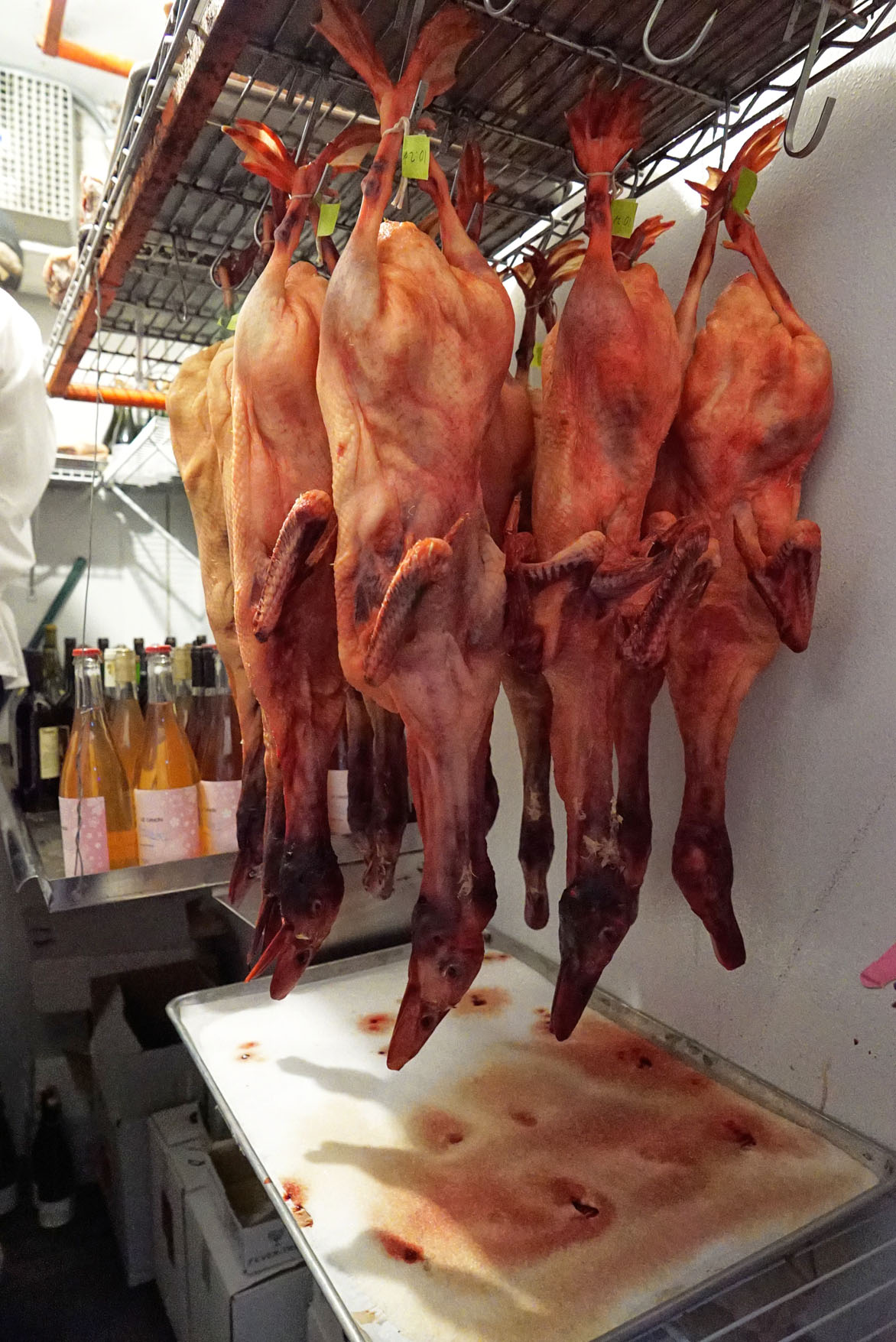
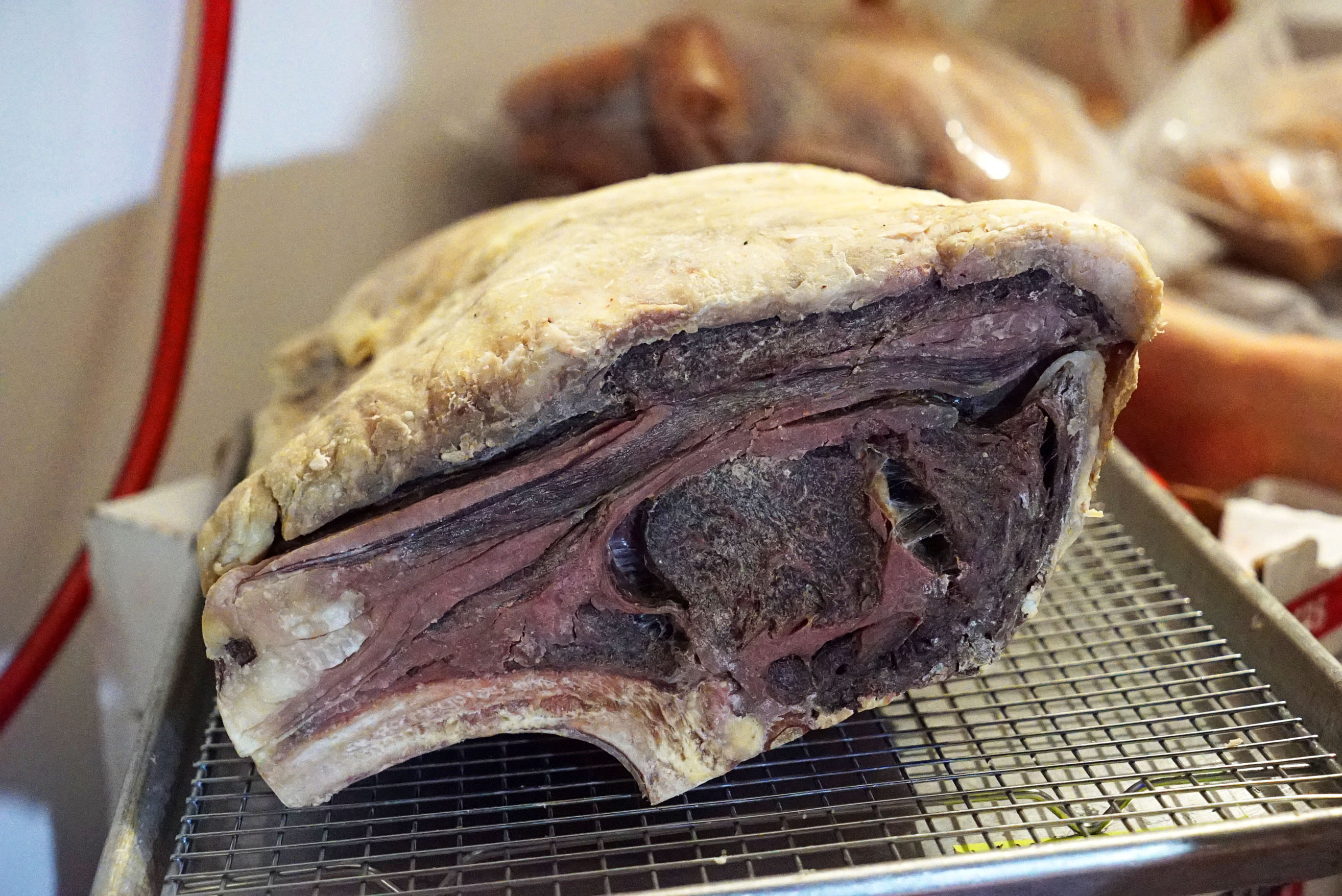
Please do yourselves a favor and go here. They may even give you a quick tour of the aging room out back if you ask nicely. Take a look at the ducks and steaks aging away! I think those ducks are at two weeks, and the steak is something like 86 days.
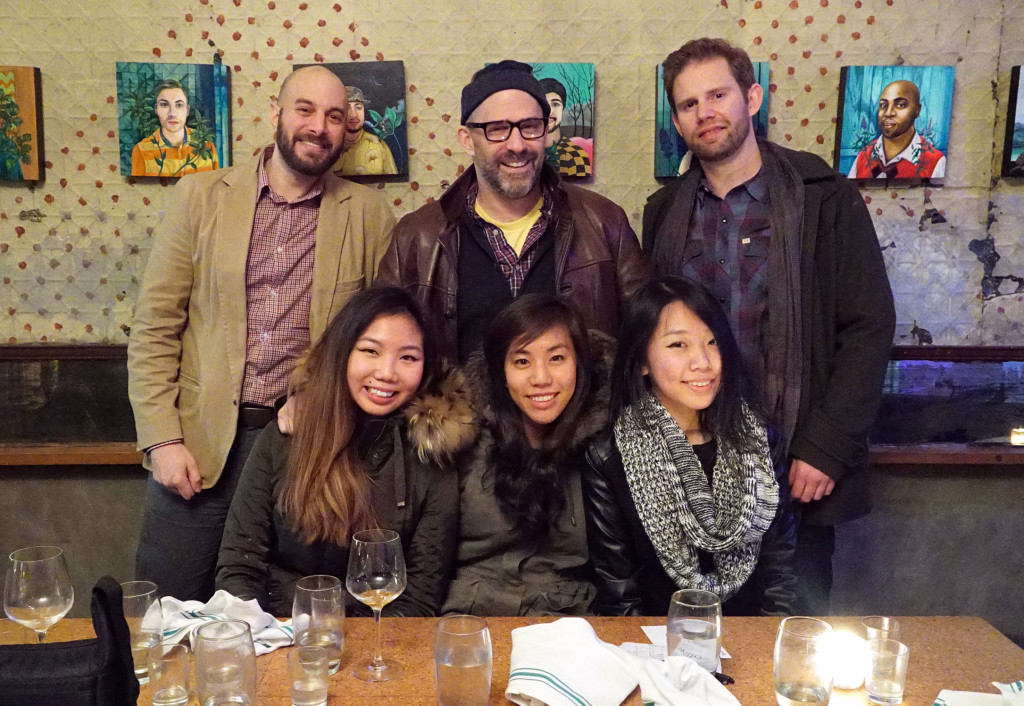
I went back with a crew of food bloggers and instagrammers for a nice meal around the holidays.
Here’s a photogasm of everything we ate, which included a duo of rib eyes – one aged for 35 days and another aged for over 80 days.
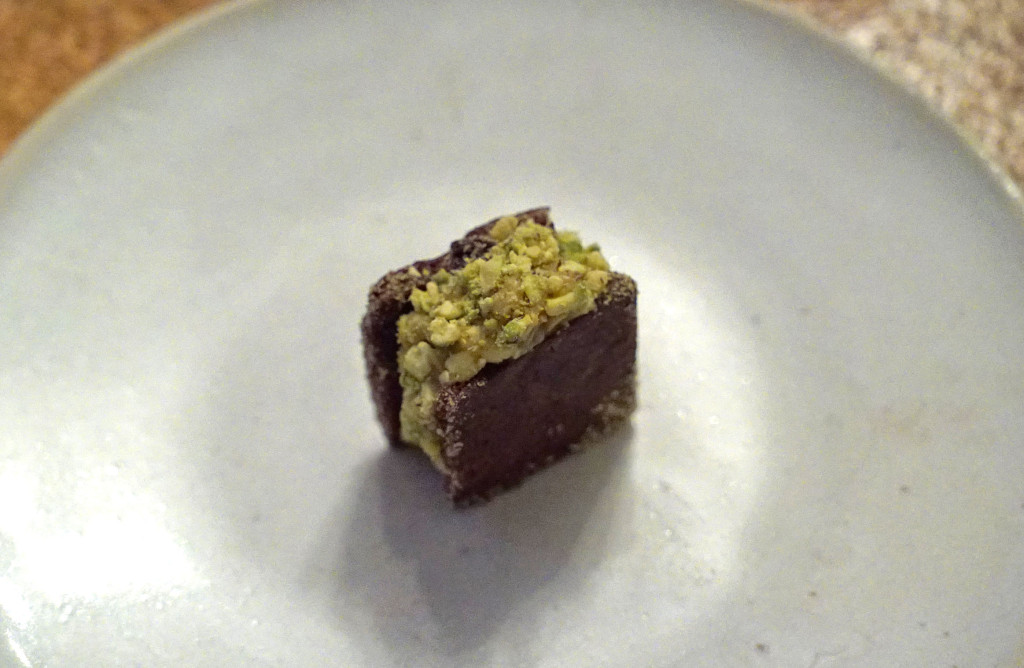
Molasses gingerbread cookies stuffed with fois gras and pistachios:
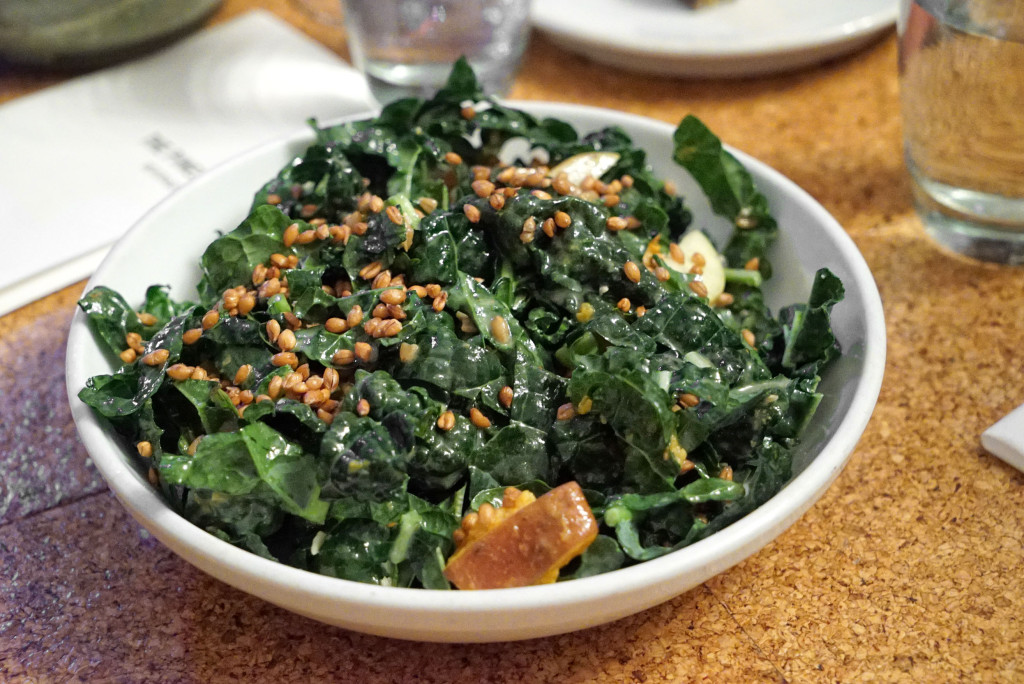
Kale salad with toasted barley:
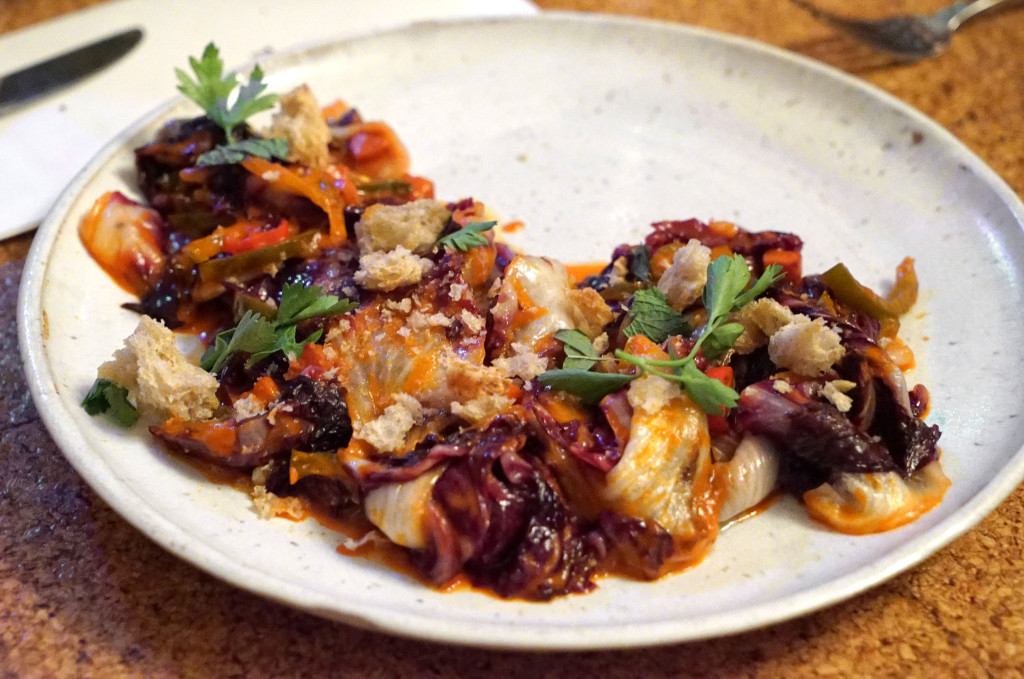
Grilled radicchio salad:
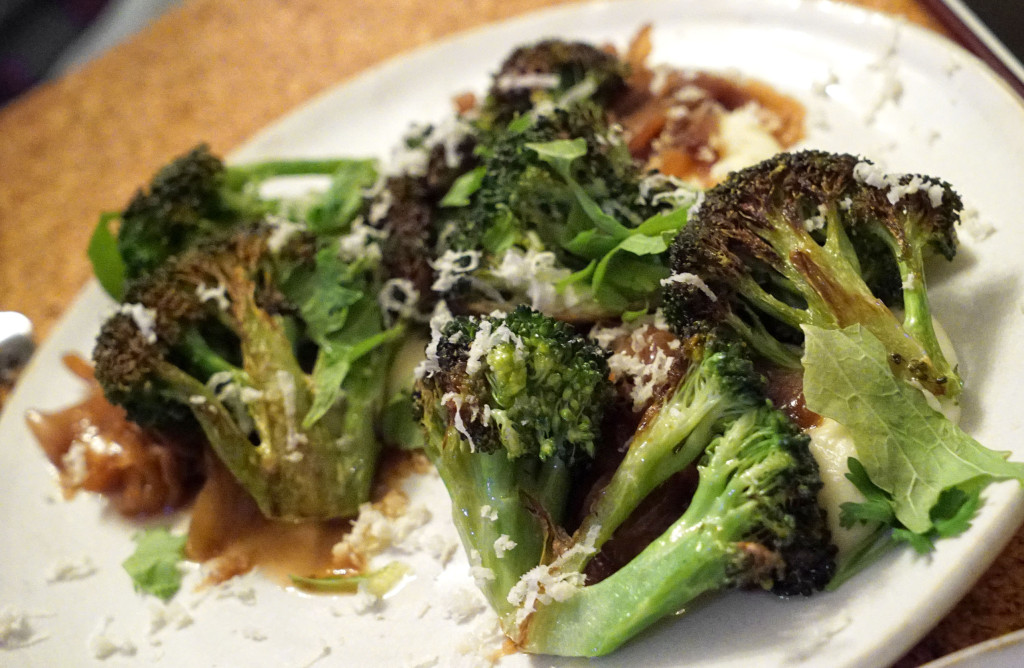
Roasted broccoli with shaved horseradish:
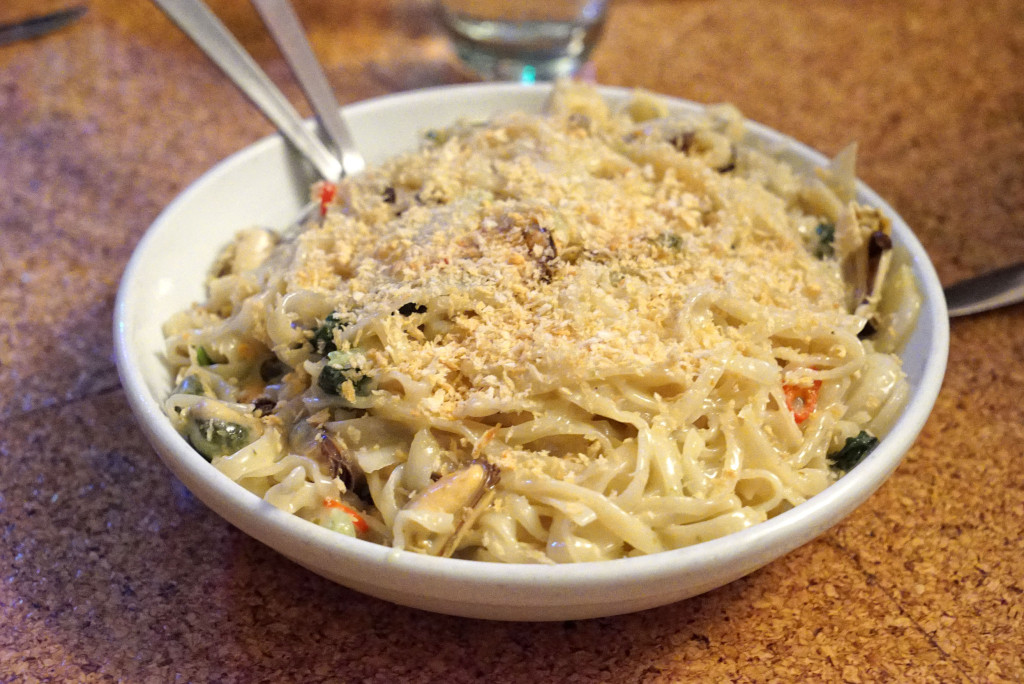
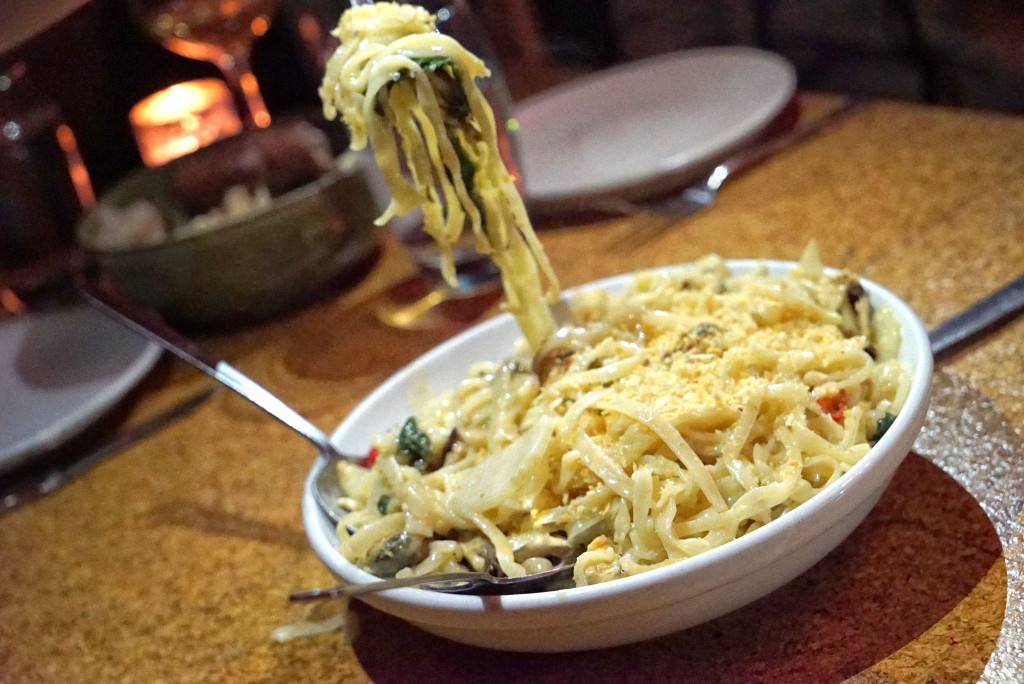
Fettuccine with mussels and chilies in a Parmesan cream sauce:
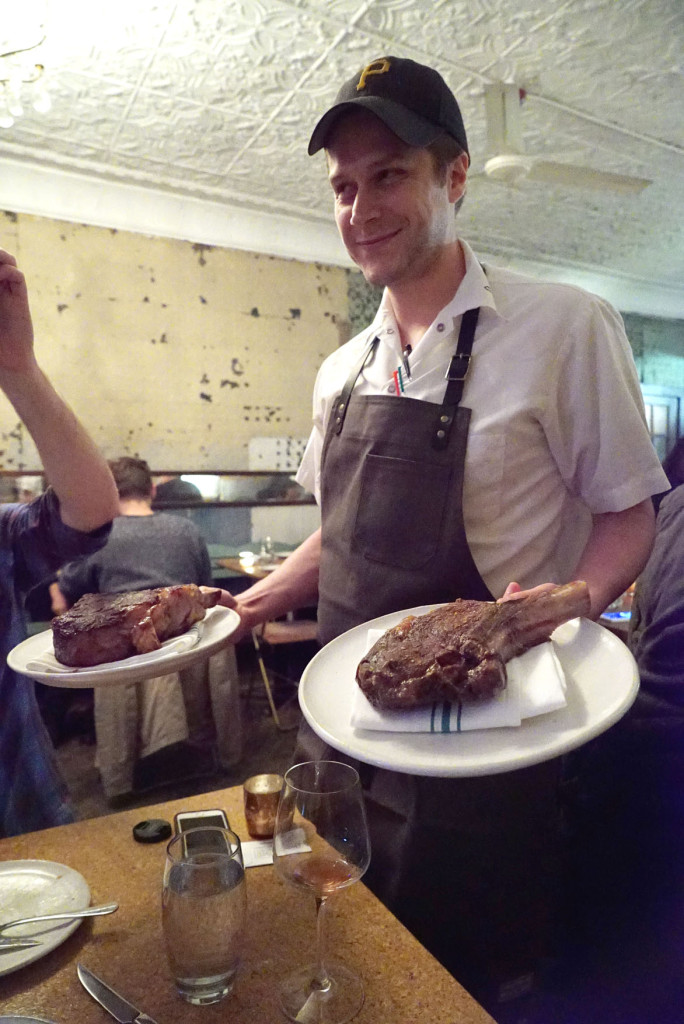
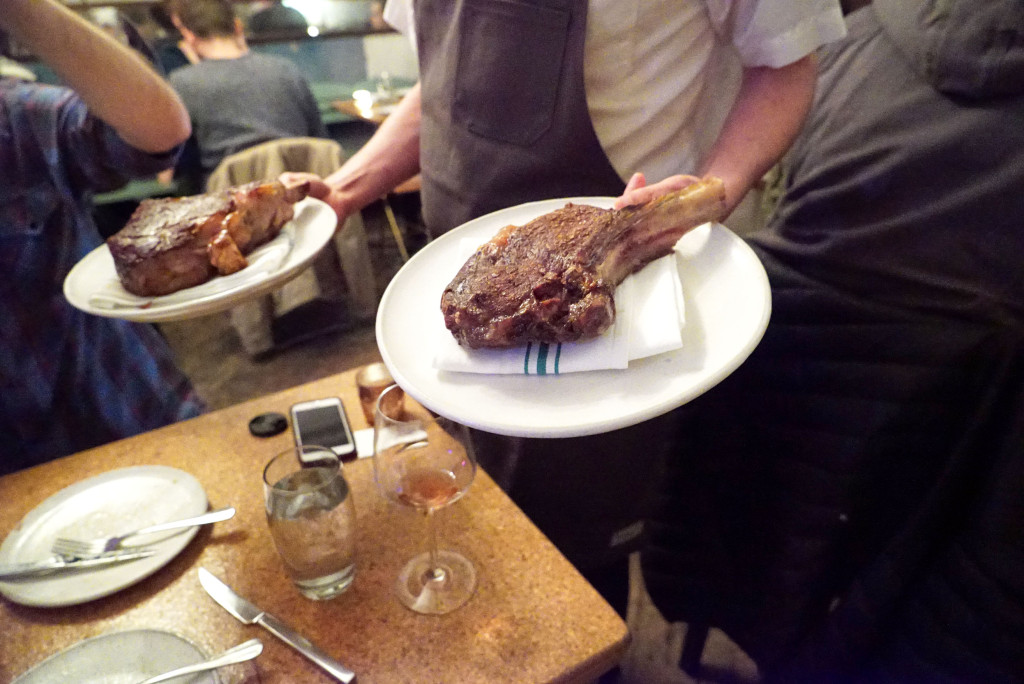
Presentation of beef!!!
Post slicing:
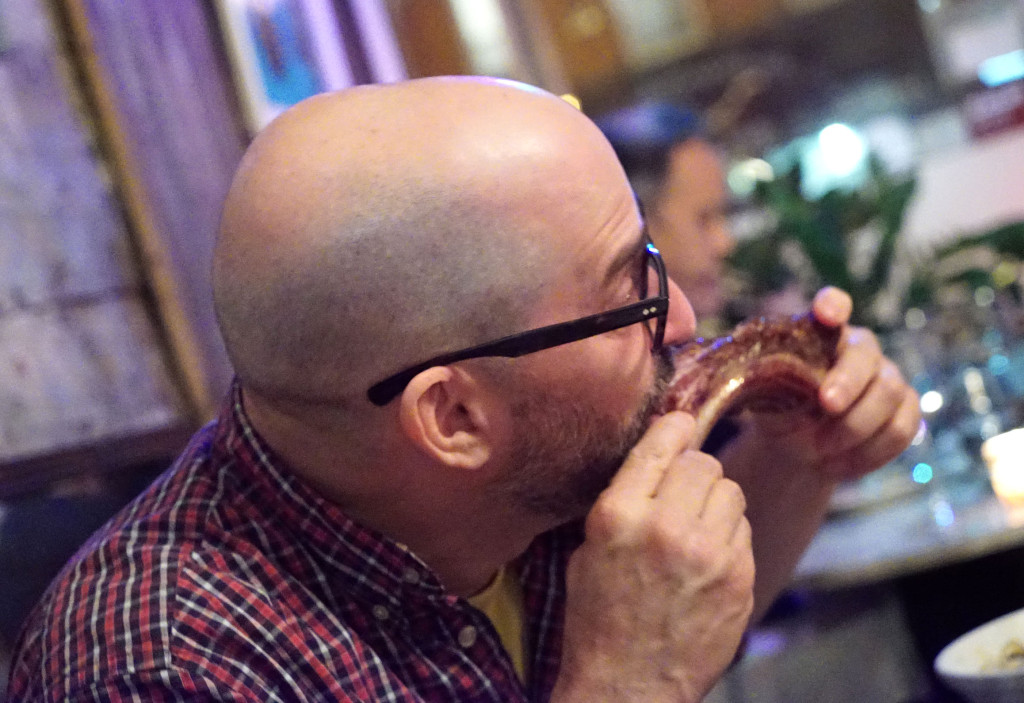
Gnawing on the bone is always fun:
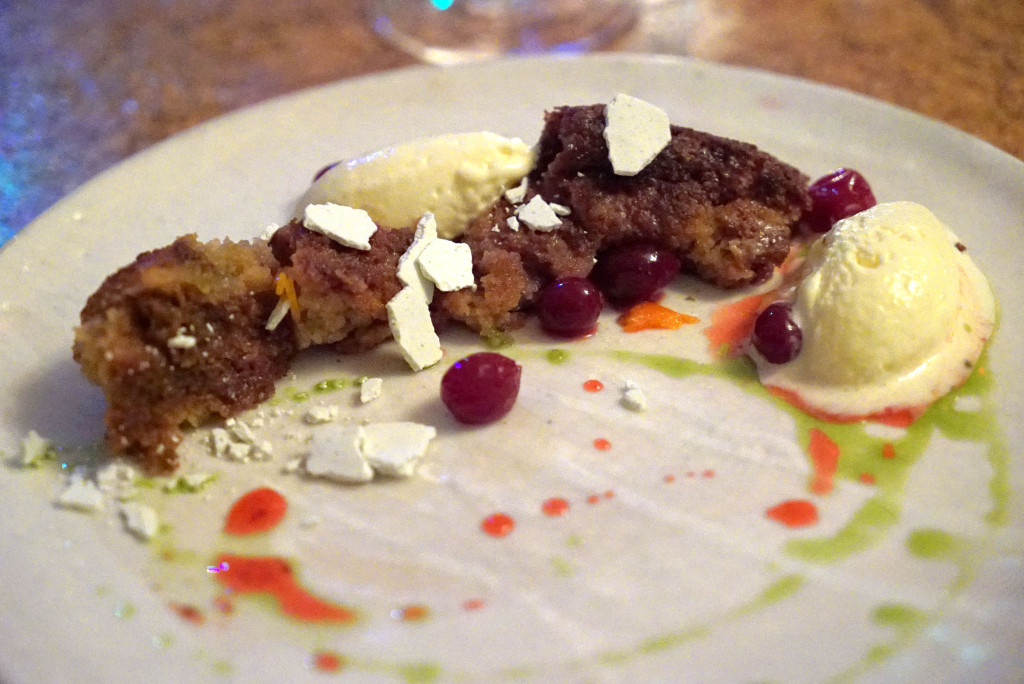
Dessert 1: bread pudding.
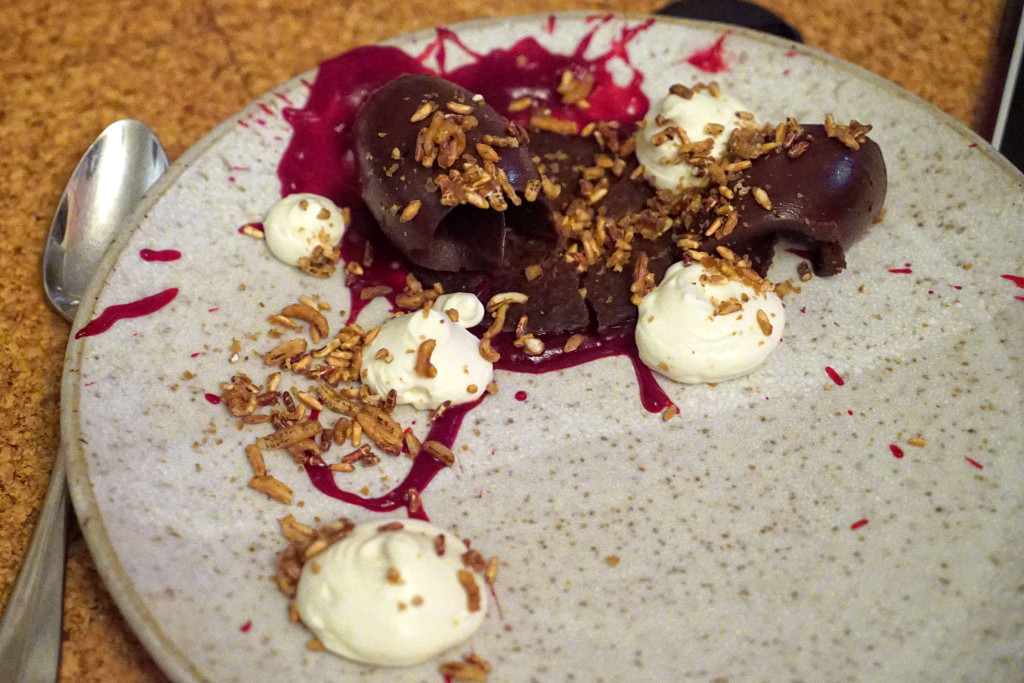
Dessert 2: herbaceous chocolate ganache.
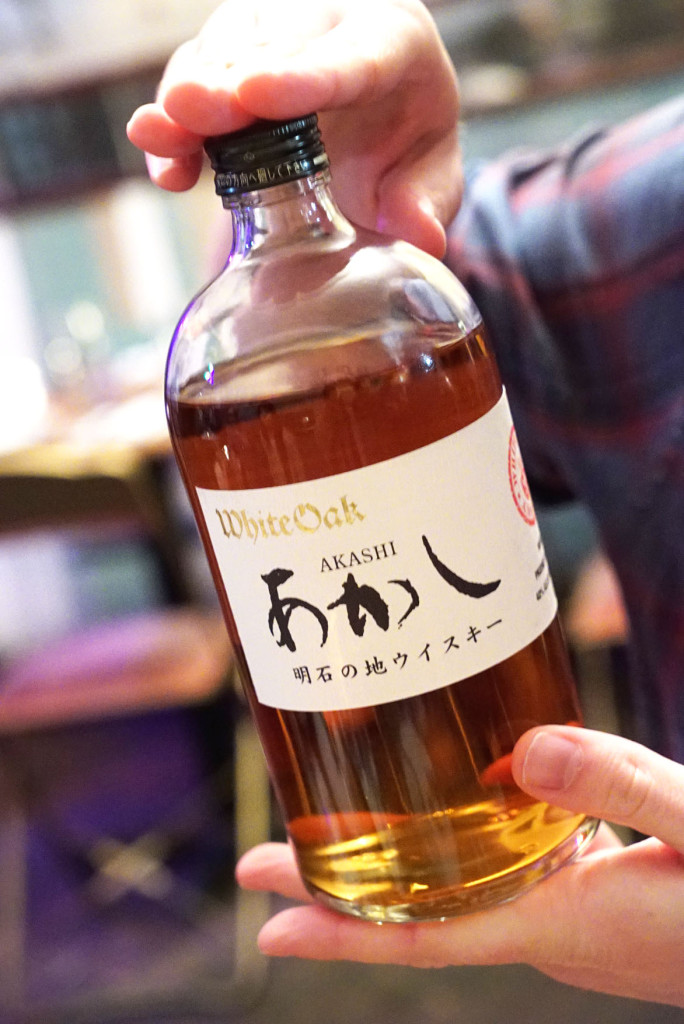
We even drank some Japanese whisky from a bone marrow slide!
Chef John even got in on the action. Marrow luges rule!!!
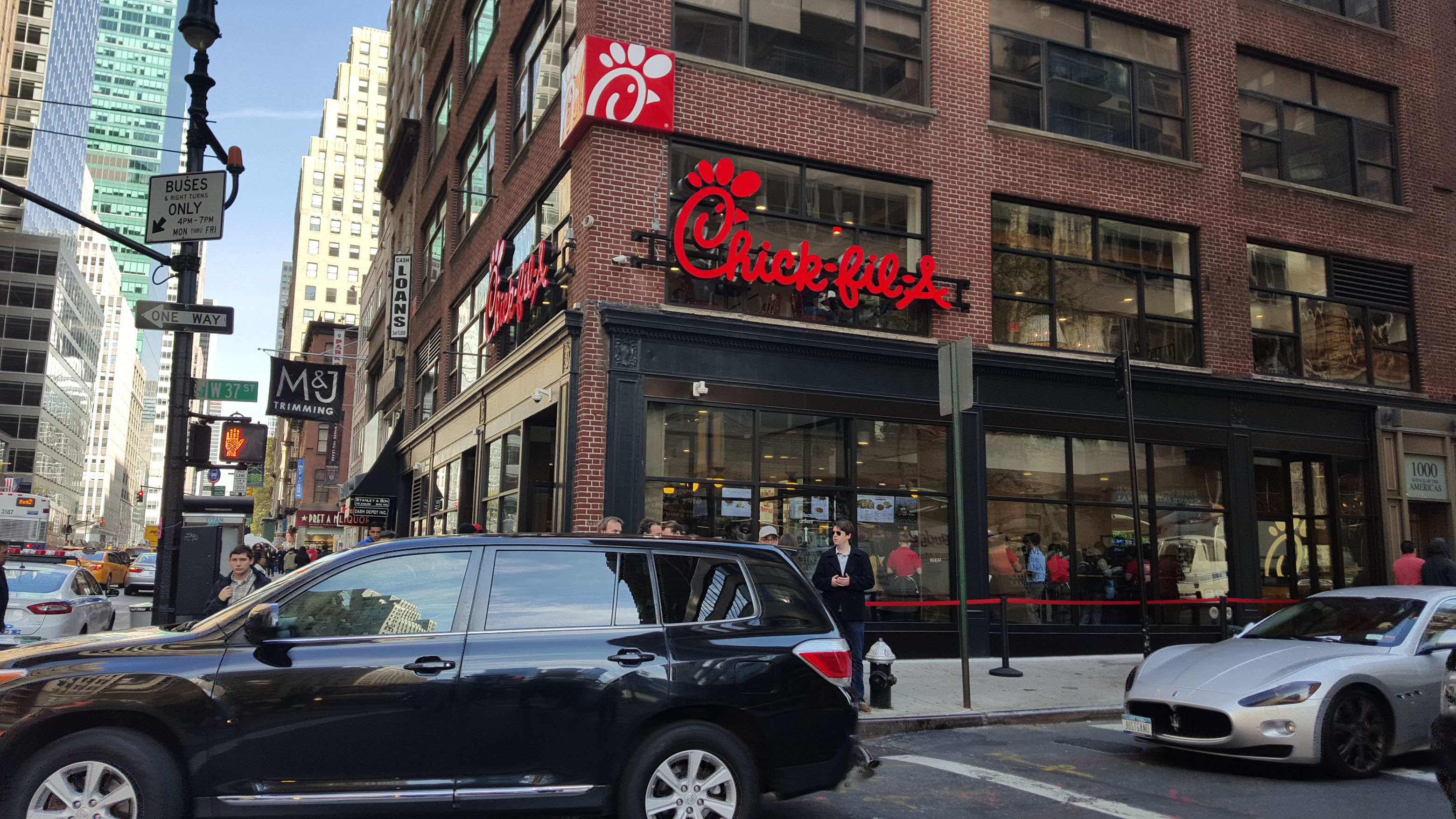
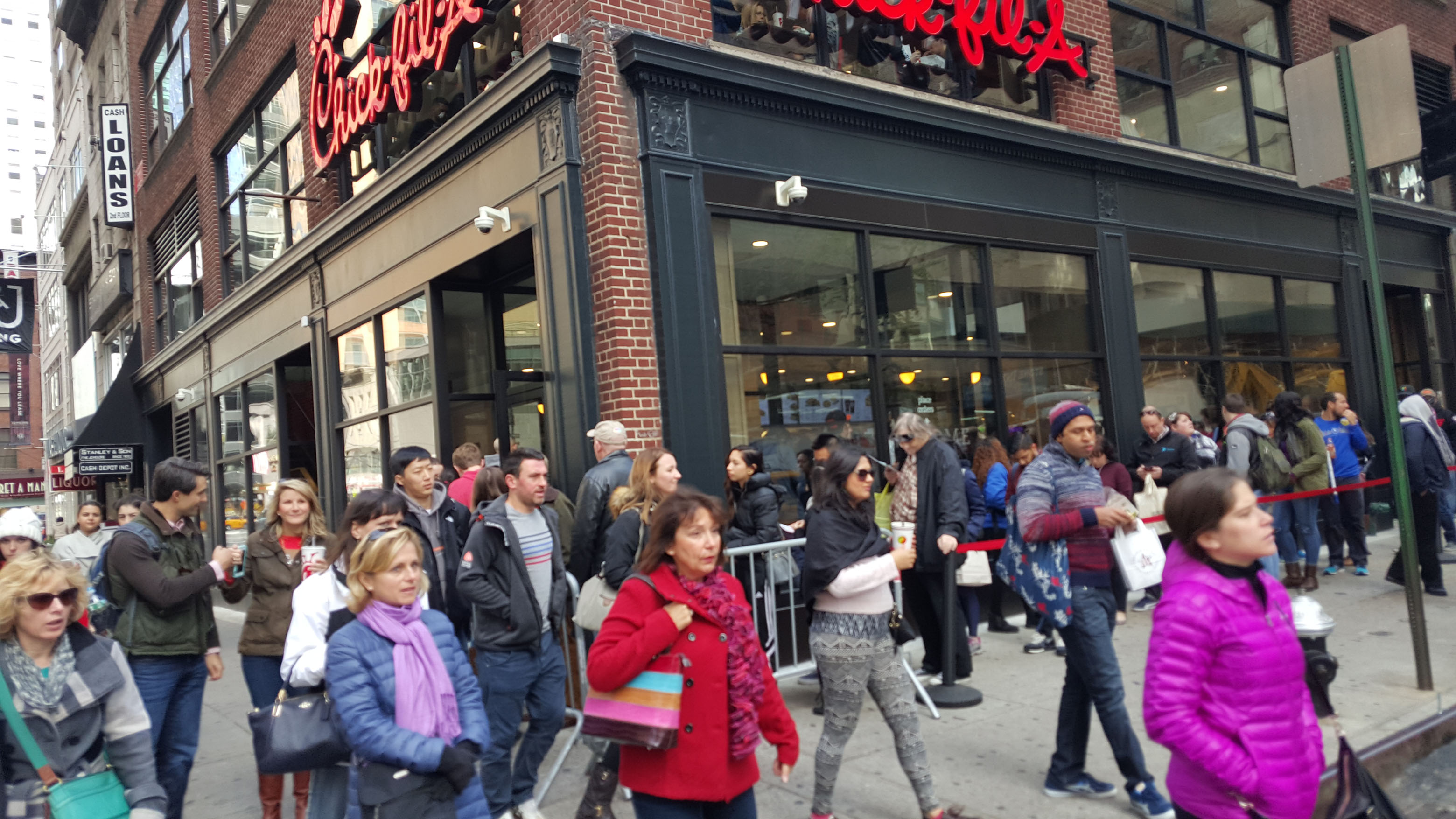
NYC has gone bonkers with the opening of its first official Chick-Fil-A restaurant (not counting the small, kiosk shop in an NYU cafeteria downtown, of course).
Amid equal parts protest and jubilation, the joint seems to be off and running to a great start. If you’re living under a rock and don’t know, Chick-Fil-A is all about the “traditional marriage” (knee slap) of fried chicken and sandwich bread to form the holy and spiritual union of said ingredients into one righteous chicken sandwich.
Needless to say, lines have been out the door since said doors have been open.
I ran down at noon on a Saturday and, to my surprise, the line ended AT the door. I was literally in the vestibule at the end of the line, and was told that the experience would only take about 10 mins. That was an accurate estimate, if not a “conservative” (kneeslap) one. I was probably back out the door, food in hand, within 8 minutes.
But my timing was impeccable. One could even say my timing was, oh, I don’t know… divinely inspired? Perhaps providential? As I left, I turned and noticed that the line had grown to go OUT the door and around the block:
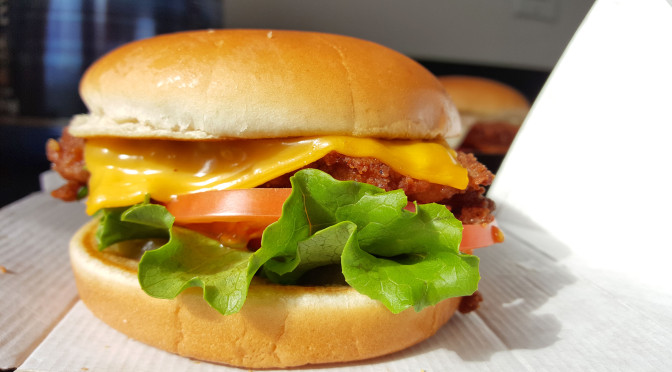
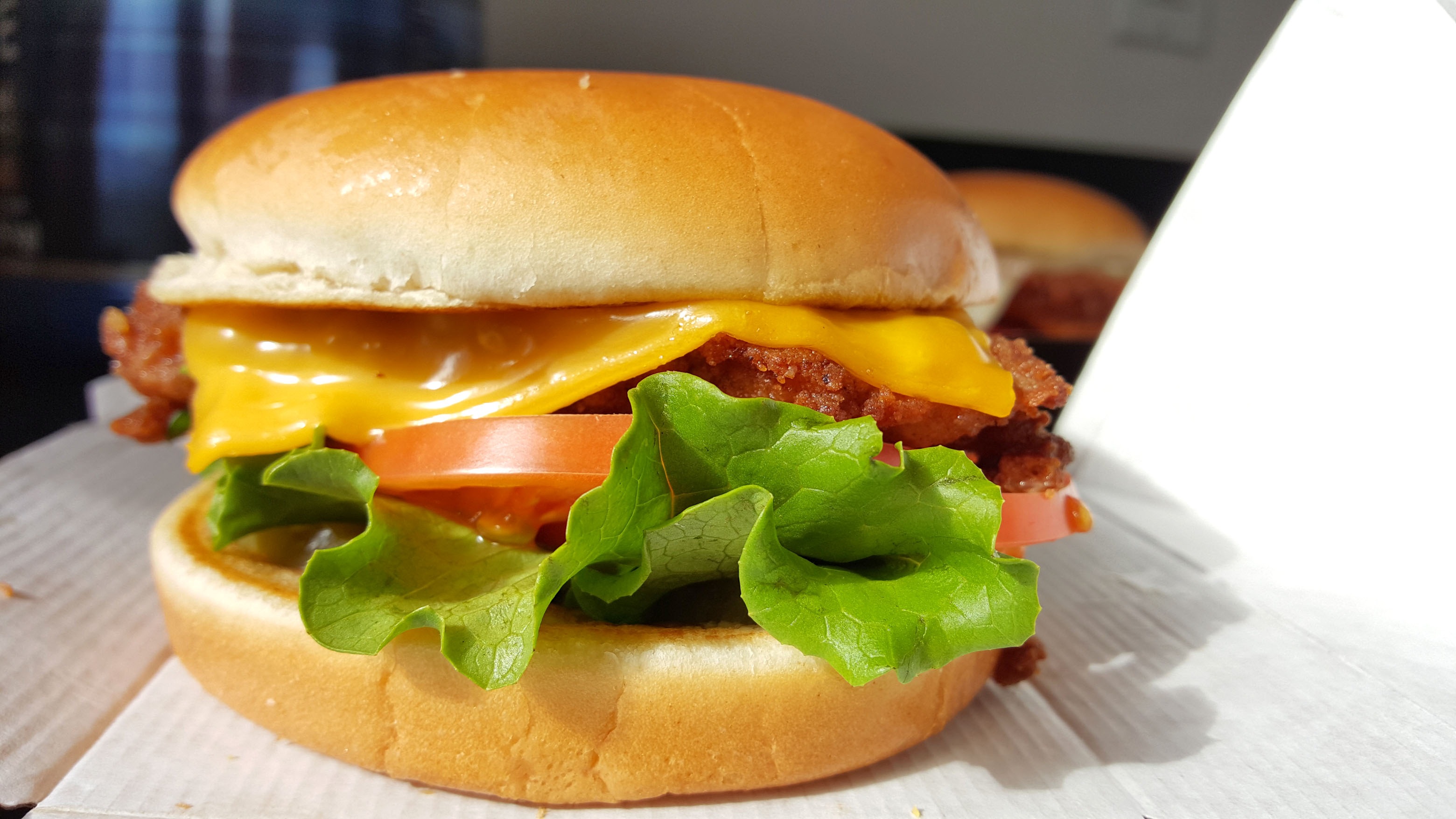
Anyway, I ordered about $18 worth of food, which consisted of the traditional sandwich with cheese, lettuce and tomato:
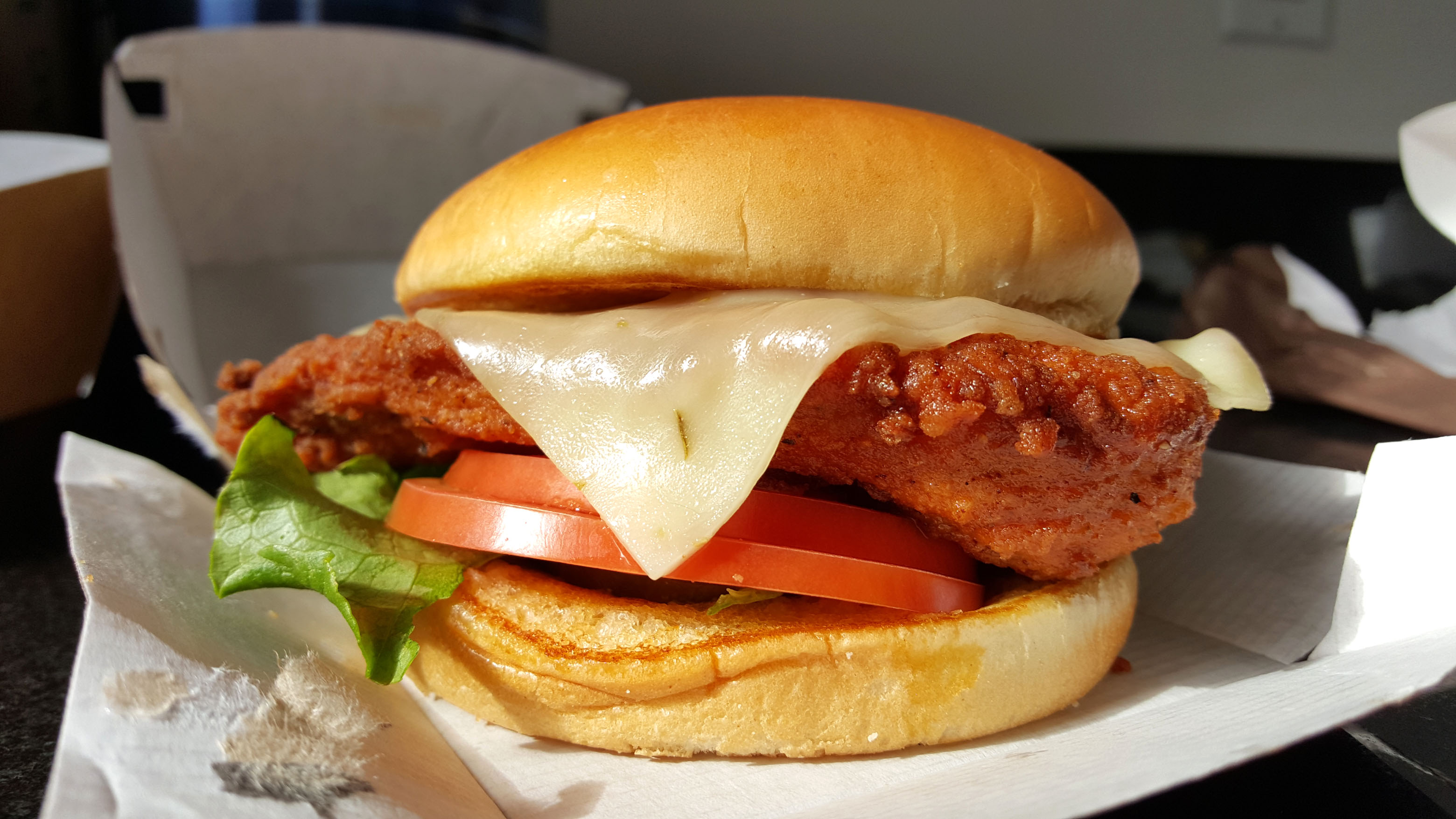
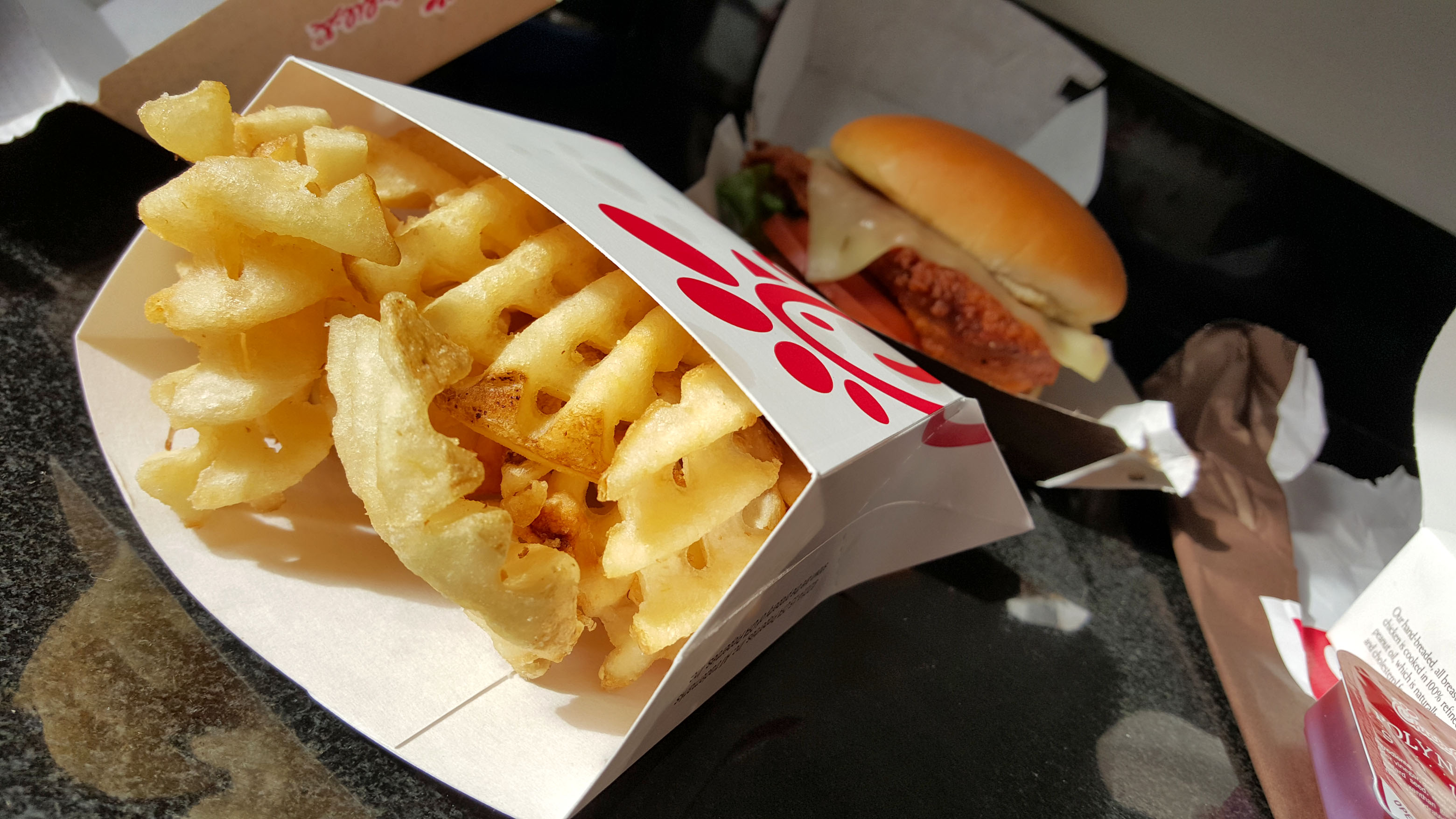
The spicy sandwich with a spicy breading, pepper jack cheese, lettuce and tomato:
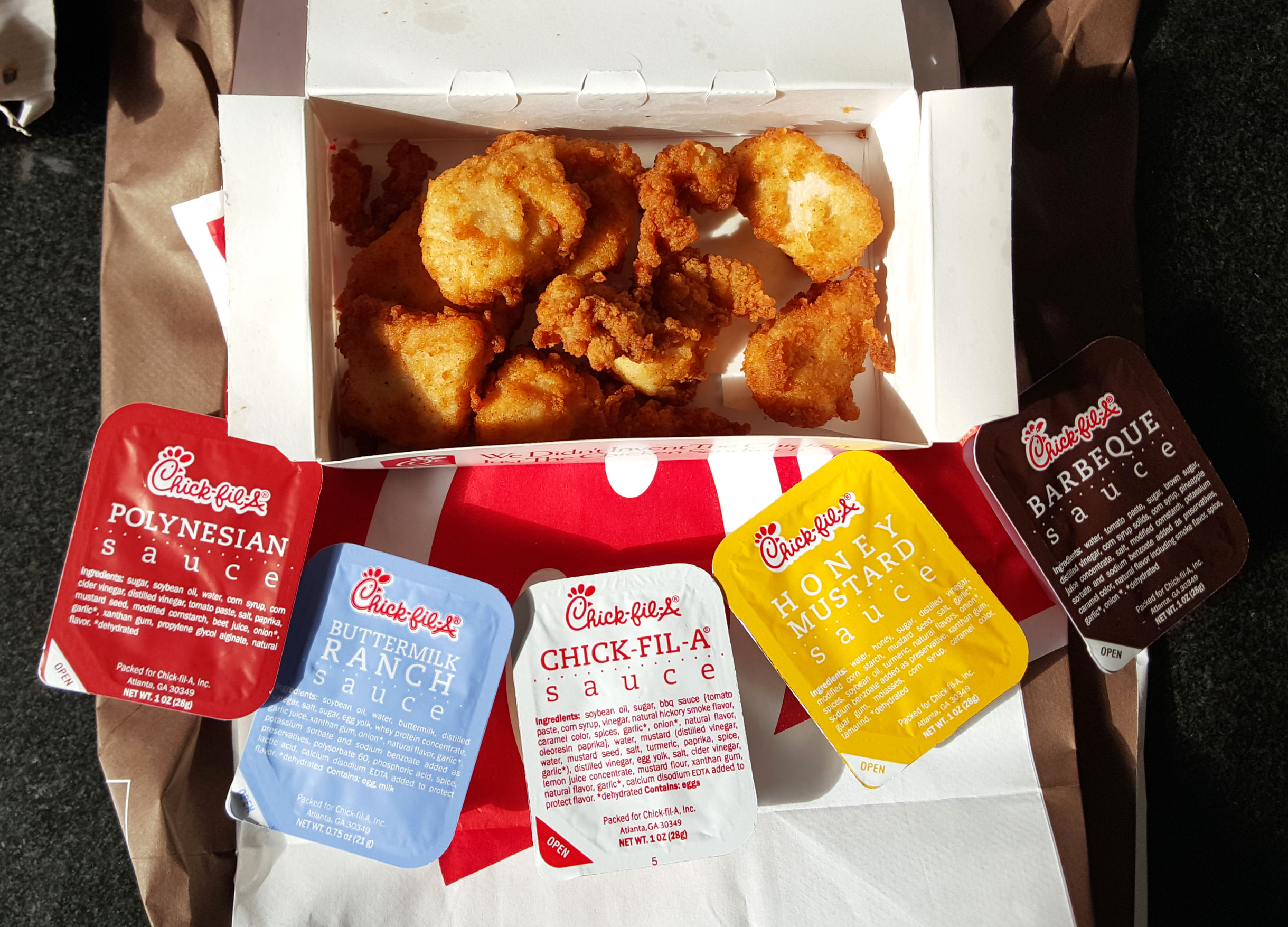
An 8-piece nuggets, with all the sauces:
And a medium order of waffle fries:
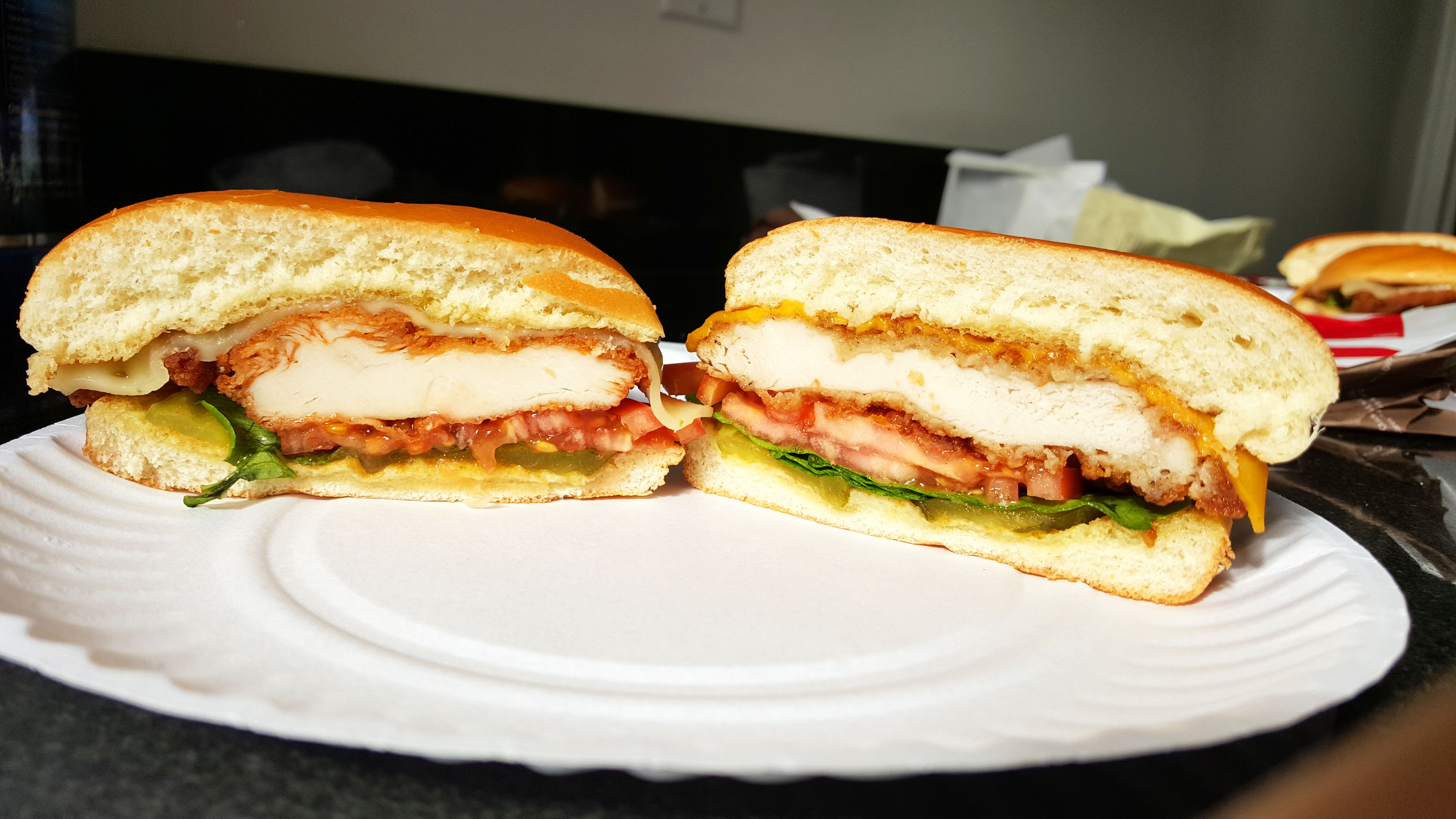
As far as fast food goes, this comes in on the upper 75th percentile, I’d say. I’ve had better, but I’ve definitely had worse. The chicken is tender and juicy, but when competing in NYC with the likes of places like Fuku+ for a chicken sandwich, there’s really no choice. Anyway take a look at the inside:
In conclusion I’ll say this: sort of like the entire Chick-Fil-A controversy itself, there’s just more hype and loud voices than actual substance when it comes to the taste of Chick-Fil-A. If you’re like me and you absolutely MUST try something that looks interesting, for fear of missing out, then go for it! But since this place is somewhat out of my hood, I will probably be sticking to Fuku+ from now on, which is literally just a few streets away and SO much better.
One last thing I’ll say is that the service truly was incredible, which is something that Chick-Fil-A is known for. Everyone was super friendly and accommodating, and the whole process was really fast. If I may say so, it was probably one of the best fast food buying experiences of my life. So there you have it.
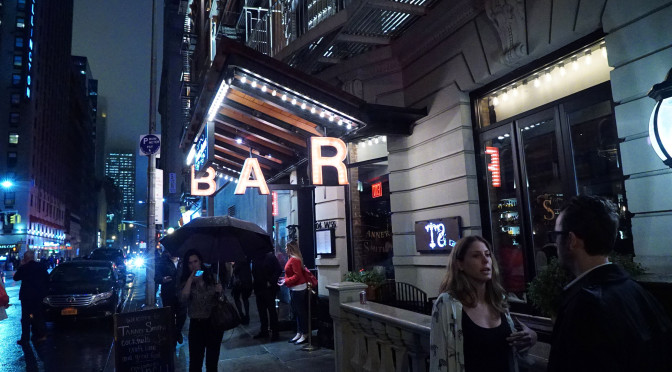
This joint is home to some really excellent cocktails.
I had been eyeballing the place for a while, and when a buddy was in town and staying at a hotel nearby, we decided to go in.
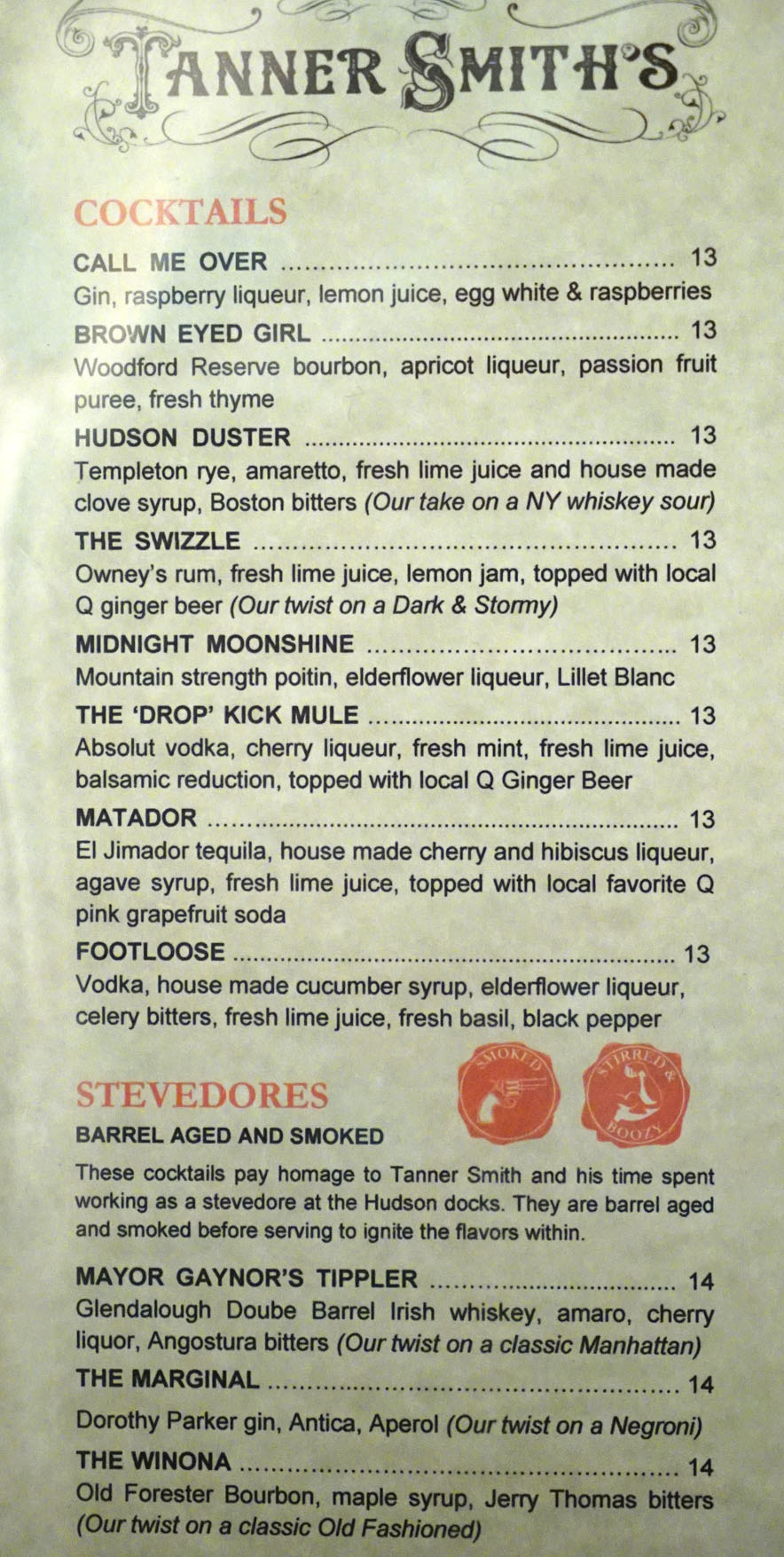
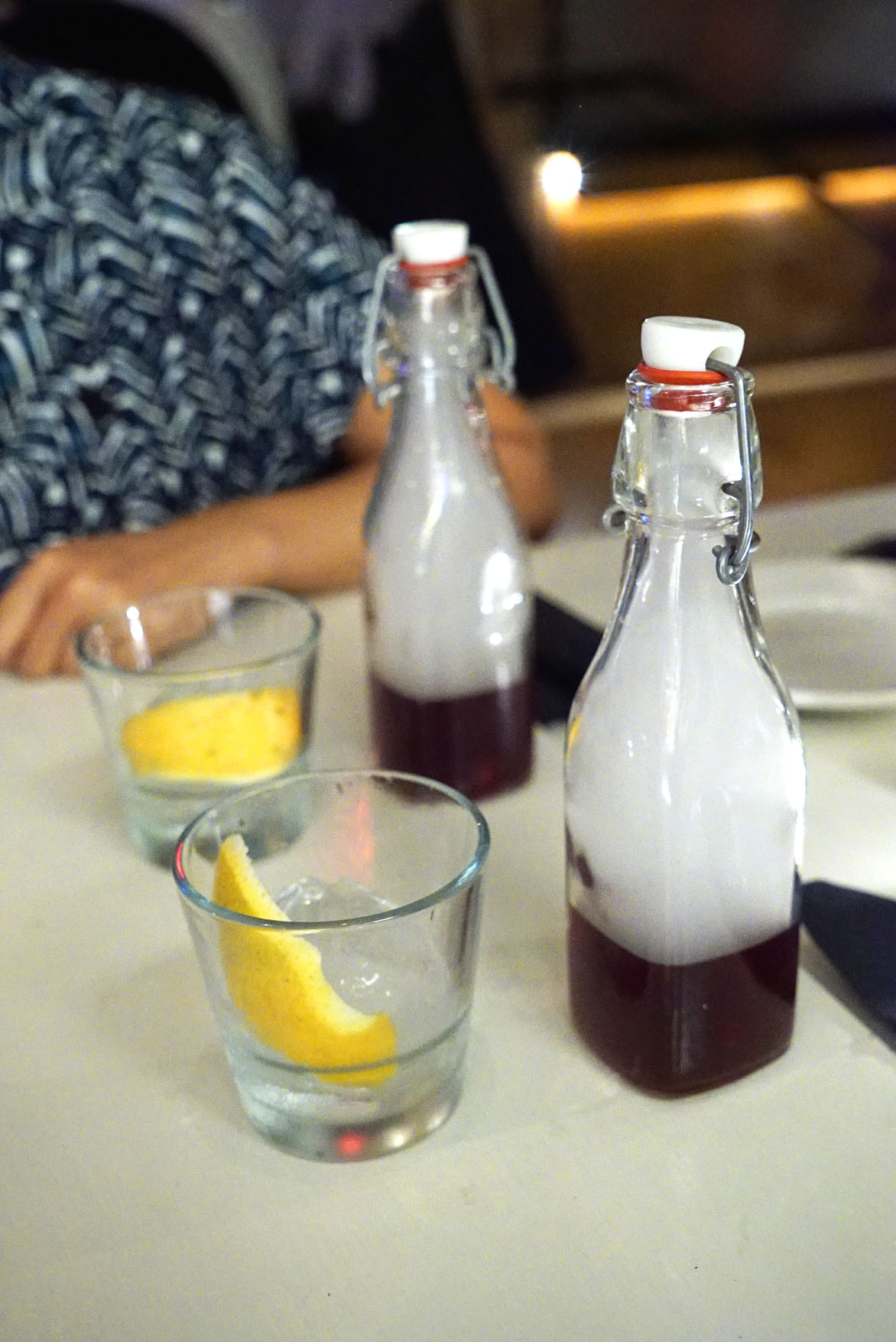
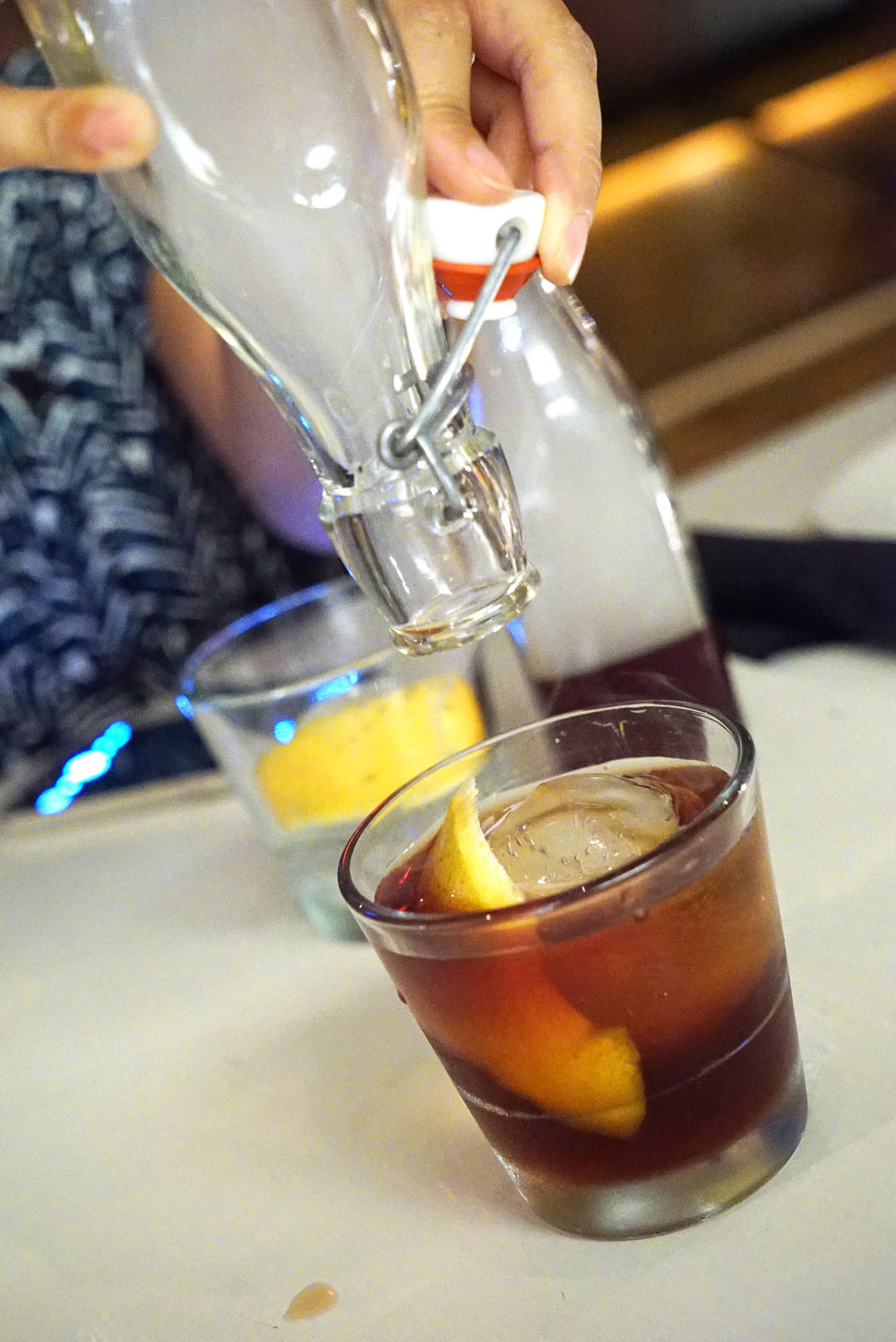
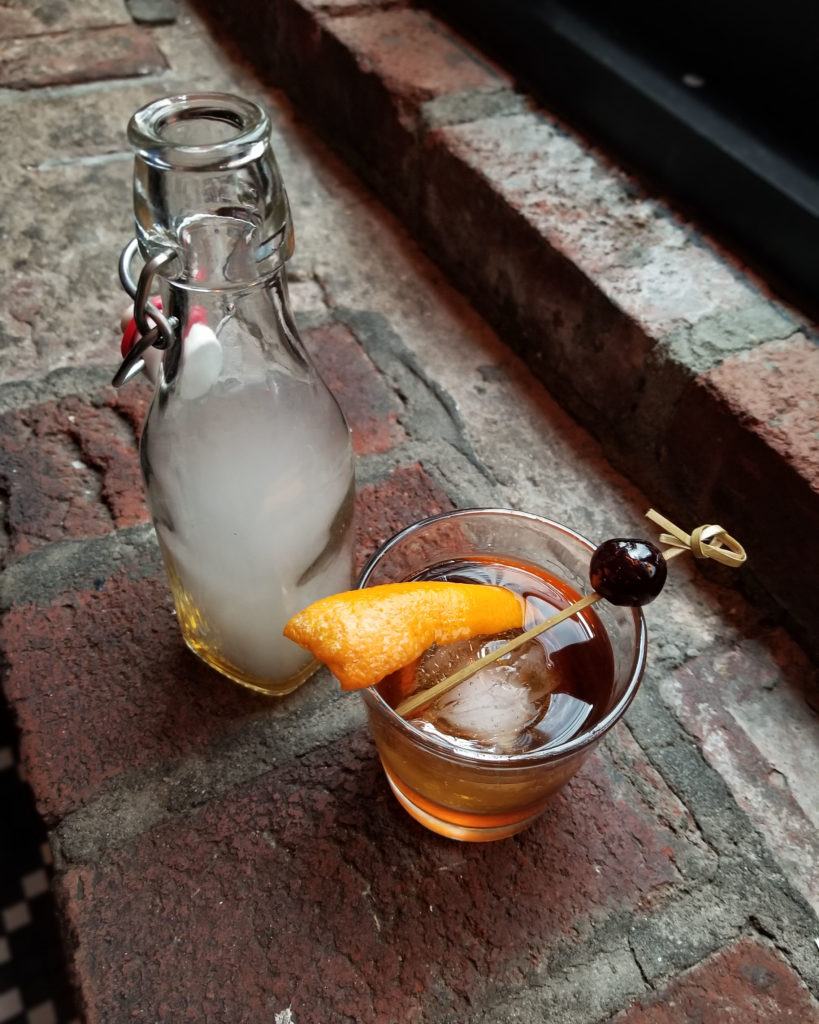
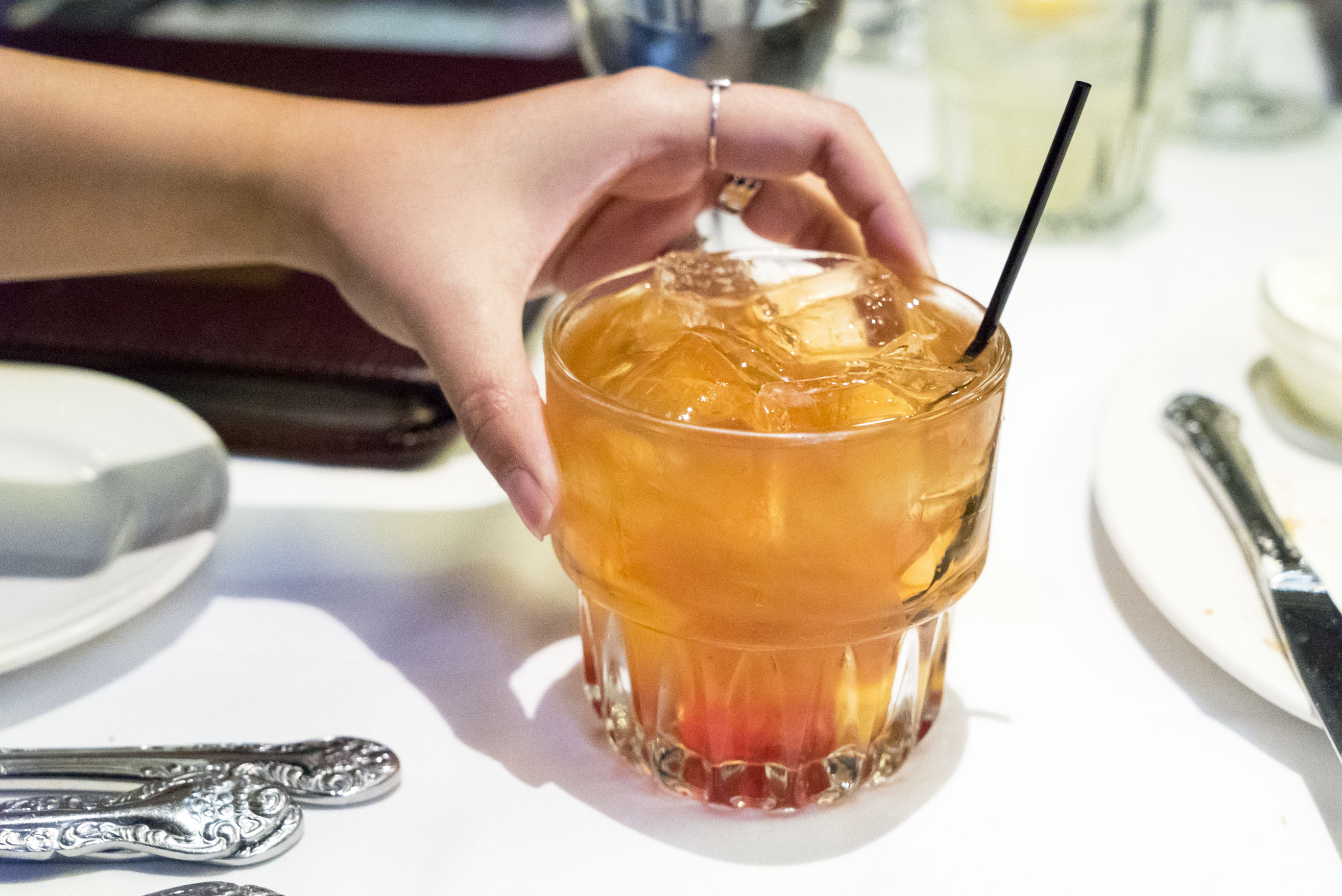
Our bartender, Albert, mixed up the absolute, hands-down best Old Fashioned I have ever tasted. On the menu it is called a Winona, and is made with a few flourishes to the standard ingredients, the most impressive of which is its delivery in a smoke infused bottle.
Watch as the smoke billows out and creates a nose for the drink as you sip it:
I’m not big on the whole “mixology” thing. Mixing drinks is cool but I still call it bartending. Bartending with interesting ingredients doesn’t require a scientific-sounding name. It’s all about pairing flavors, and that’s what any good bar tender should be able to do. Albert is one of those people who takes pride in what he does. He isn’t afraid to try new things and come up with new drinks. I even told him about the Germain Scotsman. His initial reaction was “mixing peaty scotch with anything is blasphemy,” but he embraced the drink with an open mind and found that he actually liked it! It works on many levels.
Anyway, after another visit here for drinks with ANOTHER friend who was in town and staying in midtown, my wife and I finally made it over to try out some of the food.
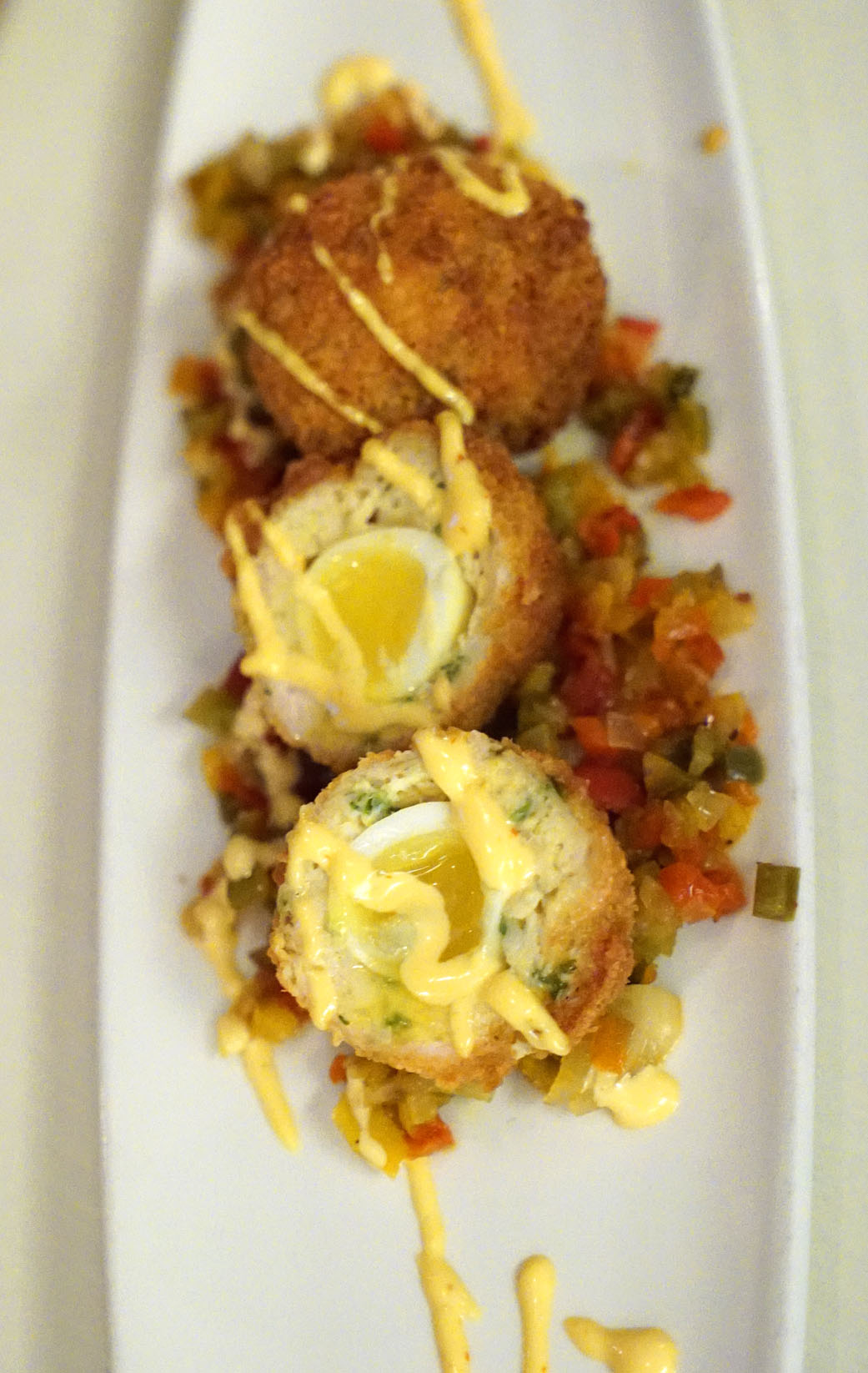
We started with the scotch eggs. These seem to be made with quail eggs, so the ratio of egg to breading is a bit off. While they tasted really good, had good seasoning and crunch, the egg just got lost a little bit in the breading.
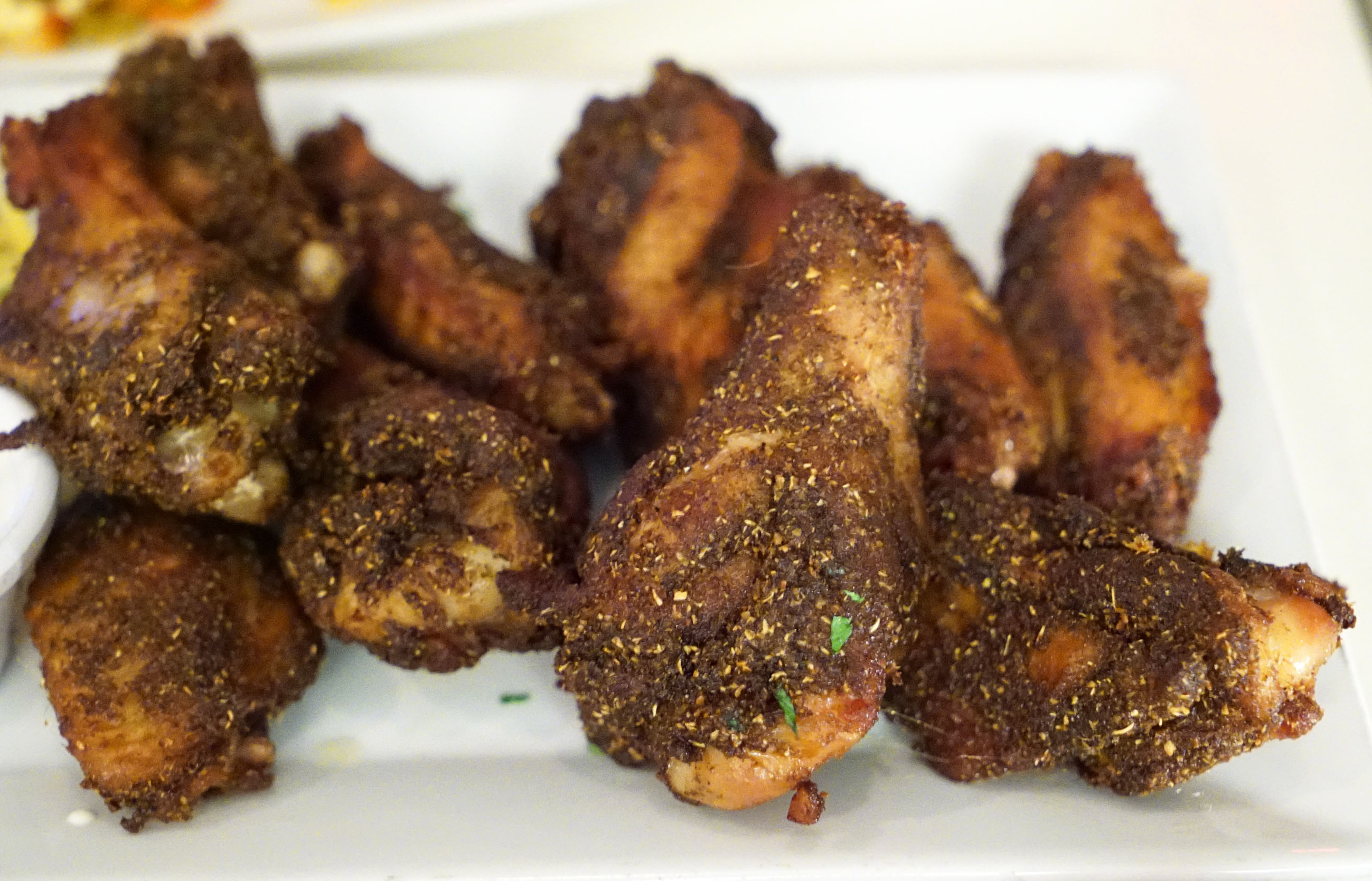
The dry rub chicken wings had nice flavor. If I had to guess, it was some kind of mild jerk spice rub. Very interesting. Good crunch on the outside and nicely cooked inside, and served with a celery and jicama slaw.
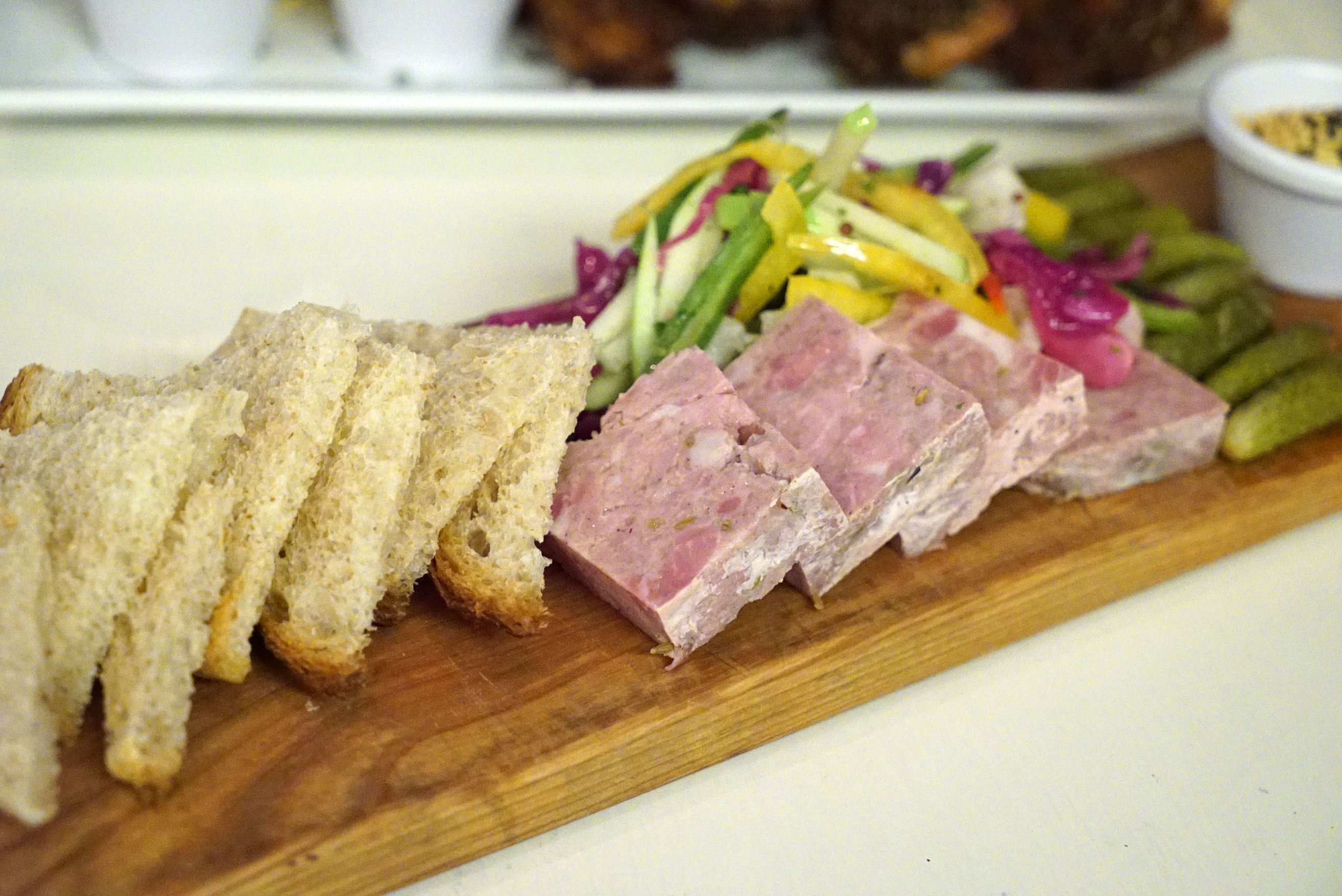
We also dug into the pork terrine. The meat was a bit more solid than I expected. When stuff like this is served with toast, I expect more of a spreadable texture. The taste was nice, however, and paired nicely with the mustard and jicama, pepper and cabbage slaw.
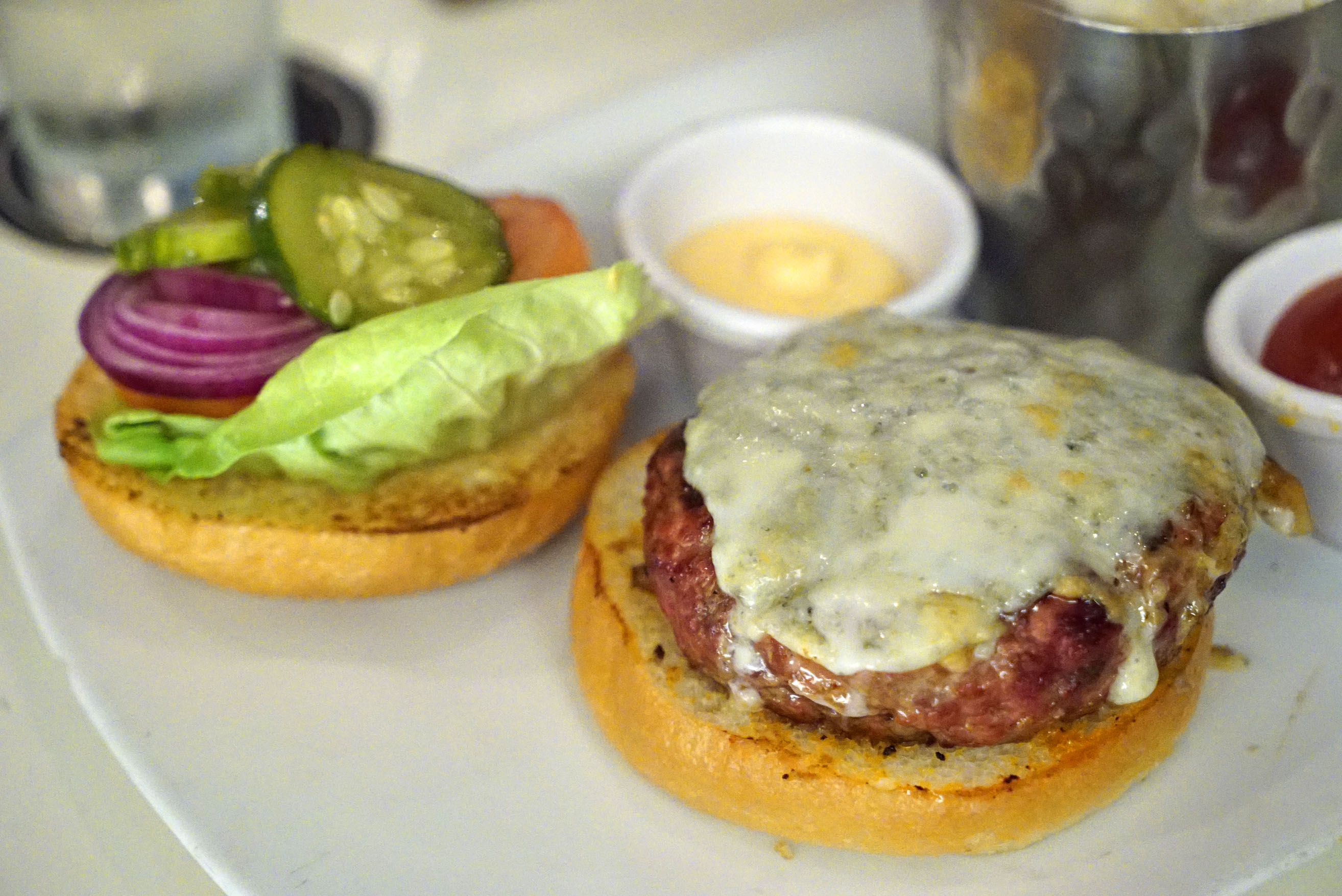
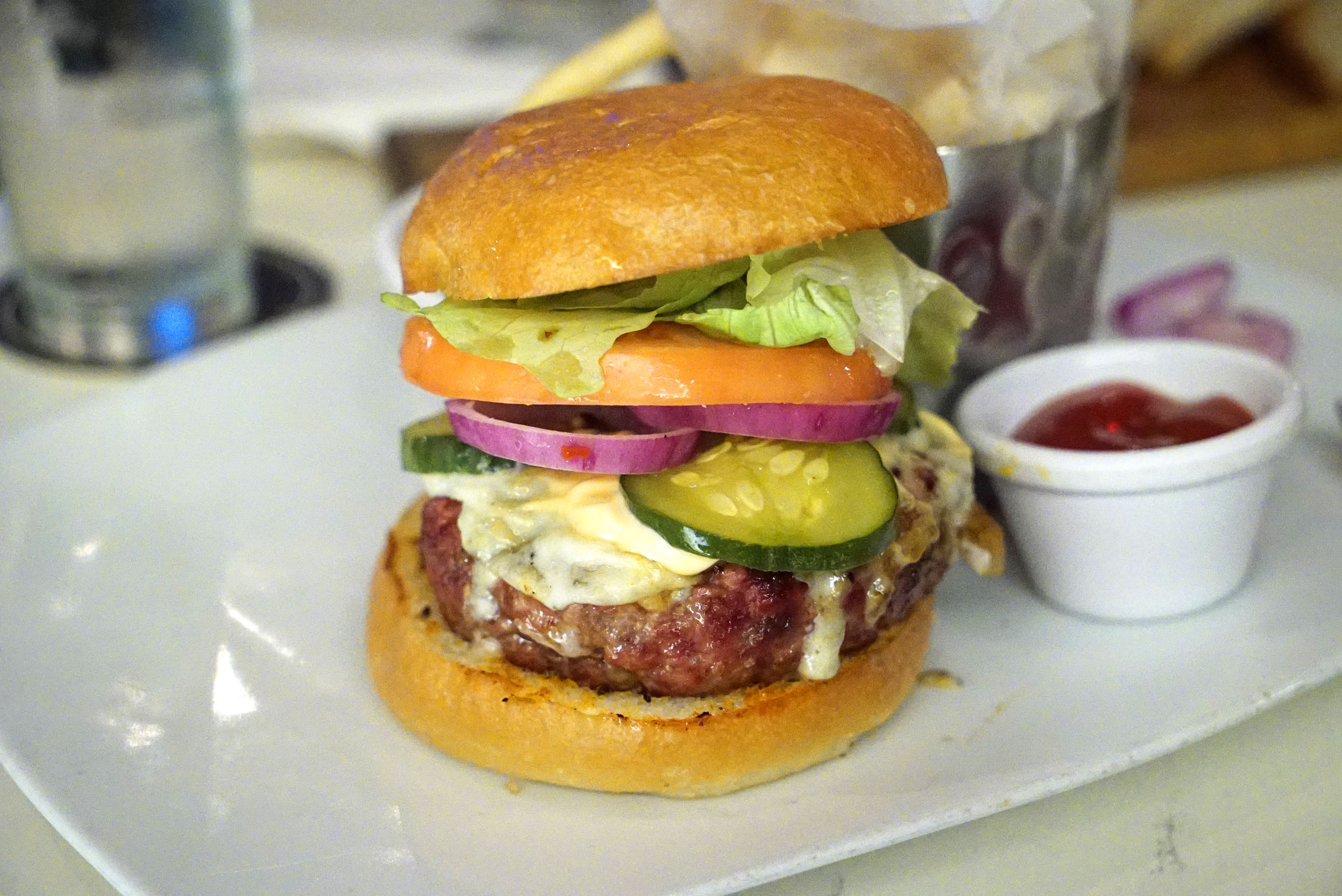
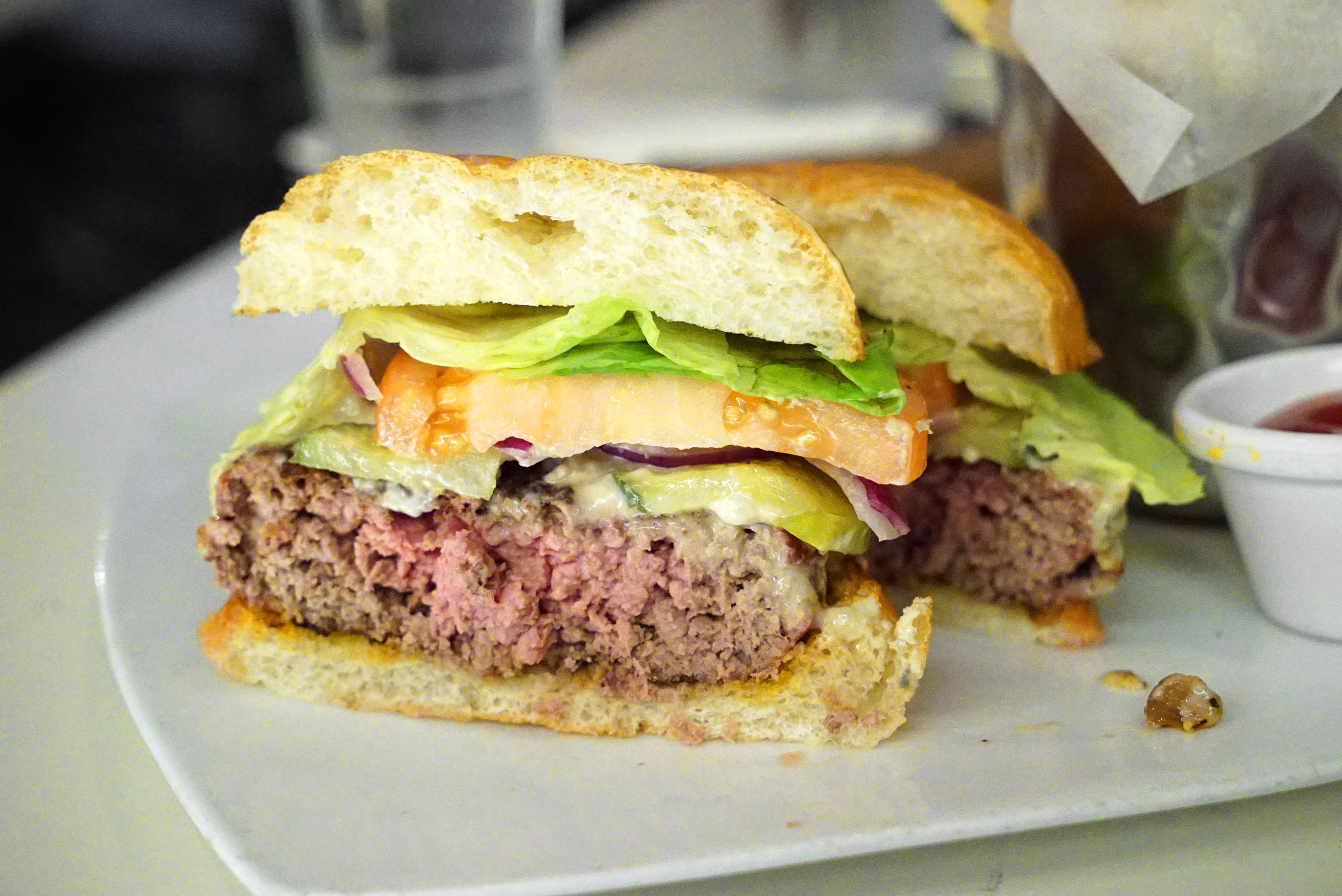
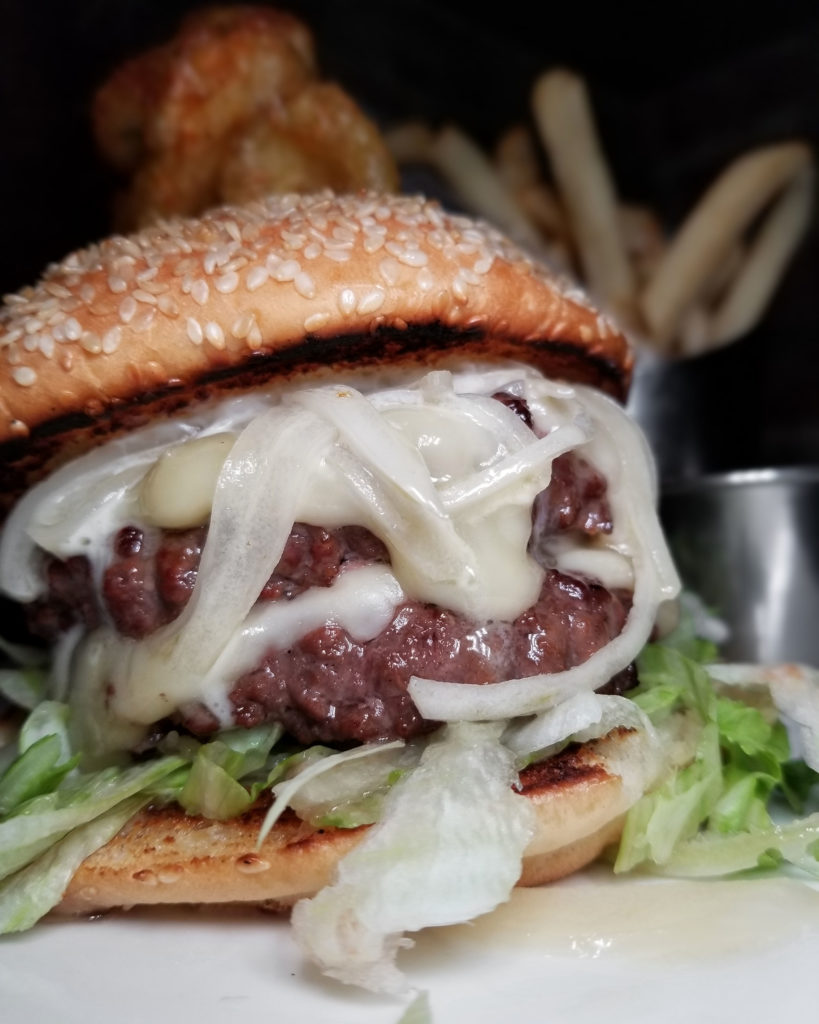
Our last savory course was the burger with blue cheese.
I ordered medium, and that seems about right to me on the inside. Perhaps just a bit over?
The pickles, bun, lettuce, tomato and cheese were all on point, but the meat was a little grainy in texture. I think maybe the beef was over worked after it went through the grinder to become a patty. It also could have used a bit more seasoning.
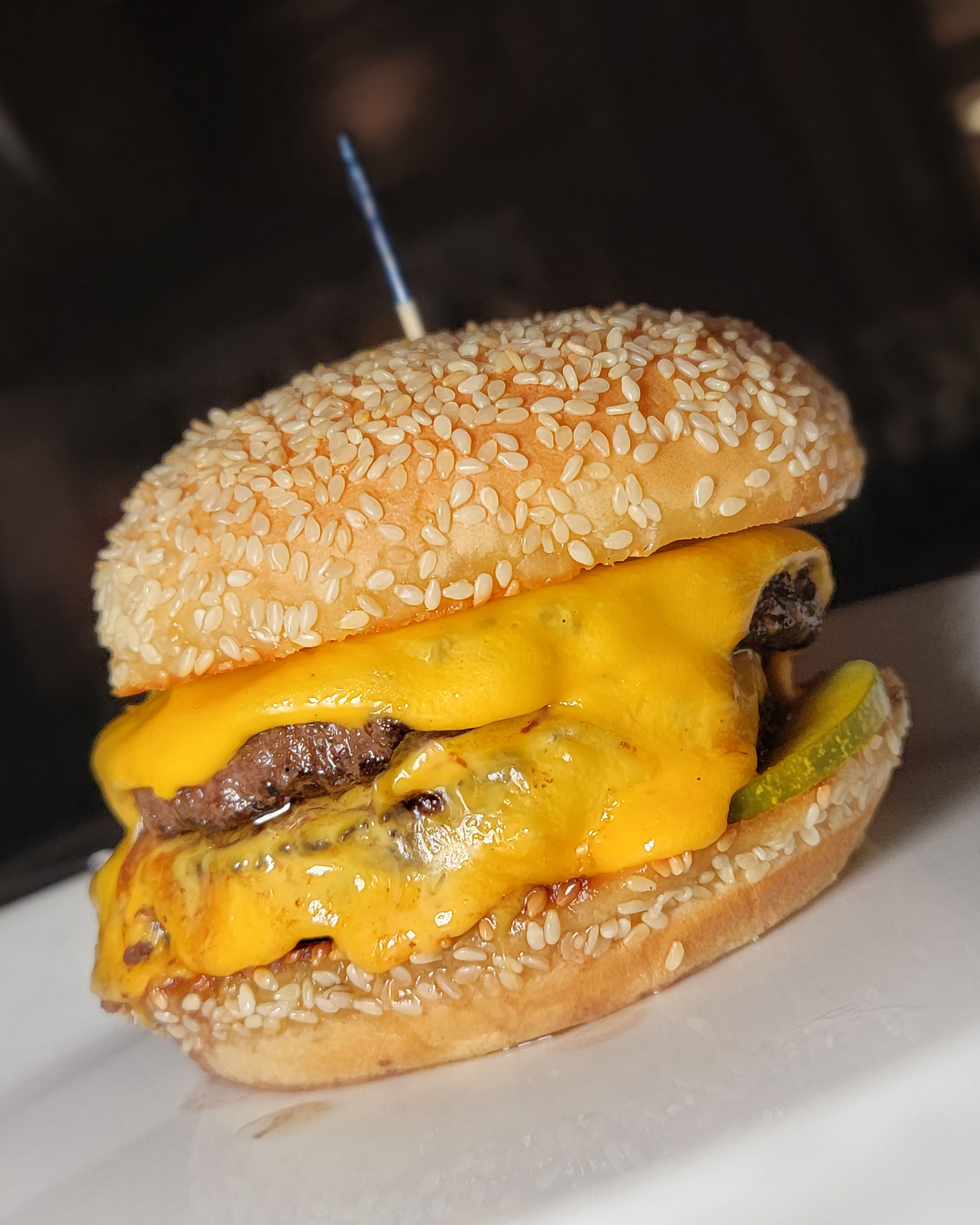
The new version of their burger features 4oz smoked patties and a red onion bacon jam. Way better.
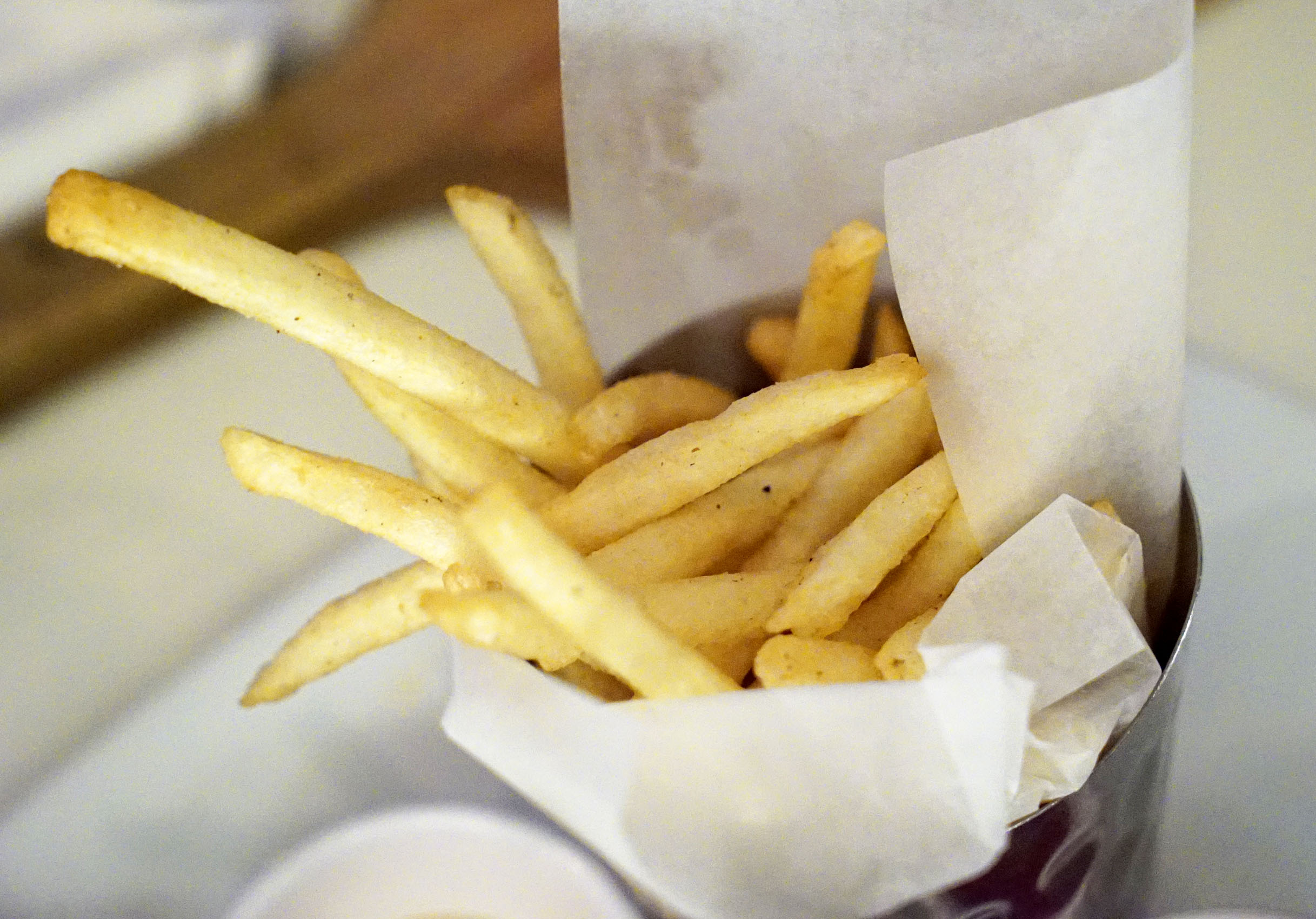
Fries were shoestring style – like McDonalds (a good thing).
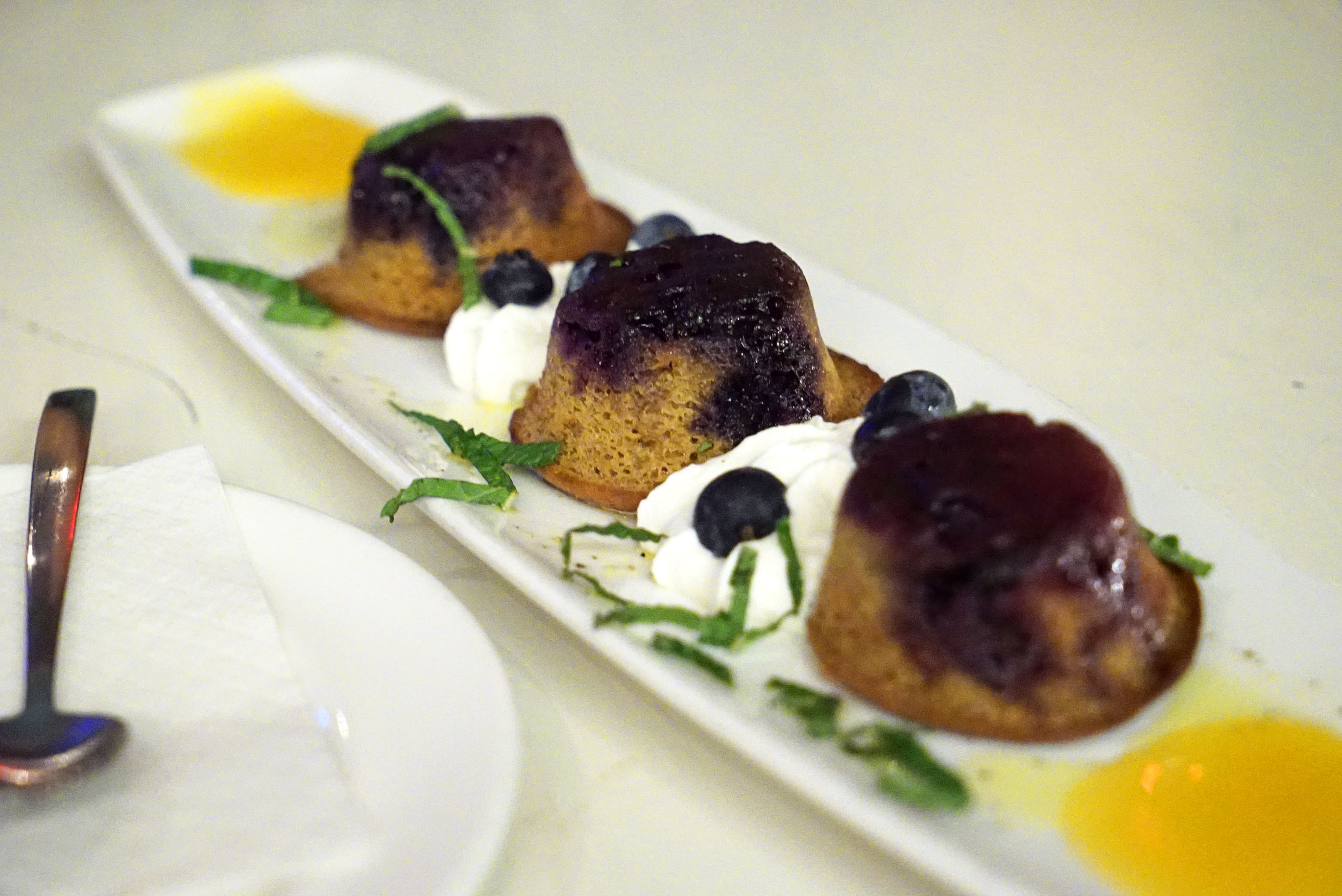
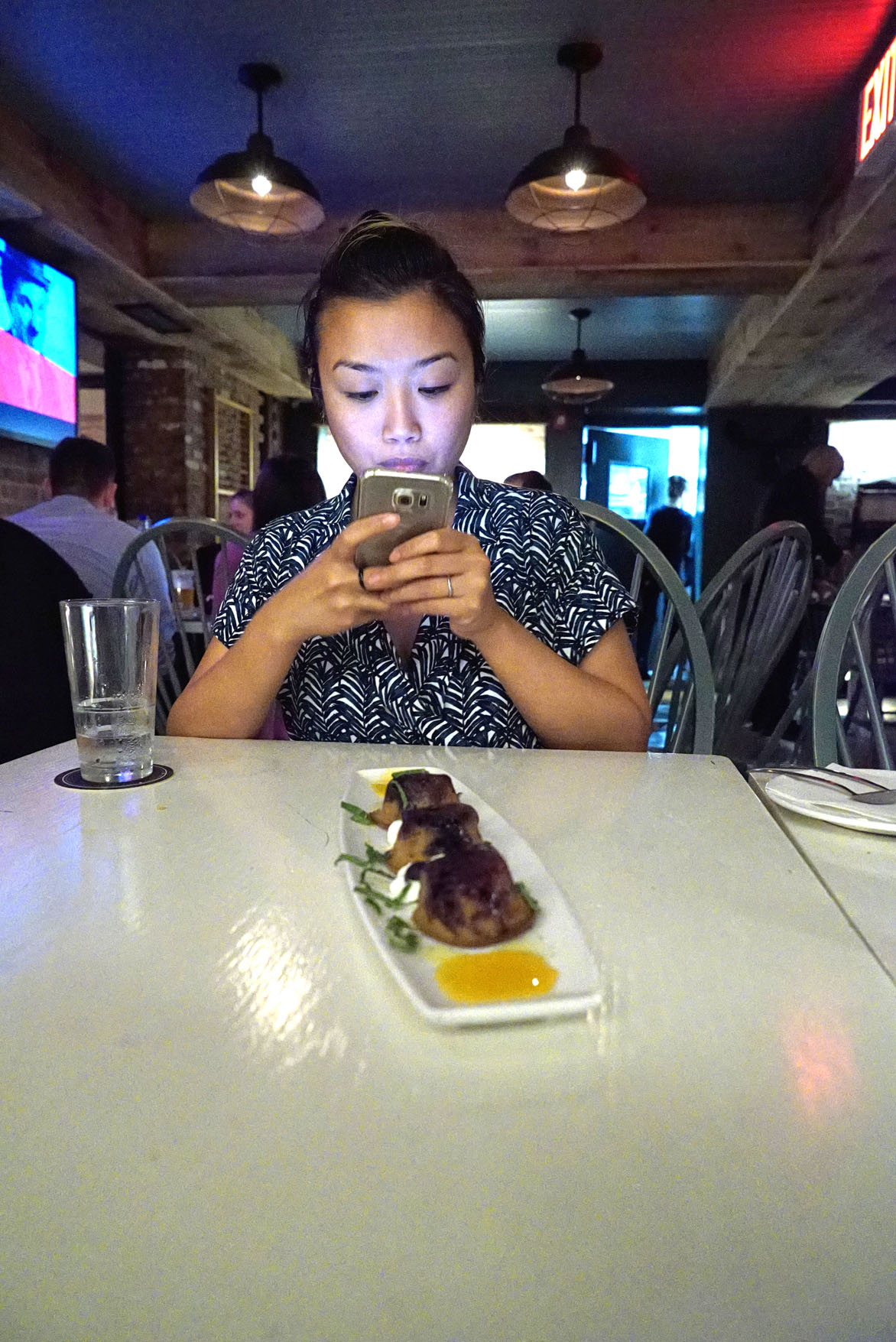
For dessert we tried the blueberry upside down cake. This was essentially three small muffin sized cakes served with fresh blueberries (both in the cake and as garnish), tangy orange/lemon curd, whipped cream and basil.
The flavors worked really well together, and the cake was warm and fresh. Even my wife, a baker, gave it her seal of approval.
I’ll definitely be back to try a few more items from the food menu, but it seems like the drinks are really the star of the show here. Nicely done!
UPDATE! IMPROVED BURGER & SECRET BURGER, SAME GREAT COCKTAILS!
This page is dedicated to the greatest liquor around: whiskey. Aside from a dirty, dry, gin martini, a glass of scotch and/or whiskey is probably the greatest thing to happen to the male sex since the discovery of female tits, ass and vagina. Read and learn all about these great accompaniments to dinner.
You may sometimes see it spelled “whisky,” or generically (and often erroneously) referred to as “scotch.” You might also see scotch lumped in with things like bourbon or rye. Shit, you’ll even see single malts confused with blends. But words have meanings, my friends, and this is where you will learn them, and where you will find my opinions about which are the best.
Terminology
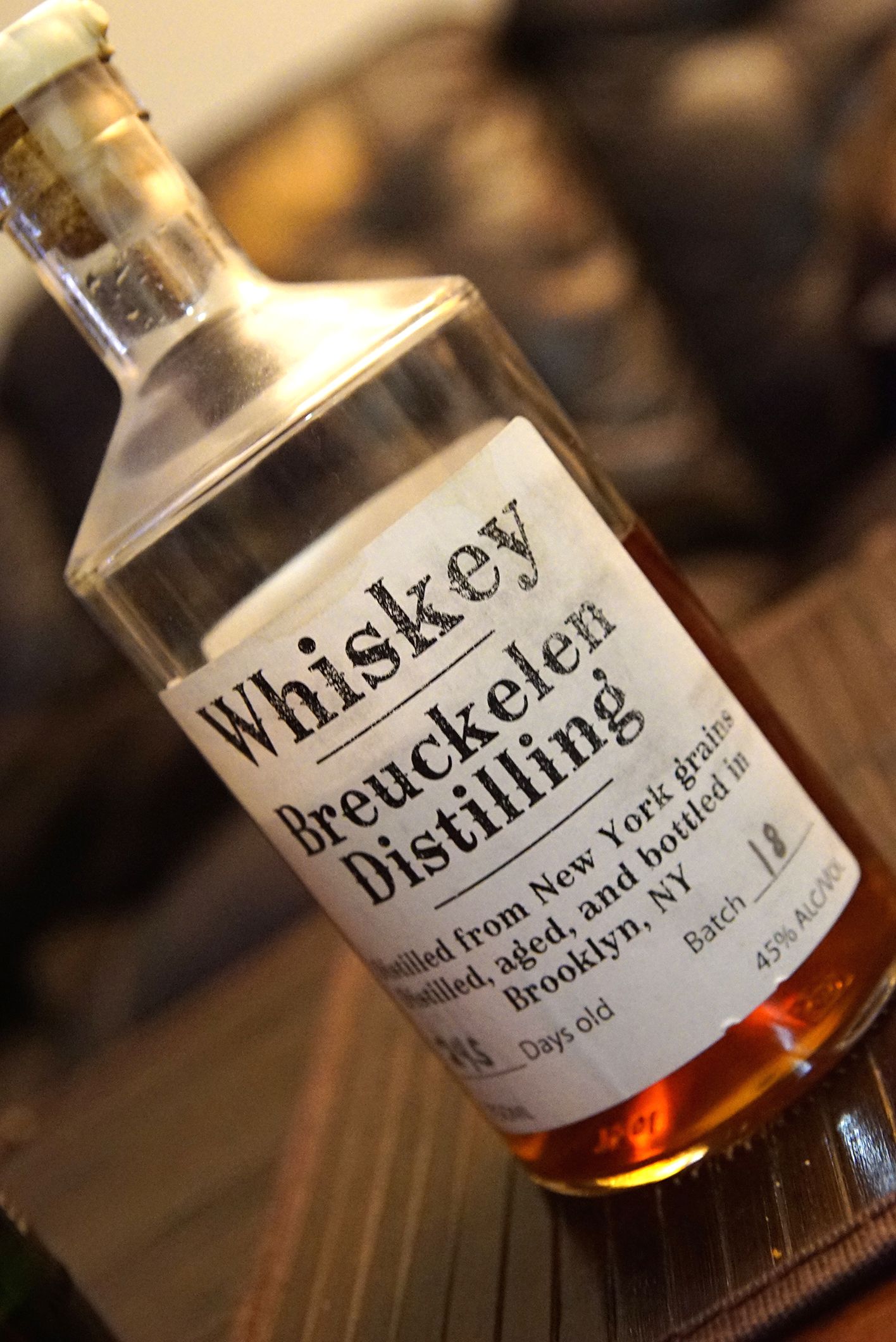
Whiskey/Whisky: Whisky is alcohol that’s been distilled from fermented grain mash. All whiskey must be distilled at a minimum of 40% and a maximum of 94.8% ABV. The spelling is generally different based on which country it is from. A nice rule of thumb is that countries that do not have an E in their name do not spell whisky with an E. Examples: Scotland/Japan = Whisky; America/Ireland = Whiskey
Where Brooklyn at???
Grain Whisky: Whisky made, at least in part, from grains other than malted barley.
Malt Whisky: Whisky made primarily from malted barley.
Irish Whiskey: Yup, you guessed it… whiskey made in Ireland. It must be distilled to an ABV of less than 94.8%. Additional rules are that it must be aged three or more years in wooden barrels, and if two or more distillates are used the whiskey must be labeled as a “blend.”
Scotch: The mash must be barley, it must be from Scotland, and it must be aged in oak barrels for three or more years at an ABV of less than 94.8%. Pretty simple.
Single Malt: Essentially this just means that the whisky is a product of a single distillery. A single-malt Laphroaig may contain whisky from many barrels produced at their distillery, but it must contain whisky produced only at Laphroaig.
Blended Malt: Also known as vatted malts, these are a blend of single malts from two or more distilleries.
Single Grain: Very misleading. It means barley and one or more other cereal grains were used, produced only at a single distillery (similar to single malt).
Blended Grain: Blend of single grains from two or more distilleries.
Blended Scotch Whisky: A mix of both single malt whisky and single grain whisky, sourced from several different distilleries.
Single Barrel: This is a whisky from a single barrel, unmixed with other barrels. Very rare.
Bourbon: Grain mix must be at least 51% corn, and bourbons are from the USA and aged in new charred oak barrels. Straight bourbon is a bourbon that has aged two or more years. While most bourbon is made in Kentucky, it is not a requirement. Bourbon can be no more than 80% alcohol (160 proof) and no more than 62.5% when put into casks for aging in new charred oak barrels.
Tennessee Whiskey: Straight bourbon made in Tennessee and filtered through charcoal.
Rye: In Canada, there must be some rye in the mash. In the USA, however, there must be at least 51% rye in the mash, and they must be aged in new charred oak barrels. Like bourbon, straight rye is a rye that has aged two or more years. Rye can be no more than 80% alcohol (160 proof) and no more than 62.5% when put into casks for aging in new charred oak barrels.
Personal Preferences
I have two distinct likes when it comes to scotch. I enjoy the extremes of the spectrum: creamy and sweet like butterscotch, and super medicinal and peaty.
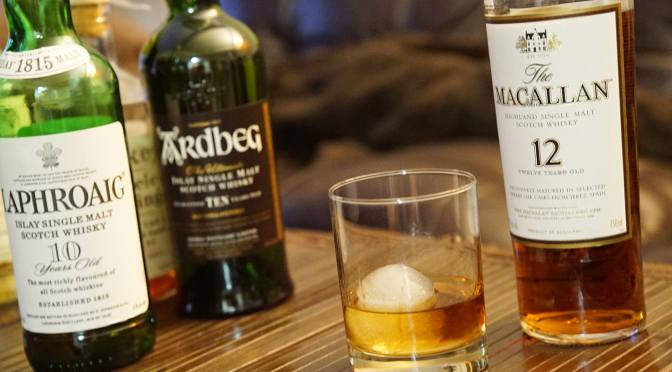
Let’s start with the peaty ones: Laphroaig 10 is like baseball glove leather, and I mean that in the best way possible. Very smokey and definitely an acquired taste. I absolutely love it.
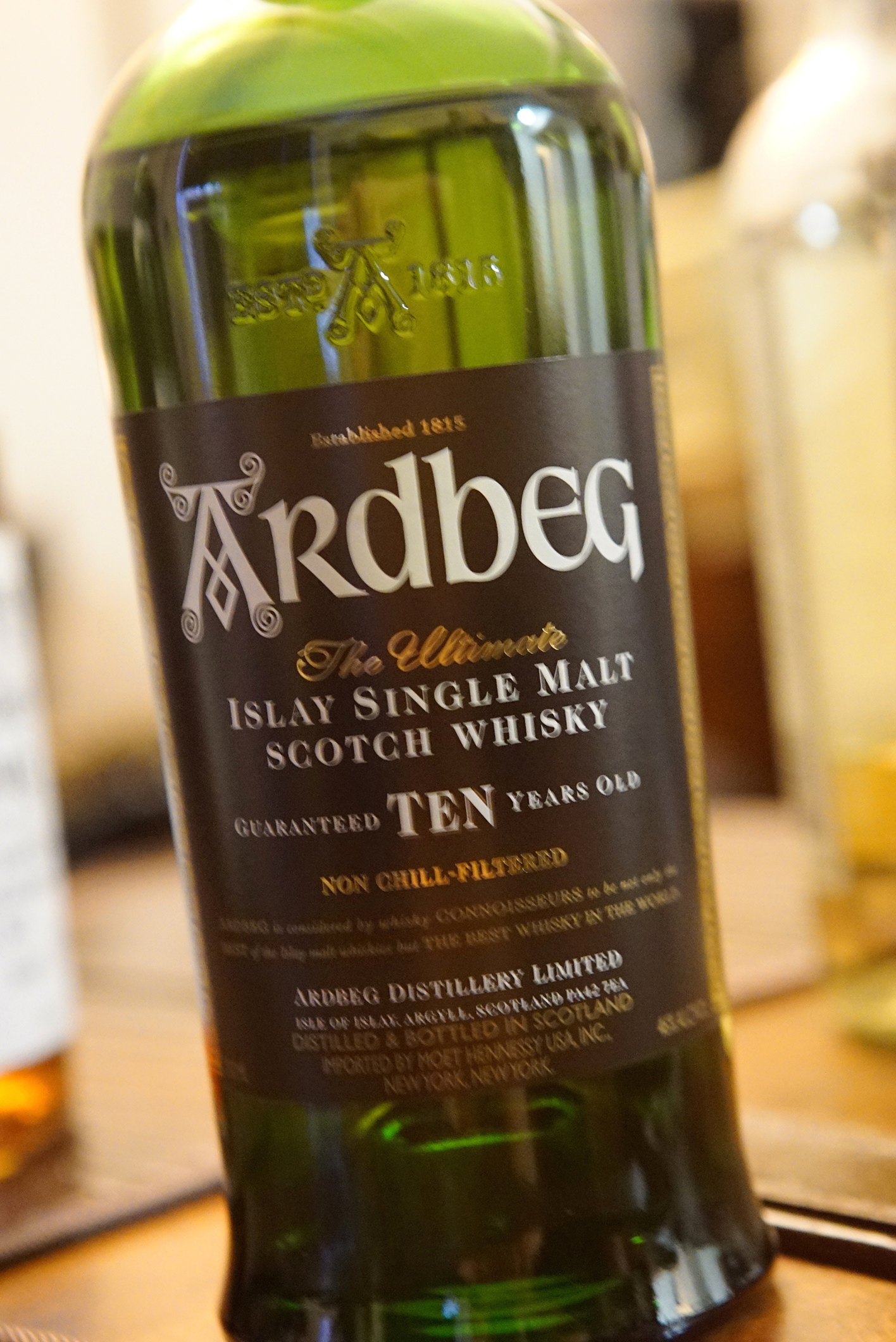
That, Ardbeg (both the 10 year and the Corryvreckan) and Lagavulin are my favorite of the smokey, peaty varieties.
I have a great book called “Michael Jacksons Complete Guide to Single Malt Scotch” that I found to be very useful (Not Jacko – some other dude). It also rates them out of 100. Lagavulin 16 (their most common) gets like 96/100. That’s pretty fucking amazing for a bottle that typically costs $75-$100 (depending on how hard you are being raped in cities). Tasting anything higher ranked is going to cost you a shitload of scratch. In fact, I don’t think I’ve tasted anything rated higher than Lagavulin. Get it. It’s fucking totally mint.
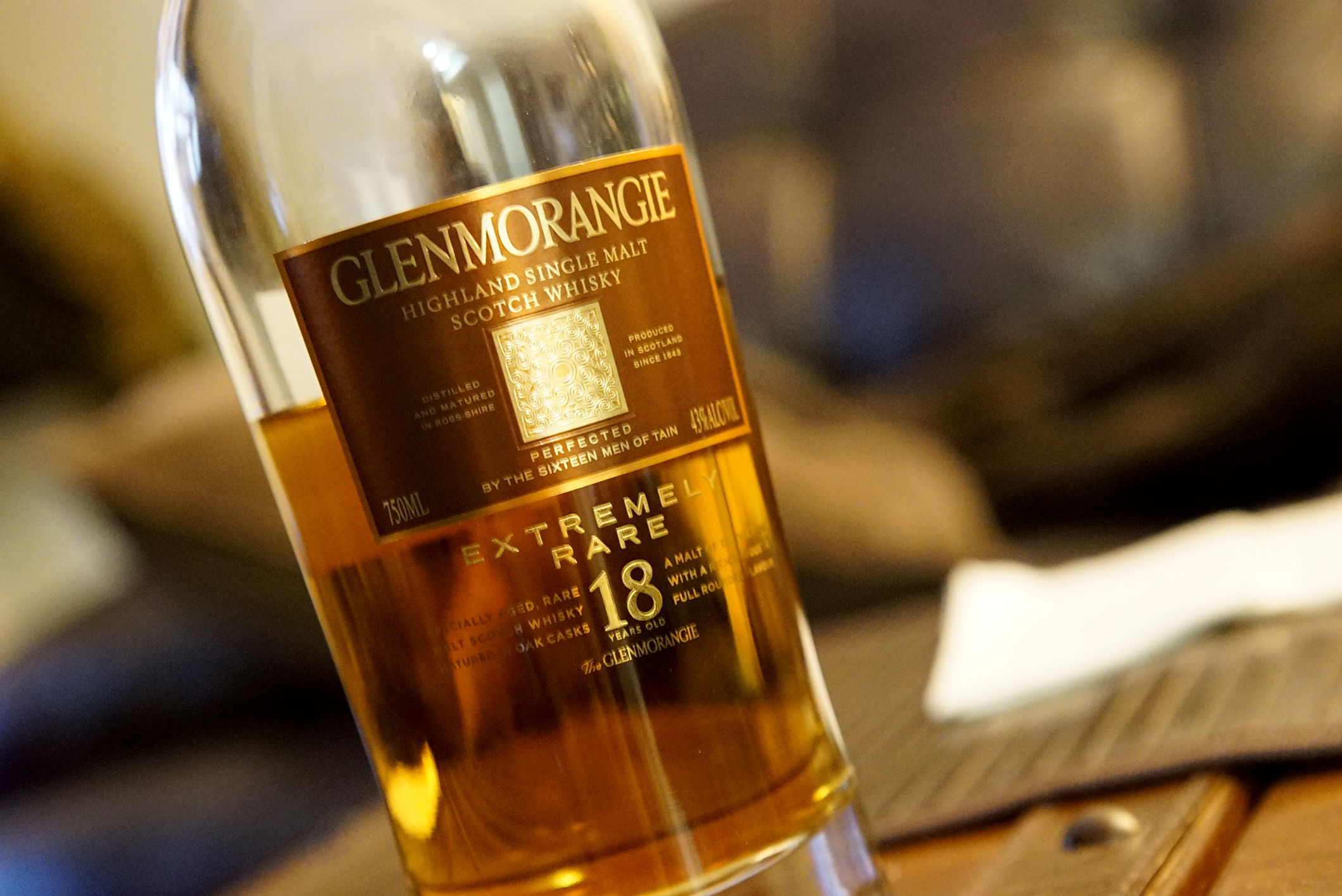
For the smoother types: I like Macallan 18, Glenlivet 21, Balvenie Double Wood 12, and Glenmorangie 18.
That Glenlivet 21 is as clean as a freshly shaved snatch too, assuming there was a shower taken afterwards, and no STDs or weird rashes… One Christmas Eve I drank nearly half a bottle of GL21 and had no hangover whatsoever the next morning. Happy Birthday Jesus!!! The smoothies I listed here are all a bit more expensive (though Balvenie is not) but well worth it.
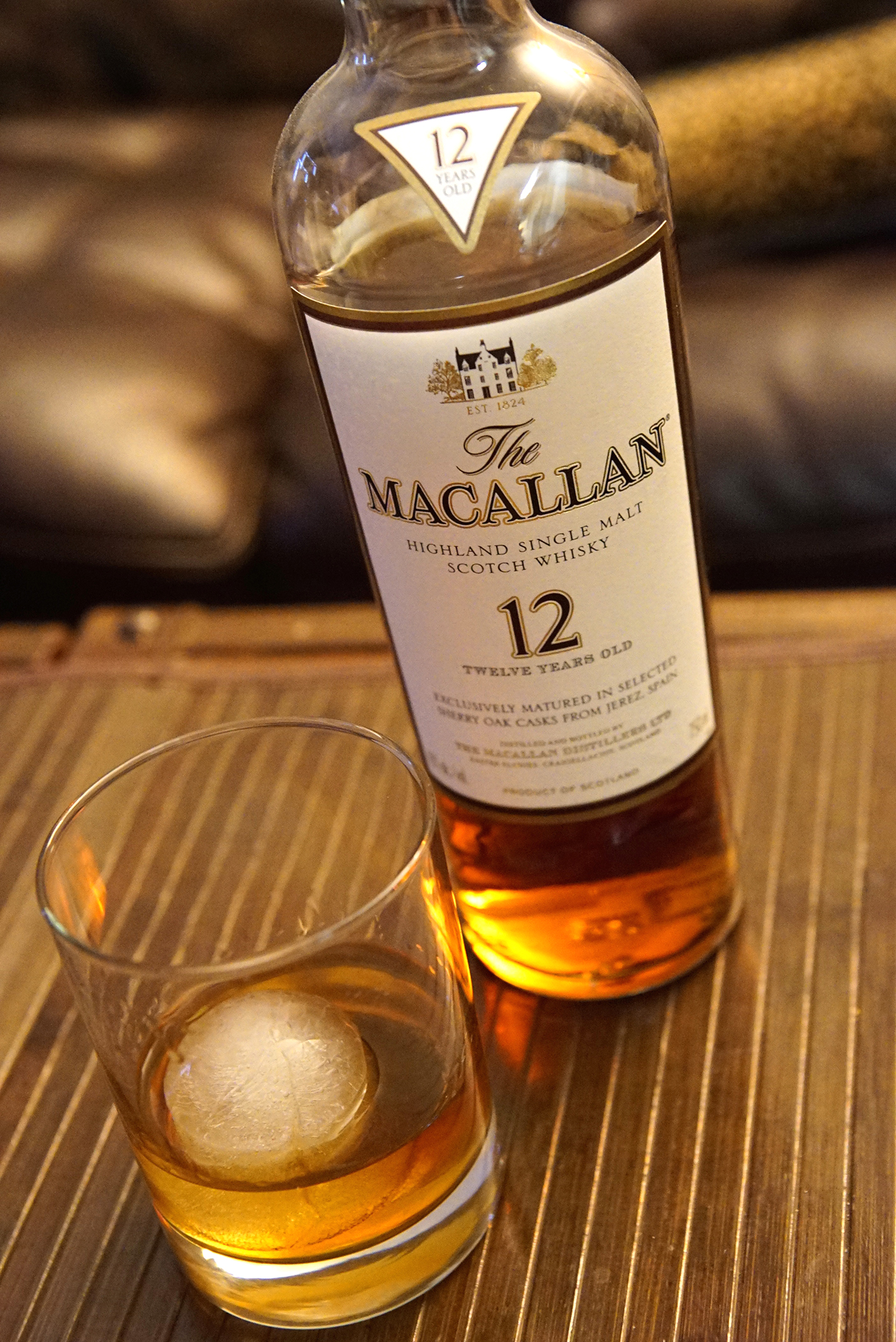
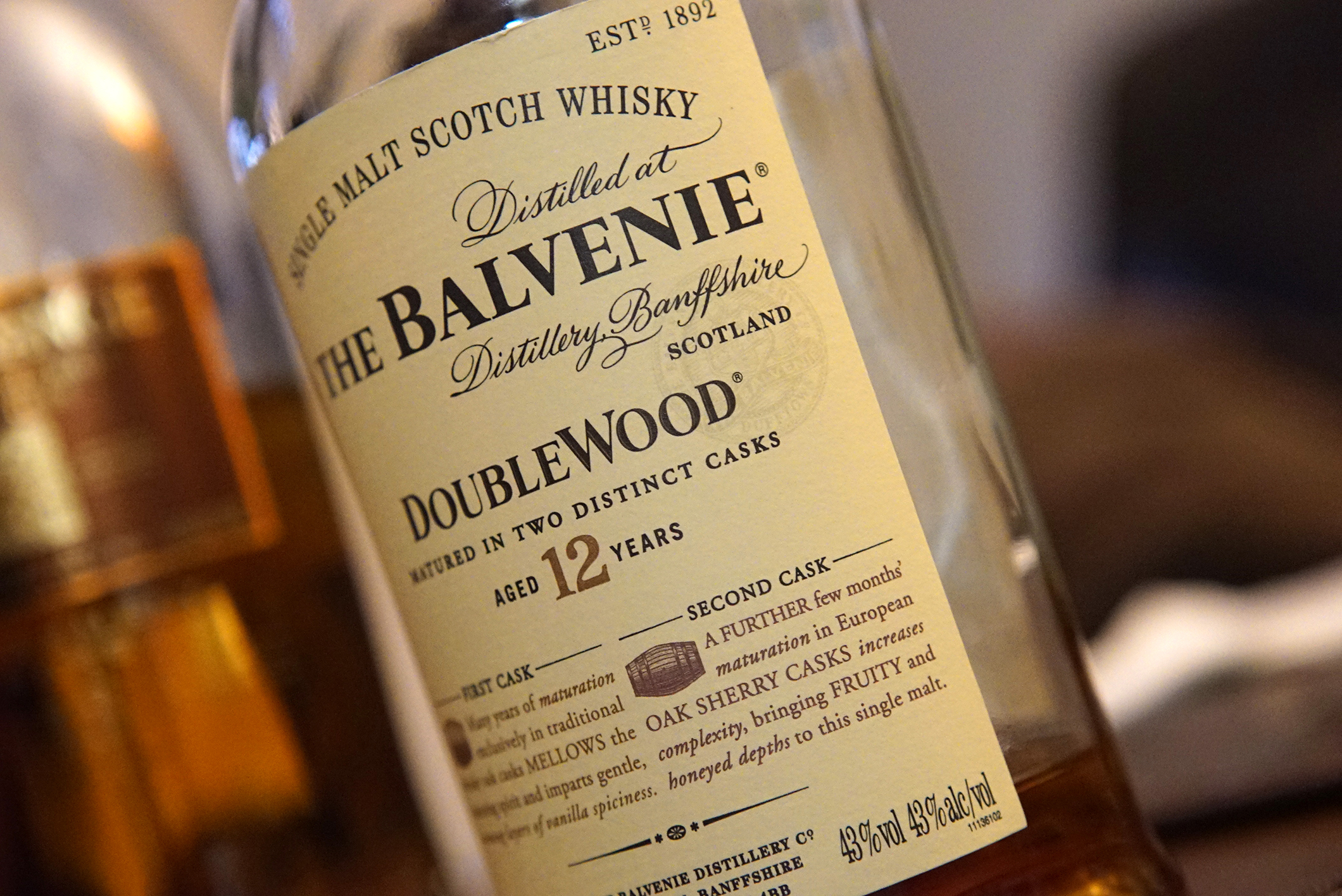
The Macallan and Glen Livet 12 years are nice to start with if you’d like to try something smooth as well, but I prefer the Balvenie Double Wood by far at that price point. They call it “double wood” because it has two hard cocks. No… because it is aged for most years in oak casks, but then finished in sherry casks, so it has a unique flavor.
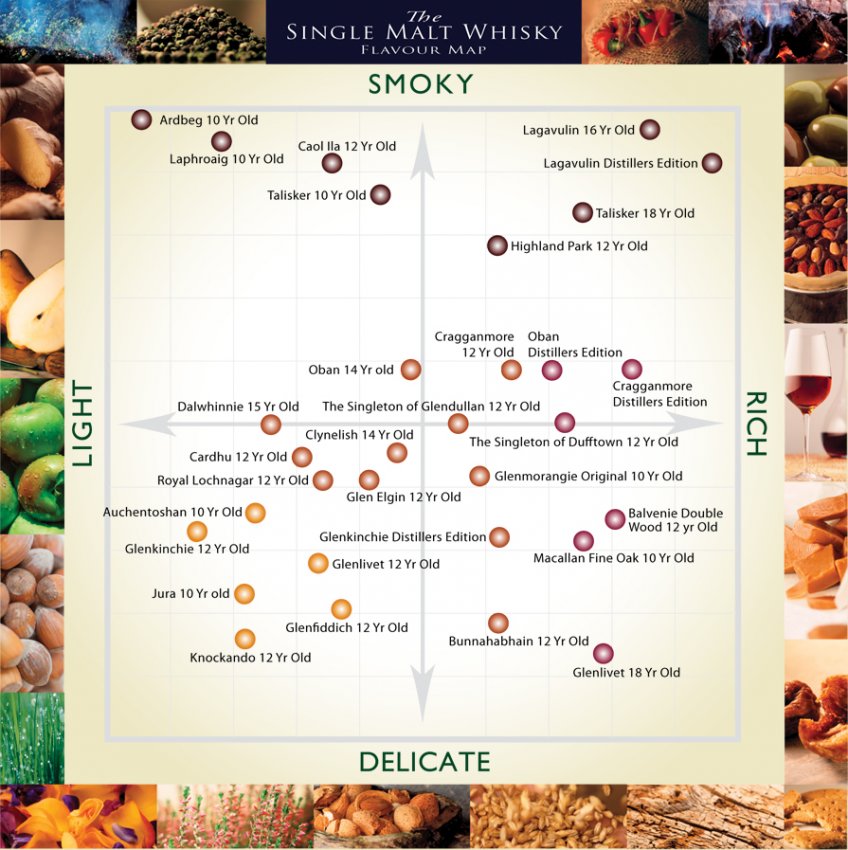
Scotch Flavor Map
I came across this pretty cool chart thing a while back, and kept it handy for quick reference. This gives you a little visual of the flavor profiles people often discuss with scotch:
From http://www.foodrepublic.com/2012/01/03/all-hail-scottish-whisky-flavour-map
Regions of Scotch Production
There are essentially four main regions of scotch production in Scotland, and each region has flavors that are often typically associated with their scotches.
Speyside: fruity and delicate. The valley of the river Spey is often associated with flavors like vanilla, honey, apples and pears.
Lowlands: fresh, light. These malts are fragrant, floral, taste of cereal and are light in color.
Highlands: smooth and floral. In the west, you have some maritime influence in the flavor, and in the central highlands you get some honey and heather.
Islay/Skye Islands: peaty and briny. These robust malts are laden with the medicinal / iodine aromas of the sea.
Drinking Tips
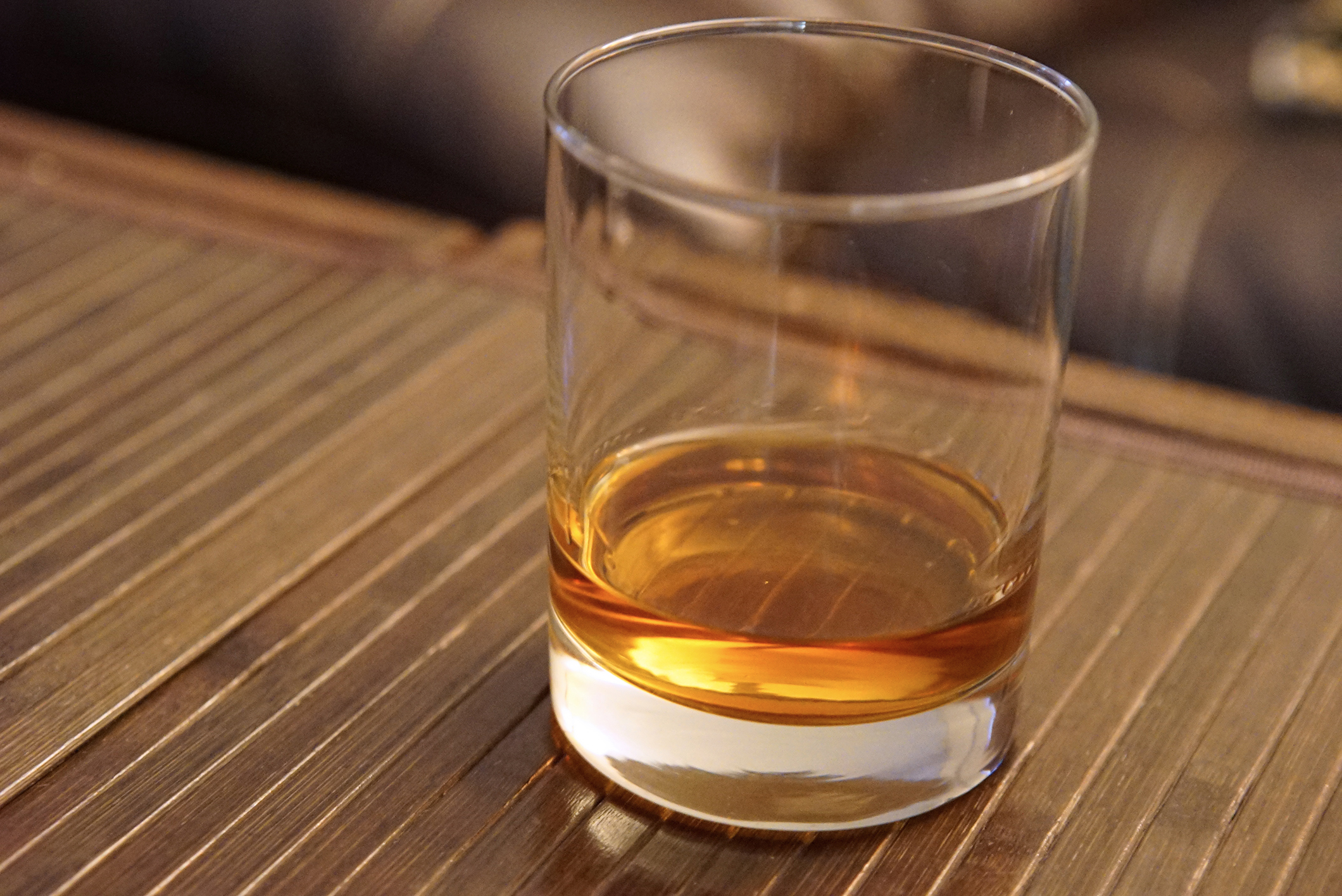
One thing I like to do: drink the first half of my glass neat, then throw one or two ice cubes in and allow the flavors to change. It’s like having two different glasses of scotch in one, because the ice and water allow the scotch to open up (kind of like wine), and different aromas and flavors can be more easily detected.
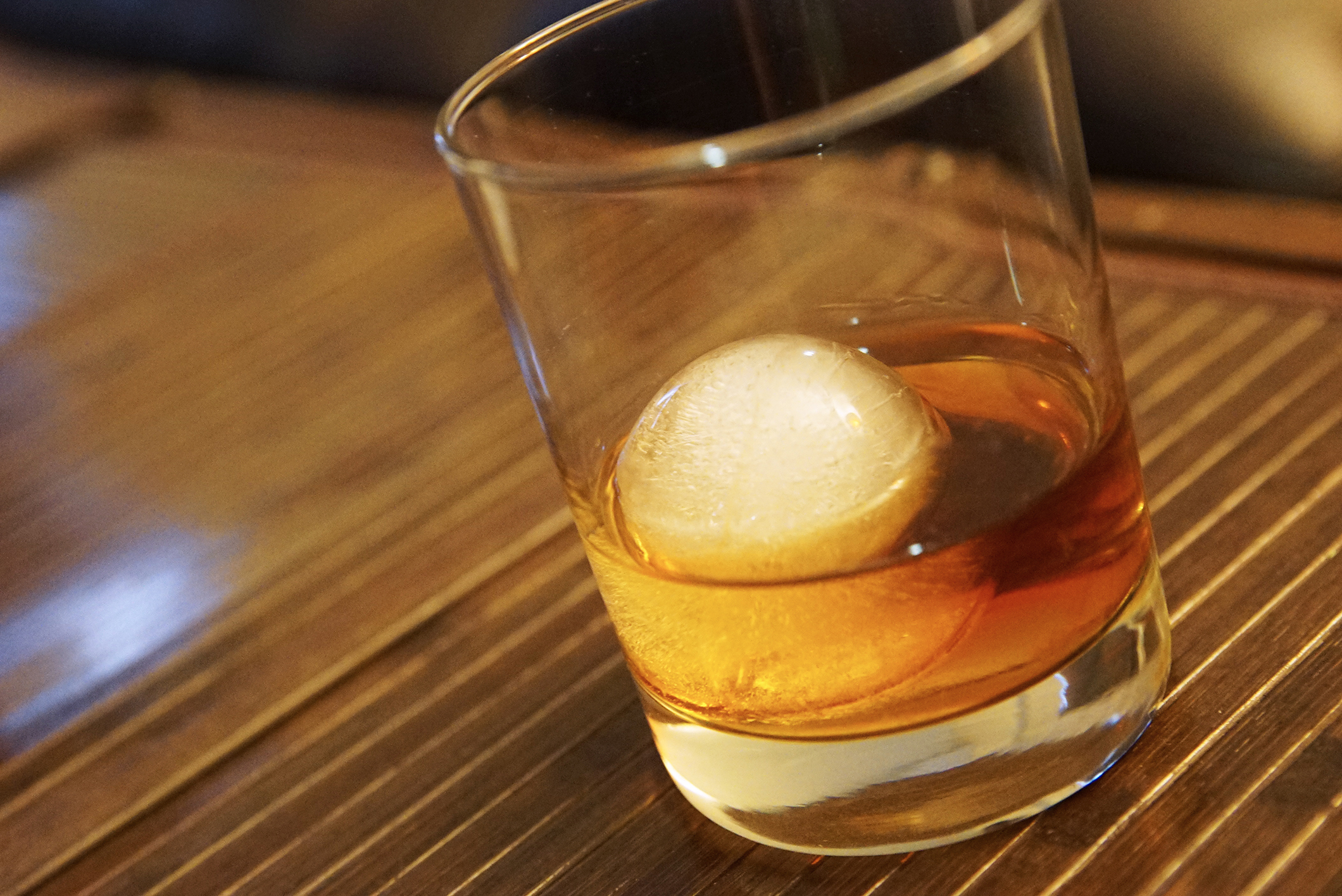
The ice sphere is so much cooler than the ice cube. The ice cube is such a square.
Another cool thing I learned at a tasting: splash a little scotch on the palm of your hand and rub your hands together like Mr. Miyagi. Then smell your hands. All sorts of aromas are unleashed. You’ll smell florals, vanillas, nuts, wood, etc. Very cool.
An interesting trick: suck air in through your teeth as you have some scotch in your mouth and on your tongue. The break-up and aeration of the liquid will release aromas and flavors that you might have otherwise missed.
Most important: take your time. I sometimes see scotch amateurs order a nice scotch and then shoot it fast. What a waste! Don’t be that fucking guy.
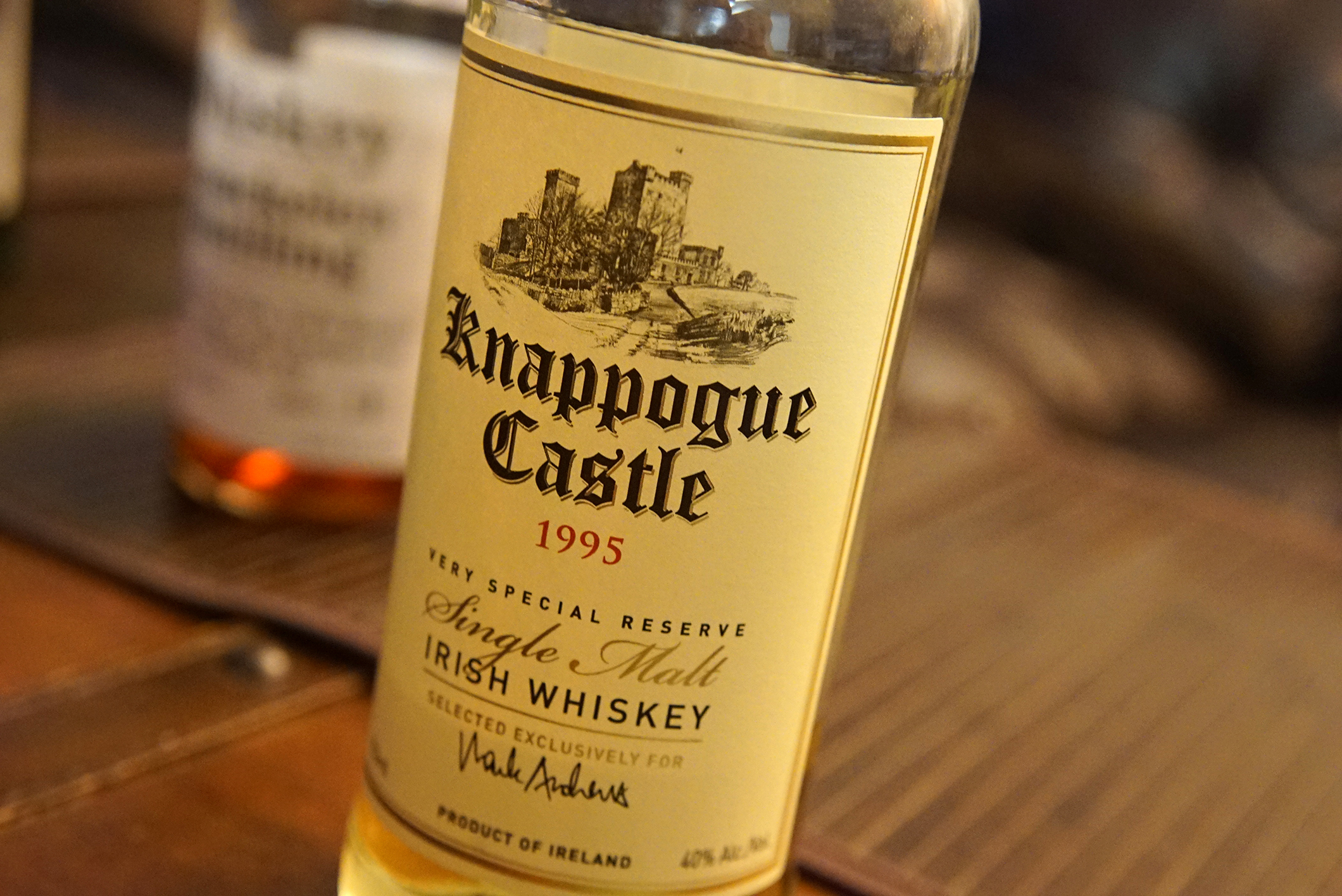
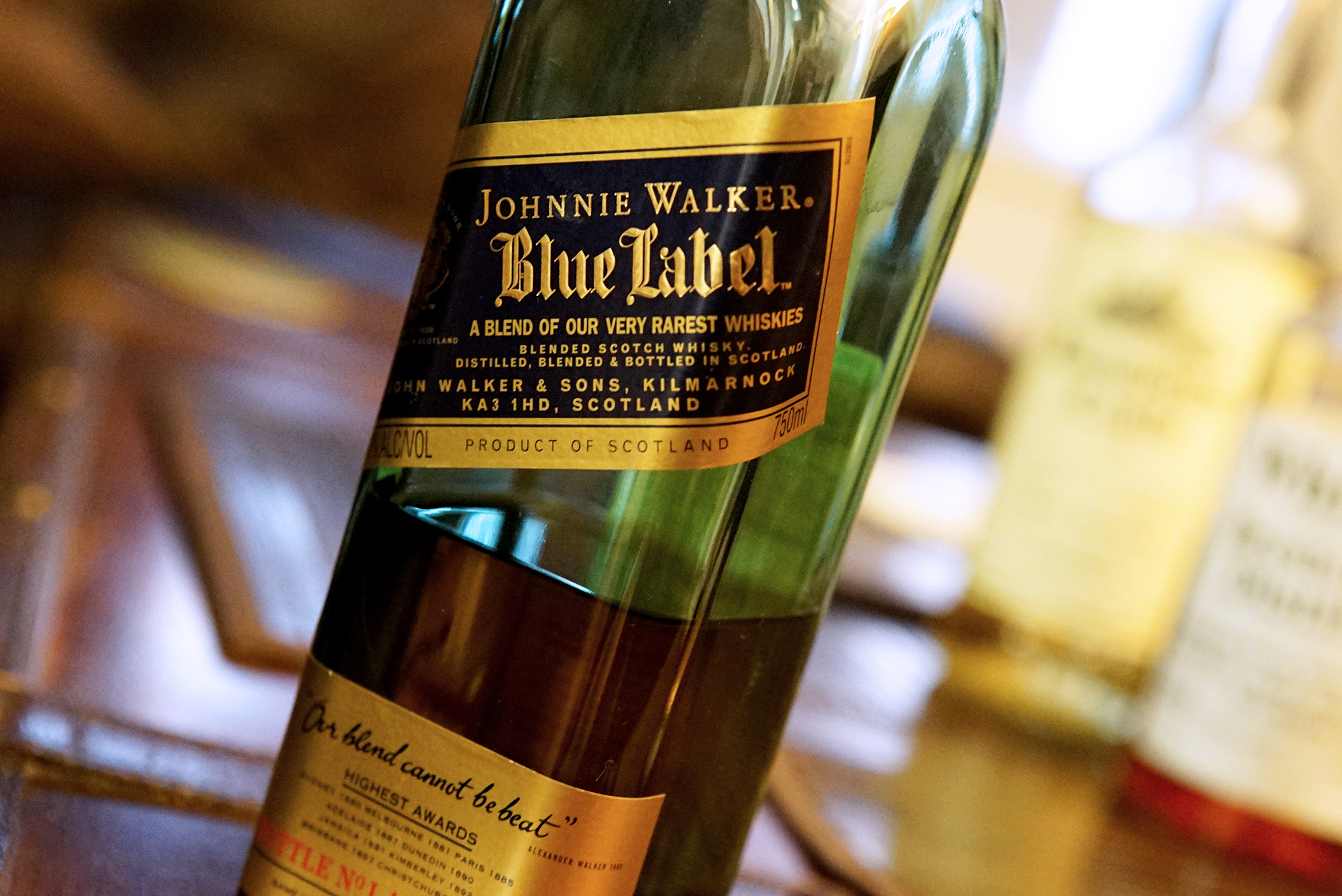
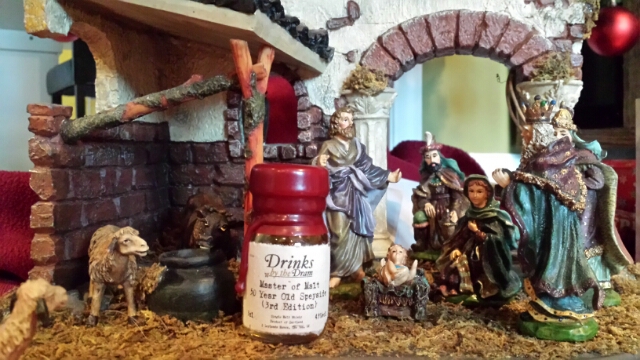
Organize a tasting: maximize your exposure to various scotches. If you’re anything like me, you have a bunch of buddies who love to drink. Chances are, a good crew of them dig scotch. Call them up and organize a scotch tasting. Everyone can bring their stash and you’ll have a really big selection to work with. Check out this selection we amassed last Christmas. Fuck yeah! I think we had 30 bottles total when a last minute arrival showed up, and it was something he brought back from China. Sweet!
A final note: scotch isn’t for everyone. Some people just don’t like this shit. Tastes are subjective, but tastes do change over time. I always hated tequila, for instance. But I respect the spirit and understand how tons of variety exists in the product lines. In fact I’ve recently started to come around to tequila through my enjoyment of aged mezcal. Maybe you’ll come around to scotch if your first impression is bad. Keep trying. You never know – your taste buds might have adjusted and now you might love scotch if you tried some good ones.
Other Resources
For a more in-depth dive into terminology, check out THIS SITE. Start at A, and work your way through Z. Do it. Don’t be a bitch.
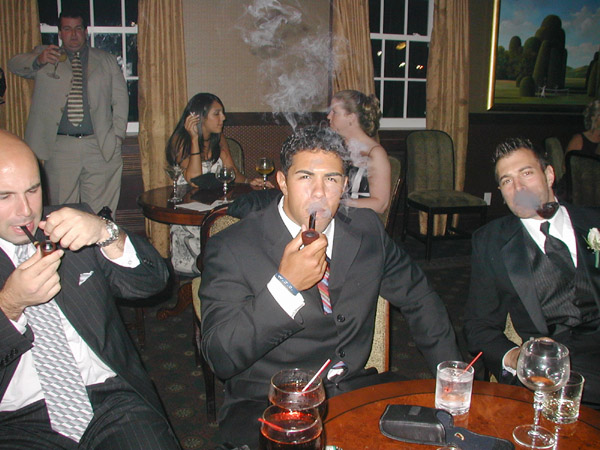
Something that many discerning men enjoy after a steak is scotch. But these days, there are a dwindling few who have a chance to partake in the OTHER delight of a post-steak meal: a good smoke. Whether you’re a cigar or a pipe guy, or even one of those ridiculous e-cigarette fanatics, NYC has pretty much fucked your world when it comes to lighting up at the table as you wait for the bill.
Look – I get it – no one wants to go home smelling like an ash tray. And by now it’s old news that NYC has a ban on smoking in food establishments. There are a precious handful of places where you can still smoke, but there’s one thing I always thought was unfair about the smoking ban: PIPES SMELL AWESOME!
Pipe smoking is real altruism: I know it’s bad for me, but you’re getting enjoyment from it because the smoke smells fucking fantastic. I’m not really a cigar guy. Occasionally I will have one. I’m not really a cigarette person, either. If I’m out drinking and a friend offers, I might smoke one to be social. Generally cigars and cigarettes smell like shit to me, and they don’t taste all that great to boot. I DO like a clove cigarette, on occasion. And I DO like pipe tobacco. Those both taste and smell excellent, and typically neither product gets inhaled, so they’re slightly better for you than a cigarette. I guess mouth cancer is less shitty than lung cancer.
Why pipes, though? Who gets into that kind of thing? People who want to look distinguished, that’s who.
I began my foray into pipe smoking sometime in 2003 or 2004. A friend sent over a random video of himself and a friend – set to classy jazz music of course – puffing away on a long churchwarden pipe like some kind of hobbit.
A churchwarden pipe, by the way, is named so because men who kept watch over churches at night (wardens of the church) would often want a long-stemmed pipe that they could rest on their belly as they sat back in a chair.
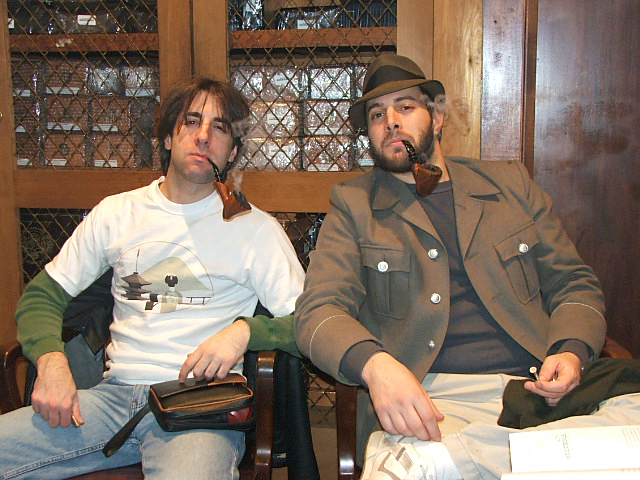
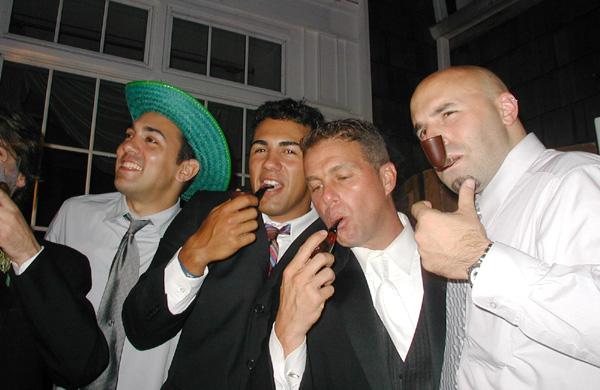
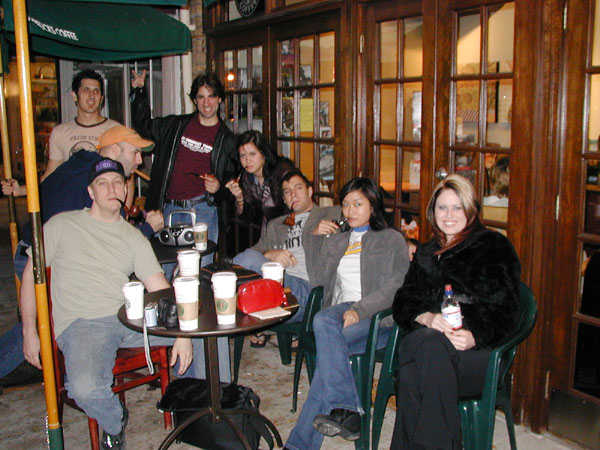
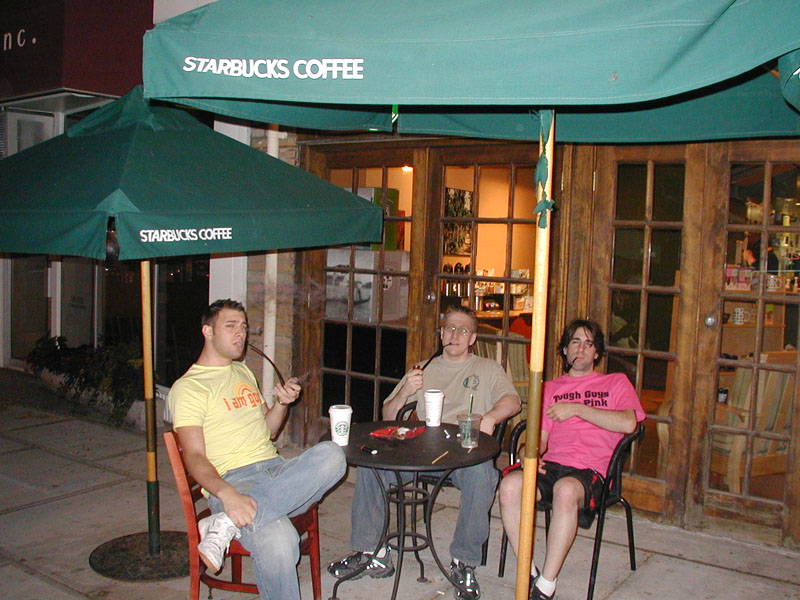
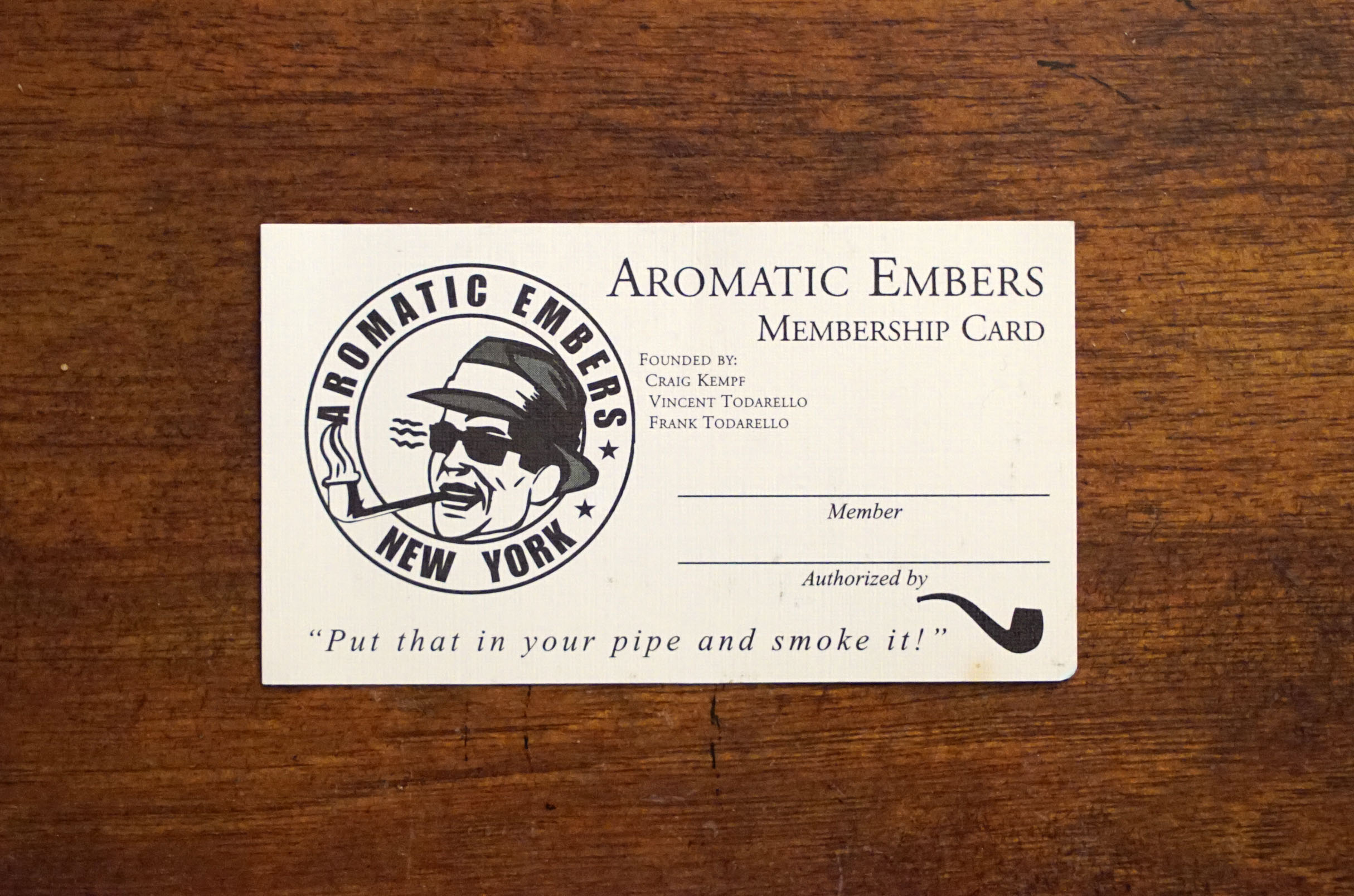
Anyway I saw that video from my friend and I laughed. But I thought, “This is actually pretty fucking cool. I need to get one now.” In fact a small group of us all picked up some pipes soon after, and we started a club called the Aromatic Embers Pipe Smoking Club.
It was great! Every week we would meet at a local Starbucks and puff away in the outdoor seating area.
Without fail people would comment about how great it smelled. We had membership cards, a nice logo, and we were even in the process of building a website.
So here are a few things you’ll need to know about pipe smoking, that way you’re ready to rock when you decide to take up this healthy and enjoyable habit.
Types of Pipe Tobacco
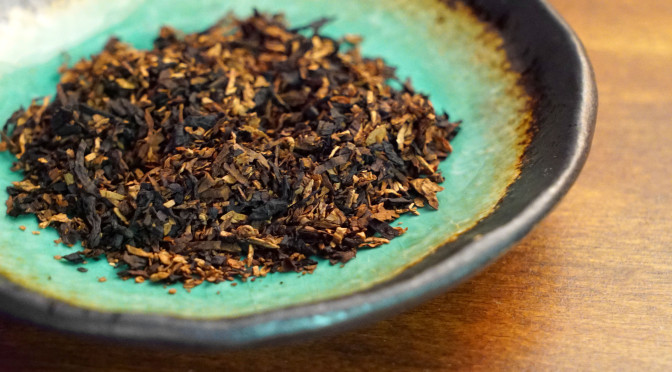
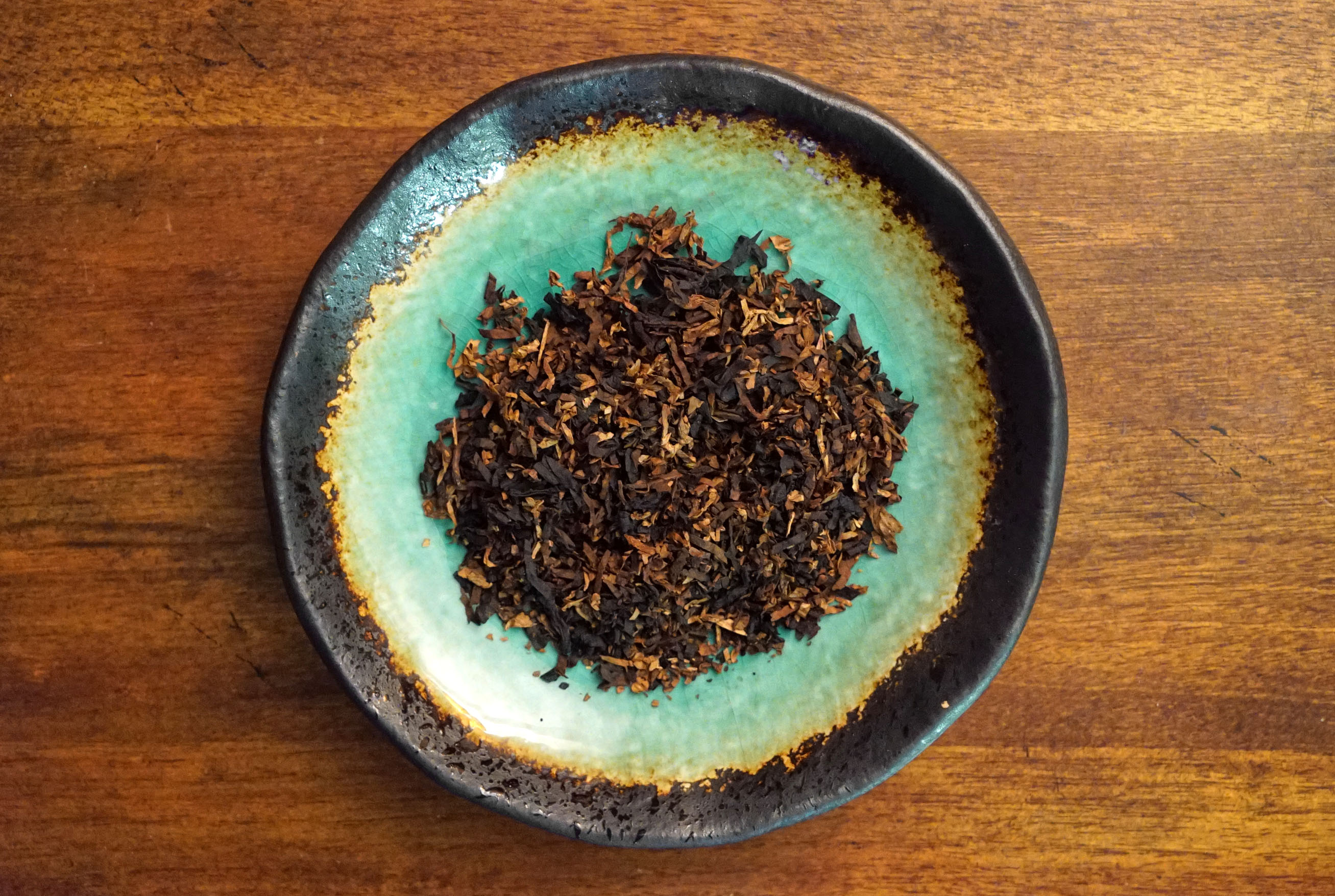
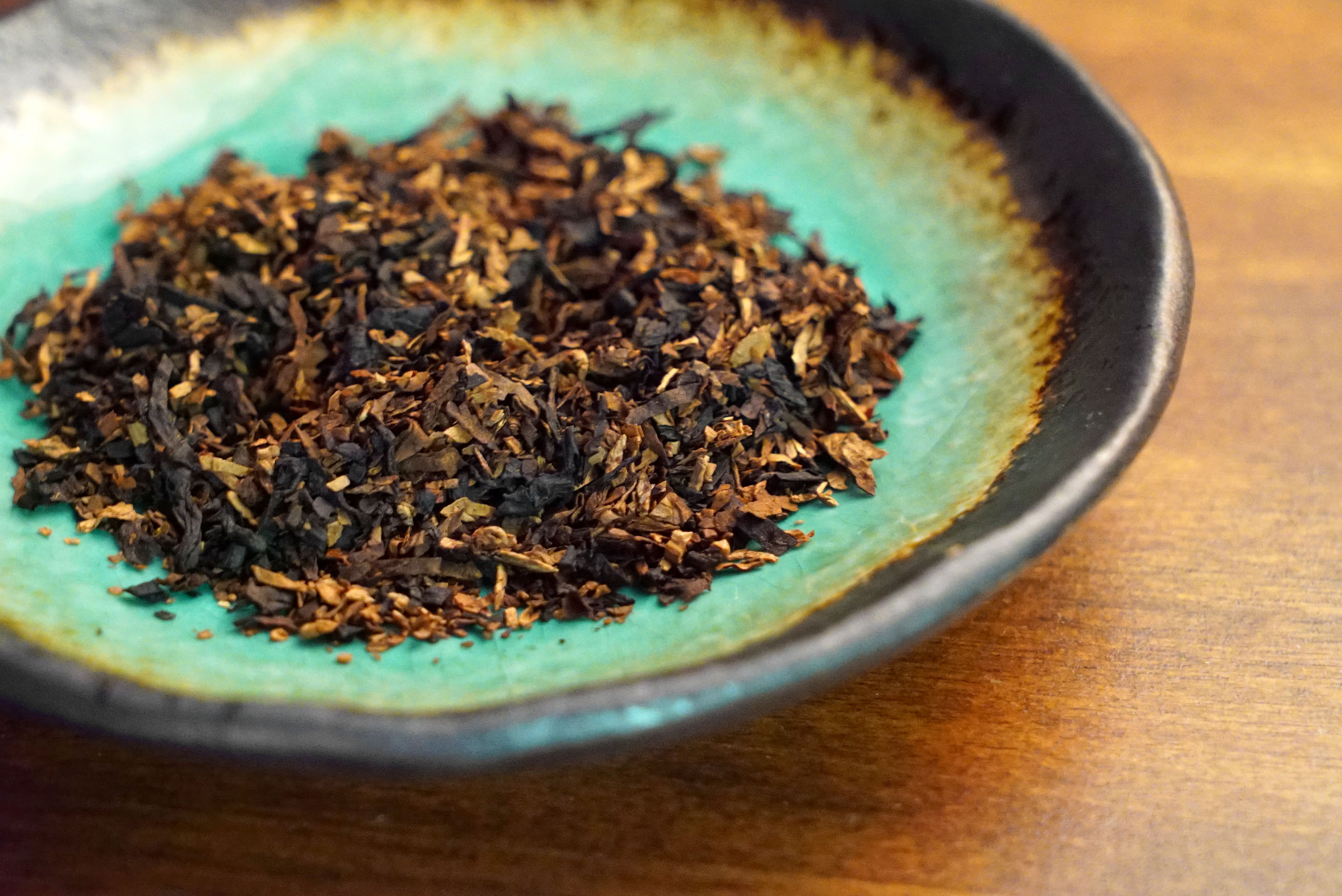
Astoundingly similar to scotch, pipe tobacco can vary from smoky like baseball glove leather, to sweet like caramel. In fact I often pair a smoky scotch with something like a Latakia tobacco, which has the similar medicinal, iodine-y aroma of peat moss mixed with leather.
Those types of tobaccos are generally less pleasant to smell when burning, but they’re still not as noxious as a cigar or cigarette. They’re not UNpleasant by any means; they just have a characteristic odor that takes a little getting used to.
Other tobaccos are infused with flavorings and even sugars to make them taste different or become very aromatic and scented when burning. It’s as if you’re burning a nice-smelling candle in the room. The smoke does tend to cling, though, so make sure you have good air circulation. If not, you may soon find yourself wading through a thick fog of pipe smoke. Here’s a more specific look at the various types of tobacco:
Major Breakdown of Tobacco Styles
Aromatic: During the manufacturing process, flavors or “casings” are added to the tobacco, as mentioned above. Some of the most common are vanilla, nougat, cherry and chocolate. Depending on the amount of flavor used, a blend in this category can also be deemed semi- or lightly-aromatic.
Non Aromatic: Natural tobaccos that derive flavors, in many cases, through aging, curing, smoking or fermenting. This technique increases the sweetness and/or flavor without using sugar additives.
English Blend: Until 1986, additives were not allowed in English tobaccos. While non-aromatic tobaccos are manufactured all over the world, a true English blend is one containing Oriental tobaccos, most notably Latakia. The most common English blends consist of Latakia, Virginia, and Perique. Depending on how much Latakia is mixed into the blend ultimately determines the overall strength of the mixture, described as mild-, medium-, or full-bodied.
Blending Tobaccos
These tobaccos are often blended together to form different flavor profiles in commercially packaged and loose pipe tobaccos.
Virginia: This is the most common and mildest of all aromatic blending tobaccos. With the highest natural sugar content, it can burn hot and “bubble” or boil while smoldering in the pipe bowl. It lights up easily, and has a sweet taste, which increases when aged prior to blending. It is sometimes sticky or damp.
Burley: This has a thicker leaf than Virginia, with a soft, nutty flavor. It burns slowly and contains little sugar. As such it is commonly used in high sugar blends to keep them from burning too hot. The color ranges from mahogany to light brown, and is typically air-cured for 30-60 days in large barns.
Spice or Taste Tobaccos
These are blending tobaccos that are used like seasonings. You add a particular amount to your blend to give it a characteristic flavor or unique kick. Examples would include varieties like Perique, Brazil, Kentucky, Oriental and Latakia. These are all commonly found in English blends.
Perique: This is a dark tobacco from St. James, Louisiana that’s spicy in flavor. It is a rare, slow burning and strong-tasting tobacco. Production is small, so its value is high. Perique’s cured leaves are put in large oak barrels under heavy pressure and fermented for a year or longer. The aroma is full bodied. The nicotine content is very high, so Perique isn’t smoked by itself. The most you usually see in a blend is about 5 %, and it’s usually mixed with Virginia.
Brazil: A dark tobacco with a strong, sweet flavor.
Kentucky: This is actually a special fire-cured Burley tobacco produced in Kentucky. It’s very aromatic and unique. The nicotine content tends to be high, so it is used sparingly.
Oriental: A generalized grouping of dry tobaccos that includes Latakia and is known for unique “spice” flavors. Tobaccos in this category come from Russia, Macedonia, Turkey, Greece, Cyprus, the Balkans and Syria. Some popular Macedonian tobacco varietals include Komotini, Samsun, Xanthi, Drama, Serrus, Izmir, Yenidji, Cavella and Bursa.
Latakia: This is a full-bodied dark, dry tobacco from Cyprus and Syria that gives off a smoky aroma that’s similar to burning tree leaves, peat moss or baseball glove leather. Latakia is a powerful tobacco: this is the “smoky scotch” of tobaccos that I discussed earlier. It is produced by smoke- and fire-curing the leaves over spices, herbs and aromatic woods. This is very similar to the process of peat smoking barley prior to fermentation in the whisky and scotch making process. It is precisely why the two items have such similar flavors and aromas. English blends sometimes contain up to 50% Latakia, and some smokers will put nothing in their pipes but 100% Latakia. Balls. One thing to note here is that this variety can sometimes get ashy toward the end, since it is such a dry tobacco. It rarely “bubbles” or boils as you smoke it, as it tends to burn cool (low sugar content).
Side-Note About Latakia: The smoking process associated with Latakia tobacco was first discovered when farmers forgot they had stored excess tobacco in the rafters of a barn where they used to cook. The smoke from all the burning wood wafted up and flavored the tobacco. When the farmers found the old tobacco in the rafters, this new, enjoyable flavor style was born.
Tobacco Cuts & Curing Processes
Like steak, there are several cuts of tobacco. However while each cut of steak has a different flavor because it’s from a different part of the animal, tobacco cuts have a more physical connotation: it’s all about the shape, size and manner of how the leaves are cut.
The curing and processing of tobacco is analogous to steak aging, marinating and applying varied cooking methods. The tobacco leaves can be dried, flavored and processed in a variety of ways prior to smoking, all to different results and imparting a wide variety of flavors.
Here’s a quick breakdown of the information you’ll need to know when you go out and buy some tobacco:
Cavendish: This special heating and curing process brings out the naturally sweet flavor of tobaccos. The result is a mild, light tasting and easy to pack product. Cavendish can be produced from any tobacco type, but mainly Virginia tobaccos are used because of the high sugar content that naturally occurs in the leaves. Examples include Black Cavendish, Navy Cavendish (aged with rum) and English Cavendish (fire-cured tobacco which is steamed and then stored under pressure to permit it to cure and ferment).
Casing: Simply put, this means adding flavoring to a tobacco. This is usually done by producing a fluid mixture of sugar, honey and/or other kinds of aromatic sweeteners and then soaking the tobacco. The goal is to produce a tobacco with a sweet and smooth aroma.
Air-Cured: Drying tobacco naturally, and sheltering it from sunlight in large barns causes sugar content to crystallize on the leaves. It usually takes about three months.
Fire-Cured: This drying and curing method is achieved by a wood-fired smoke fumigation.
Sun-Cured: Most Oriental tobaccos are cured by simply baking in the sun, which is why they tend to be drier than other varieties.
Cake: This is tobacco that has been soaked in honey, which acts as a bonding agent as well as a sweetener.
Spun-Disc or Plug: Similar to cake, this is tobacco that has been soaked in a bonding agent (like sugary syrup or honey), but then pressed together by packing it into round molds or logs before packaging. If a piece is cut off its called a plug.
Flake Cut: Tobacco packaged as large, flat flakes. It must be rubbed out to separate the flakes, or folded and then simply inserted into a pipe and lit.
Rubbing Out: While often used as a term for masturbating, in the world of pipe tobacco it means rubbing flake or plug in the palm of the hand to loosen the tobacco prior to smoking.
Ready Rubbed: A flake-cut tobacco that has been rubbed out before packaging.
Shag: Tobacco that has been shredded very finely. This is what Sherlock Holmes smoked, which, at that time, was supposedly considered an inferior product.
Ribbon Cut: Tobacco cut into long, thin ribbons, though not as long or as fine as shag.
Cube Cut: Pressed tobacco chopped into small square pieces.
Navy Cut: Traditionally the tobacco was put in a long thin canvas tube and twisted up very tight. After time it became a thick rope of tobacco, approximately an inch in diameter. Similar to spun disc, if a piece was cut off it was called a plug. It is also commonly sliced, and is generally a slow burning tobacco.
Styles of Pipes
Similarly important to WHAT you’re smoking is the vessel in which you’re smoking it. The pipe you choose is an extension of yourself; it is a personality marker. Like fashion or clothing style, it is a deeply personal matter. It may even be the kind of Harry Potter wand bullshit where the pipe chooses you, rather than you choosing the pipe. You may be surprised in what ends up being your “fit.”
Most commercial or good quality pipes are carved from high density hard woods, like briar, that won’t ignite and turn to charcoal with frequent burning. This dense wood often has some pretty cool patterning in the grain as well.
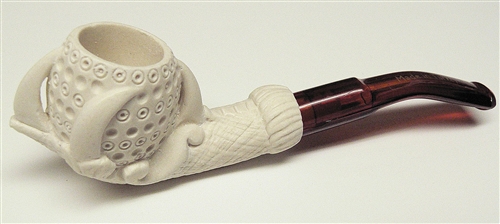
However some are made from meerschaum, which is a mineral deposit that is carved and later polished with hardened bee’s wax. These are typically ornately designed, like sculptures.
The meerschaum pipes will tend to turn slightly yellow over time as they become seasoned and used, with a dark brown or black interior in the bowl. They are said to impart a sweetness to the smoke that you don’t get with a wood pipe.
Other pipe styles are more natural, like those made from dried gourds, calabash pipes, or corn cobs. The calabash, which has a removable meerschaum bowl topper that traditionally rested in a hardened, hollow gourd, is what Sherlock Holmes smoked.
I suppose we could throw glass pipes and hookah pipes into the mix, but those are generally being used for illegal drugs, dried fruit or more harsh blends of non-pipe tobacco that aren’t very pleasing. Those pipes are more difficult to carry around for every day use too.
If you see the phrase “estate pipe,” it usually means that the pipe was used and is now being re-sold. Nice for decoration, perhaps.
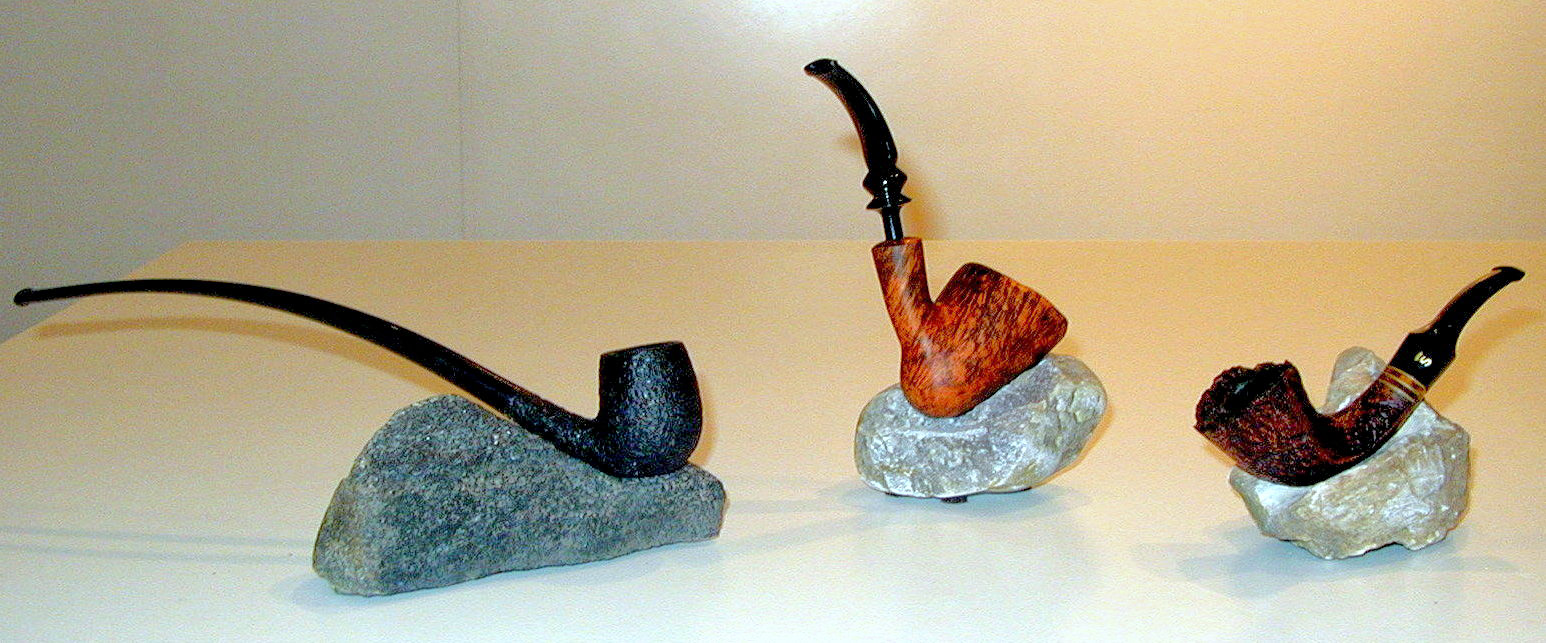
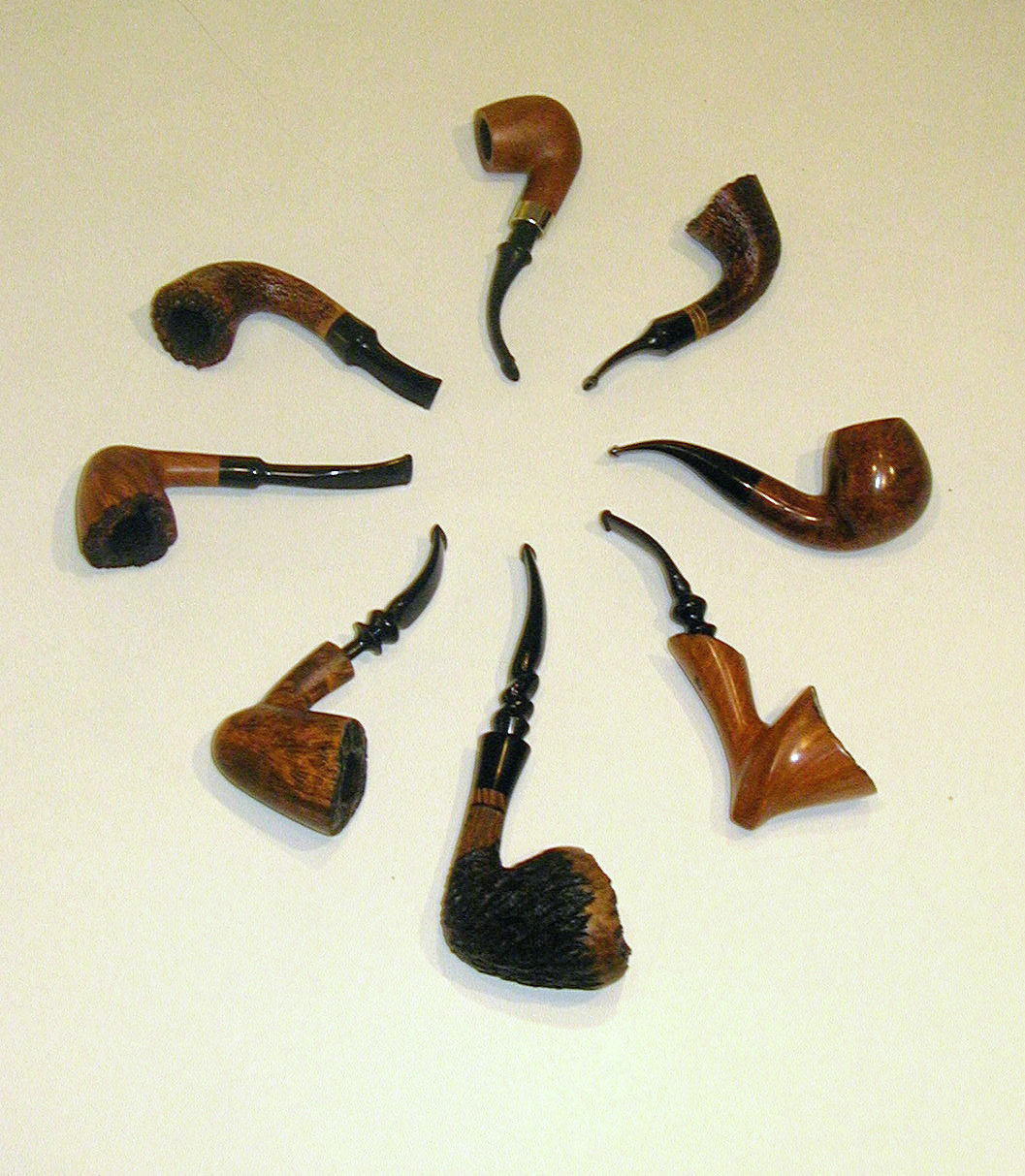
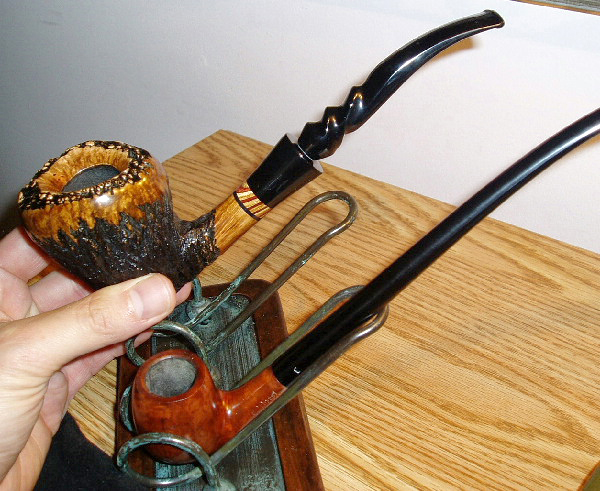
In the realm of wood, where we will remain, there are “free-hand” natural cut, rough top, and smooth varieties. Below, the top pipe and right pipe represent smooth, elegant styles – more refined. The bottom, top right and top left represent natural cut styles – more rustic. On the left and lower left, you’ll see smooth styles but with rough tops. And on the bottom right you’ll see a stylized smooth pipe that still retains a natural, rough looking shape. As you can tell, there are lots of pipe styles out there. Picking a single one that suits you is often difficult. That’s why pipe smokers tend to collect several pipes, and choose which to smoke depending on their mood.
A closer look at the bottom-most natural cut, free-hand pipe:
I apologize for the repeat photos below, but I’m popping them in so you don’t have to scroll back up to see what I’m talking about.
In additional to the overall look, there’s also the stem length. Longer stems allow the smoke to cool down before it gets to your mouth, making for a more relaxed and smooth smoke. However, a long-stemmed pipe is not the most convenient thing to tote around and carry for the evening. As such, a chuchwarden pipe might be better suited for long bouts of reading or relaxing by the fireplace.
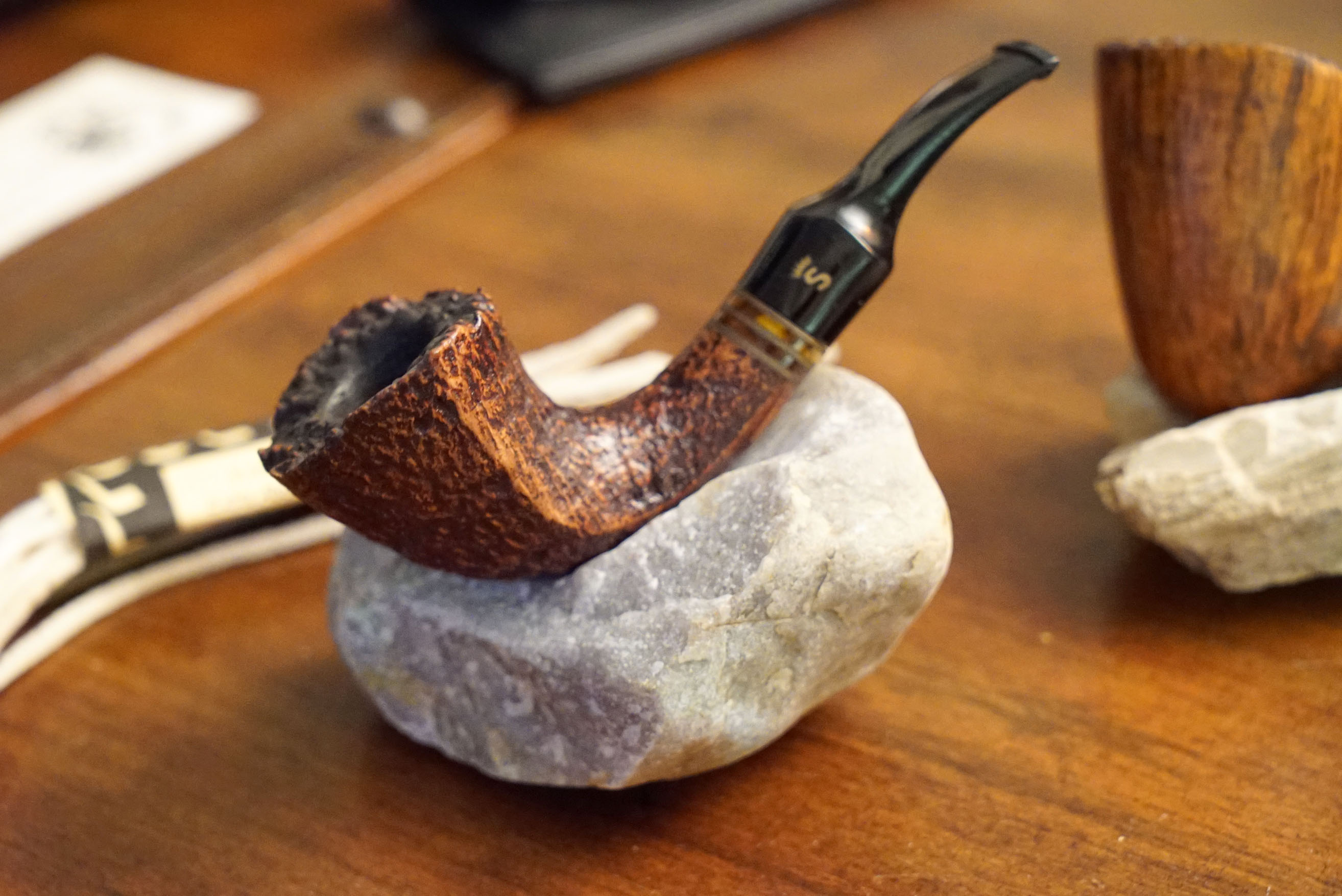
As you saw from the pipe wheel up above, a few of us prefer the traditional bowl style, or a smooth style, while others like a rustic horn pipe shape or a free-hand. Here’s a closer look at my horn:
It’s all a matter of preference. There really isn’t a difference on many of the styles other than what I mentioned about the stem length. However if you notice, in the image of the natural cut pipe, the pipe has a very large and deep bowl. When comparing the natural cut to the small churchwarden bowl, the natural pipe may stay lit for an hour as opposed to 15 or 20 minutes for the “churchie.”
Same goes for these two pipes below. The churchwarden on the left is about half as deep as the rustic/natural topped pipe on the right:
These things need to be considered before lighting up or leaving the house with your pipe gear.
Pipe Gear
Pipe gear can range from tools and accessories to satchels and pouches. There’s a LOT of cool stuff you can pick up for your new and awesome hobby. Below are some examples:
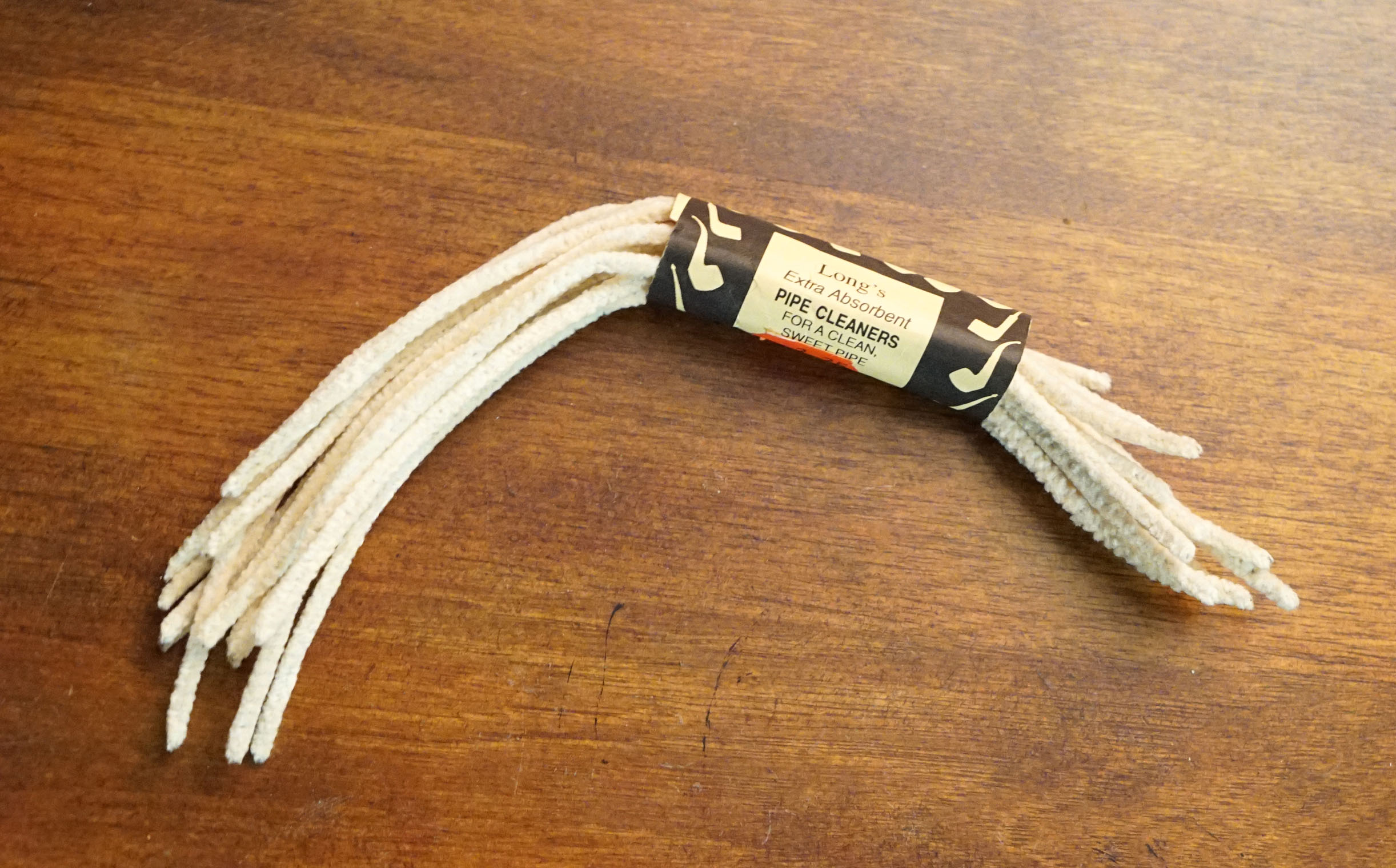
Pipe Cleaners: Yes… these are actually used for something other than children’s craft-making. You stick them down the stem to remove excess gunk, sludge, moisture, tar, spittle, you name it…
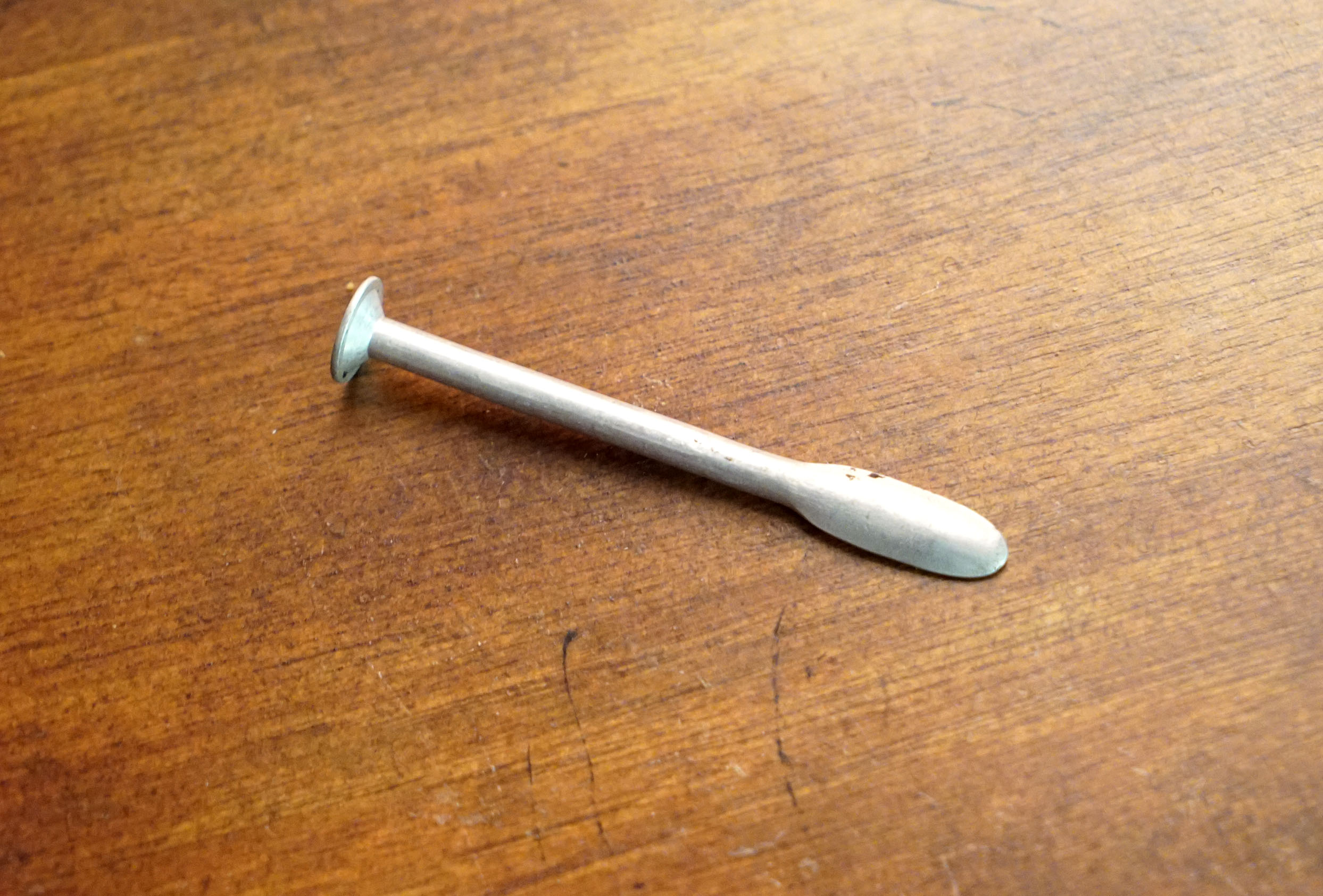
Pipe Nail: A poor man’s pipe tool, this is primarily used for tamping down your tobacco as it burns (to keep a compact but well-breathing ember/smolder going). At the end of your smoke, the flattened point can be used to scrape out the ash and gunk. Picking up a pipe nail will only run you a buck or two at most.
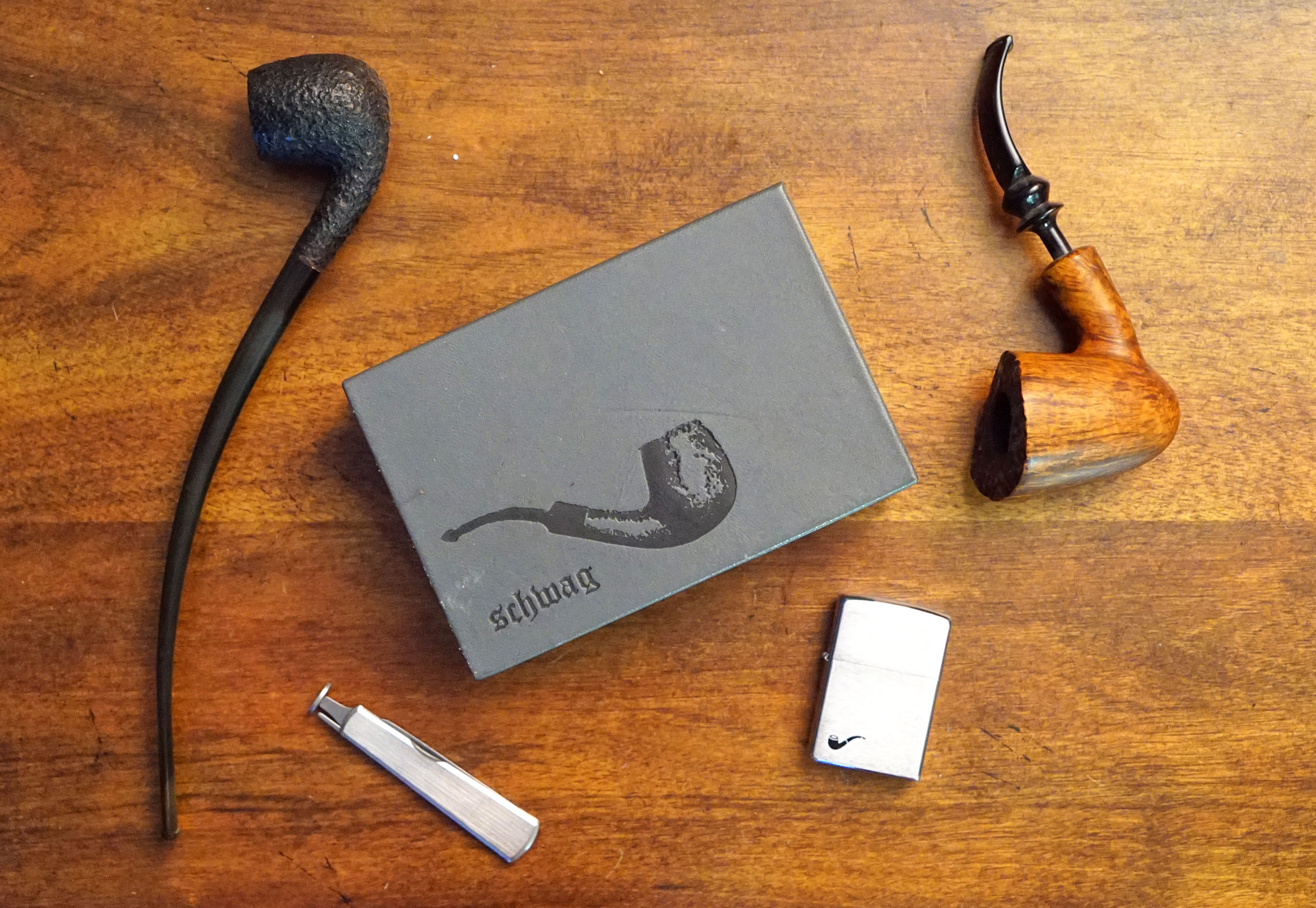
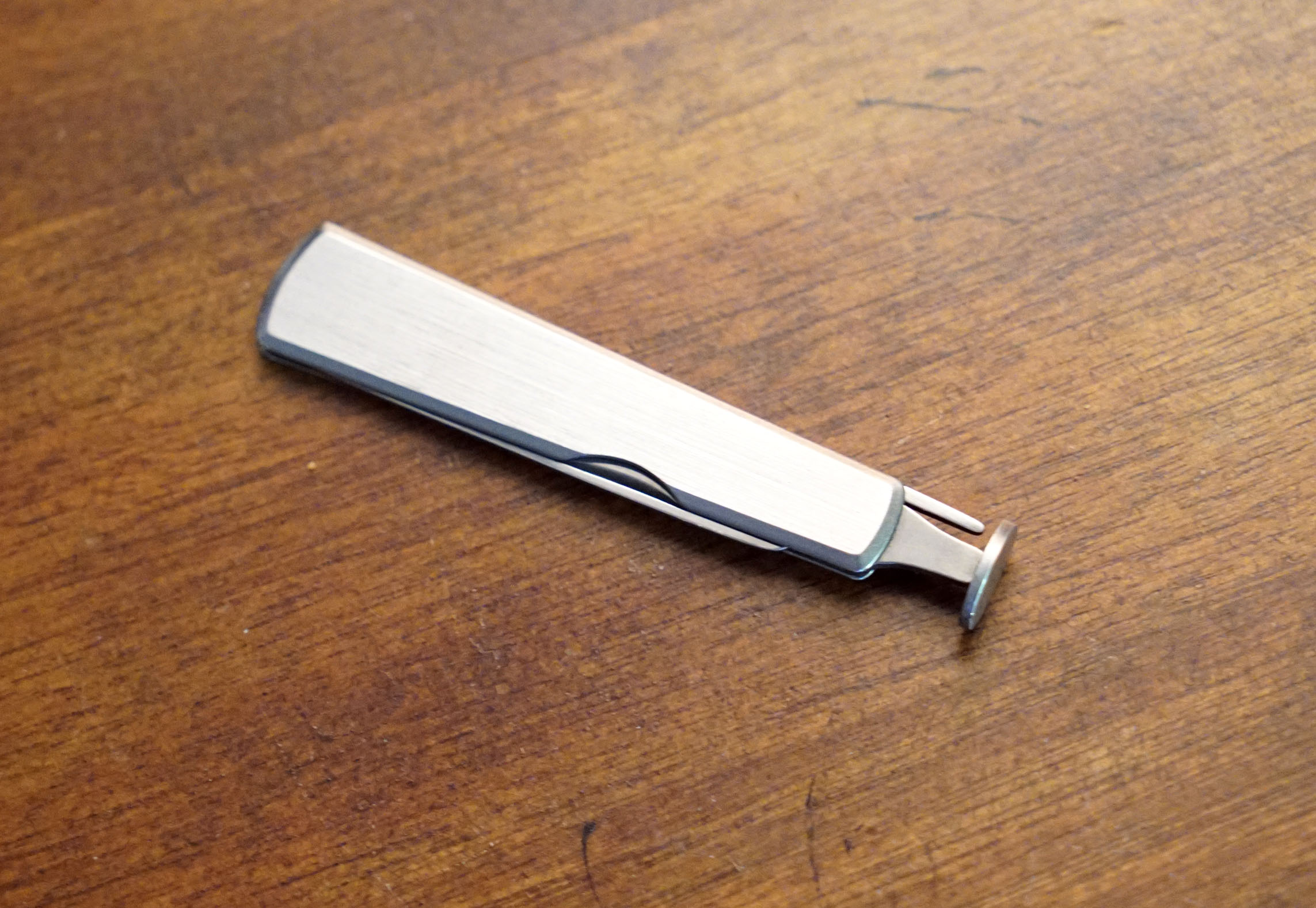
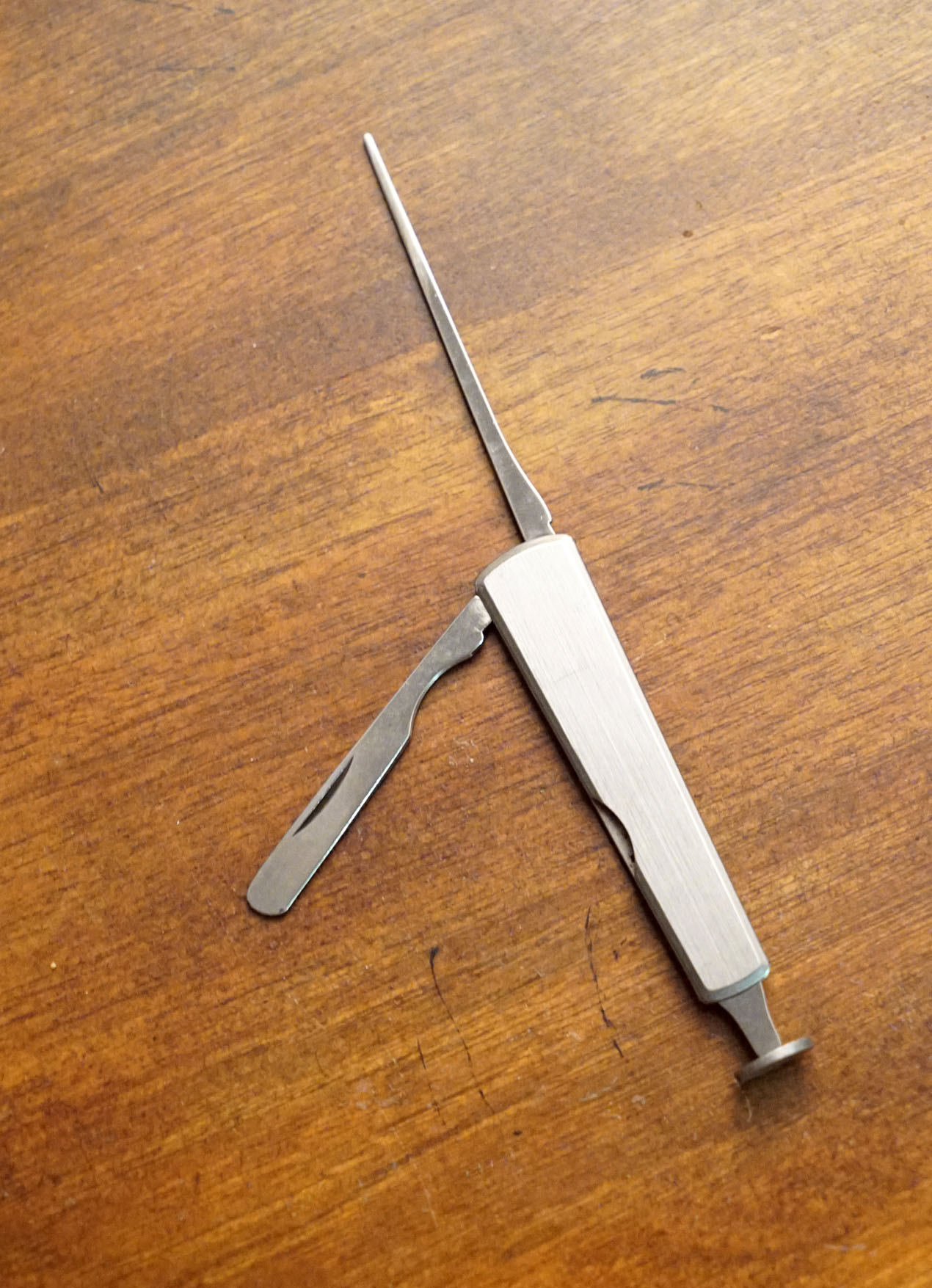
Pipe Tool: A full fledged pipe tool looks a bit like a folding pocket knife. One side is a scraper, the other side is a poker. And the flat bottom portion is for tamping down your tobacco, like a pipe nail. Fancy pipe tools can range from $10 to $100 depending on the craftsmanship and materials involved.
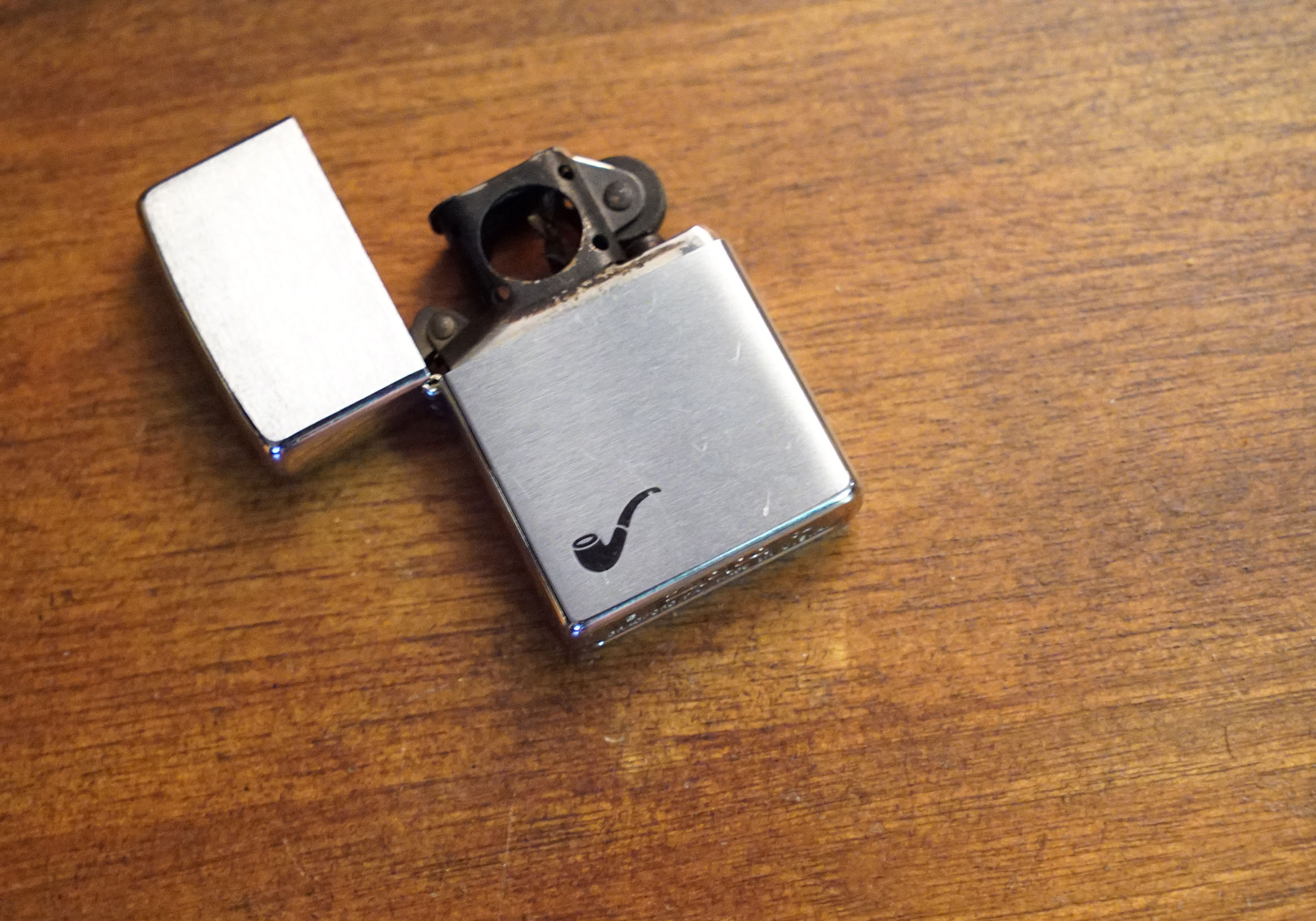
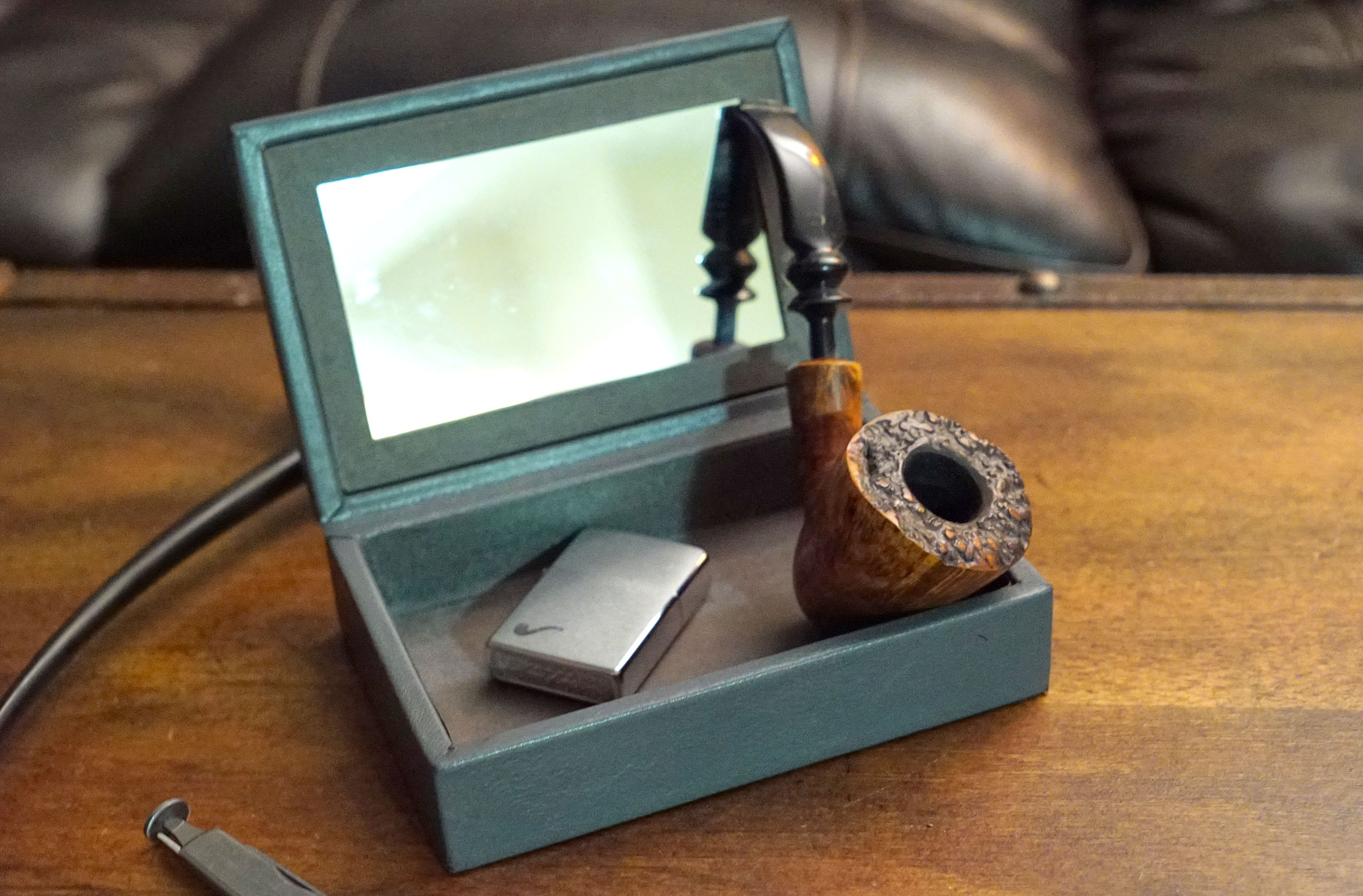
Pipe Lighters: Special lighters like this Zippo are made for lighting pipes, as they have a cut-away hole for holding the lighter sideways, with the hole hovering over the bowl of your pipe as you light up.
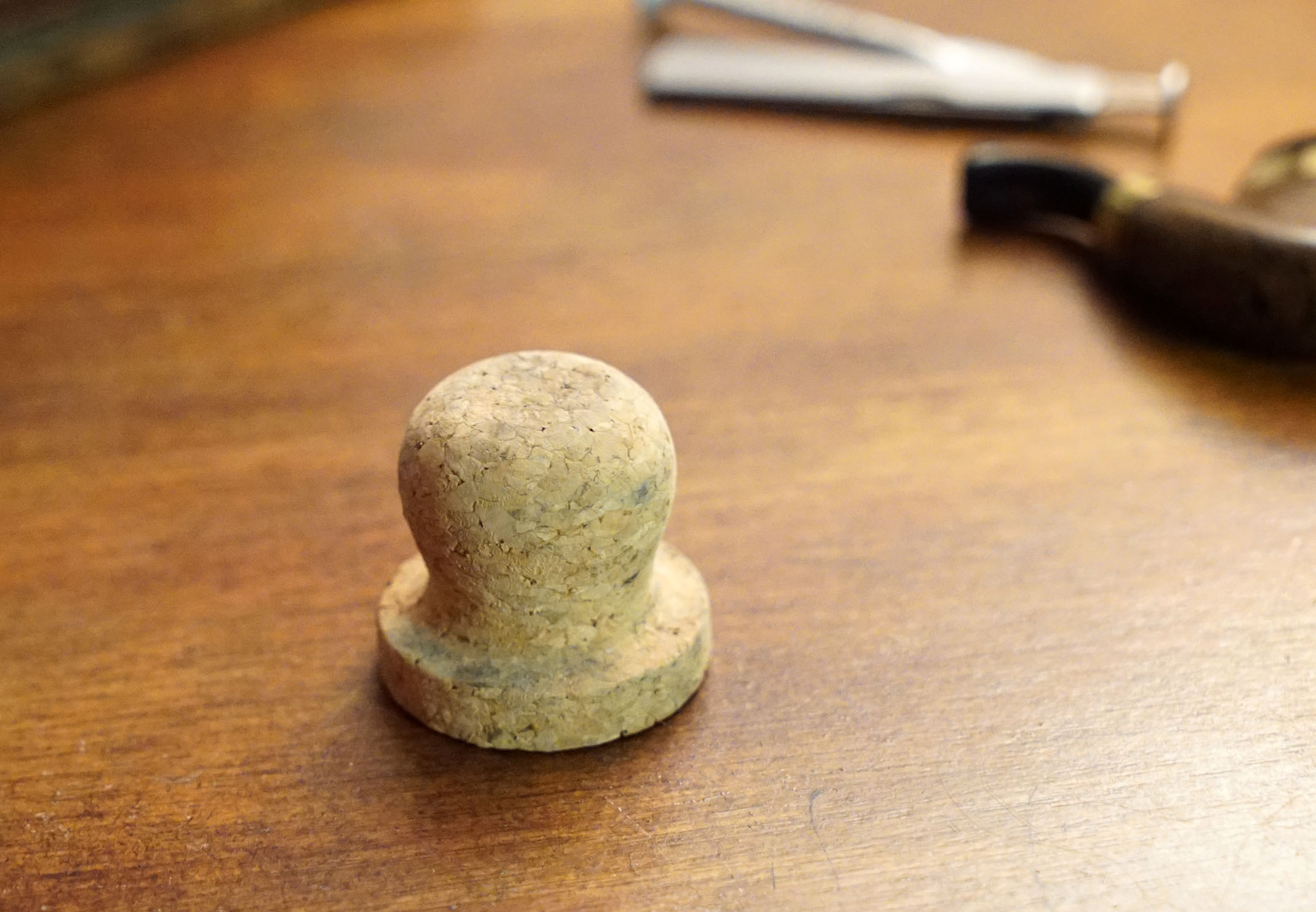
Pipe Knocker: This cork doo-dad is for tapping against the side of your pipe bowl to get excess out before scraping out with a pipe tool. It’s safer than using your hand (burns suck), and it also protects the finish of your pipe so you don’t ruin it by tapping the bowl against something that could scratch or nick the wood.
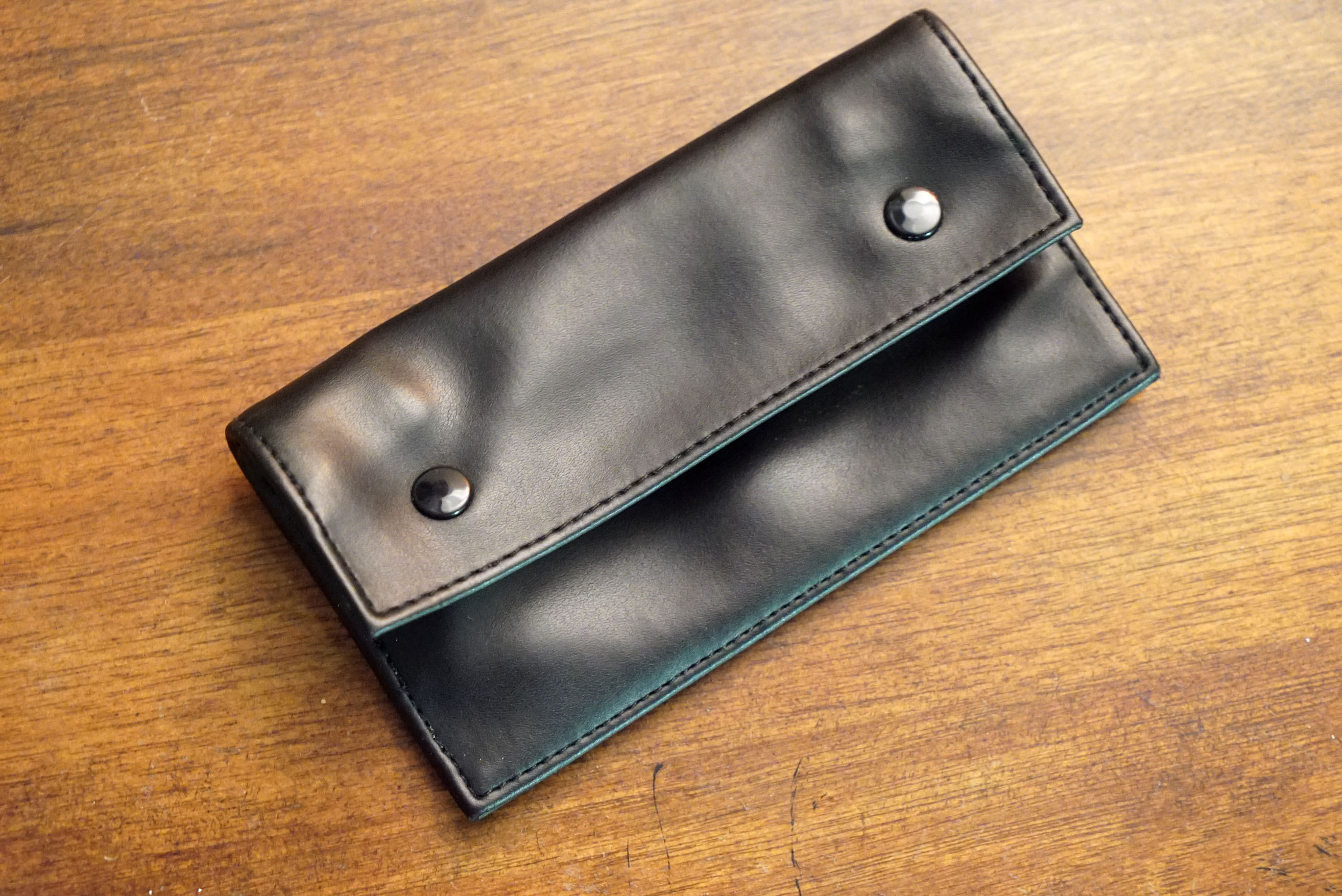
Pouches: Simple. This accessory is for holding loose pipe tobacco that you may have purchased by the ounce at your local tobacconist or smoke shop.
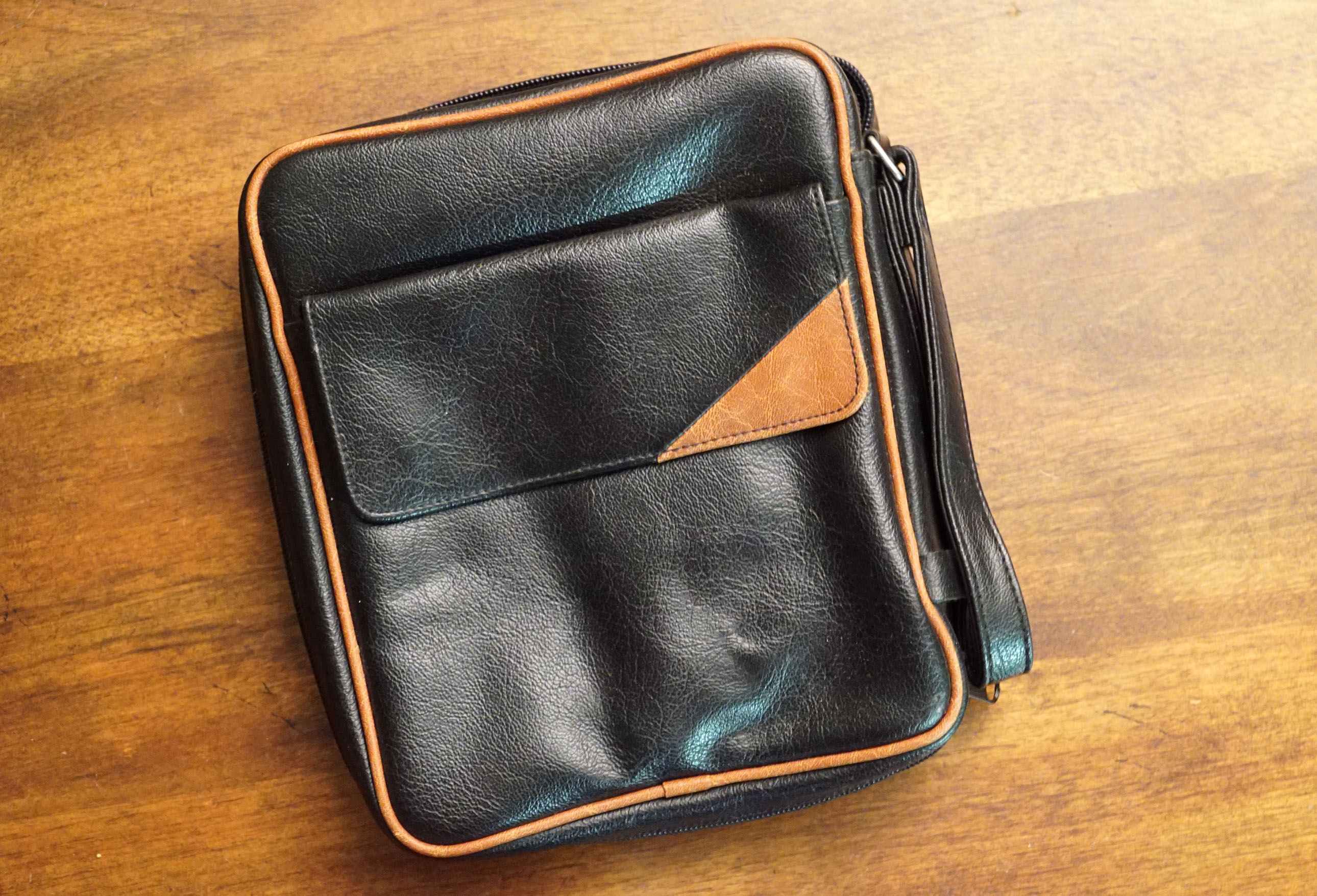
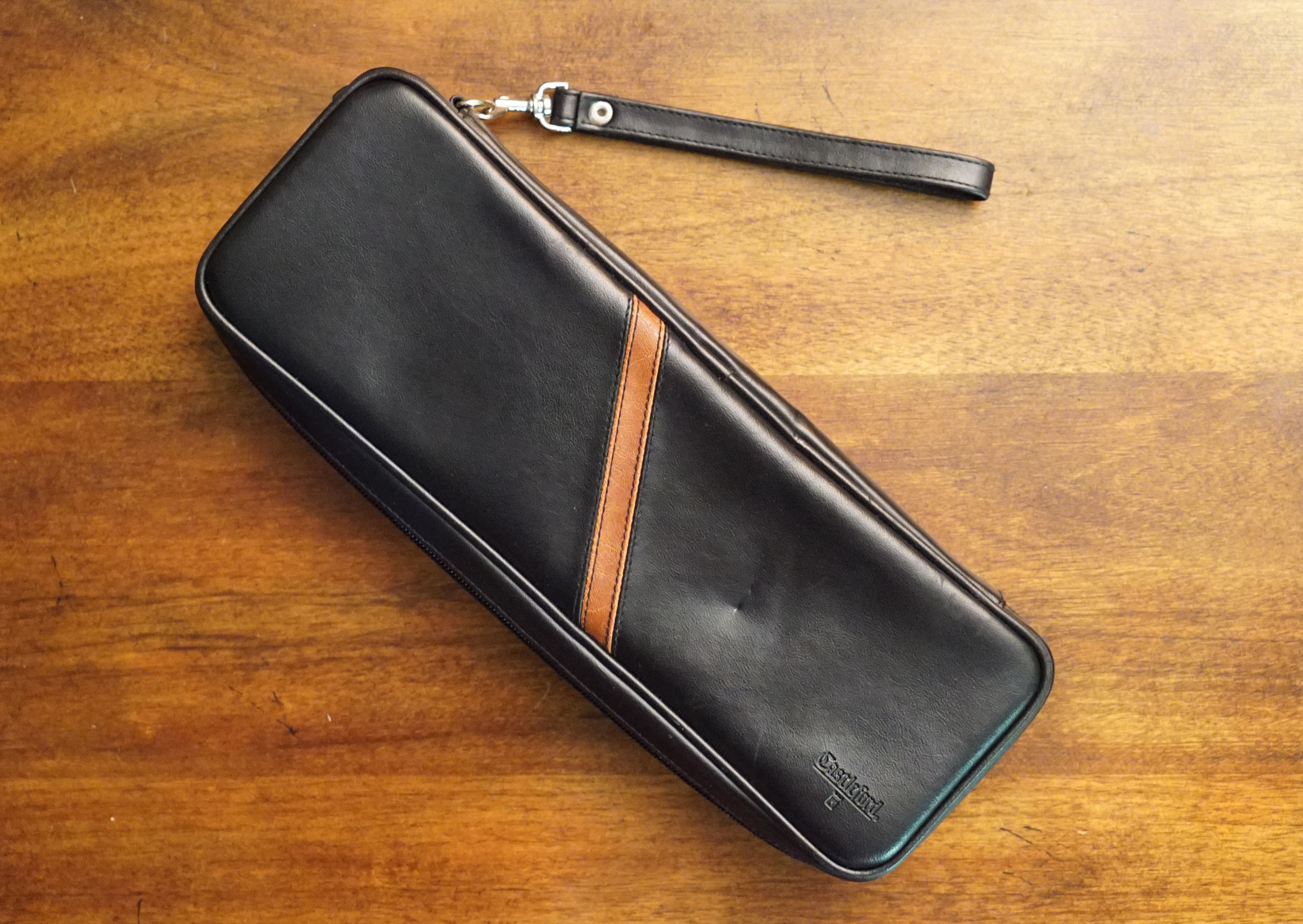
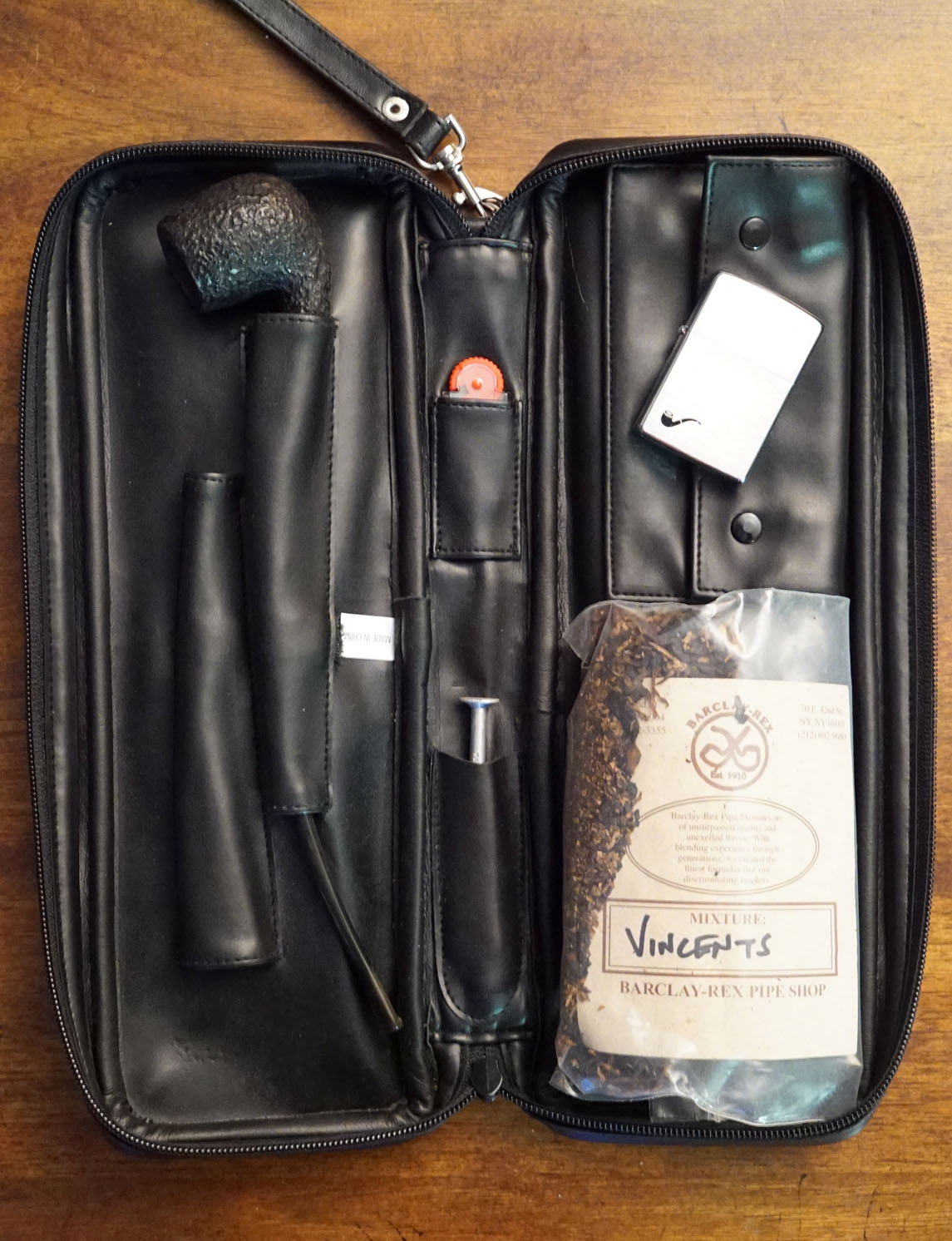
Pipe Cases: These nice leather-bound satchels are for holding pipes and everything involved with pipe smoking all together in one easy-to-carry item. Plus they’re pretty sharp looking.
They even make these things for long-stemmed churchwardens:
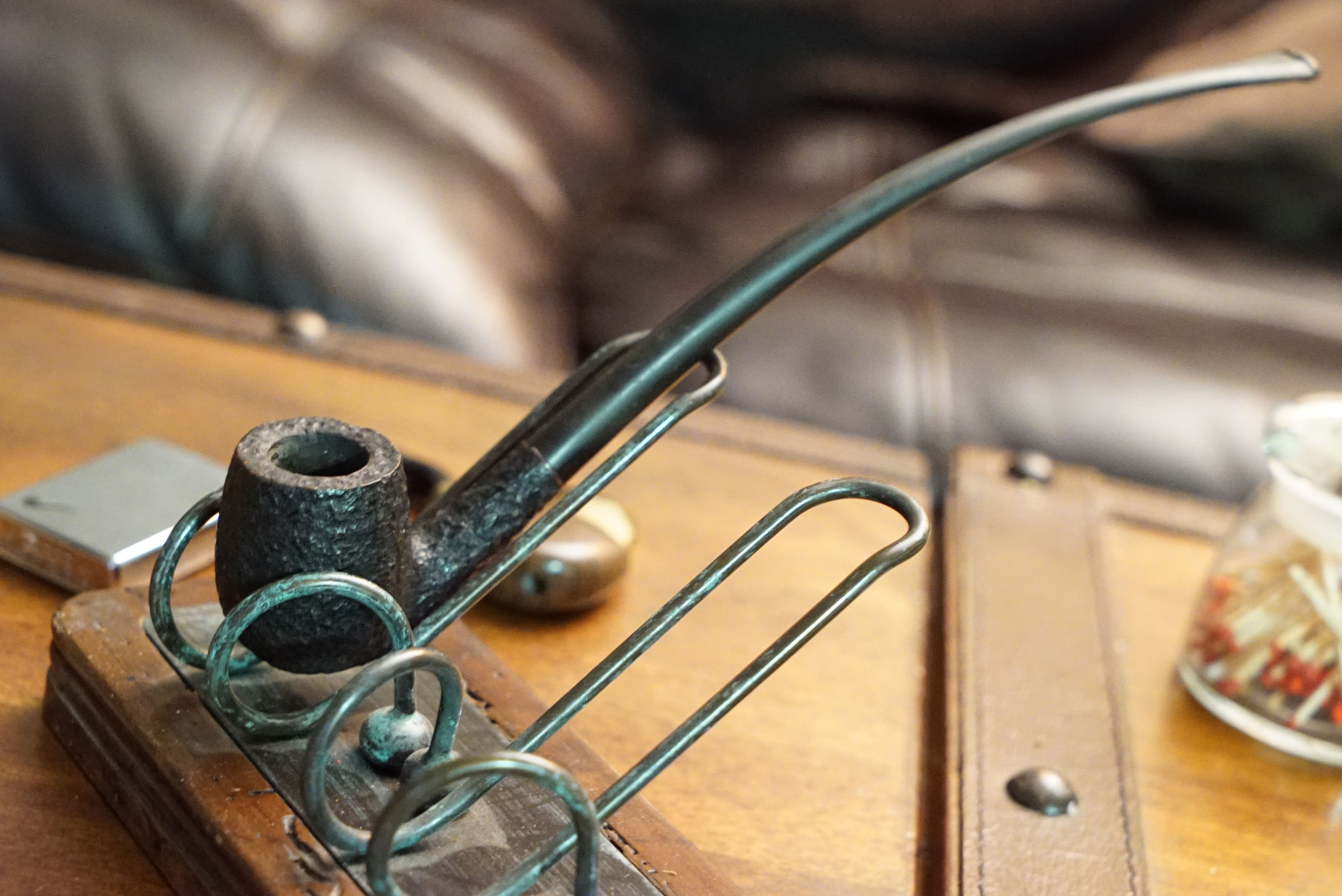
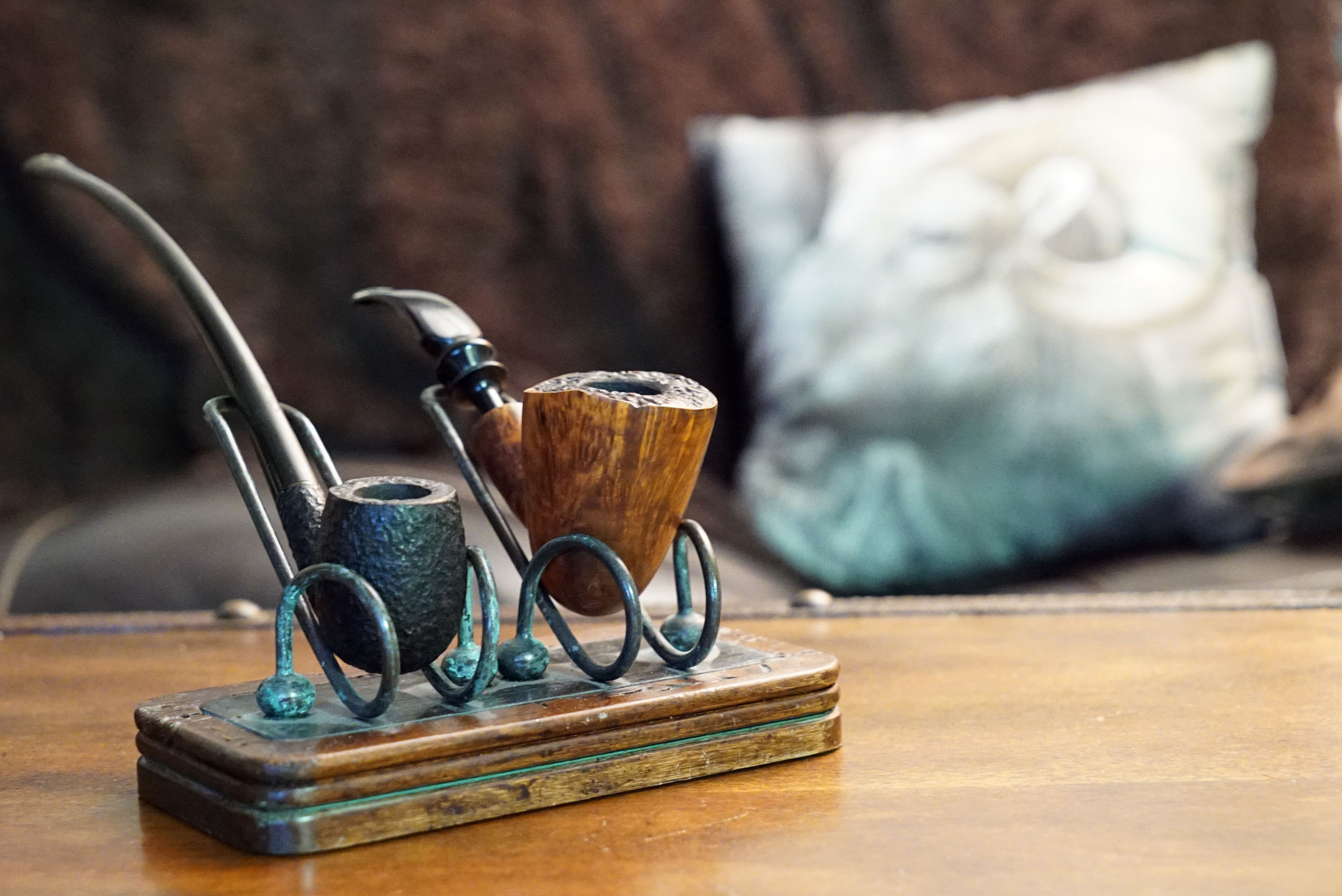
Pipe Display: If you’re like me, you like to show off what you’ve got sometimes. These stands and display cases are perfect for classy, old school home decor.
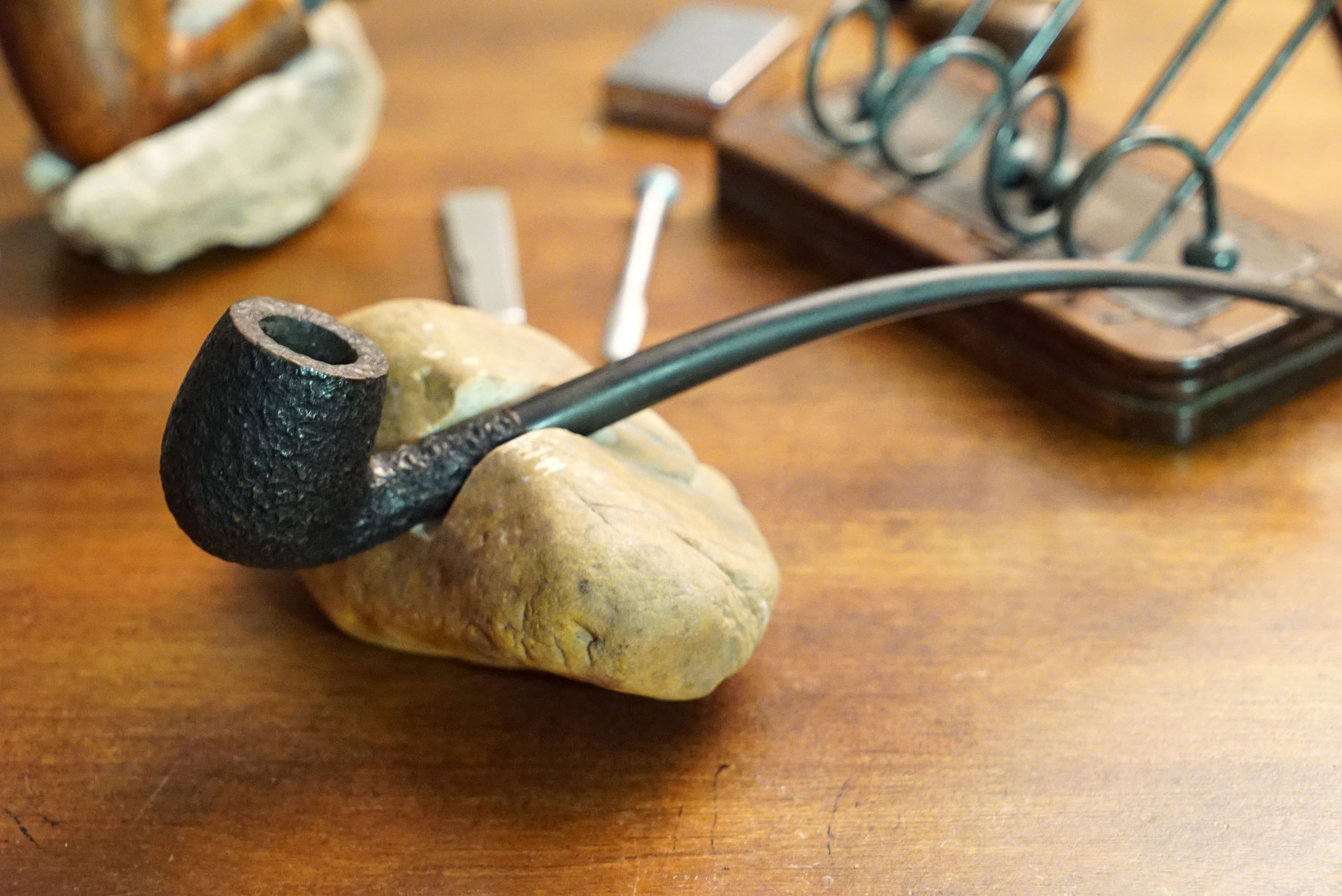
I’ve even made some out of rock, to emphasize the natural, rustic look of this horn pipe:
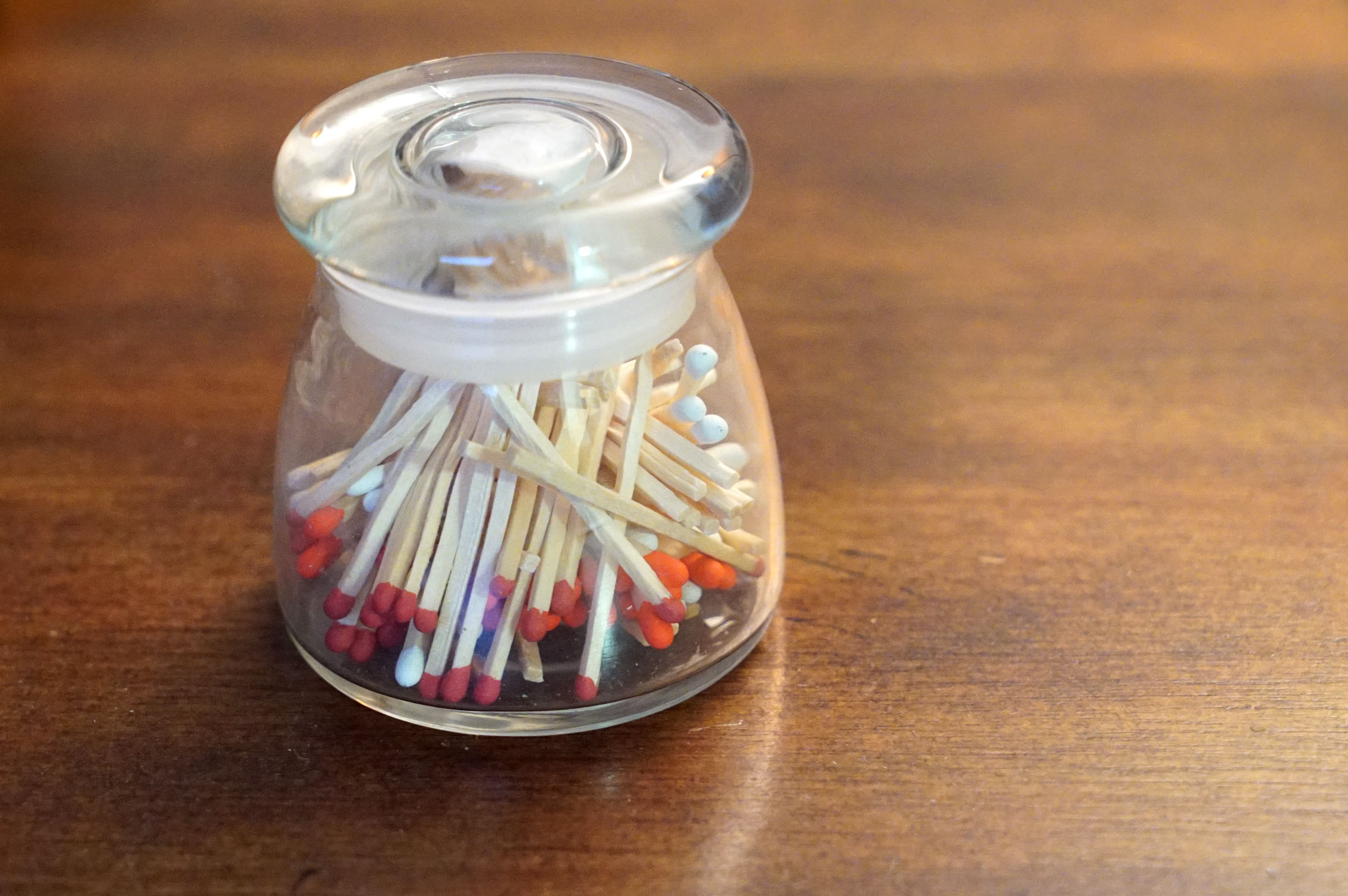
Tobacco Jars: These are usually for storing your loose tobacco purchases. You should pop a small humidifier into the lid if you can to keep your tobacco moist. I use my jars for matches, since I have a humidor for the tobacco:
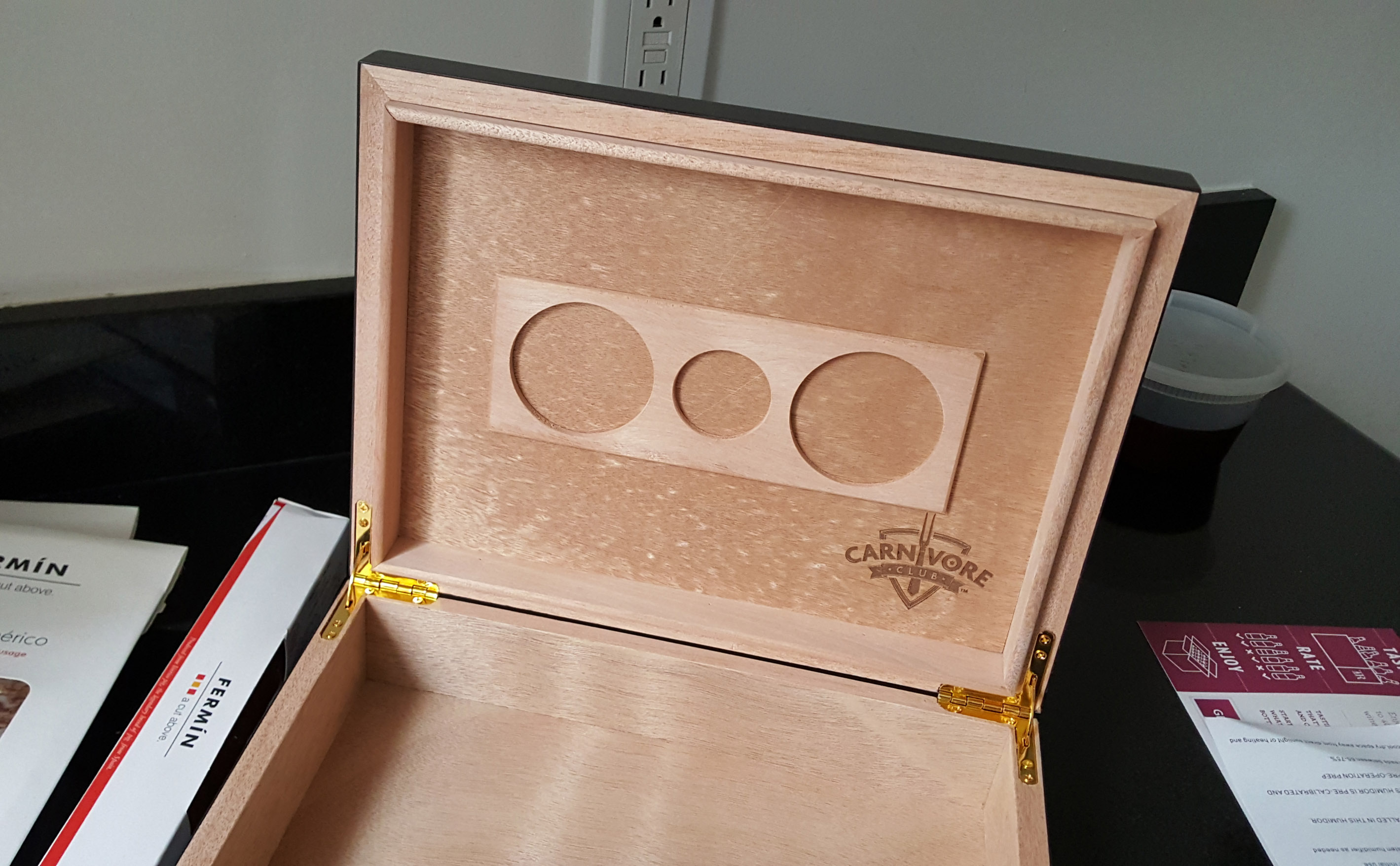
Speaking of humidors, a shot of mine is below, which I got from Carnivore Club. There are also other cool things too, like special pipe ash trays and schwag boxes for storing some or all of your shit:
Packing Your Pipe
This here is a pretty good method for packing your pipe with tobacco in such a way as to preserve maximum air flow when pulling through the stem, but also allowing for a good burn, with which you won’t have to re-pack or re-light your pipe several times throughout the course of your smoke.
Your first pinch of tobacco should go into the pipe and be pressed down gently. A rule of thumb is to fill the bowl loosely and then pack it down so that the bowl is half full. Your second, and any successive pinches of tobacco, should be pushed down more firm as you go. When you fill from half to full again with the second pinch, you should pack down to 3/4. And a third pinch should pack down to 7/8. When you continue in this vein, you’re creating a more solid bump of tobacco at the top as opposed to the more loose shreds at the bottom. You want the tobacco to be a little loose at the bottom so that air can be pulled up the stem easier and allow for fresh oxygen to feed the flames and keep the pipe lit.
Check out the short demo video below for how to pack your pipe:
Lighting Your Pipe
Many people use a special lighter or their favorite fancy torches for lighting a pipe, but I like a good old fashioned pair of wood stick matches. Two matches, both simultaneously lit and held slightly apart from one another, makes for the perfect flame size to get a good, even light.
I prefer matches because they don’t impart a lighter fluid or butane smell/taste to the process. Torch style butane lighters can damage your pipe if the flame is too hot and concentrated. They can also burn your mouth if you pull too hard while lighting. The flames from those things are piercing, and can actually over-light your tobacco, burning it out too quickly, if you aren’t careful in how you apply the flame to the tobacco. My suggestion: don’t use a torch lighter.
If you’re just starting out, you may not have a cool lighter yet, and wood stick matches are typically free when you buy tobacco from the smoke shop. The only down side to matches is that it can be difficult to light if you are outside in a windy environment. That’s when a pipe Zippo comes in handy.
Okay so here’s how you actually do it: Strike your matches and hold them slightly apart. Make small circular motions over the top of your tobacco while you pull long, even and powerful puffs through the stem. About three to six good long pulls through the stem should do the trick to get a good light. If you do it right, you won’t have to light it again before you finish. See below for a short demo video:
Smoking Your Pipe
Piping should be a relaxing, soothing experience. If you find that you’re furiously puffing like a madman just to keep the embers glowing and billowing, then you’re probably doing it wrong. You should take occasional long pulls and allow the smoke to swirl around your mouth for a moment before blowing out. I don’t inhale.
While doing so, I occasionally will partially cover the top of the bowl with my thumb or palm to deprive the flame of oxygen prior to pulling through the stem. This technique keeps the embers smoldering nicely because when the flame gets the air it needs, it gets it in abundance. Think of each pull like a billows for a fire.
If you find that your smoke is thin and ashy, it probably means you’re losing your light. You should tamp down your tobacco occasionally as you smoke, with a pipe nail or pipe tool.
Pushing down gently or “tamping” the lit tobacco will keep your fire burning. A compact tobacco preserves heat for a longer, more steady burn. This will prevent your bowl from going out. Check out my video demo below:
I had a few decent smoke rings in there. I’m still working on the Gandalf ship technique though.
Once you get down to the bottom of the bowl, you may experience an ashy taste, or a chalky residue in your mouth. This usually happens when you’re running out of tobacco in the bowl, and you’re starting to pull in the ashes that remain in the bottom of the pipe. For me, this means it is time to either refill and repack the pipe, or put it out and put an end to the smoking session.
When ending your piping session, allow a few minutes of cool down time before you tap out the ashes and scrape out the excess. I also give a few gentle pushes of air through the stem and out the bowl too. This will dislodge any fluids, ash or chunks that may have gotten stuck at the bottom of the stem or bowl. Check out the demo:
Cleaning Your Pipe
You don’t have to clean your pipe after every smoke. In fact, allowing a bit of the tobacco residue to settle on the walls of the bowl will act to “season” your pipe. This is recommended with new pipes or pipes that haven’t been smoked many times yet, as seasoning the bowl actually protects the wood and makes for a more enjoyable, insulated, robust and flavorful smoke.
It was once recommended to me that I smoke specific types of tobacco in specific pipes. For example, use your English blends in Pipe A, and your aromatic Virginia’s in Pipe B. I never really followed that suggestion, because I prefer blends that contain both Latakia and sweet tobaccos. But I can see how some may prefer to smoke specific tobacco styles in an exclusive pipe for each, especially if the bowl becomes seasoned for that particular flavor profile.
Anyway it IS good to clean your pipe every once in a while to allow for better air flow and a cleaner, more fresh-tasting smoke. At the very least you’ll want to get that white/gray ashy stuff out, even if you want to allow the dark residue to cake up (for example if you are seasoning a new pipe).
Pipe cleaning is truly enjoyable for me. Here’s what I like to do:
First, work on a surface that’s easy to clean or wipe down afterward. Set yourself up with your pipe cleaners, pipe tools and a dry cloth.
Next, use your pipe tool scraper or the flat end of your pipe nail to lightly scrape the inside of the bowl in a circular motion. Do this a few times to get the bulk of hardened tobacco residue off the walls.
Then get a shot glass and fill it with whisky or scotch. This is not for drinking, per se, although you certainly could have a sip. But alcohol evaporates quickly, and, as such, is a great fluid solvent to use for cleaning up sticky, gunky stuff like tobacco residue. I prefer whisky because it tends to pair well with the flavor of the tobacco I smoke, but if you’re averse to whisky you can use vodka or some other neutral flavored liquor.
I use a cloth material to dip into the whisky and then rub out the inside of the bowl. Keep doing this until you’re satisfied with how clean the bowl is getting.
Note: it will probably never wipe completely clean, especially if you end up smoking often. There’s just a lot of black shit that embeds into the wood. The idea is to get the loose shit out so you have a clean smoke in your next puff.
Then dip your pipe cleaners in whisky and run them through the stem a few times to get the dark residue out of there. This will make for a better, cleaner pull on your next smoke. Again, do should this several times until you are satisfied with the amount of residue coming off. You should be able to get the pipe stem pretty clean inside since it isn’t made from absorbent wood.
Most pipes can be disassembled by detaching the stem from the bowl. You’ll want to do this to get all those nooks and crannies clean where they connect.
Finally, run a dry pipe cleaner through the stem to dry the inside, and wipe (or pat dry) the inside of the pipe bowl with a dry section of cloth. Then run a flame across the bowl to finish drying it, and to cook off any excess whisky left over in there from the cleaning.
Re-assemble your pipe and store it for your next use, or pack it with a fresh bowl of tobacco for a fresh smoke!
That’s pretty much it. Don’t forget to wipe down your pipe tool/pipe nail with a cloth to get the residue off before you put everything away. Use that whisky again if you have to.
Here’s a video demo of me cleaning one of my pipes:
So there you have it: a one-stop guide for all your pipe-smoking needs, provided by yours truly, Johnny Prime.
One word to the wise: don’t overdo it. I only smoke maybe once every month or so, and only that often around the holidays and in the colder months. Everything in moderation, as they say (including moderation). Anyway feel free to share this educational post with all of your friends, you pipe-hittin’ mutha fuckas!!!
Here’s all the demo vids together as one:
Still want to see more? Check out my dedicated pipe-smoking Instagram feed, @PipeBossOfTheDay, where I feature pipe smokers puffing away with a re-gram tool. Give me a follow!
UMAi Dry contacted me a few weeks back about their dry aging bags. I was intrigued by some of their promotional materials and video demos, so I told them to send me some samples to try out at home. I already had the sealer for use with my DIY sous vide machine, with which I made some kickass steaks.
Usually when I think about the aging process for steaks, I get overwhelmed and think I could never do it. This is something I should leave to the professionals. I worry about mold, bacteria, rancid meat, wasting money on failed attempts, etc. But with UMAi Dry this otherwise daunting task is boiled down to a super simple procedure. Essentially you just pop a hunk of beef in their special vacuum seal bags, put it in your fridge, and wait 35 days.
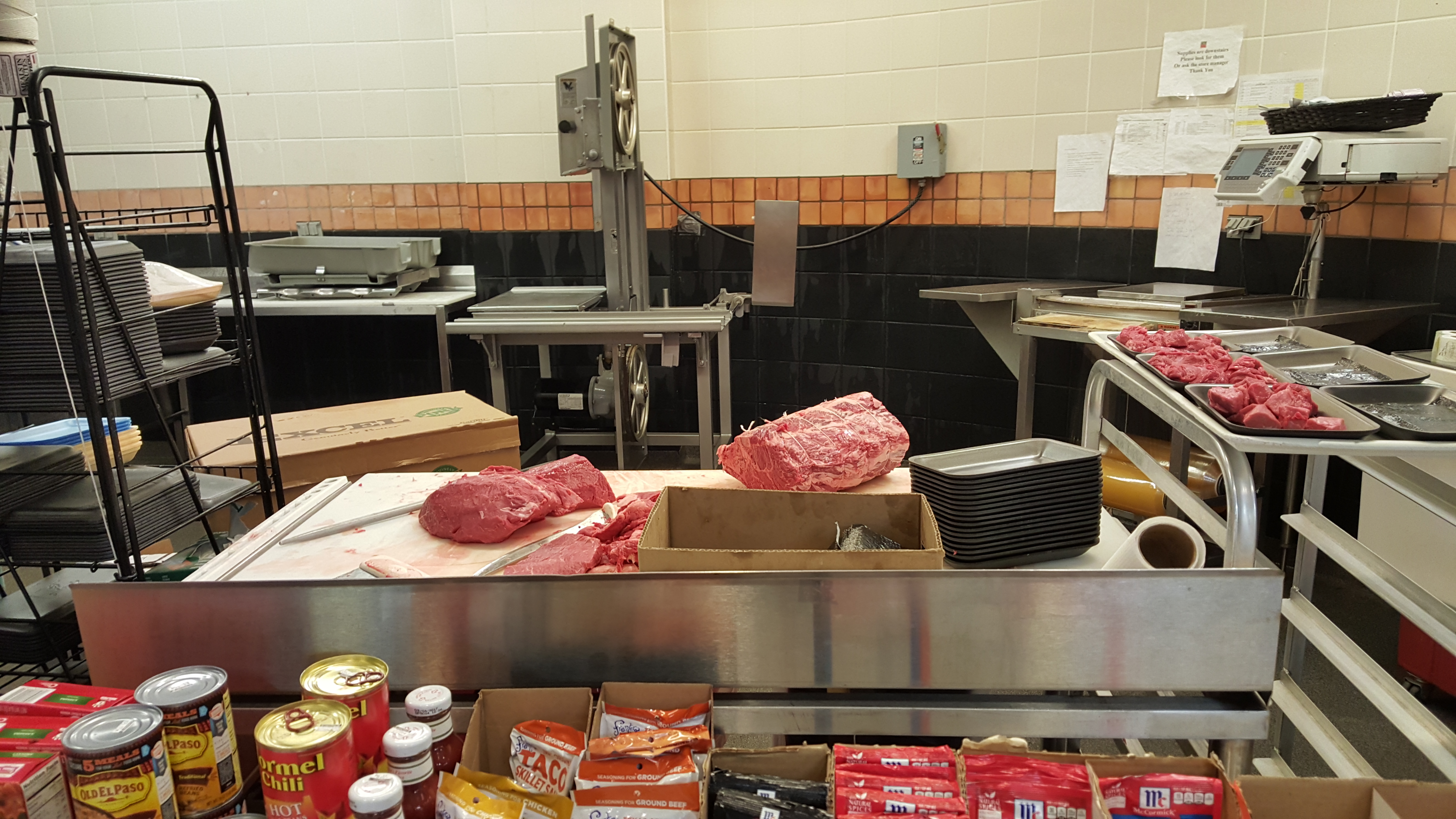
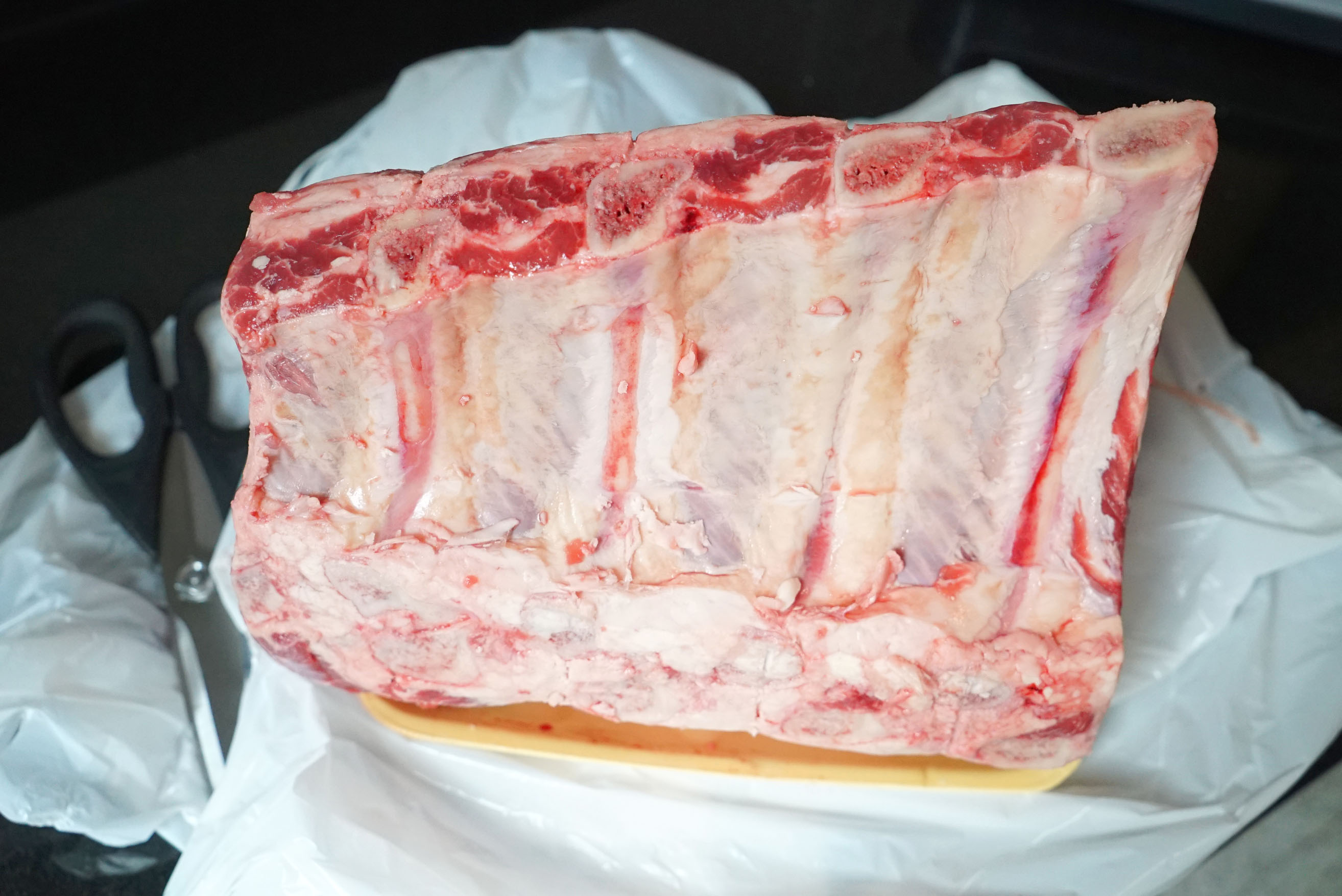
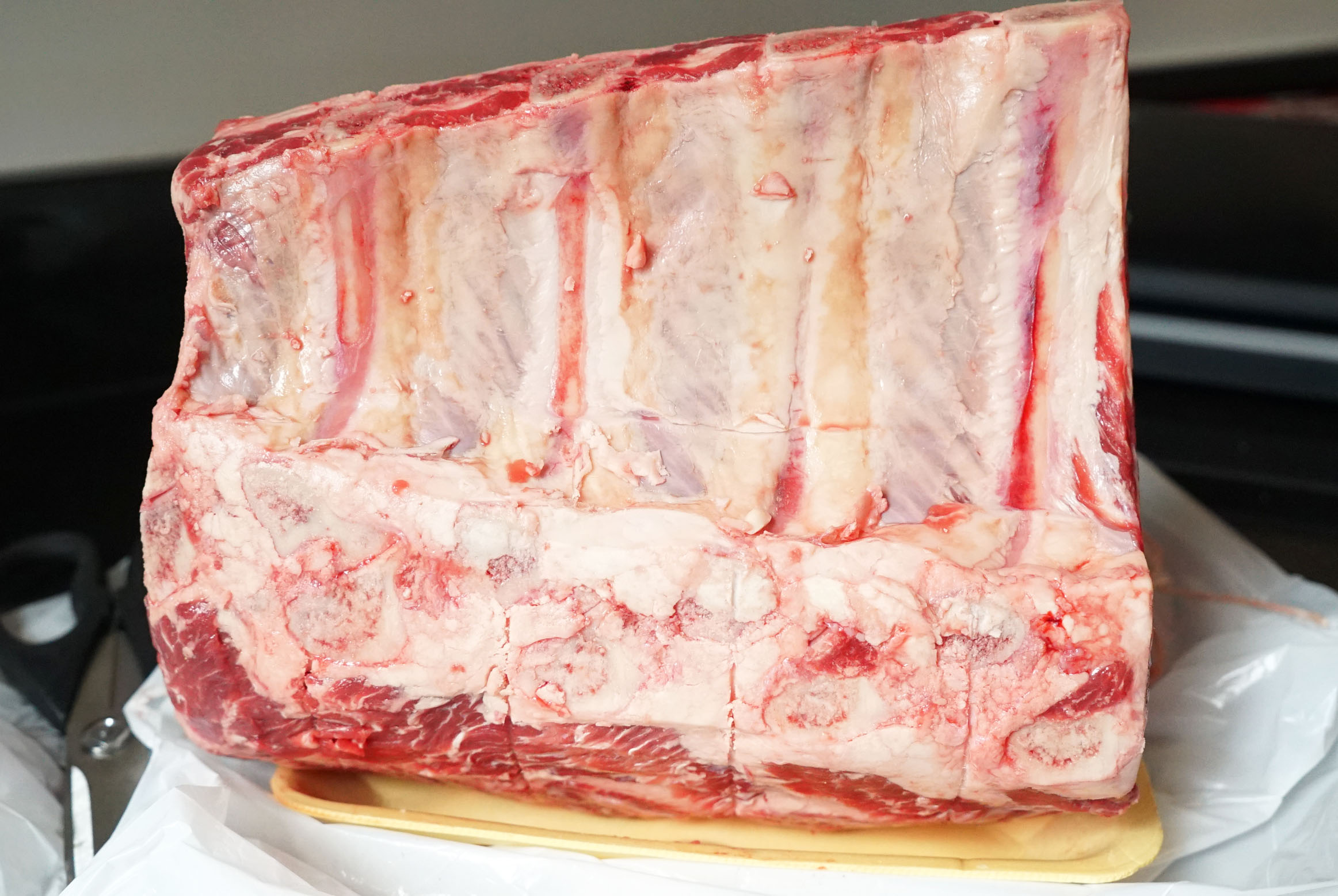
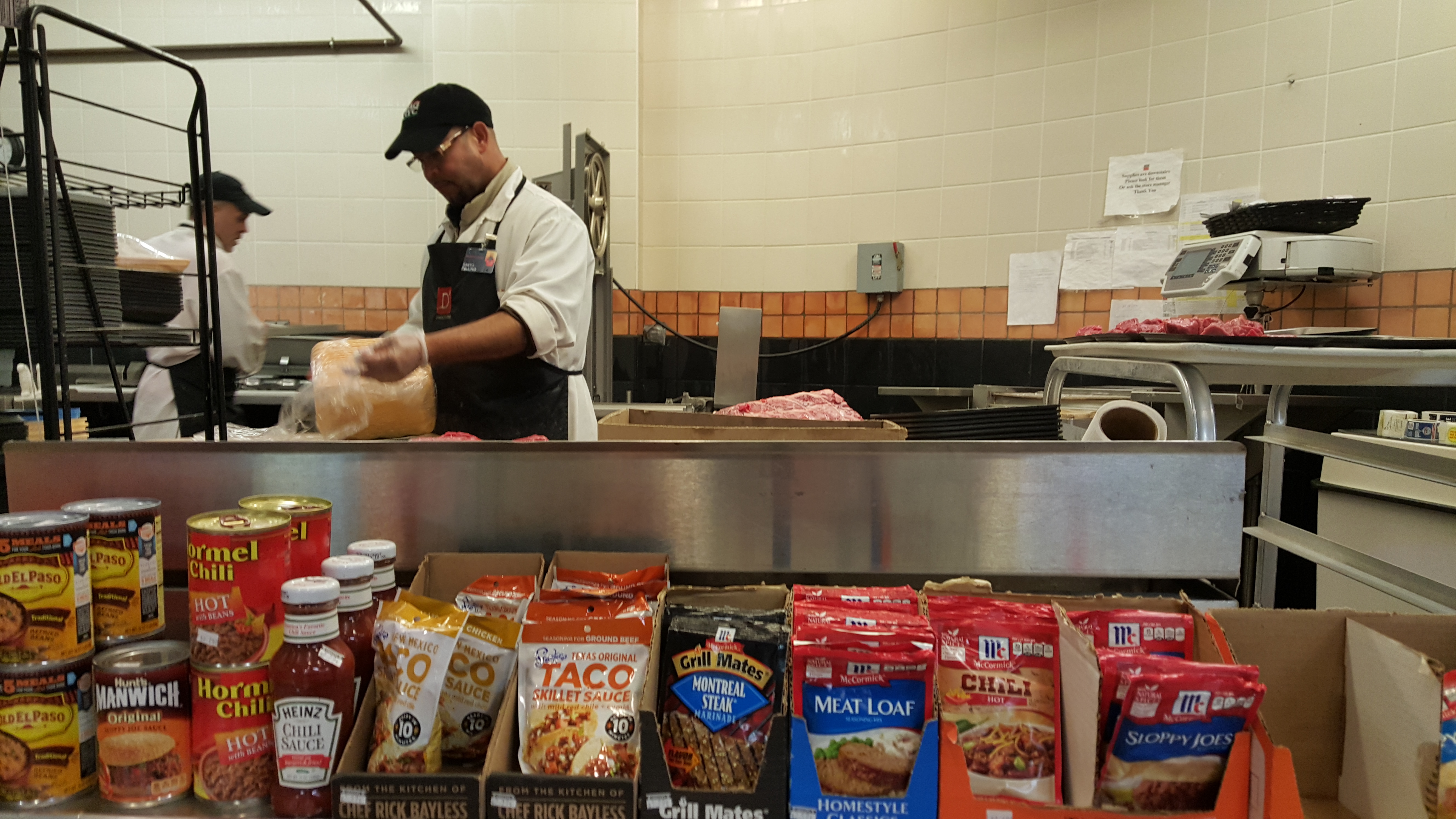
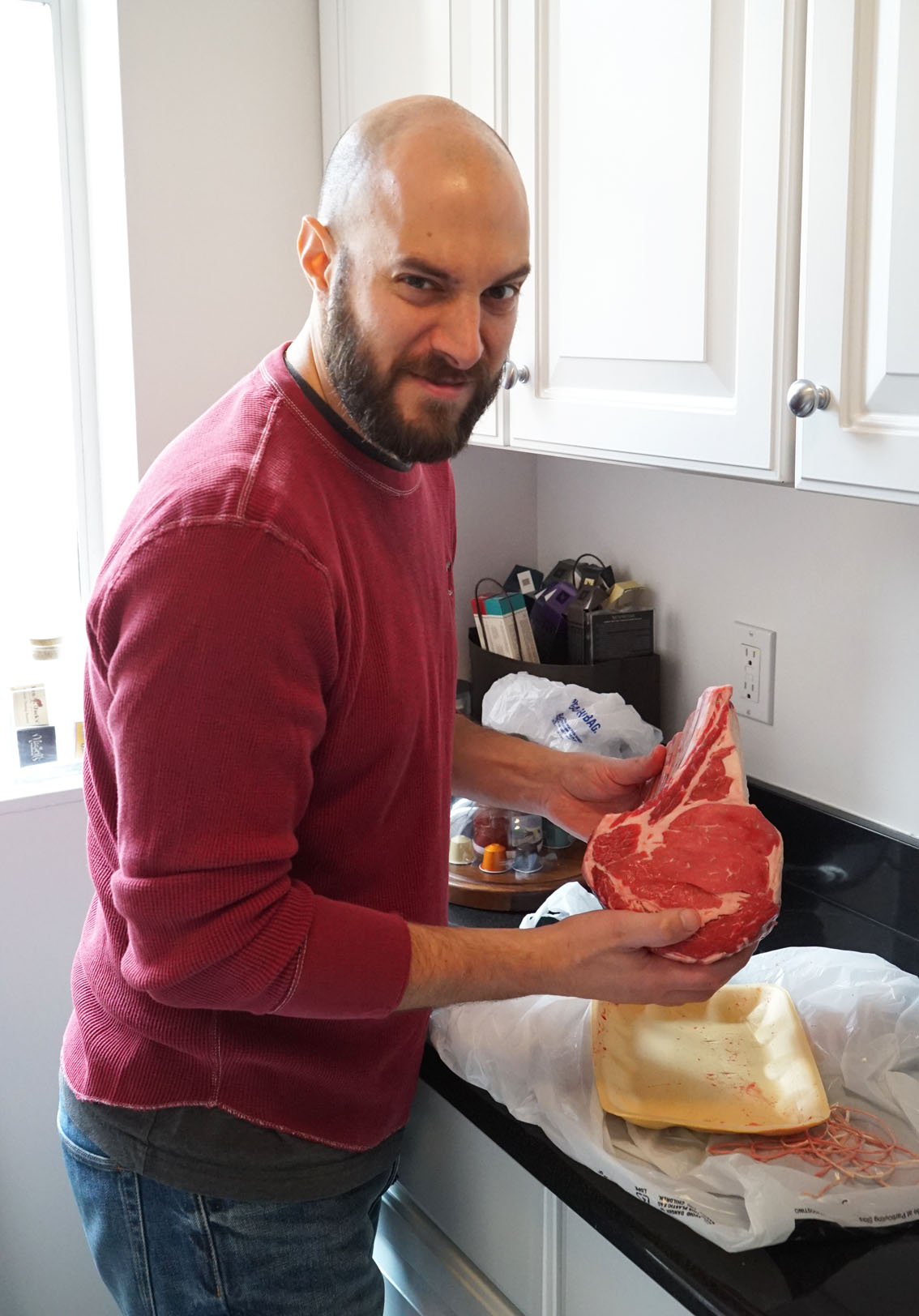
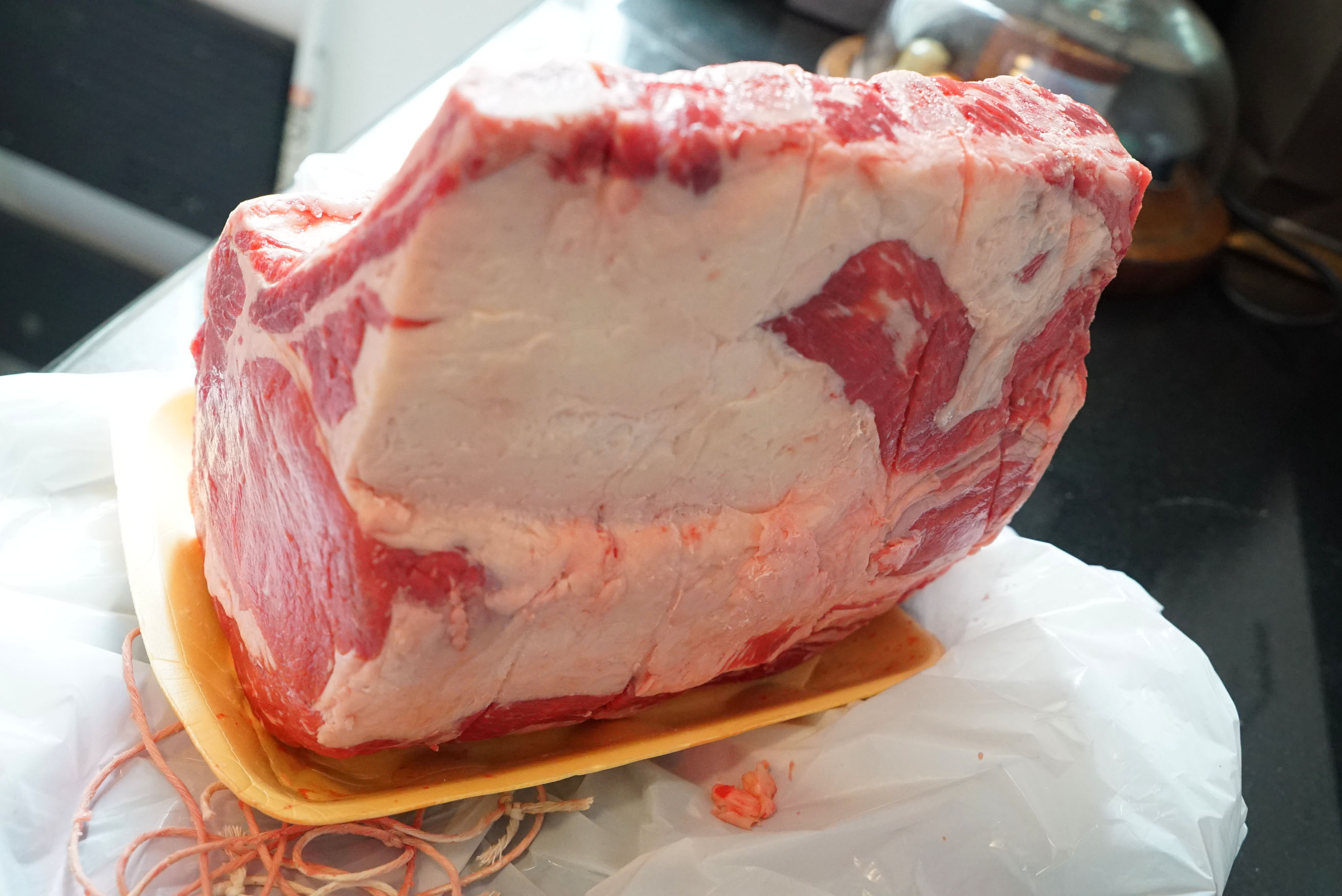
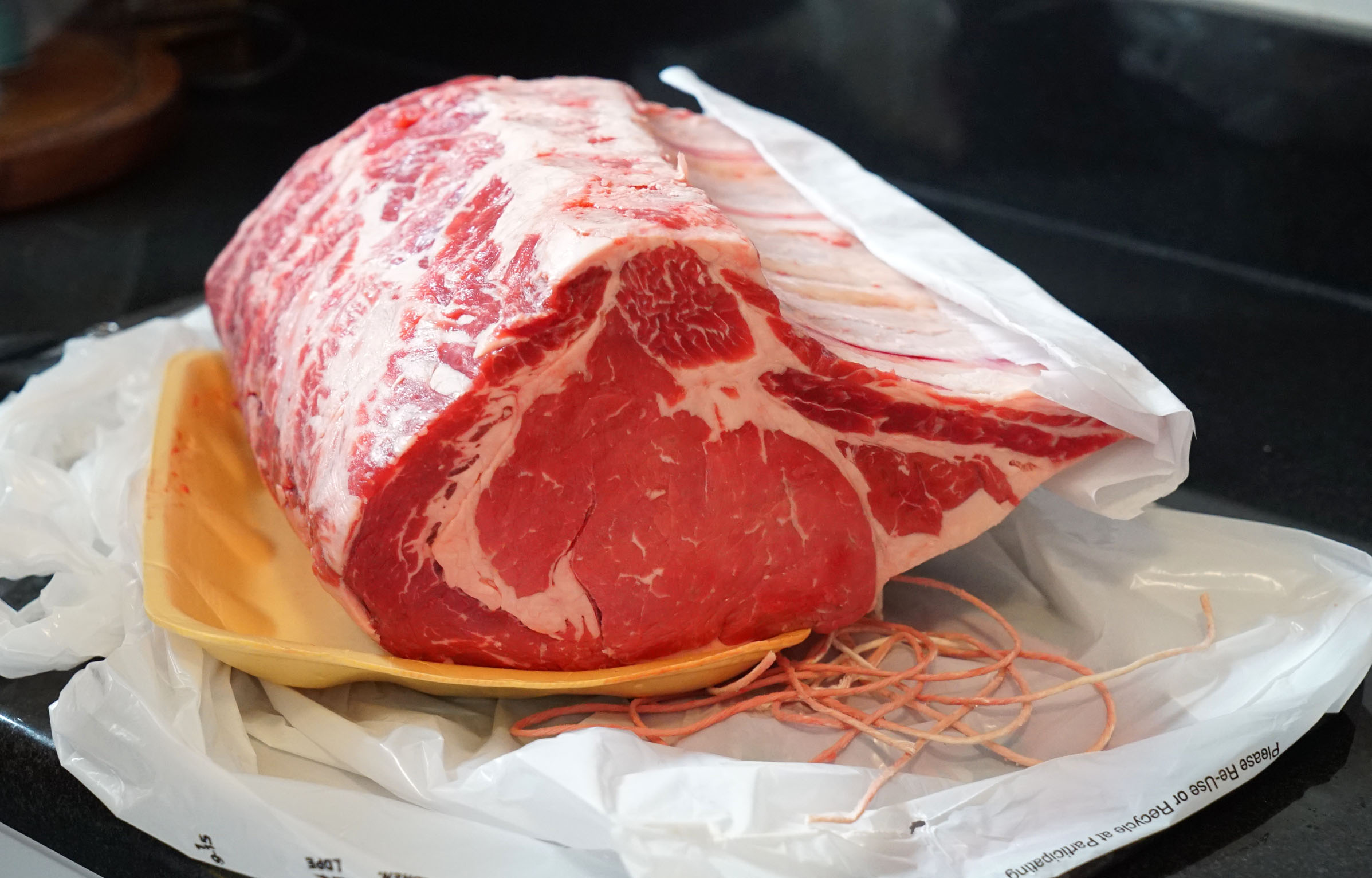
So I received my sample bags and ran out to the store to buy a nice rib roast, which I would later parse out into rib eye steaks after the aging is completed. NYC grocery stores don’t really have massive slabs of rib roasts sitting in the fridge section, so I had to ask the butcher what he had. He went to work for me, giving me a section of rib eyes with about four or five bones intact.
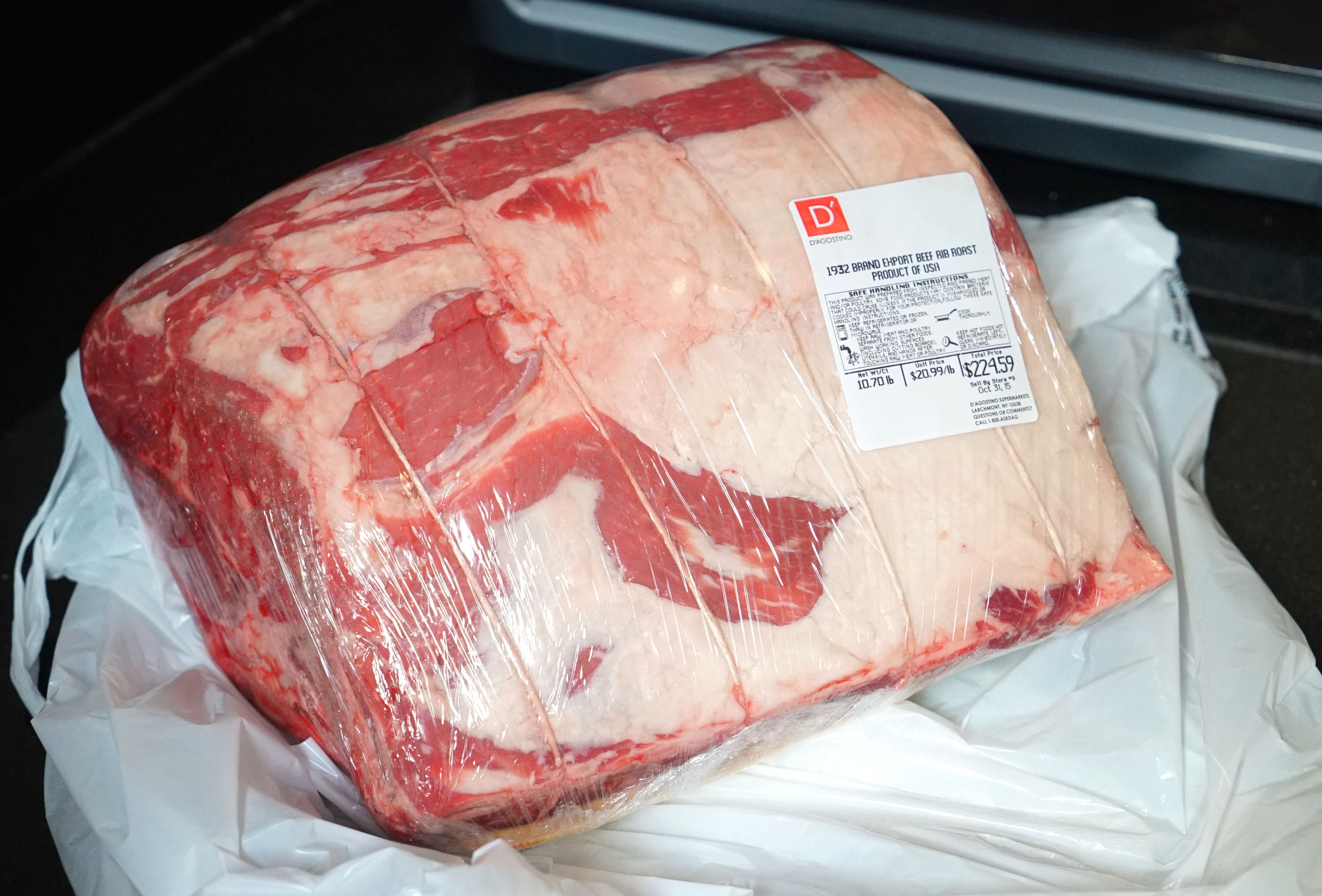
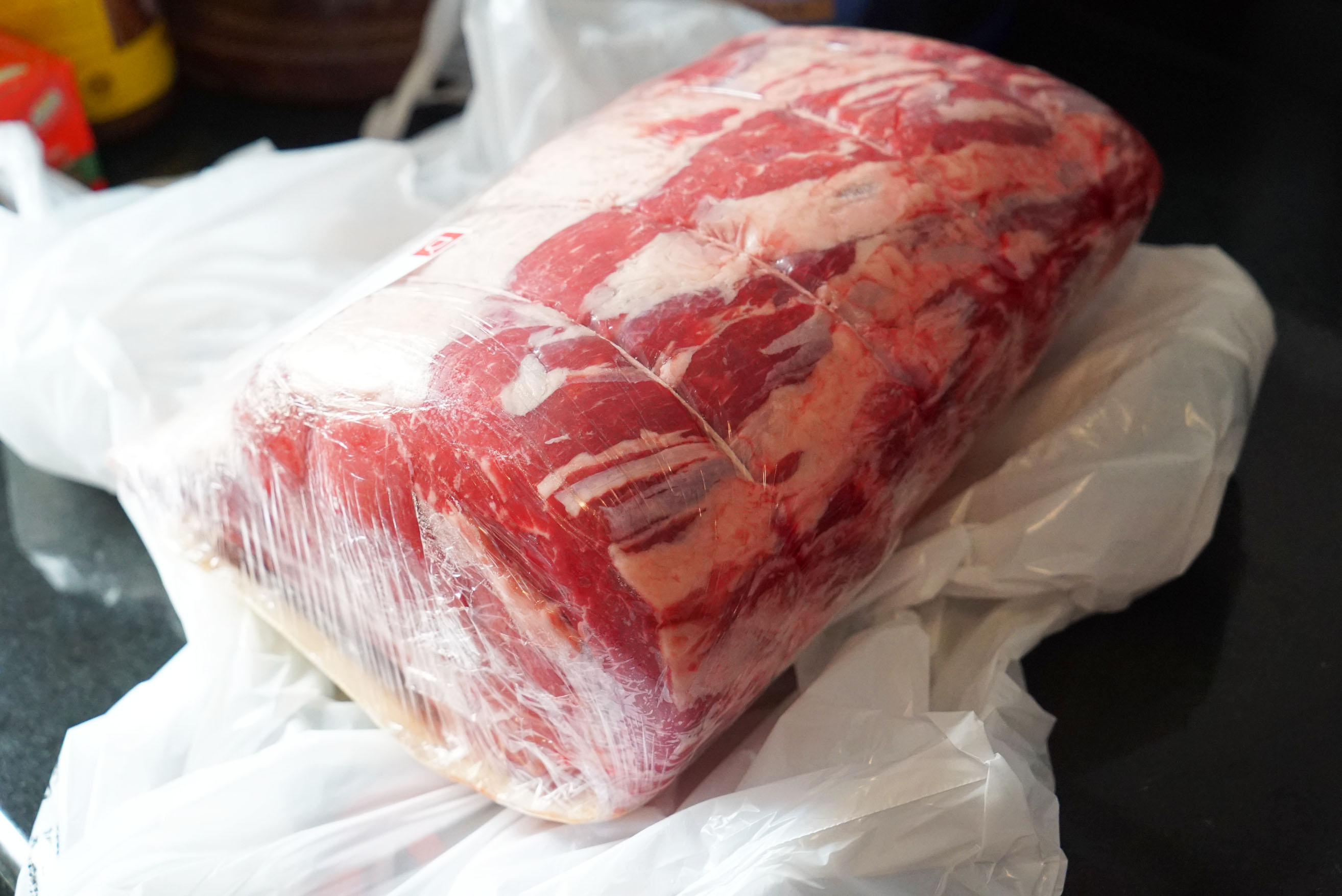
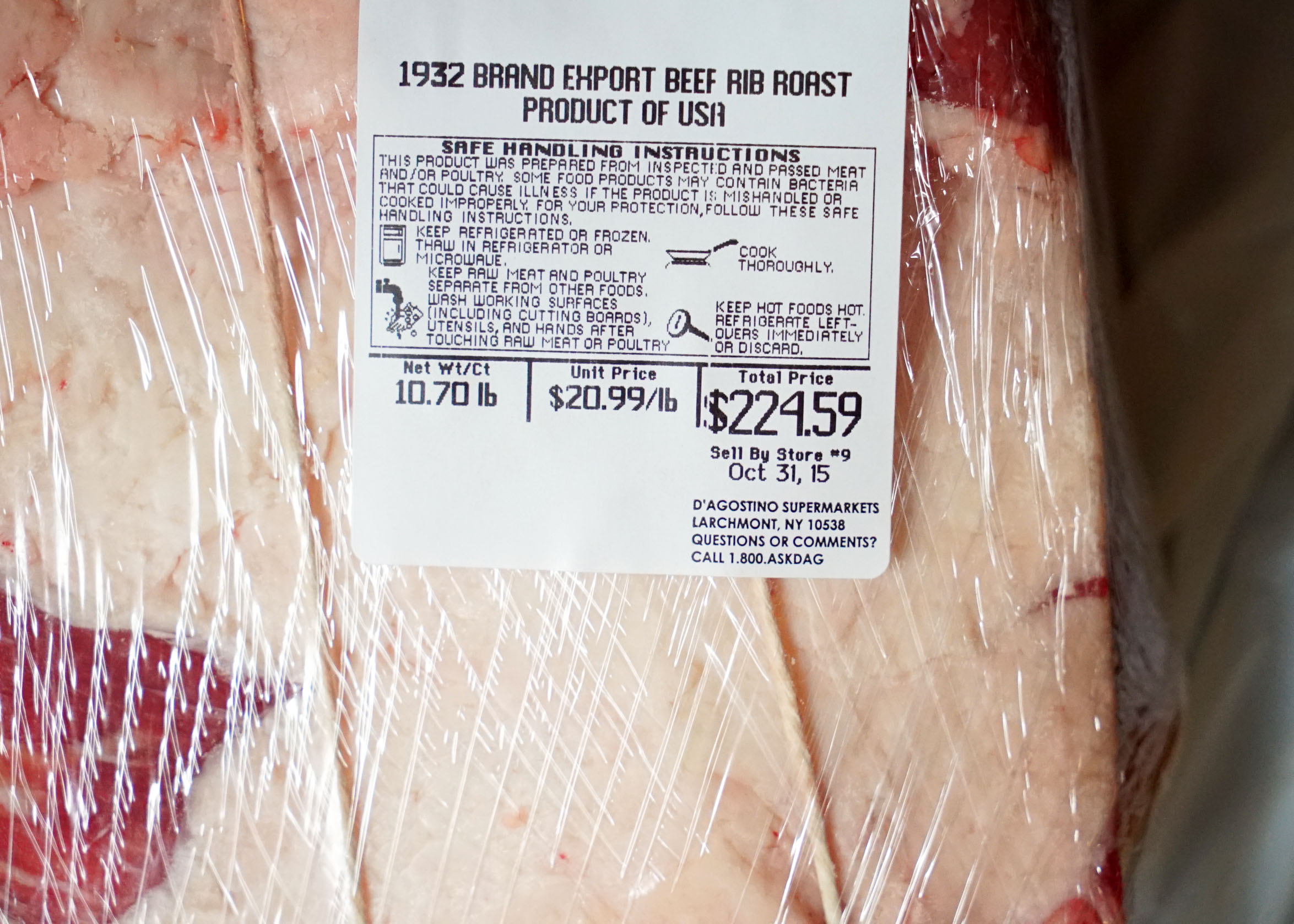
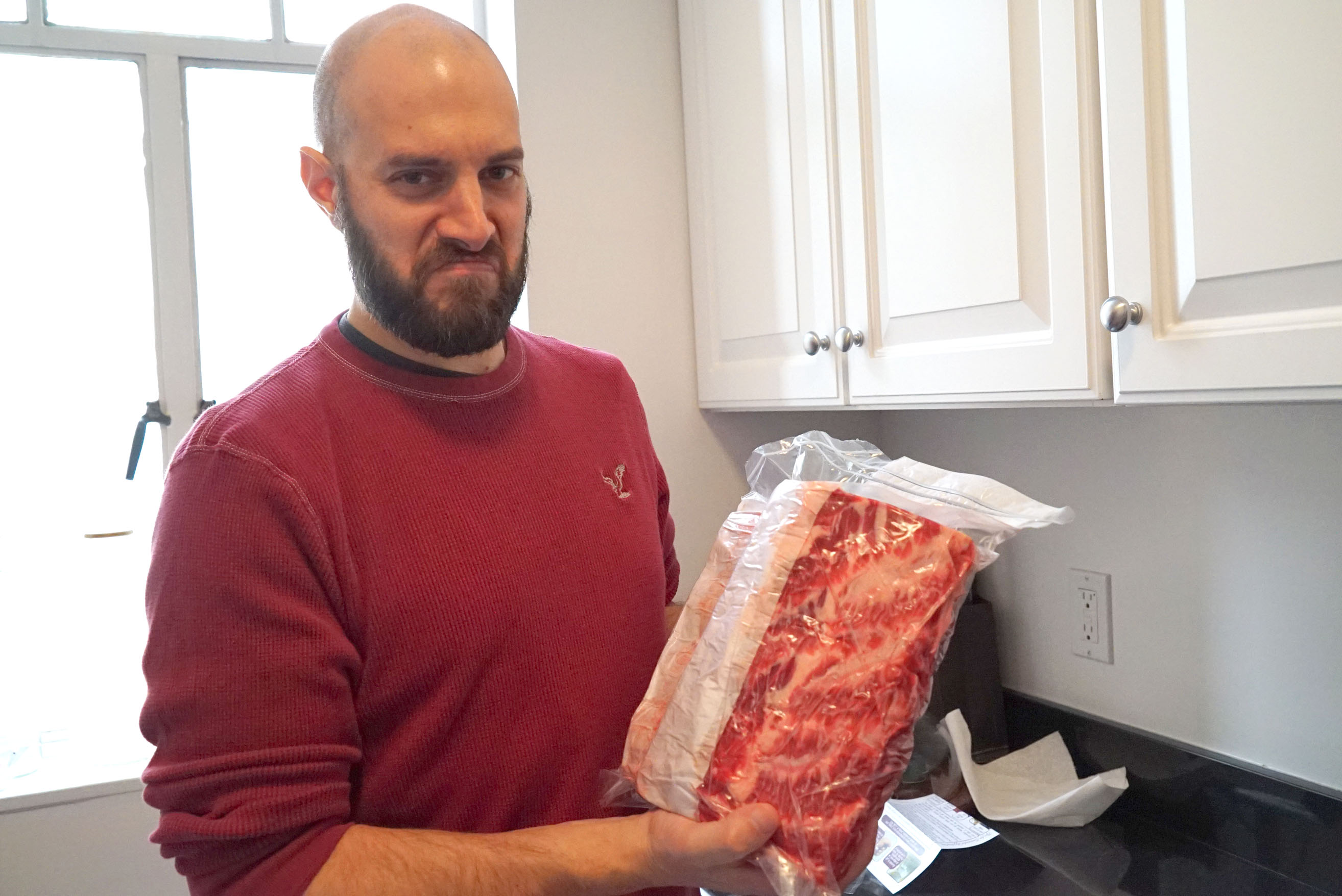
I was a bit freaked when I saw the price tag on this fucker. The butcher told me that the beef was prime, but that he only charged me for choice.
I guess that’s a good deal (several dollars per pound cheaper). But still… at $225 it could turn out to be a really fucking expensive mistake if I fuck anything up.
On the other hand, if this nearly 11lb hunk of prime rib eye ages nicely for 35 days, I could end up with several high quality rib eyes that would save me money on steakhouse dinners in the long run.
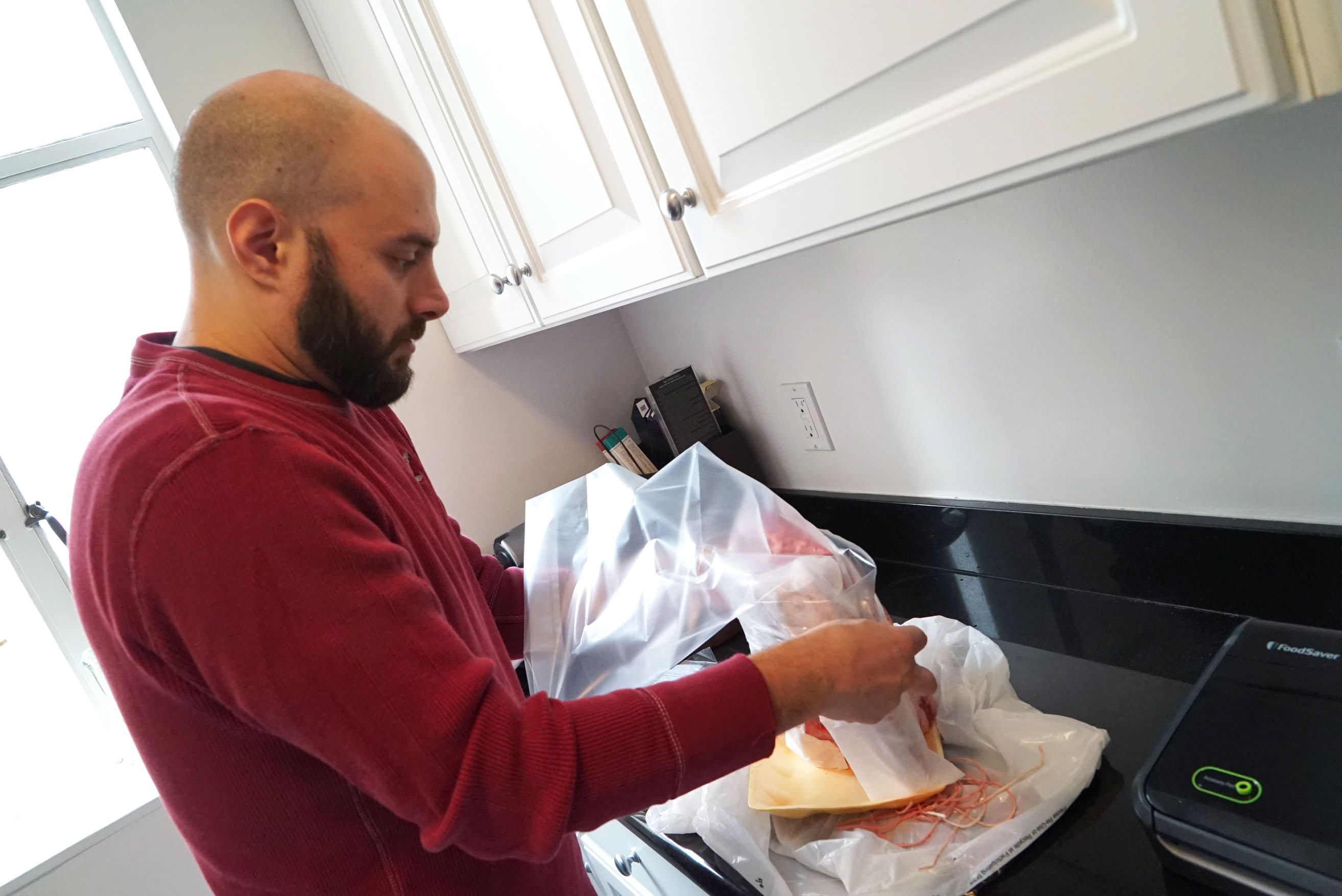
I took the gamble. I probably should have waited for a sale or something, but I was too excited to get started. About 30 minutes later I was starting the process of bagging and sealing.
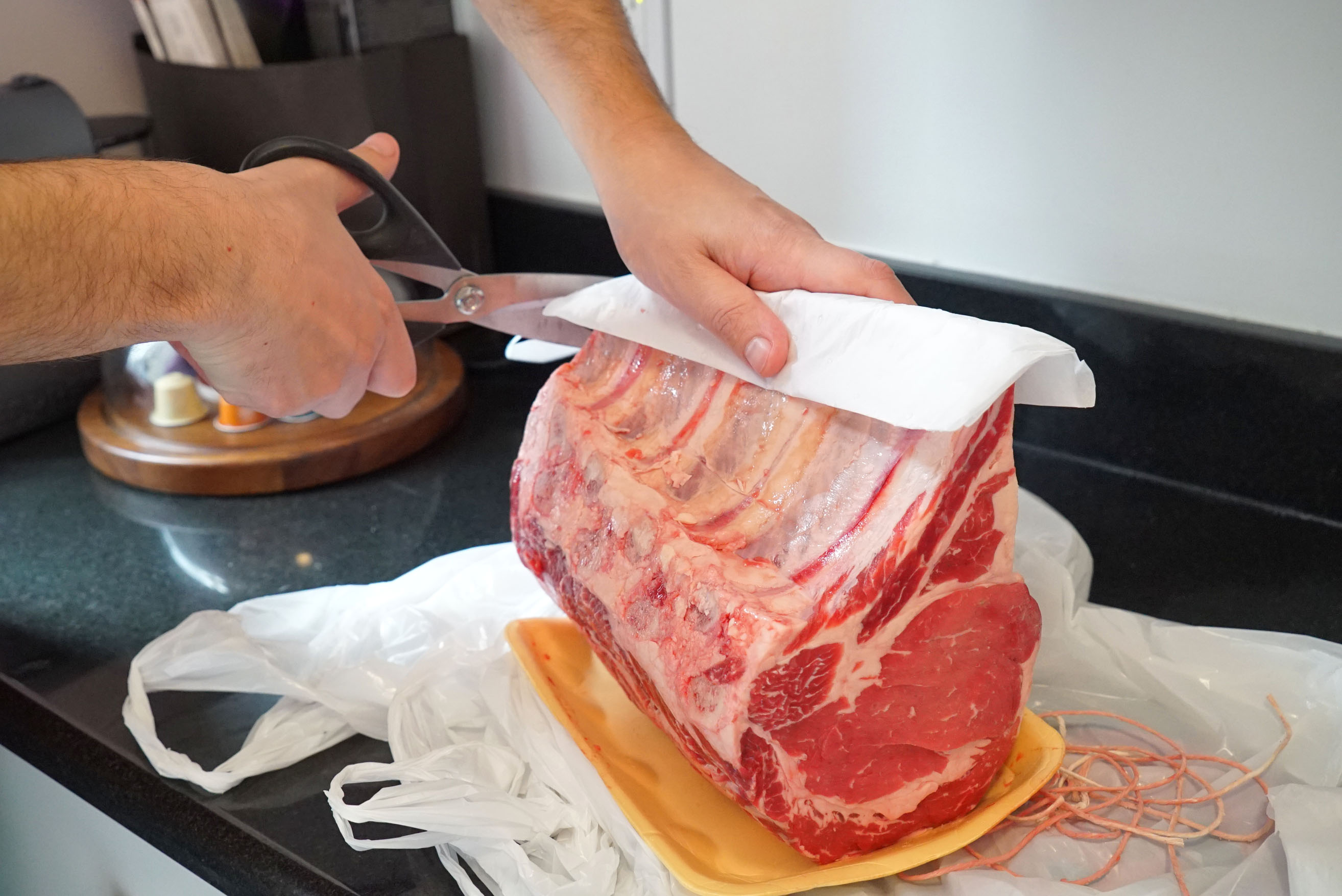
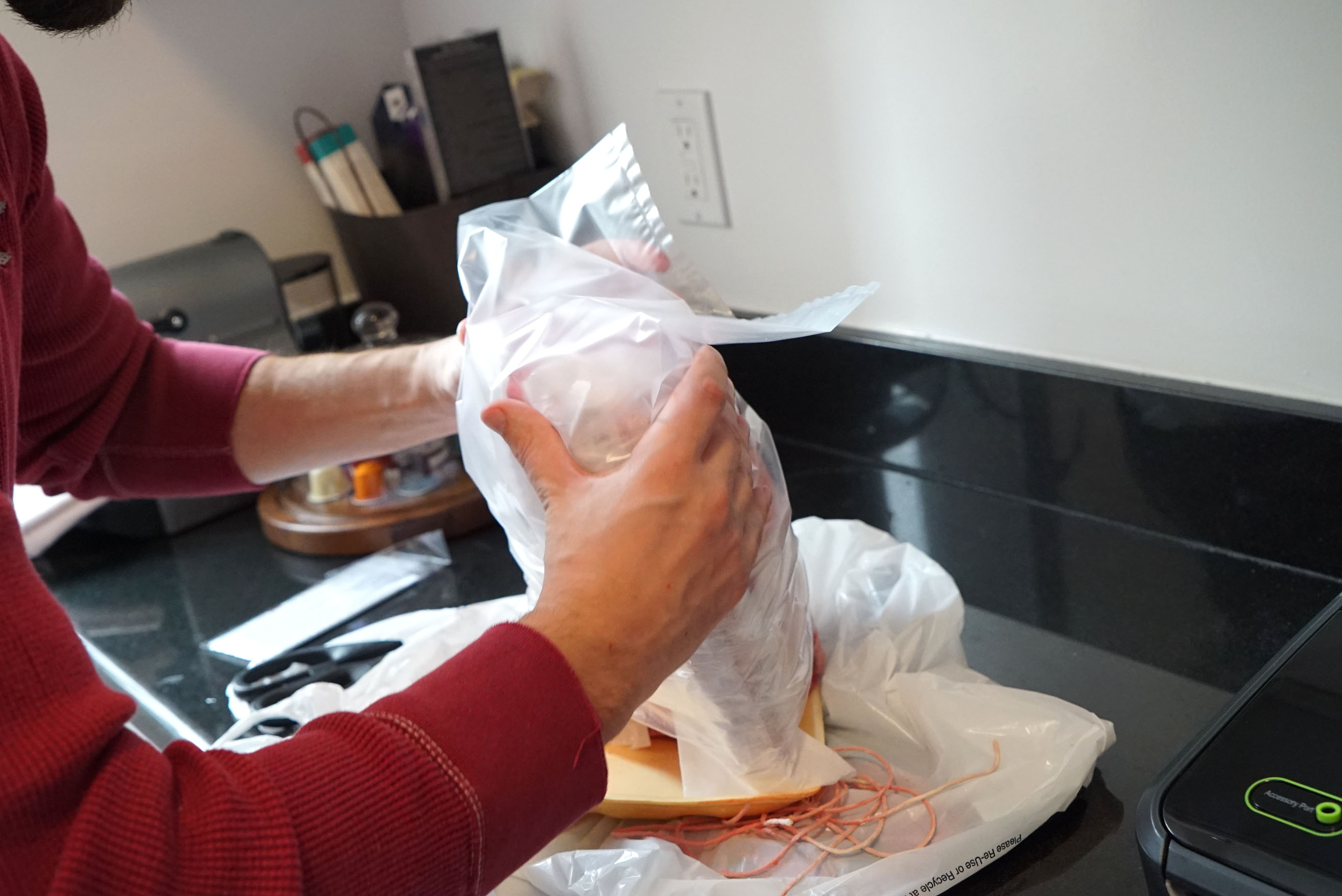
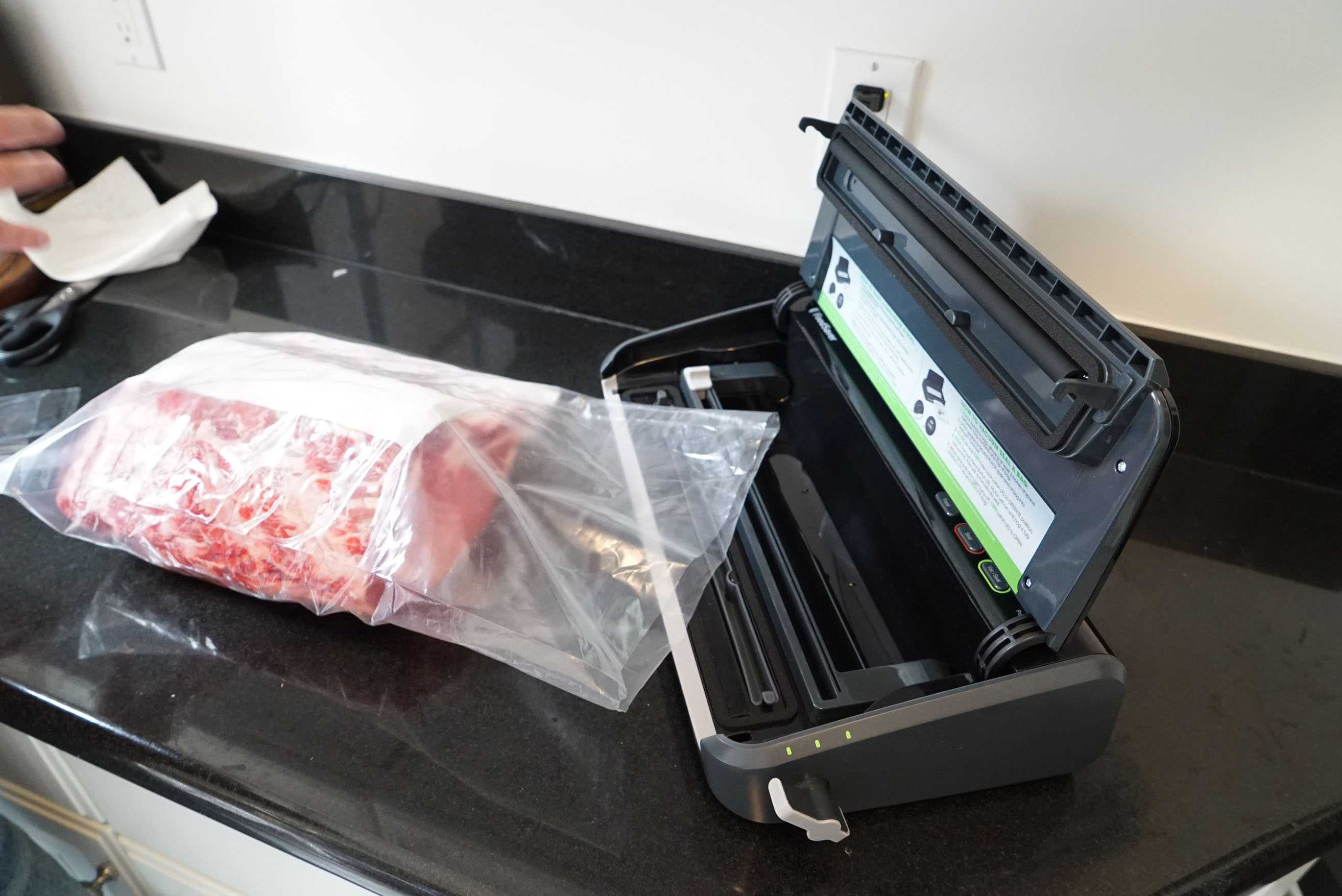
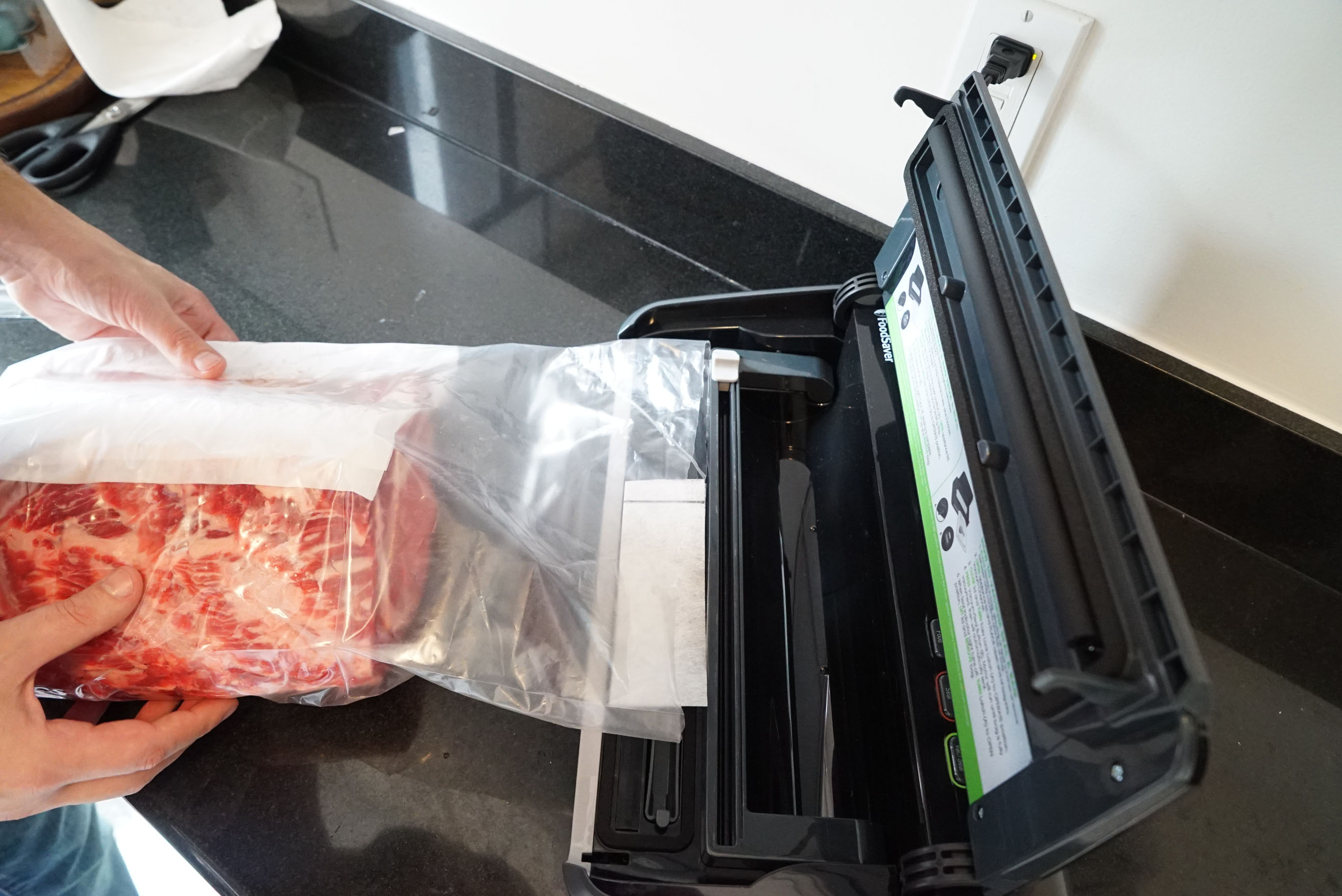
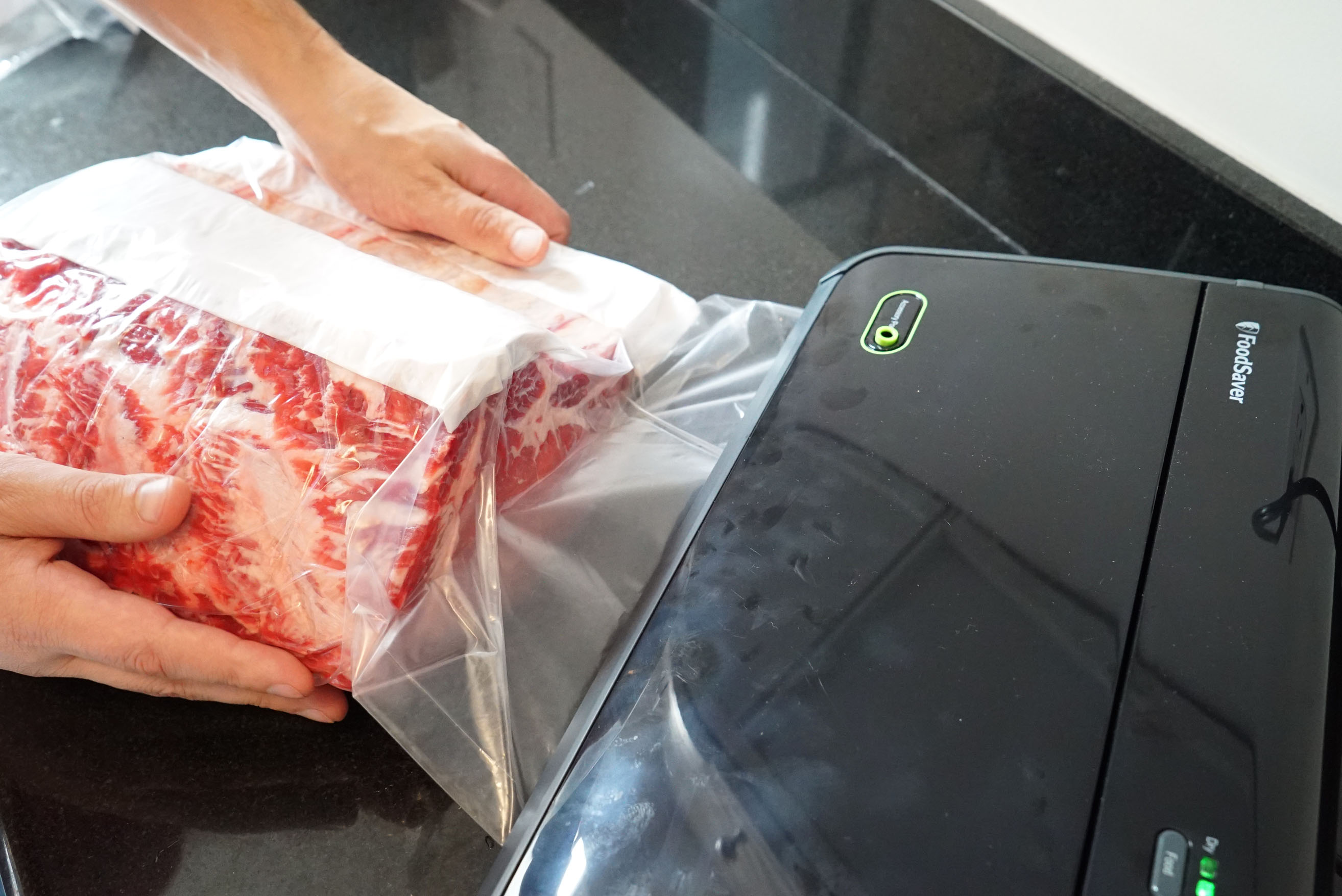
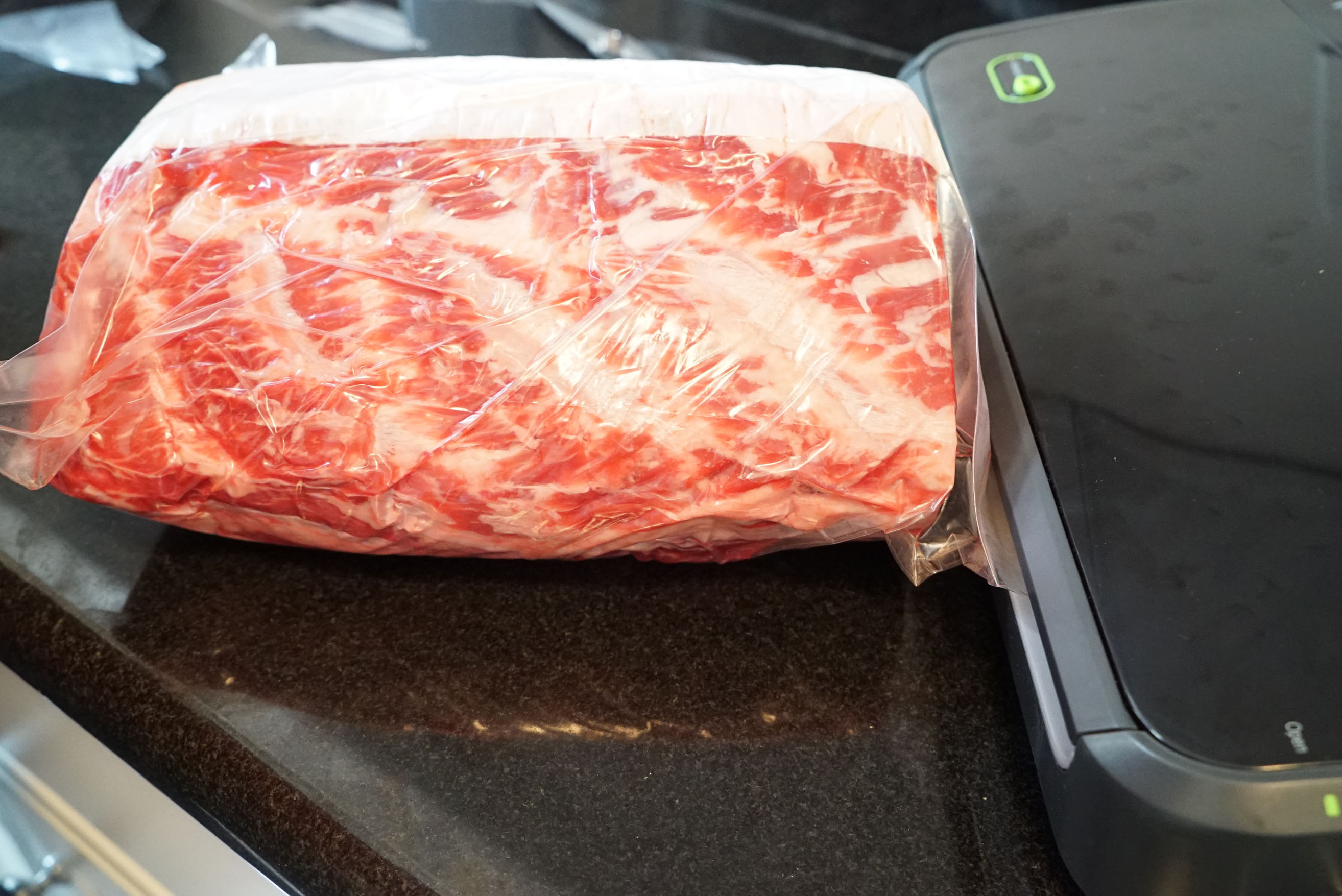
I put some wax paper across the bones so that any sharp bits wouldn’t puncture or slice open the bag.
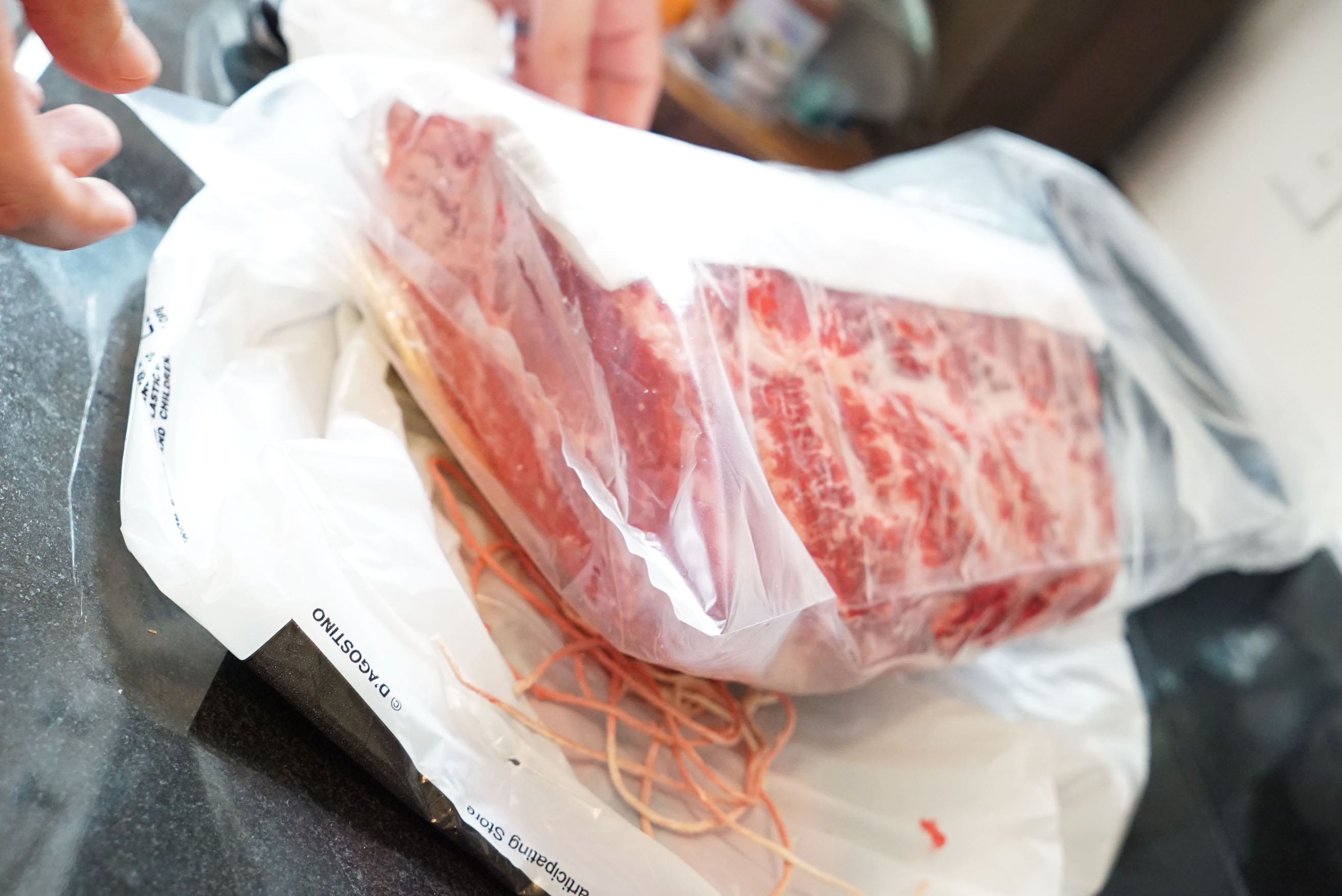
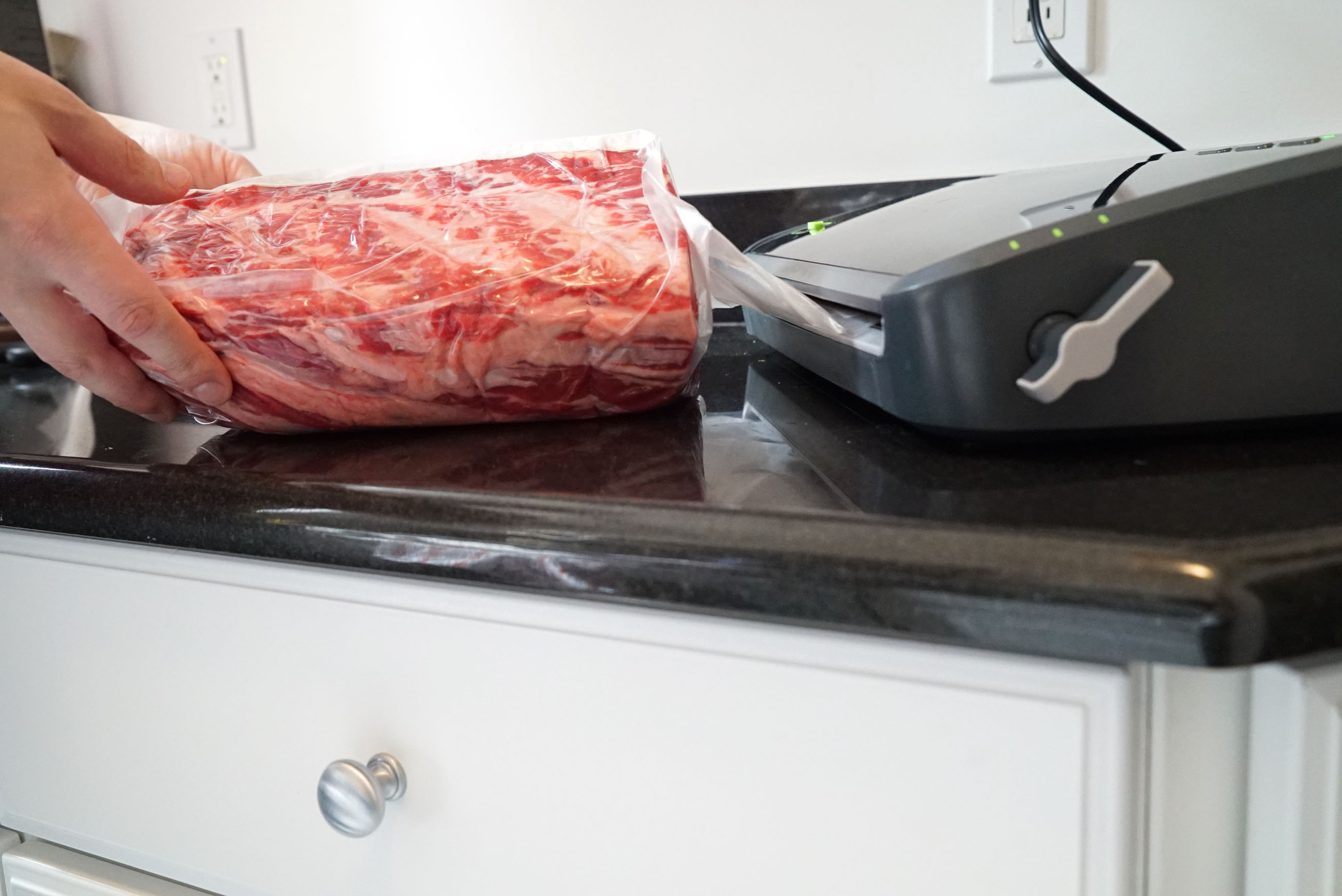
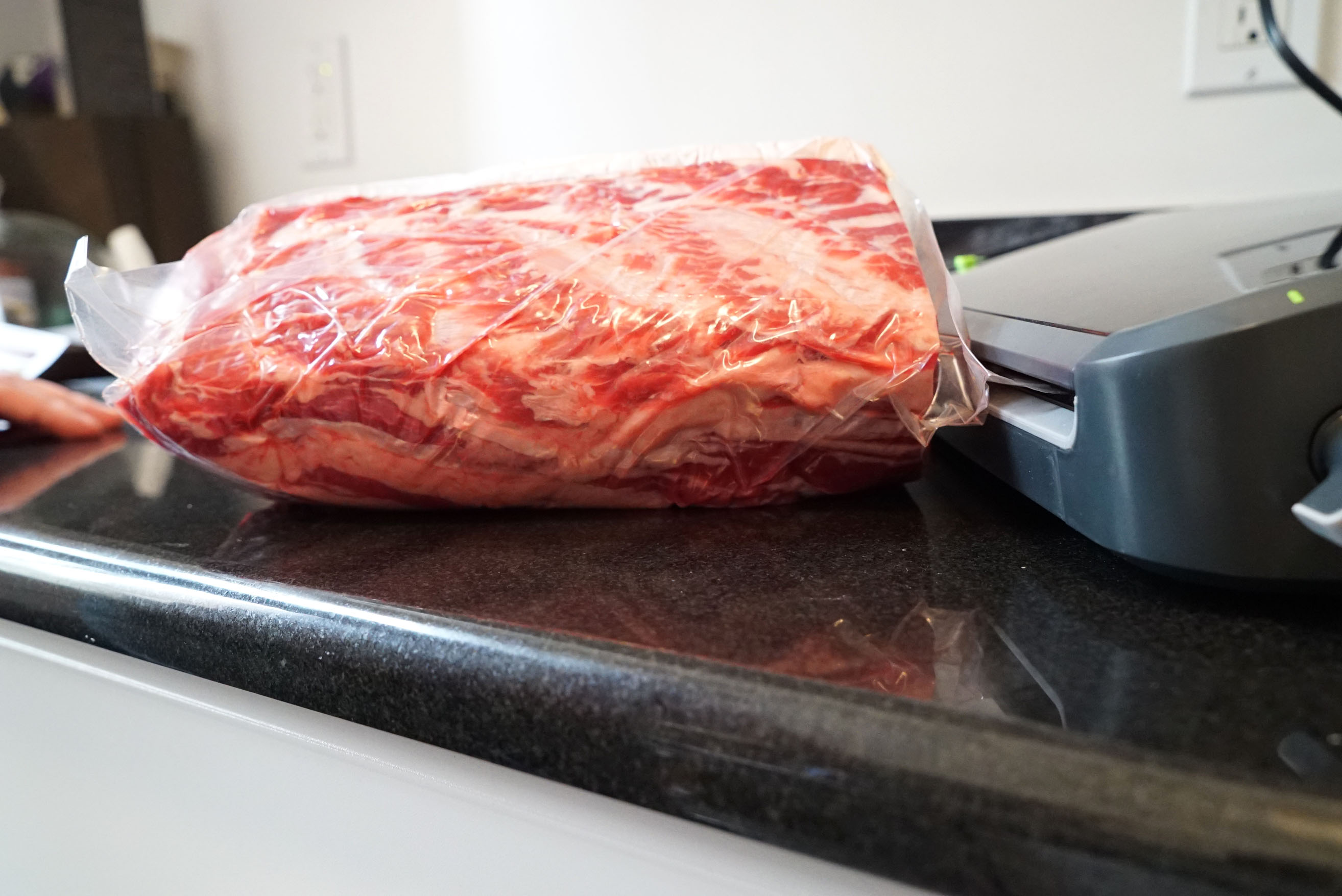
Meat condom:
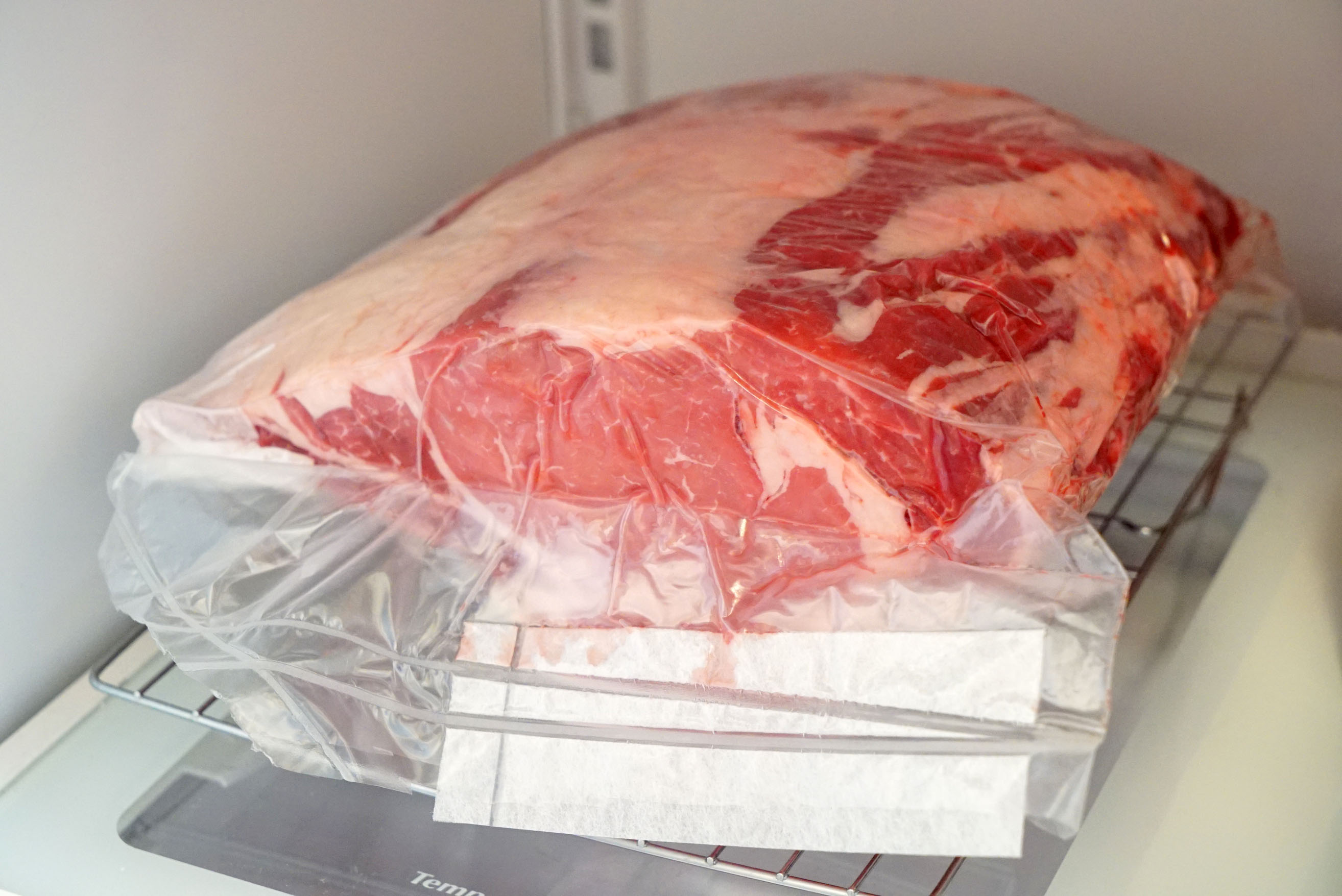
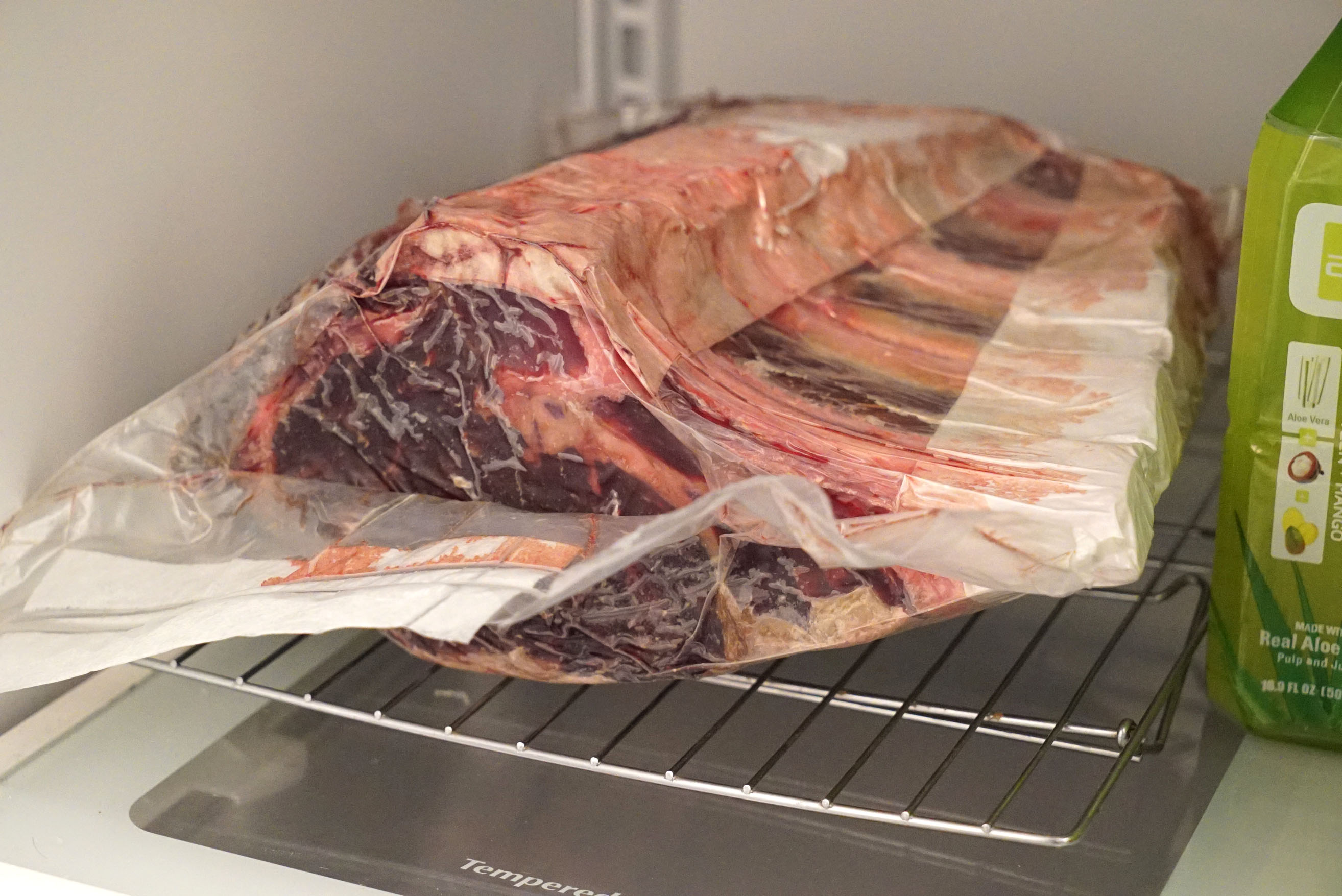
Once sealed properly, it just goes into the fridge on a cookie rack or drying rack, so that air flow goes all around the bag.
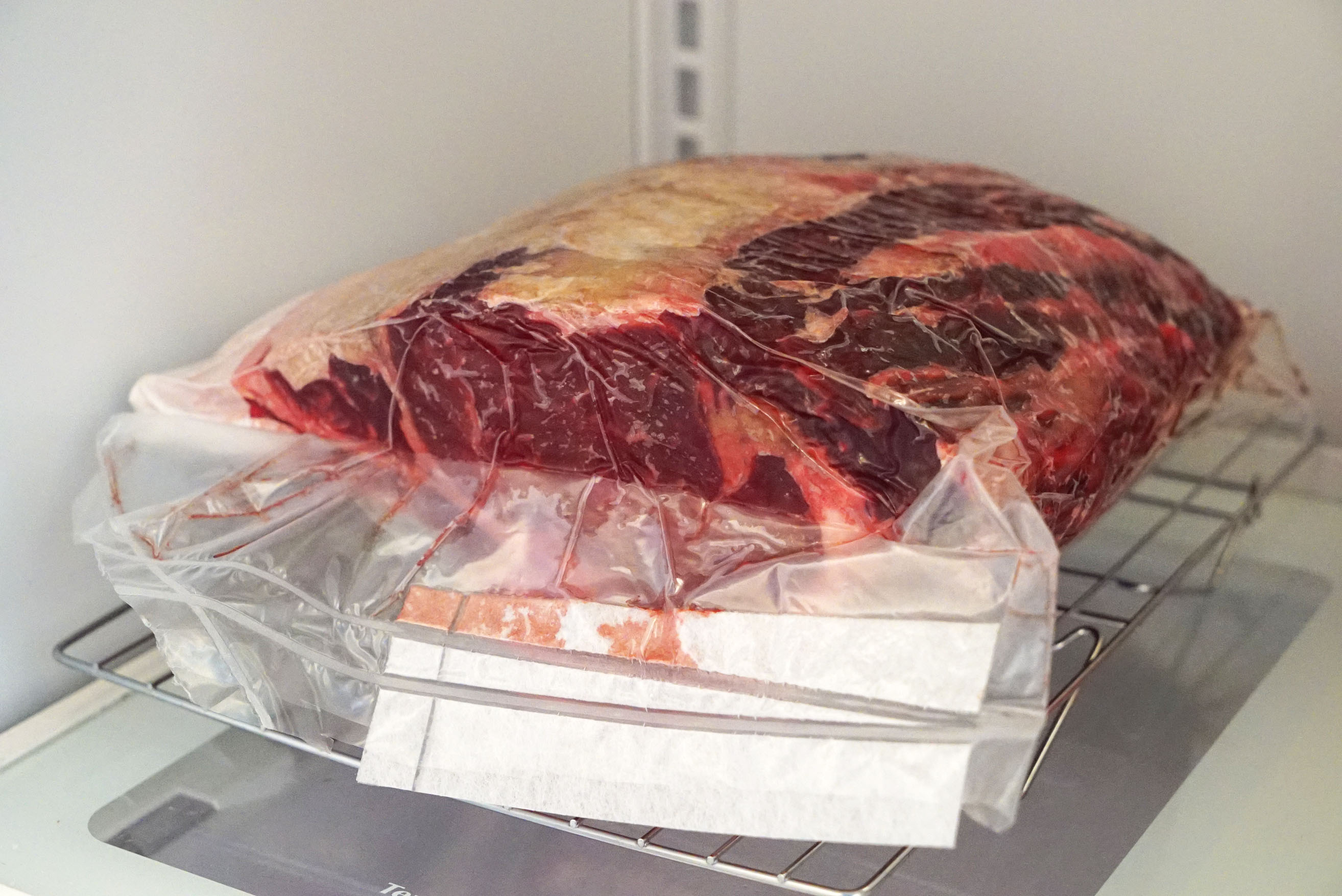
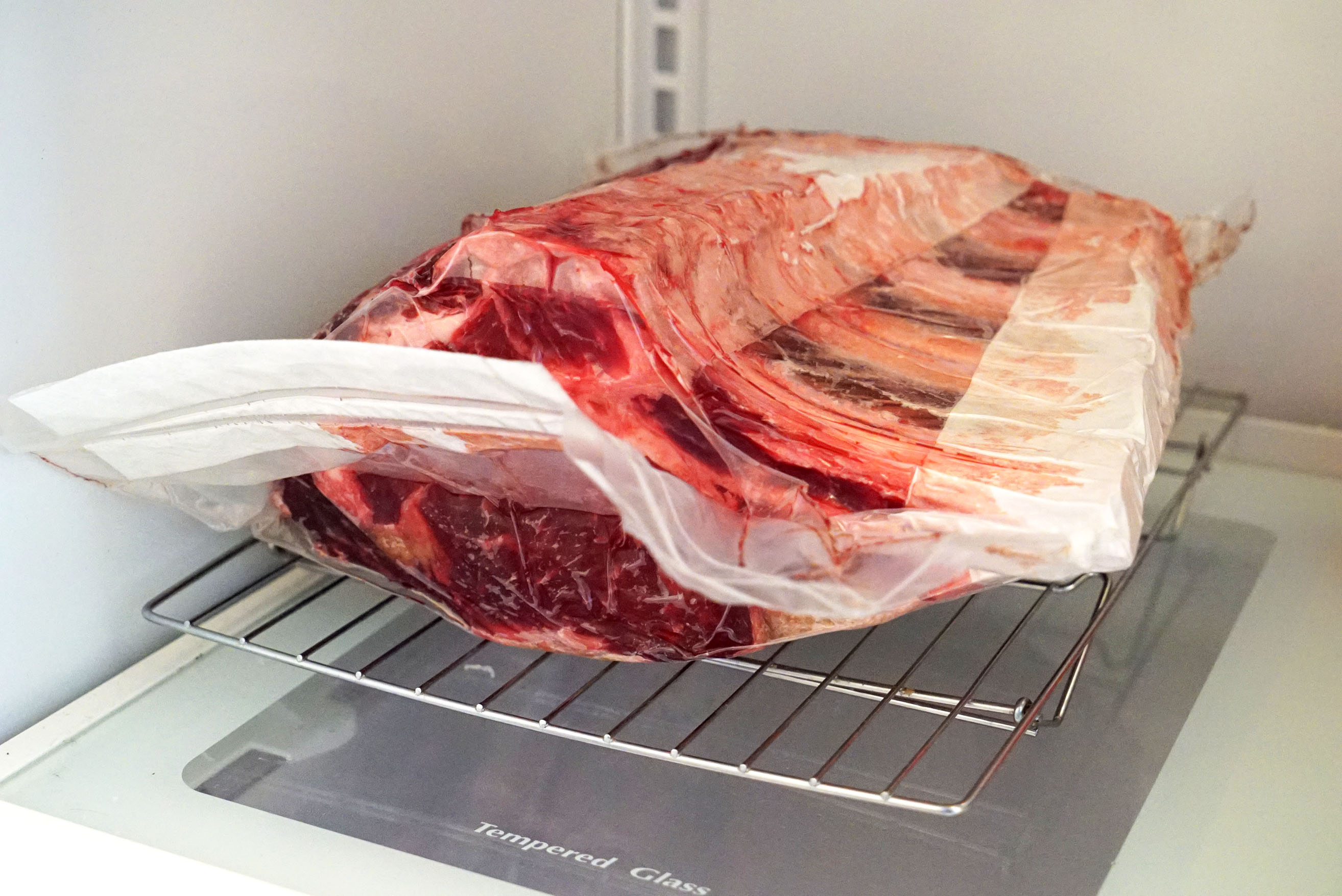
Then we just wait 35 days, with an occasional flip here and there. Here’s a pair of shots after 5 days with a flip. As you can see, the meat is already starting to darken and dry where the bag is in contact with the flesh.
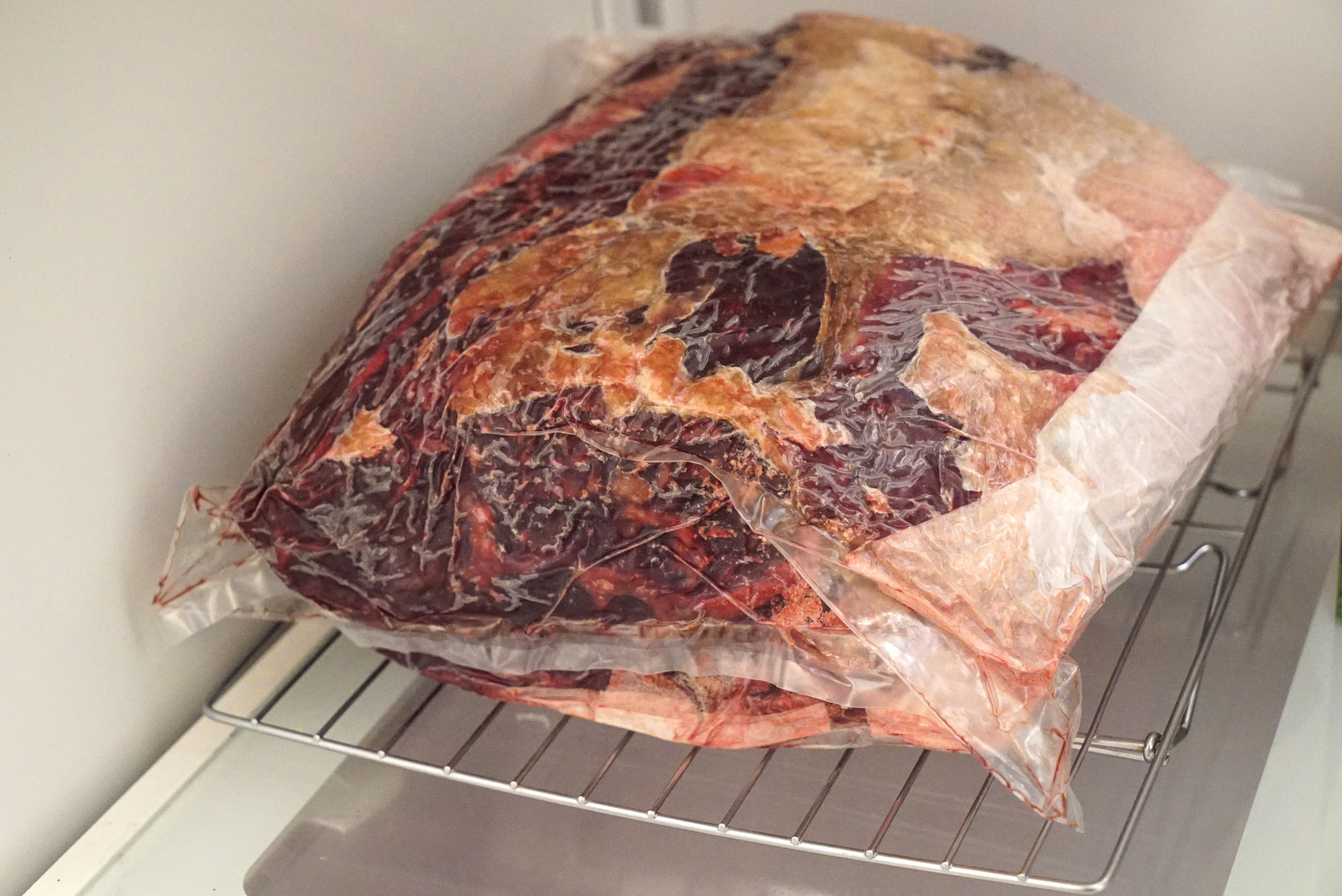
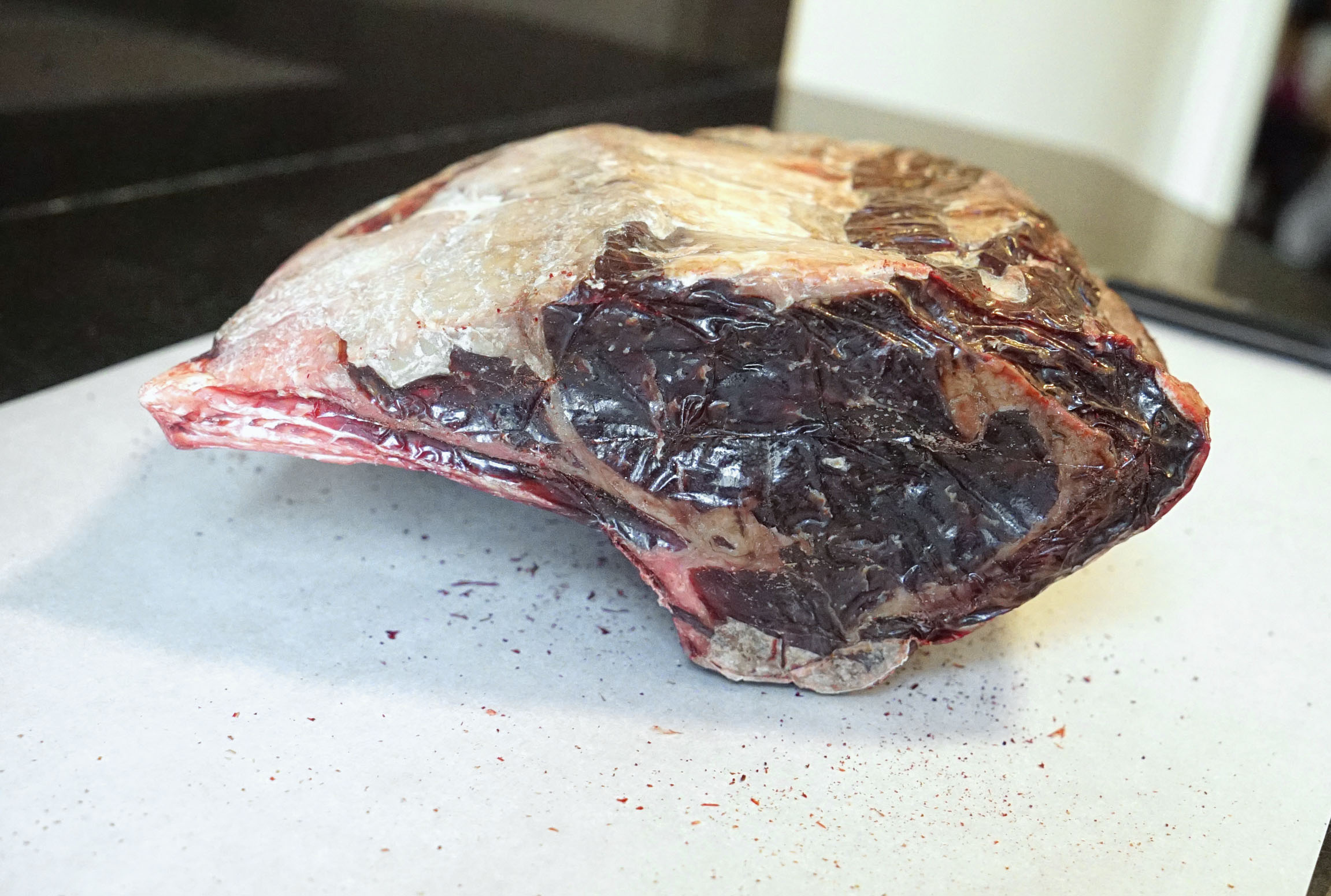
Even darker after another week. It’s forming a “bark”-like layer of beneficial mold that helps to tenderize the meat as it develops.
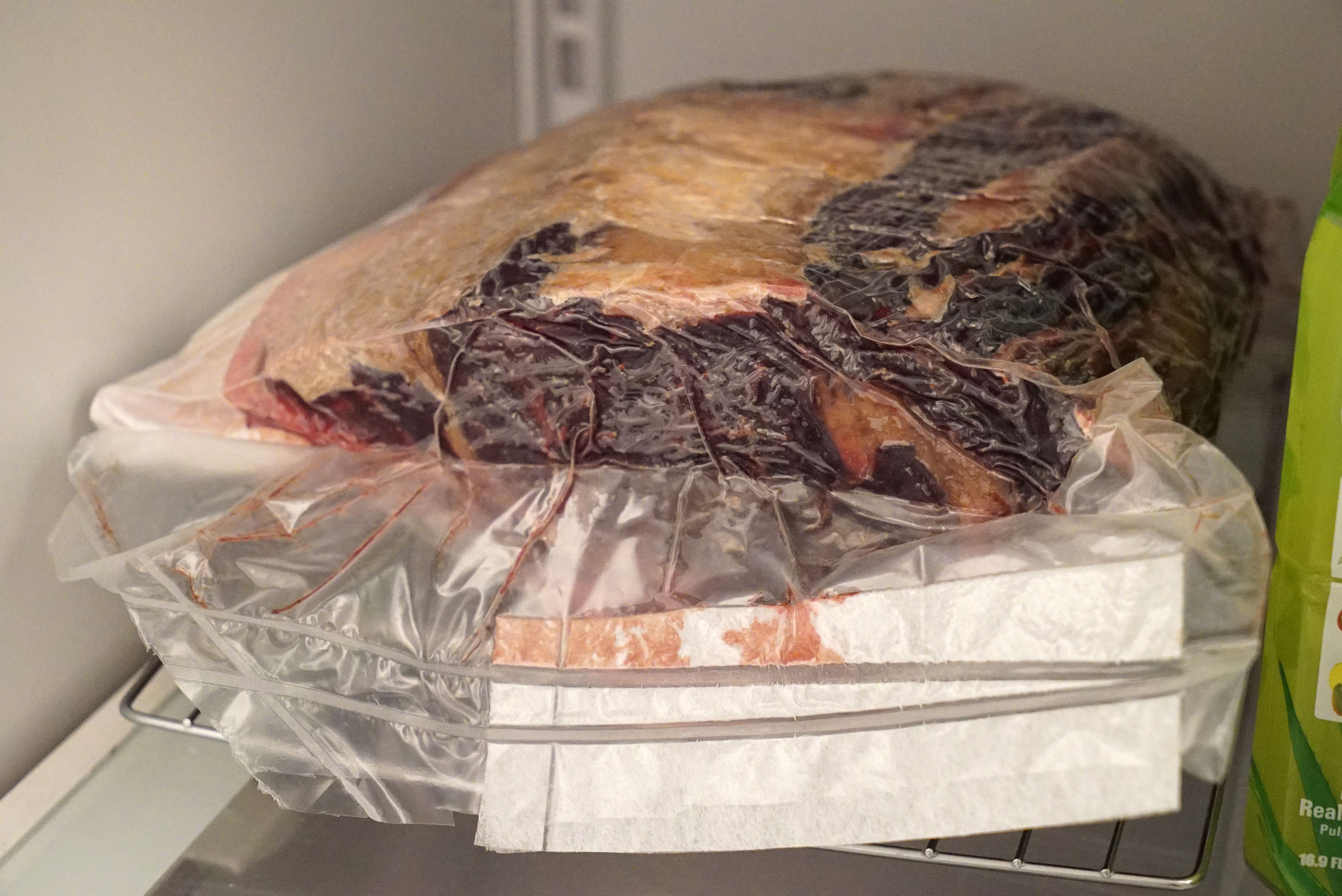
And another week or so. I notice it’s also shrinking. Dry-aging processes tend to cause the meat to desiccate to the point where you can lose almost a third of the original weight.
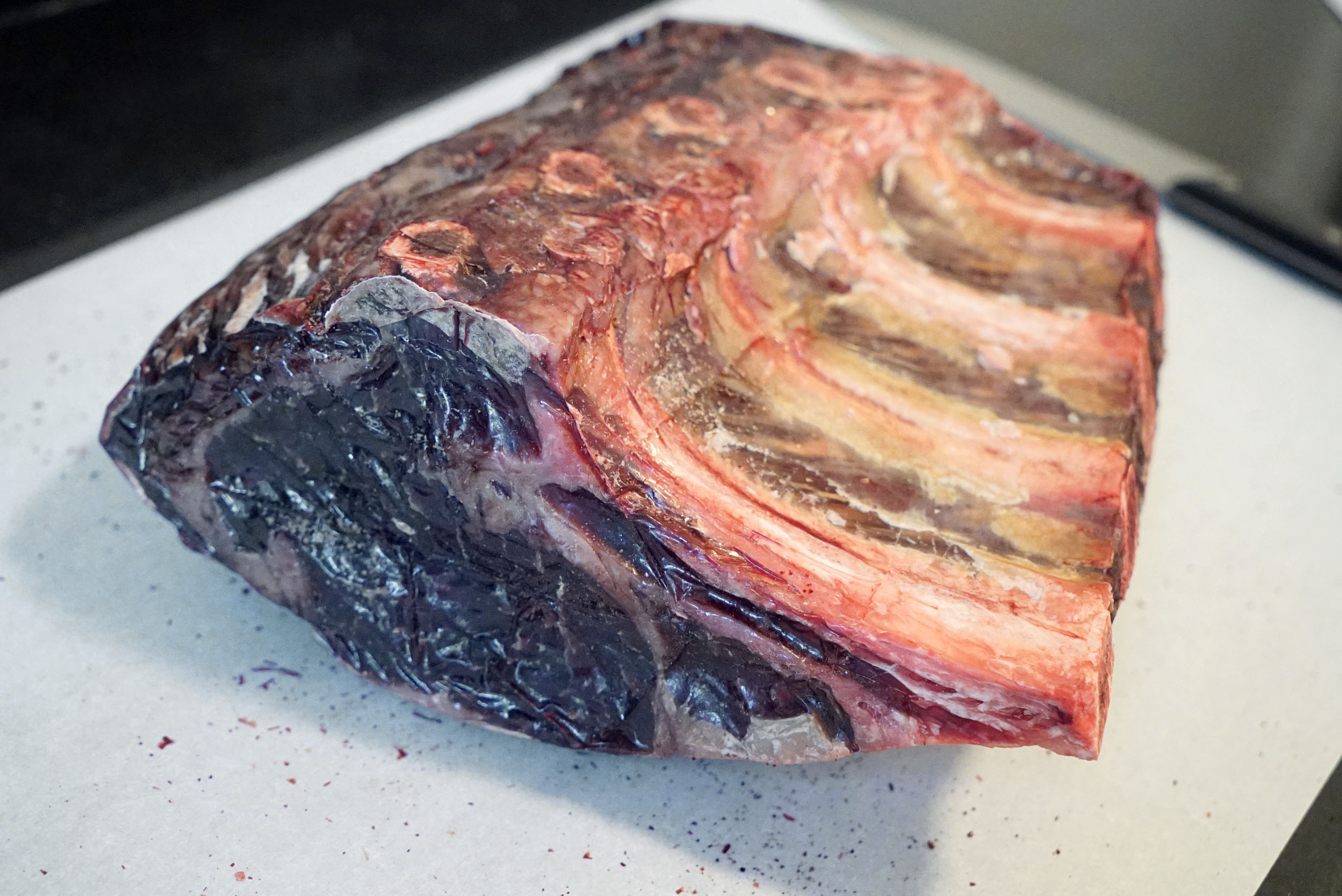
After 35 days, here is the unwrapping!
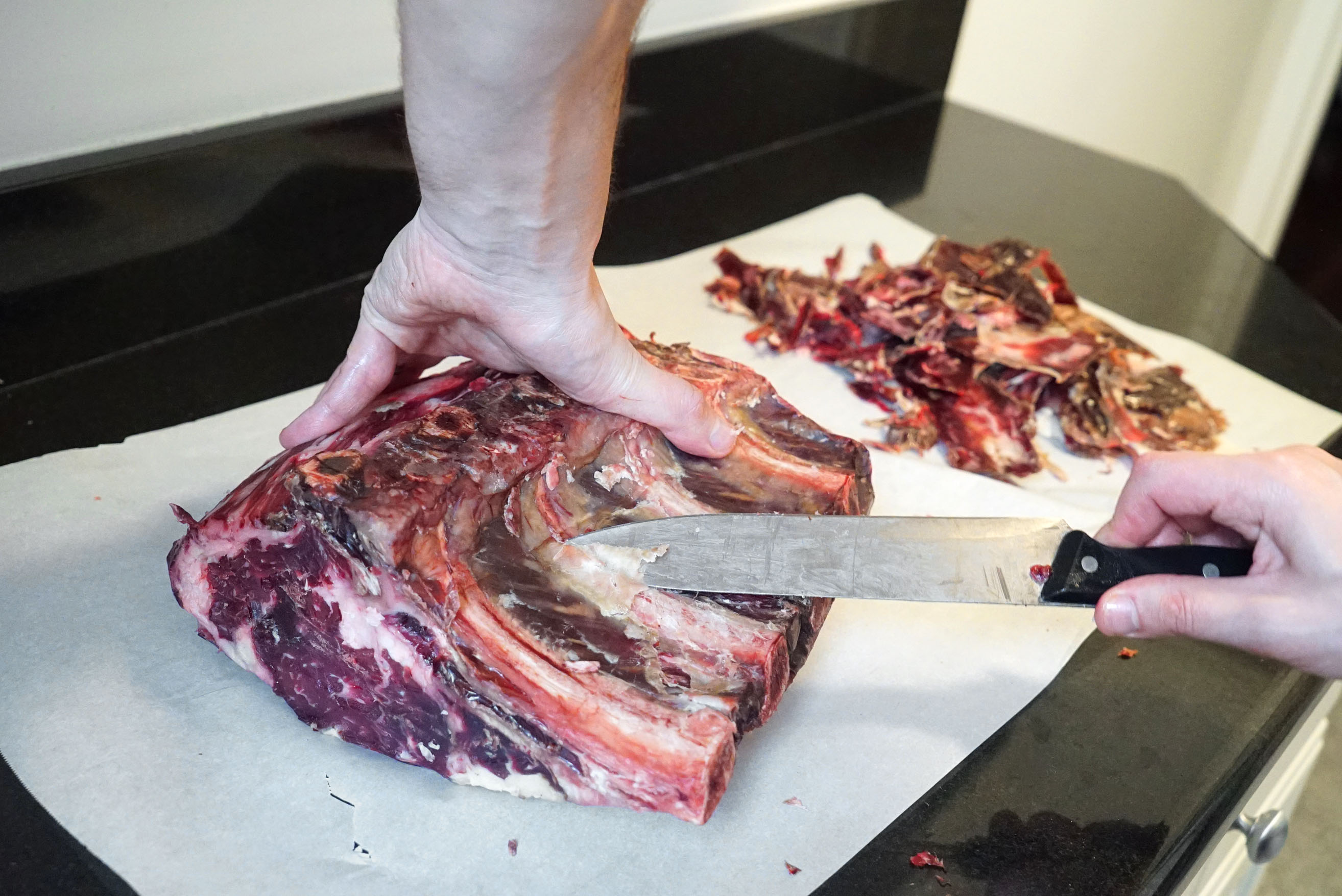
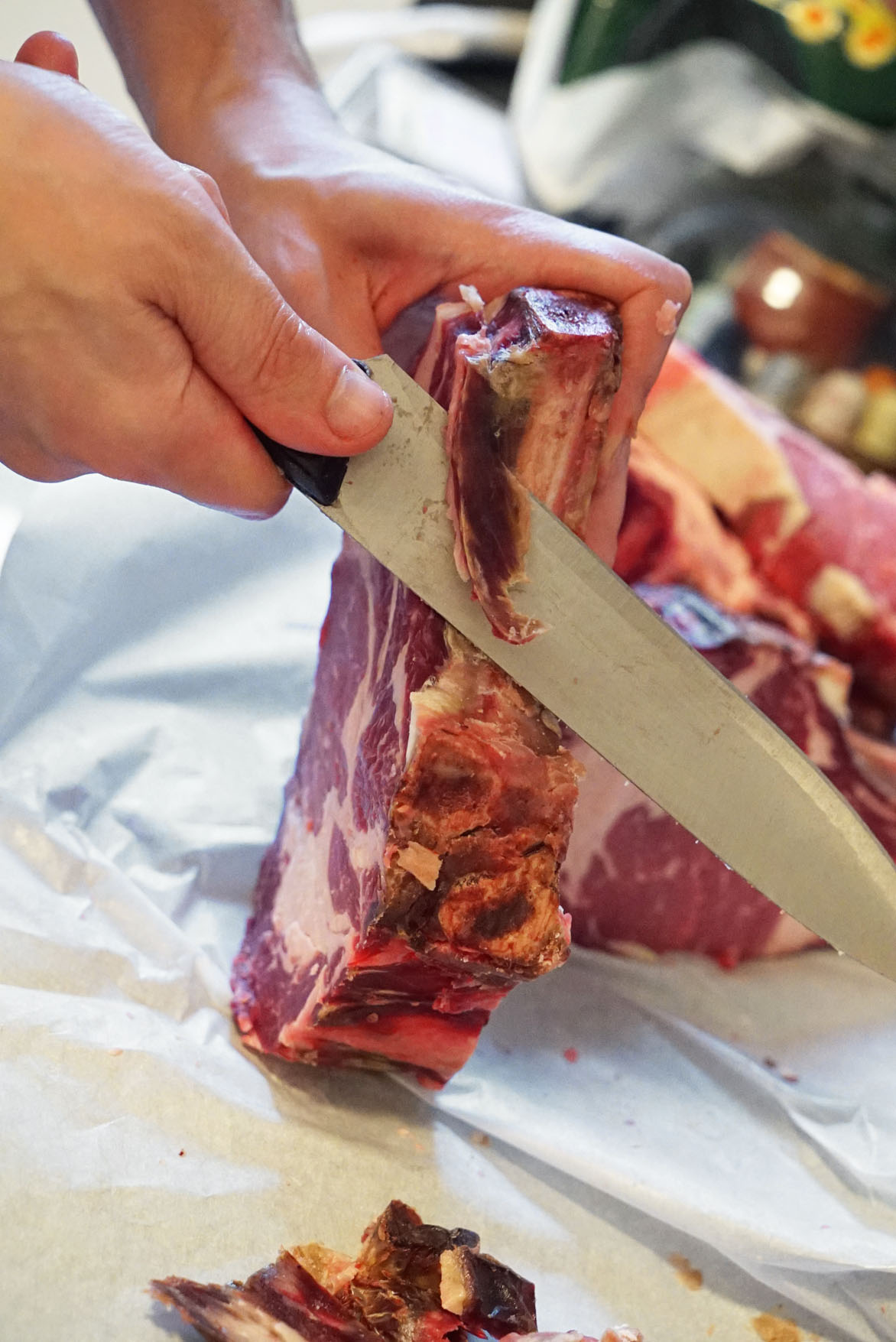
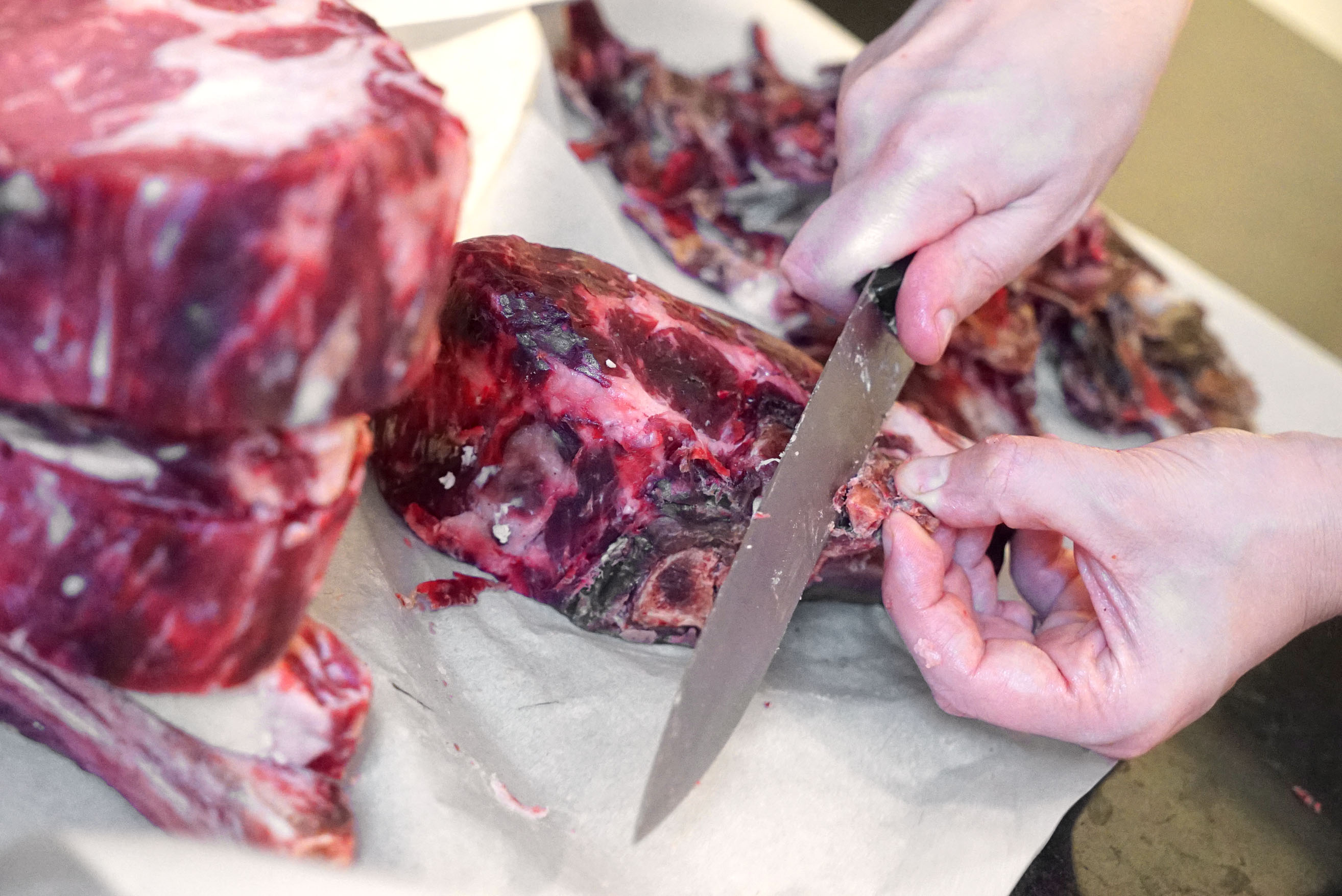
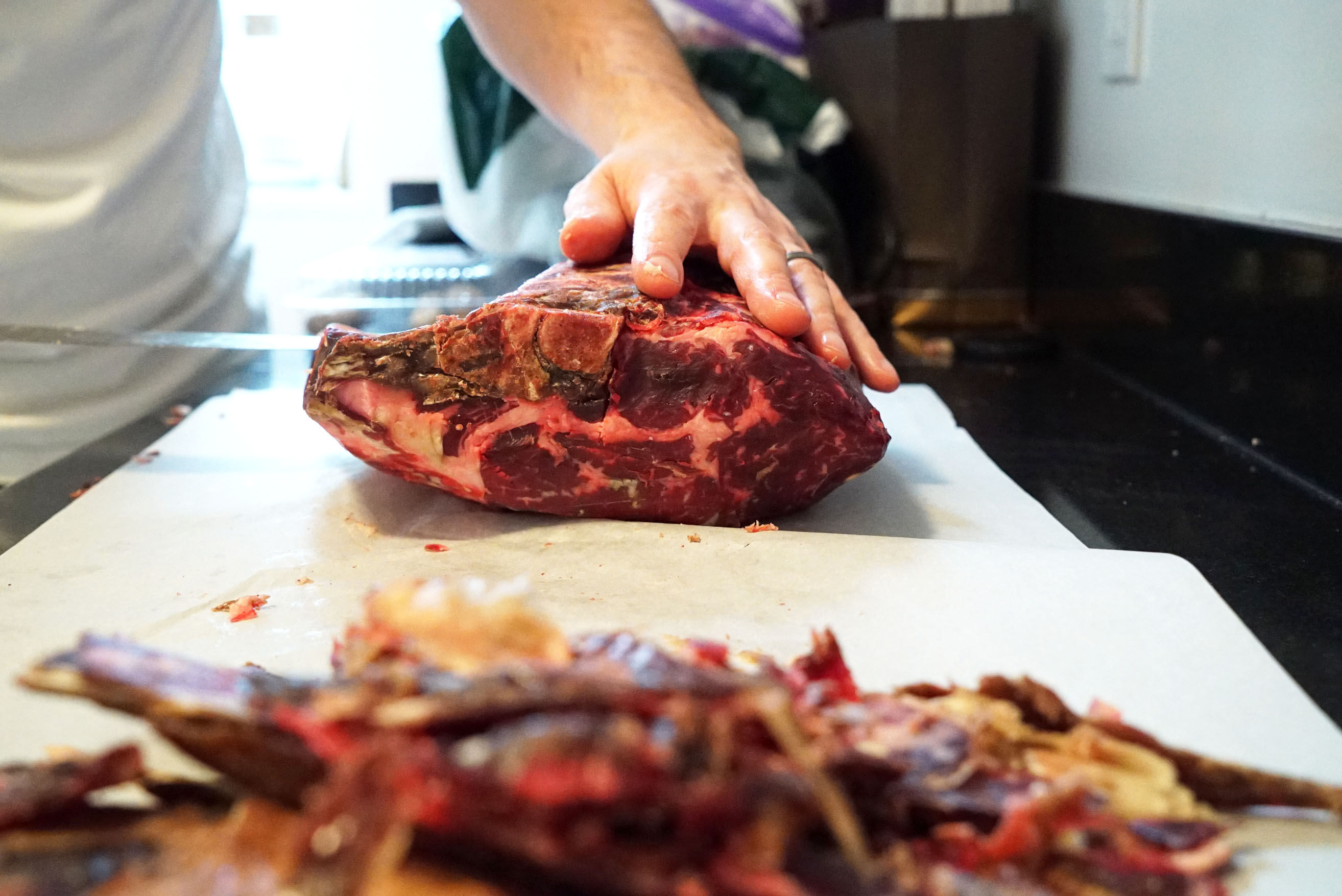
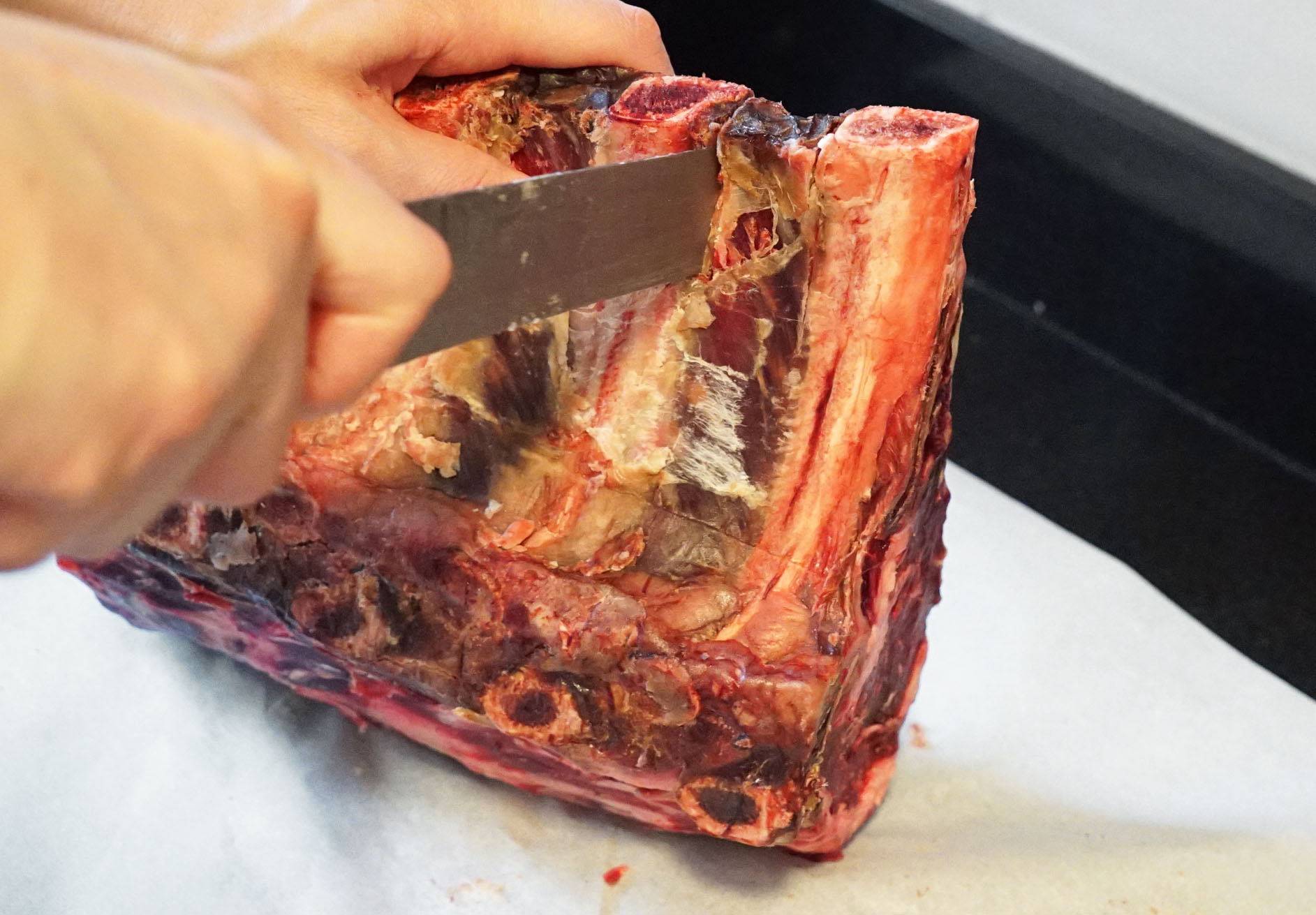
The outside bark, which has the texture of really hard beef jerky, needs to be sliced off of the underlying softened meat, and the tough skin membrane over the ribs needs to be peeled and picked off.
It’s an arduous task, but the end product is totally worth the effort. Here are some shots that my wife snapped of the slicing, trimming and portioning process.
The inside is so gorgeous. This shot looks like angel wings:
A great looking fat cap was still intact. I was worried that I would have to carve off too much of that, but we did pretty good.
I’ve saved all the bark slices to use in making another beef stock or broth at a later date.
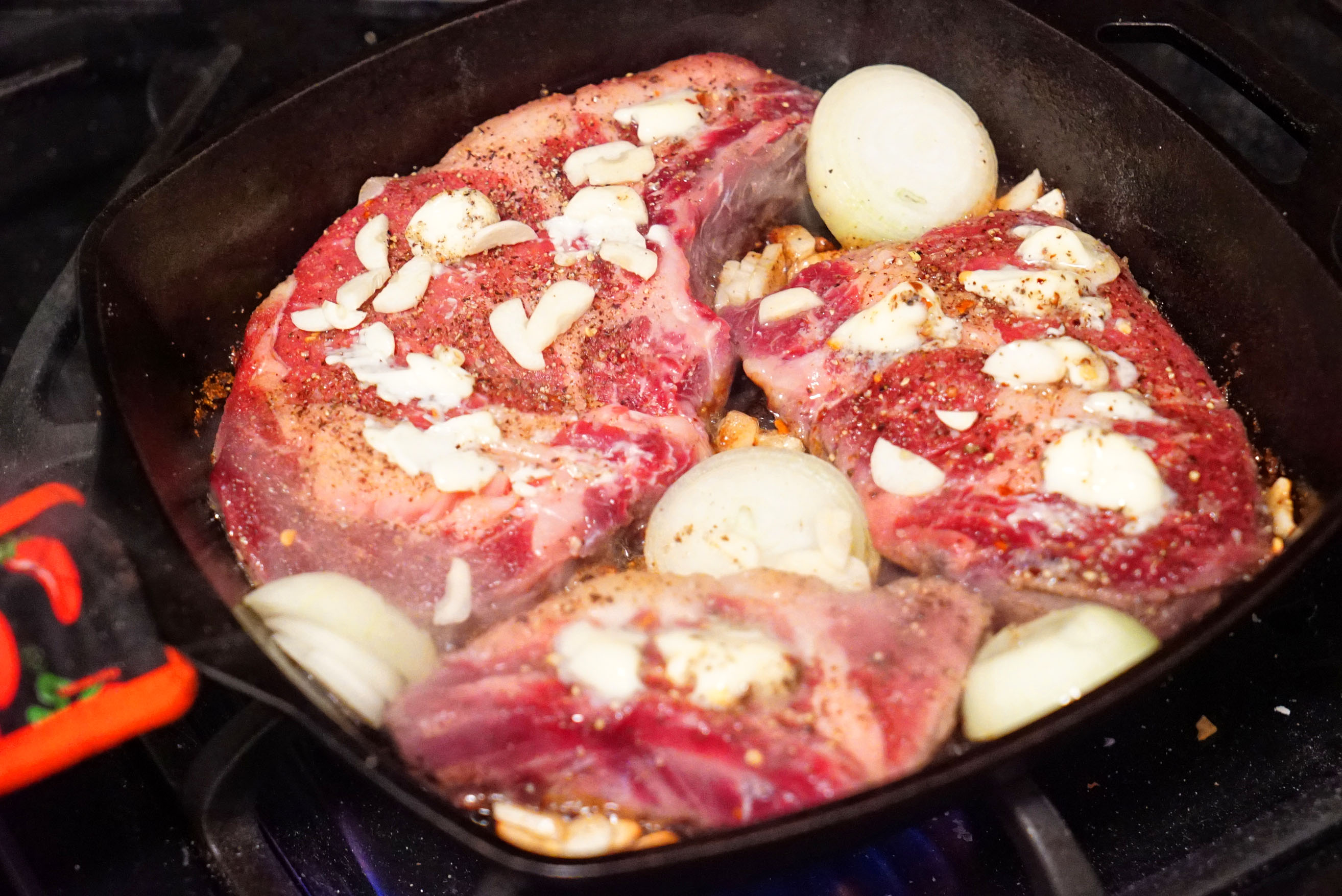
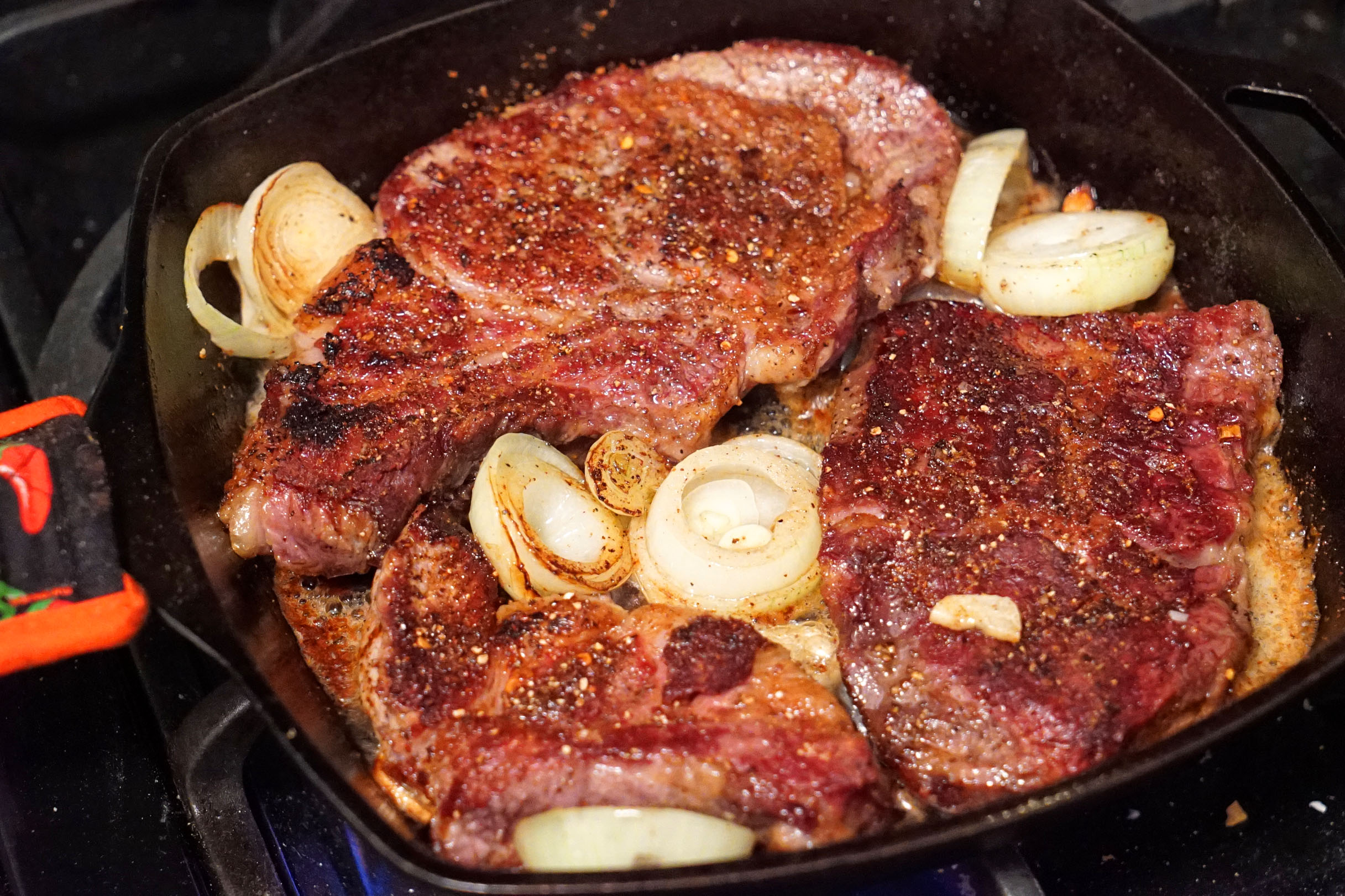
I ended up with two thinner boneless cuts, so I seasoned them up right away and seared them off in a cast iron skillet with some butter, garlic and onions (I cut one to fit them in the pan better).
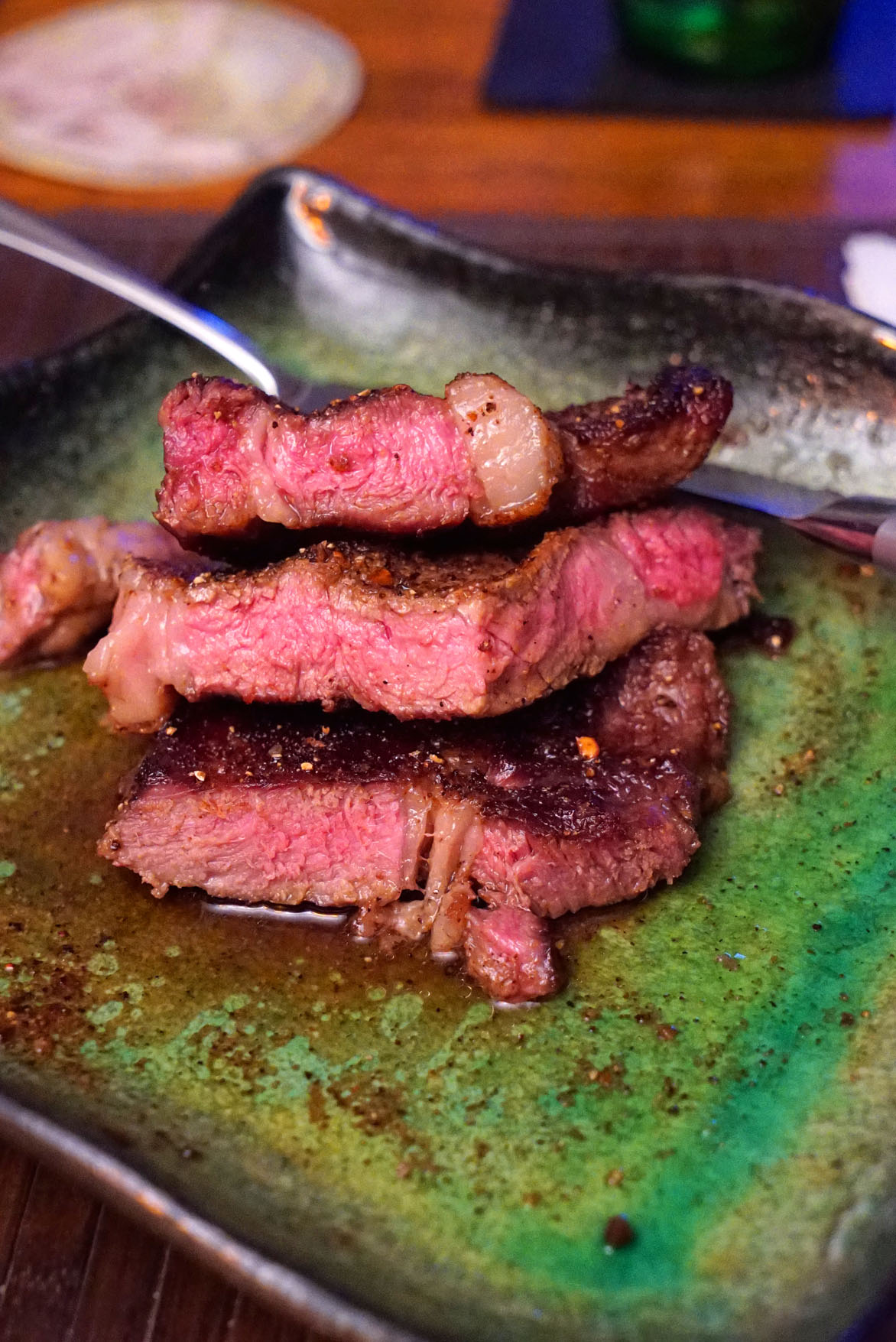
The result was awesome. Perfectly cooked, super flavorful and really well worth the wait! The fat was entirely edible. Very soft and buttery, like beef jelly.
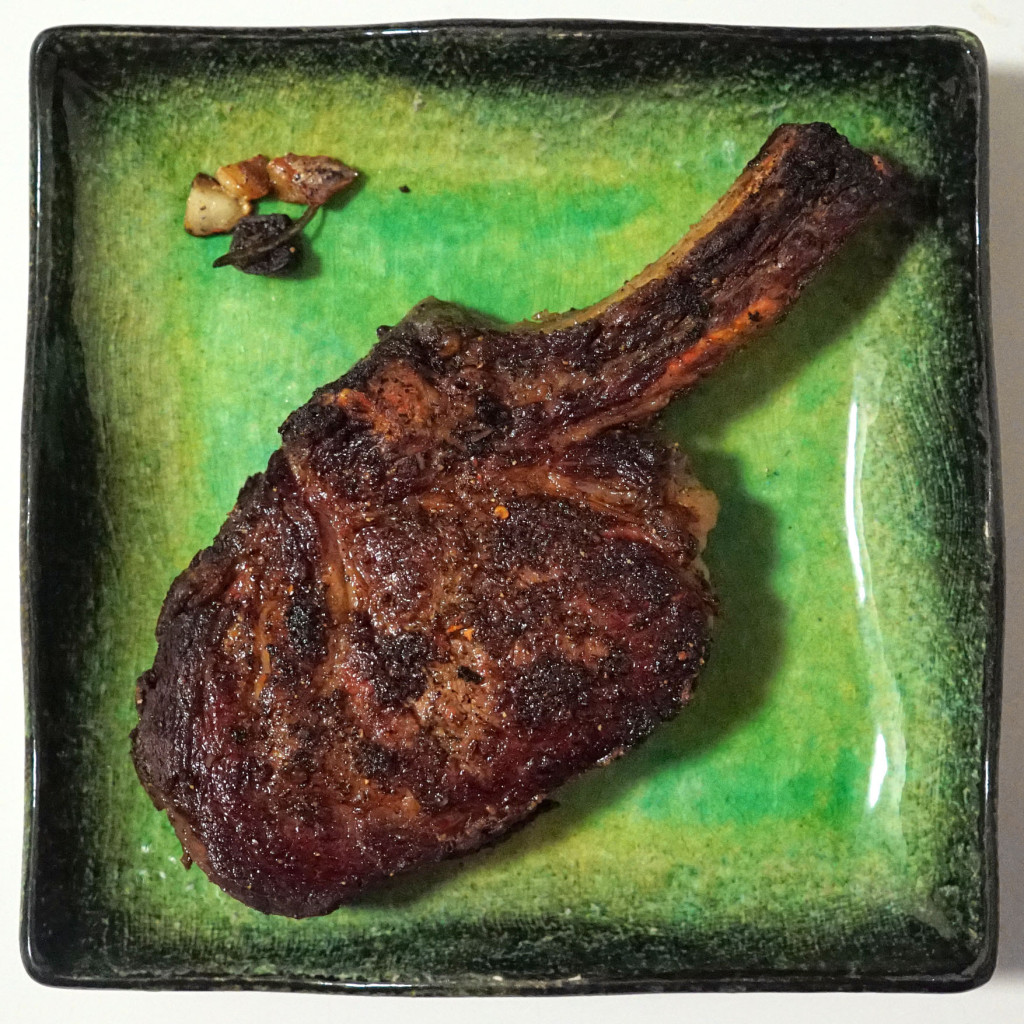
Those were just a couple of small boneless cuts. This cowboy chop was pretty incredible:
Now I’m wondering if I should try this again and just leave the shit in the fridge for several months. The flavor was great on this stuff. It had a nice earthy smell; a well-endowed scent of mushroom or truffle, with a slight hint of blue cheese. Like heaven.
If you’re adventurous with home meal prep, I highly recommend this easy-to-use product. I think I still have a few extra bags, so the next time I have a little extra fat in my bank, I might go in for another dry-aging experiment: maybe strip loin next time.
Final note: if your fridge is generally full, but you still want to age beef at home, I suggest getting a mini fridge, or a smaller dedicated separate fridge, just for beef. Put your temperature setting to about 35 degrees, and get a fan in there somehow to circulate the air. Always keep the beef elevated off the surface on a baking rack or something, too. No special aging bags necessary.
I recently dined here for a fourth time, and I’ve confirmed that the wagyu long bone rib eye is by far the greatest steak I’ve ever eaten.
The quality of the flesh is just outstanding. Every bit of it is edible, juicy and savory. Del’s uses a lot of crushed pepper to get a good crust on their steaks, and that “rub,” so to speak, really permeates down to the center of the meat and imparts flavor from end to end.
Fucking unbelievable. I was even gnawing on the bone.
As you can see in the background of one of the other pics, there’s another chunk of steak on my plate. My buddy and I split both the wagyu long bone, and the boneless strip.
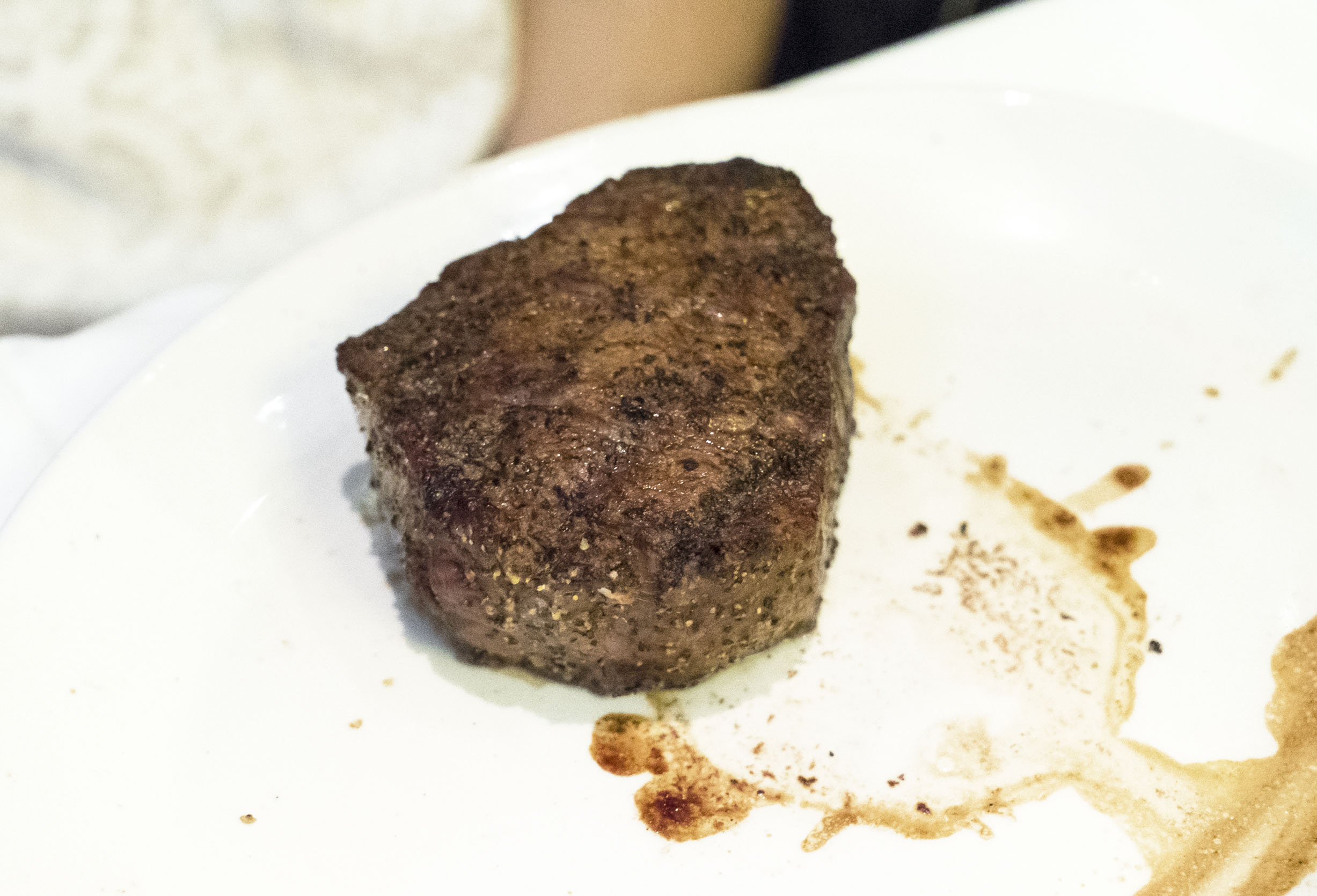
As you can see, it was also cooked perfectly, and crusted with that great peppercorn rub – the strip is on the left, and the wagyu is on the right. Although the strip can not hold a candle to that wagyu in terms of insane flavor, it was still one of the best strip steaks I’ve ever had. Del’s just really knows what’s up.
My wife ordered the special cowboy bone in rib eye that was on the menu. This, too was excellent.
You really can’t go wrong with any cut of meat here. Porterhouse is excellent as well:
My buddy’s wife ordered the 12oz filet, and that was great as well. Buttery, savory, peppery and juicy.
As you can see from the pics above, some of the plating wasn’t as pretty as in the past. It seems like Del’s got rid of their signature chopped parsley across the top and on the plate. They also failed to wipe up some of the juices from when they placed the steak on the plate and then adjusted the positioning. Not a big deal though, especially considering how delicious every cut of meat is at this joint.
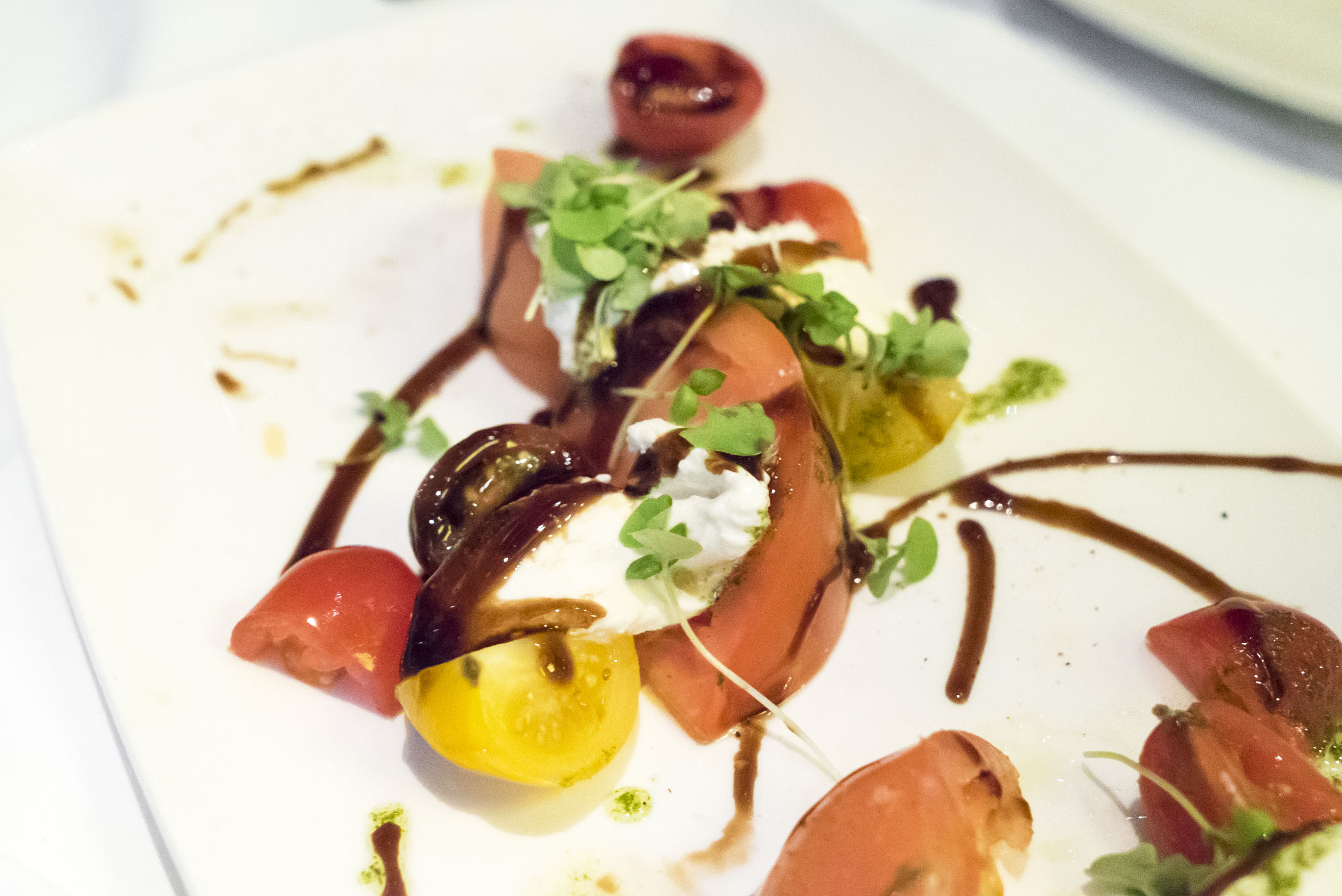
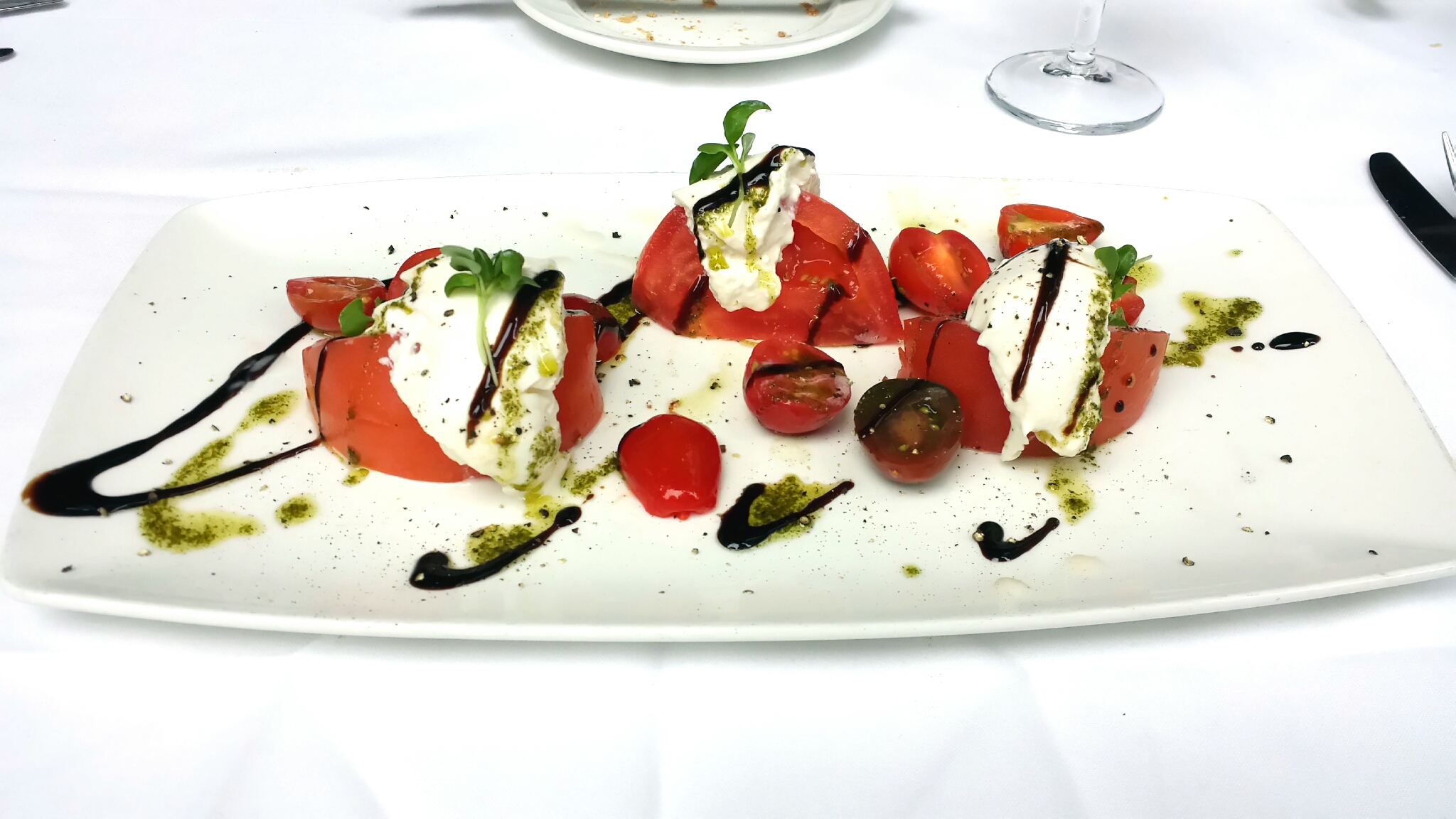
The first app that we tried this time was burrata. I thought it was a little too light on the cheese and too heavy on the tomatoes, but the quality was excellent.
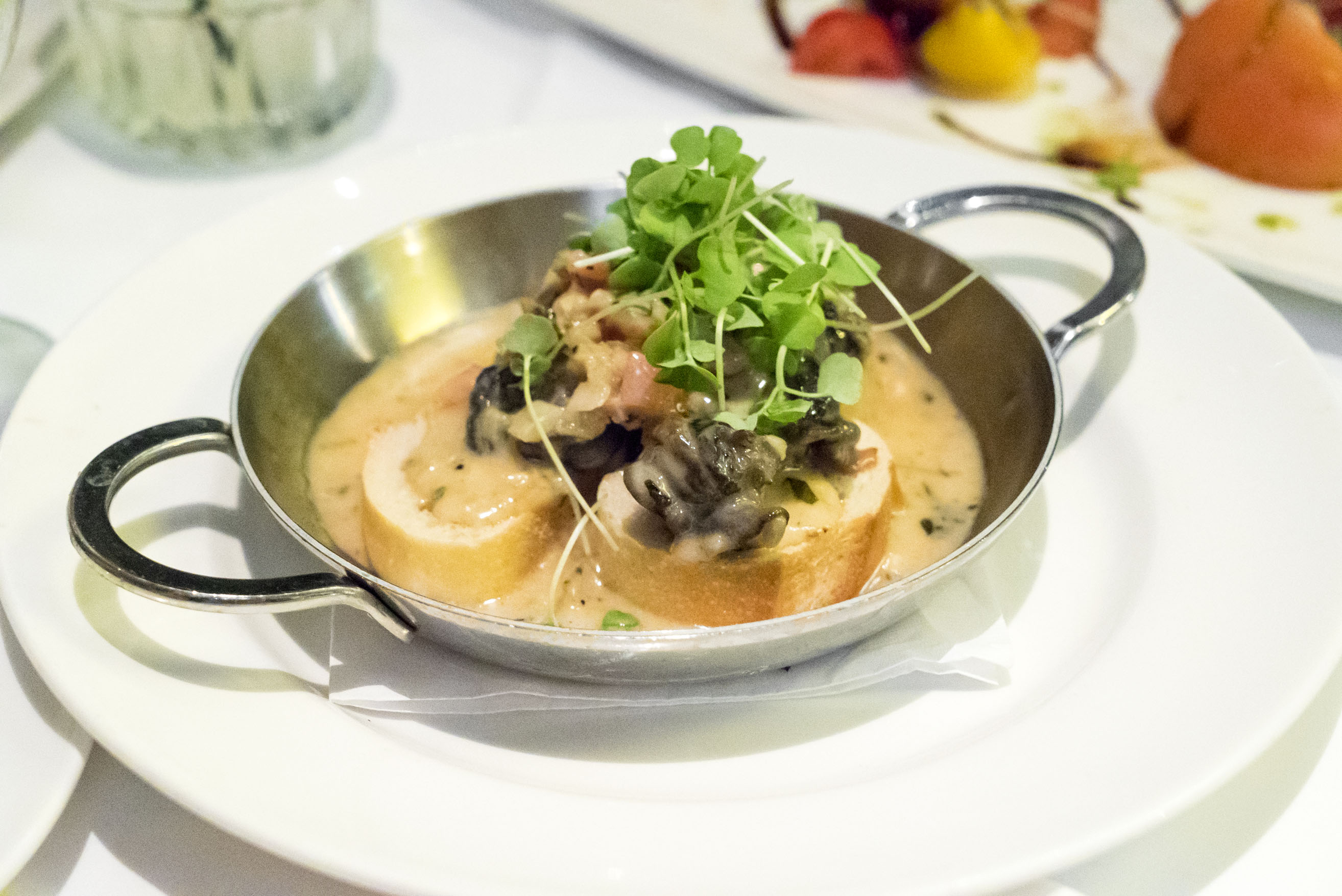
The escargot was nicely executed. While I’ve had better at French joints, this was served on toasted bread like bruscetta, and in a really nice buttery sauce.
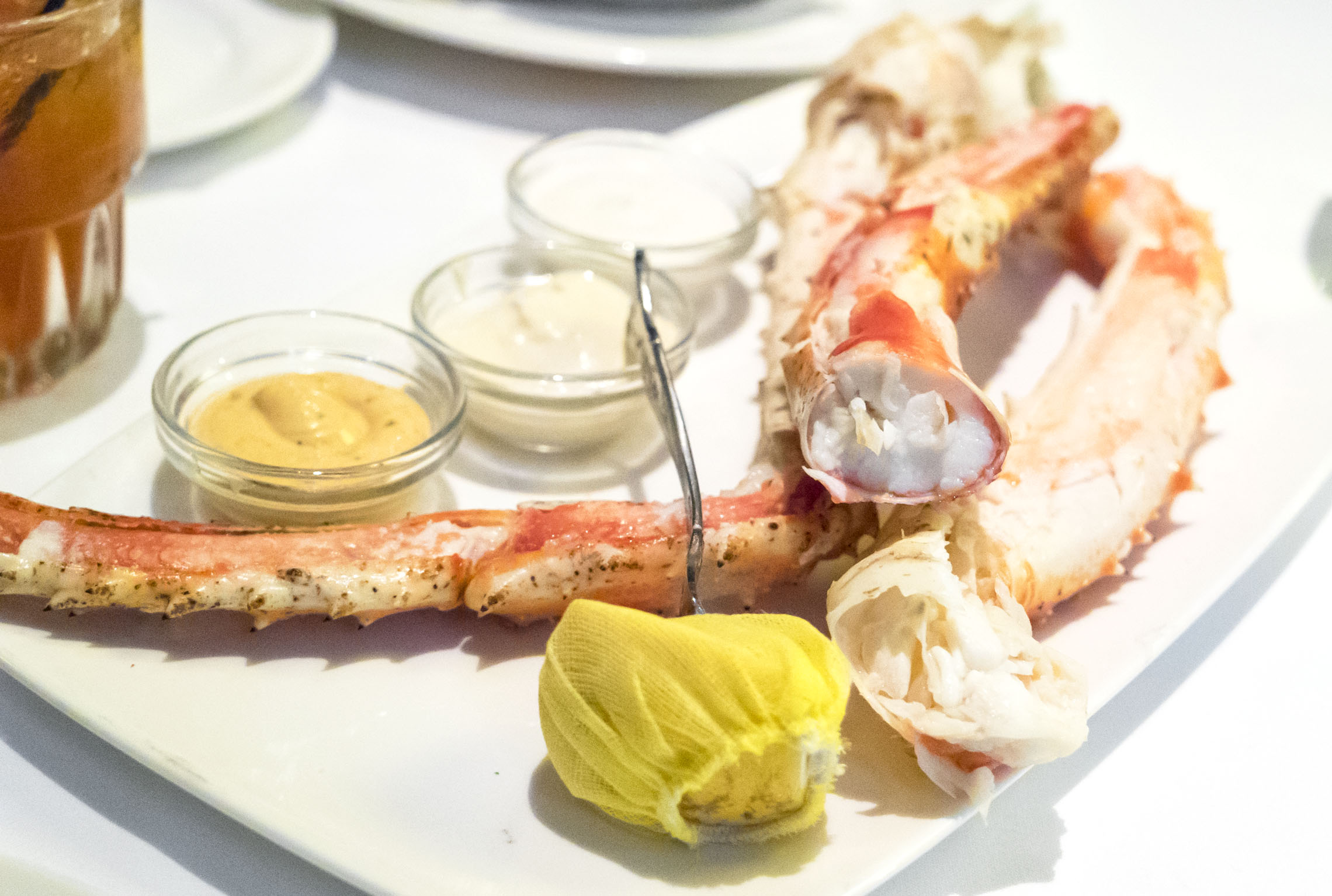
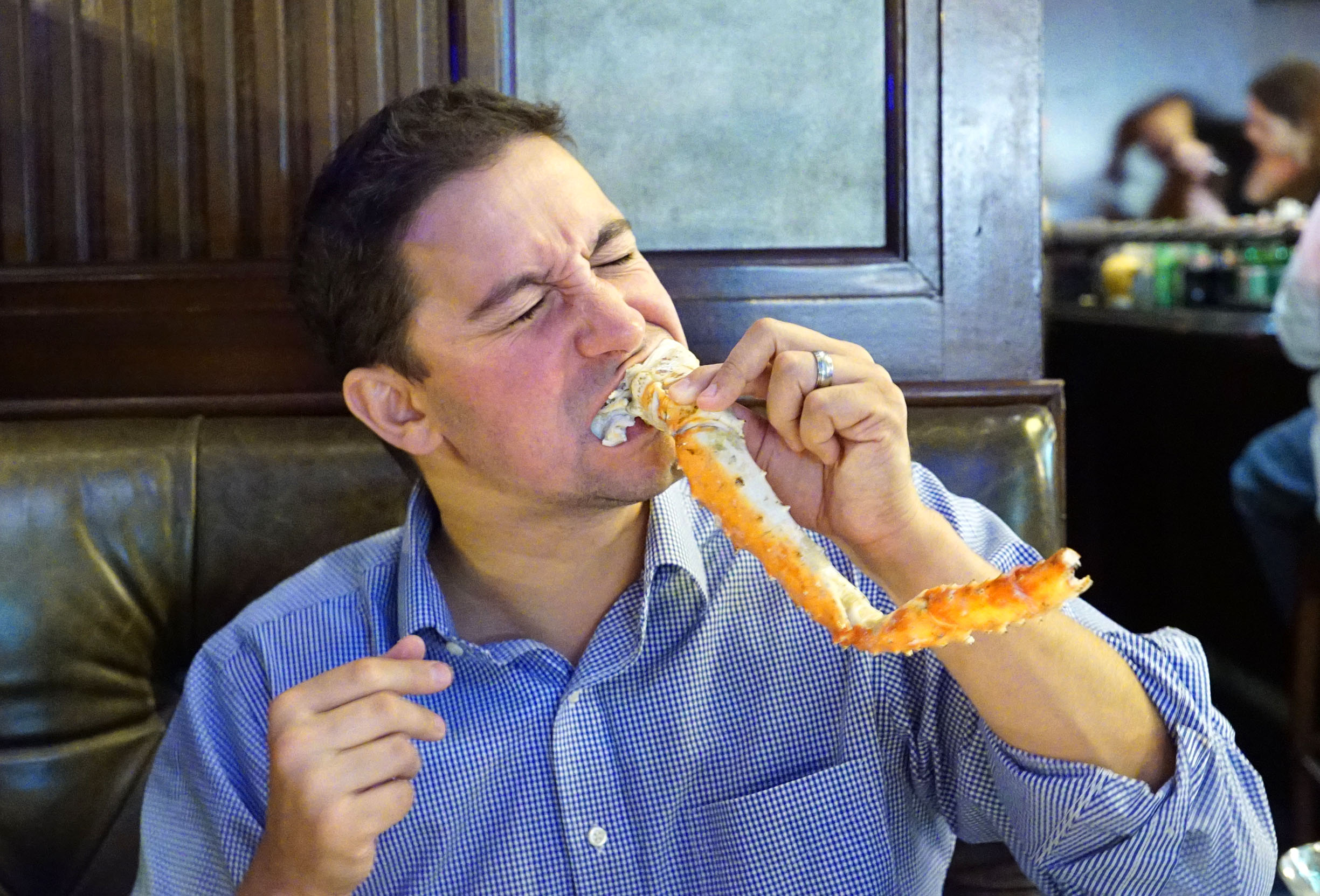
The crab legs we ordered were super pricey, but super fresh. These are dangerous because you could really eat your entire paycheck in just a few minutes time.
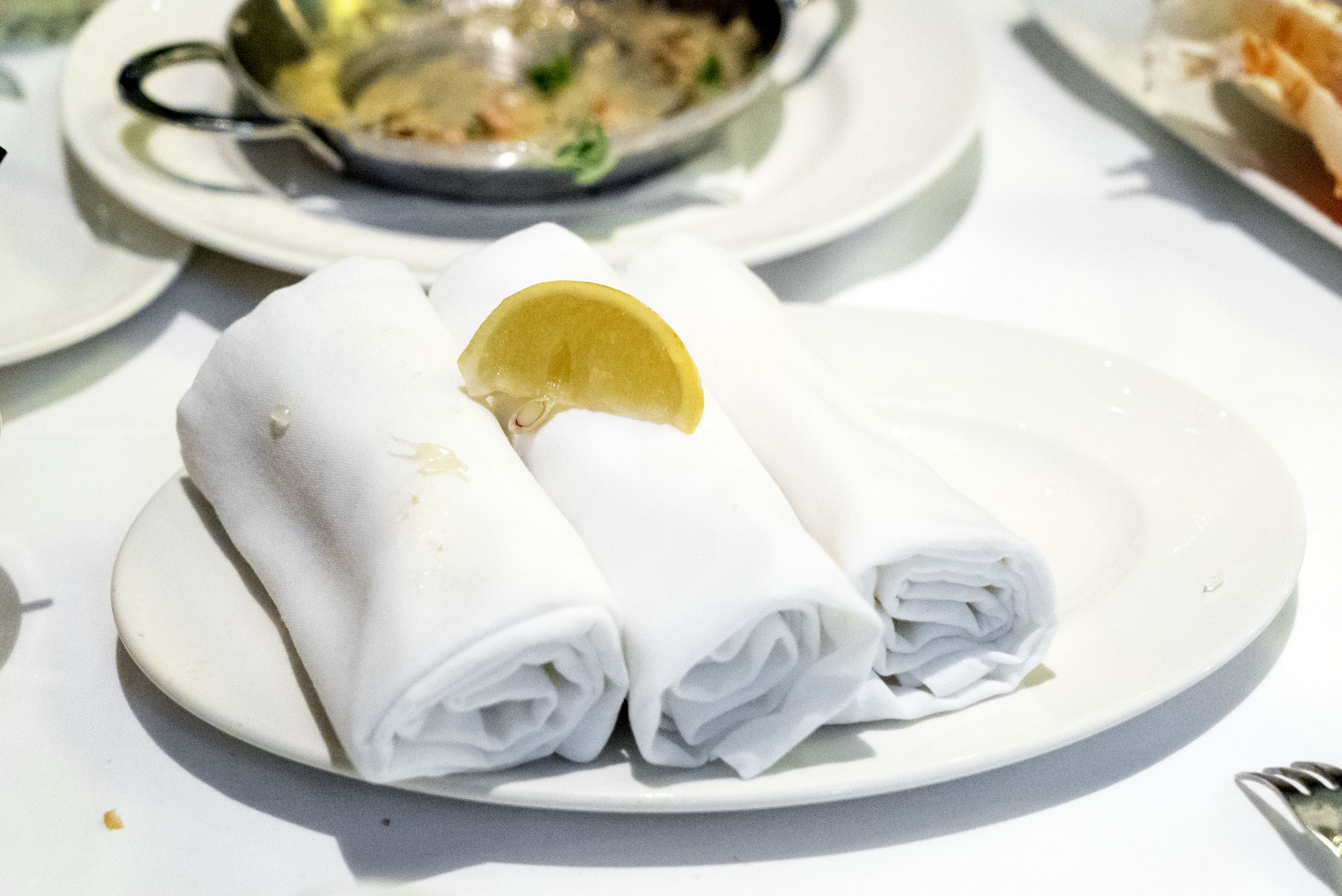
After the crab legs, our awesome waiter Luke brought out some hot towels and a lemon wedge to clean up from handling the shells.
But in all honesty it wasn’t needed, because with the insane service you get at Del’s, the shells are already cracked, opened and easy for meat extracting.
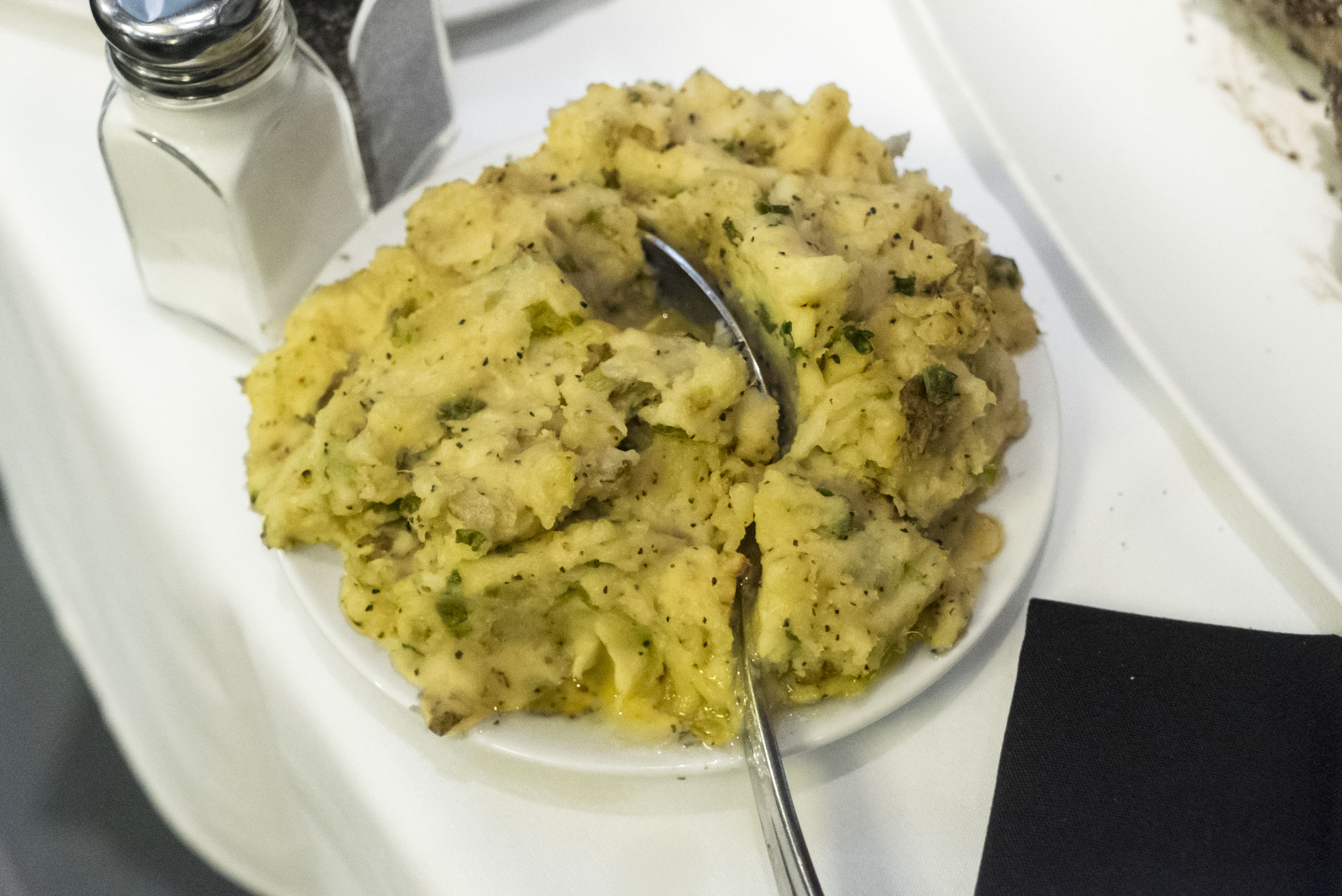
The chateau potatoes we ordered on the side were a bit dry. They were skin-on mashed potatoes with garlic and some spinach greens. Perhaps if they were served with a gravy they’d be killer.
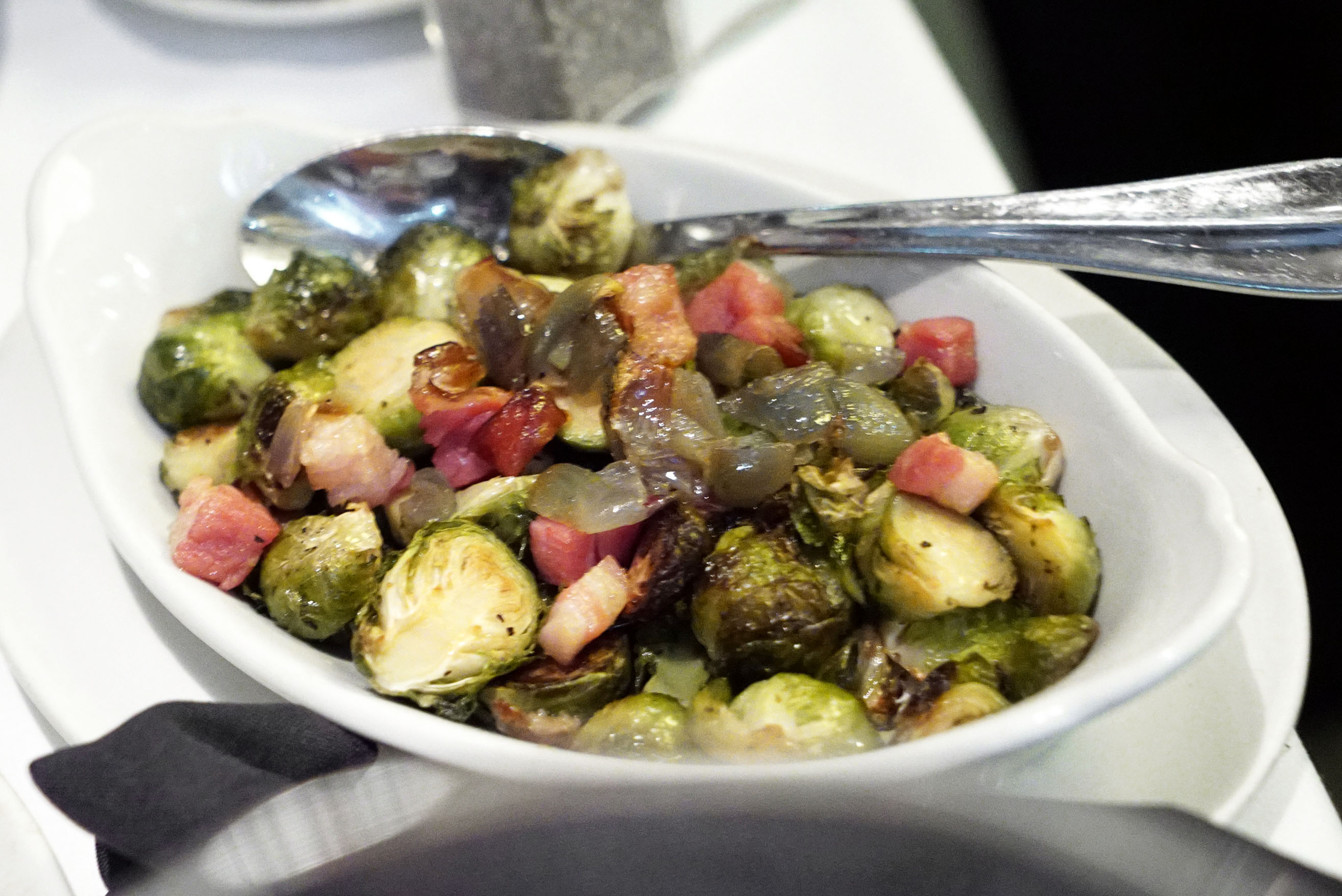
The pancetta is what made these brussels really great. I prefer a harder roast and some char on my brussels, in general, but they were nice and tiny so the surface area was coated nicely with all the seasonings and flavors. It didn’t get monotonous-tasting like brussels sometimes can.
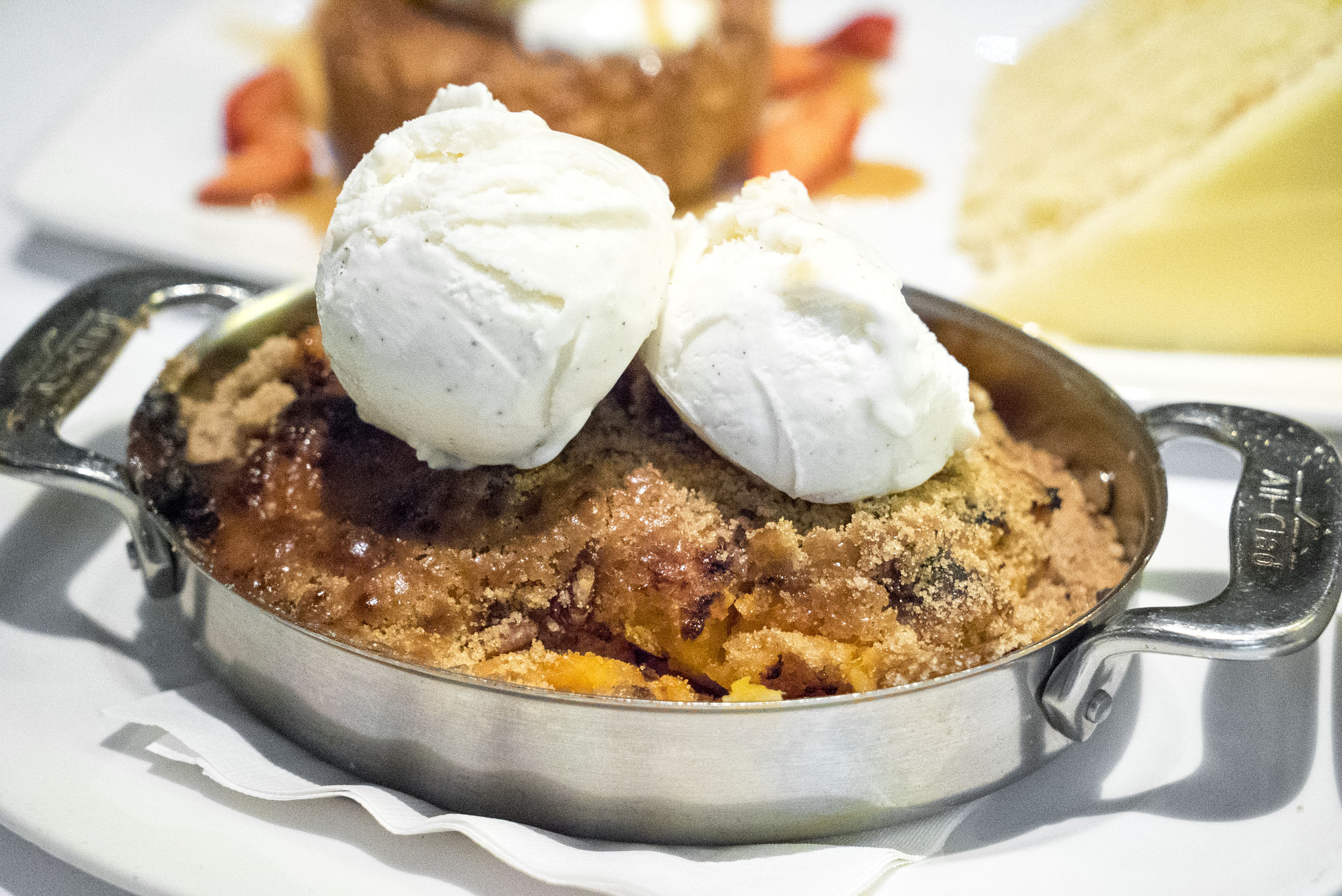
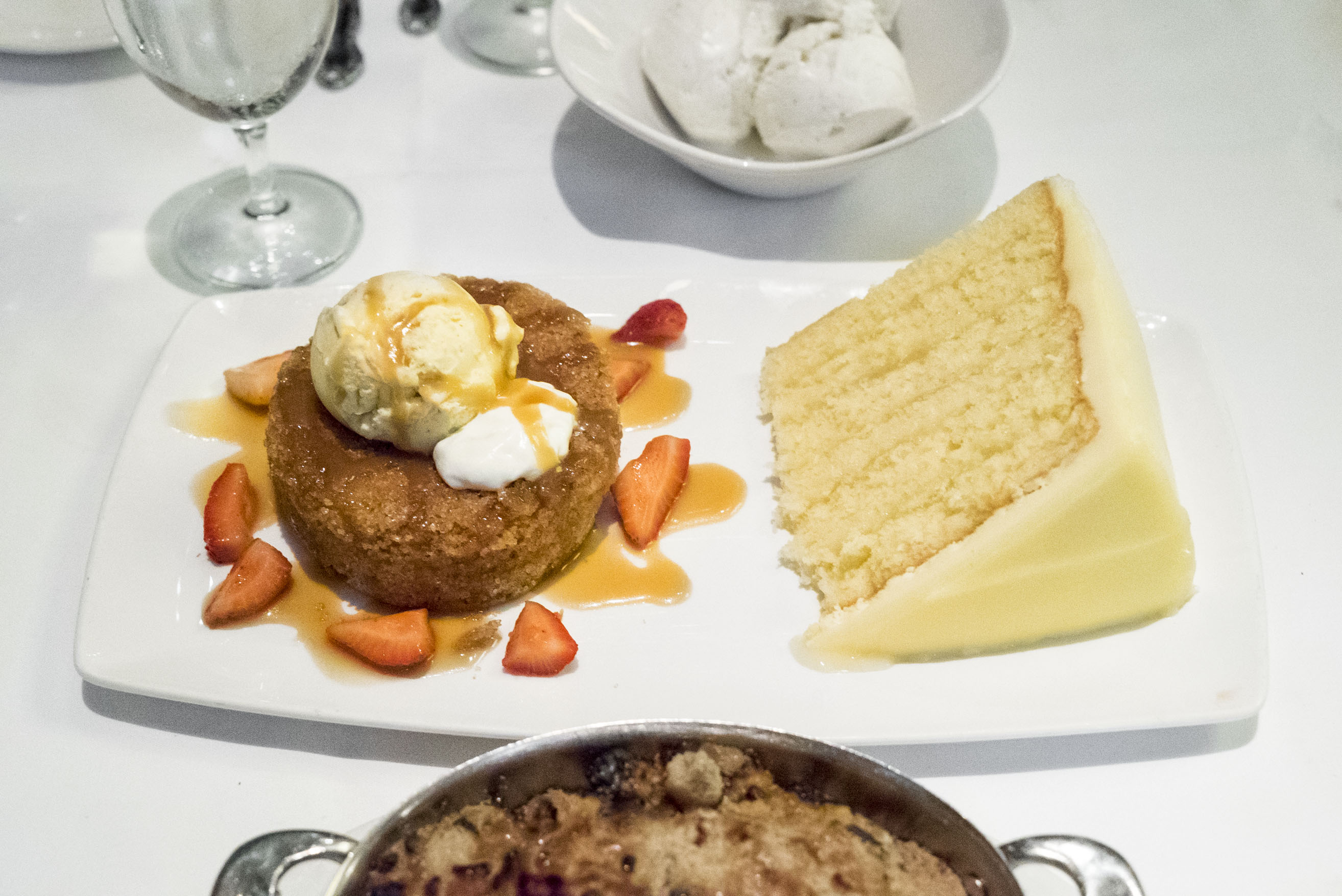
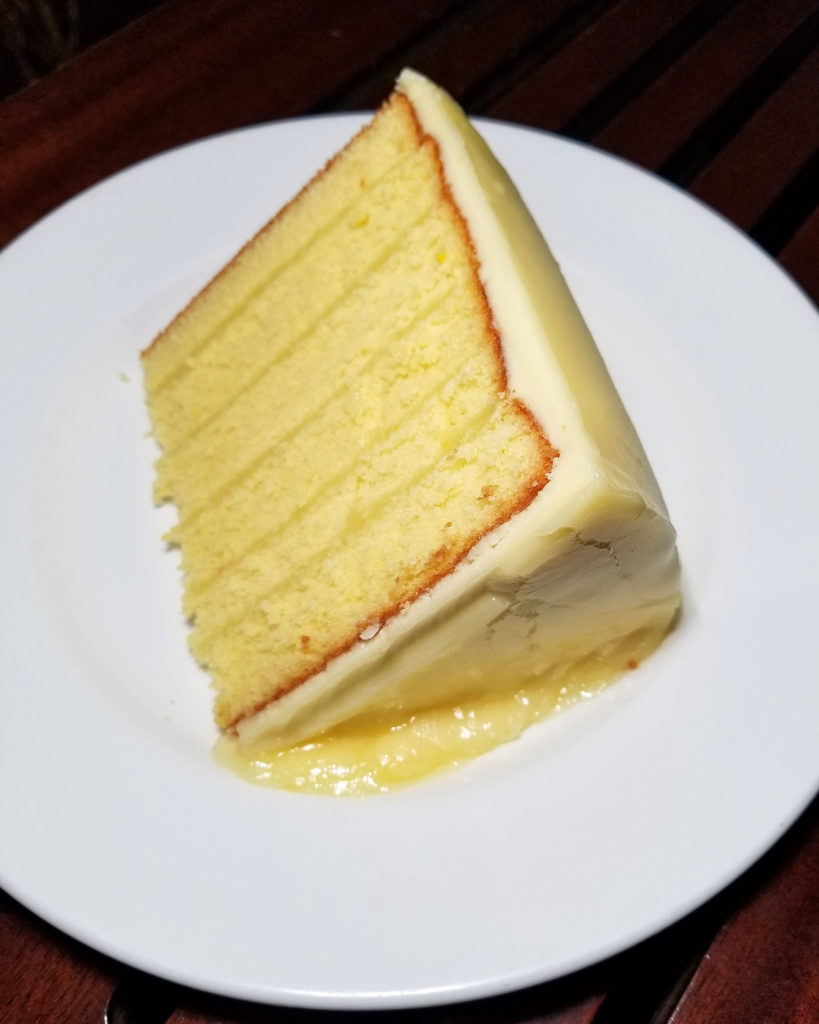
For dessert, we tried the lemon cake, as it is a crowd favorite and secret menu gem, as well as the sweet potato casserole (with ice cream on top). I have to say that the version at Ruth’s Chris is better. That lemon cake, though, is wonderful. The cake is moist without being too heavy or dense. And while there is a LOT of frosting on this baby, it is really tasty and I didn’t think it was overly sweet.
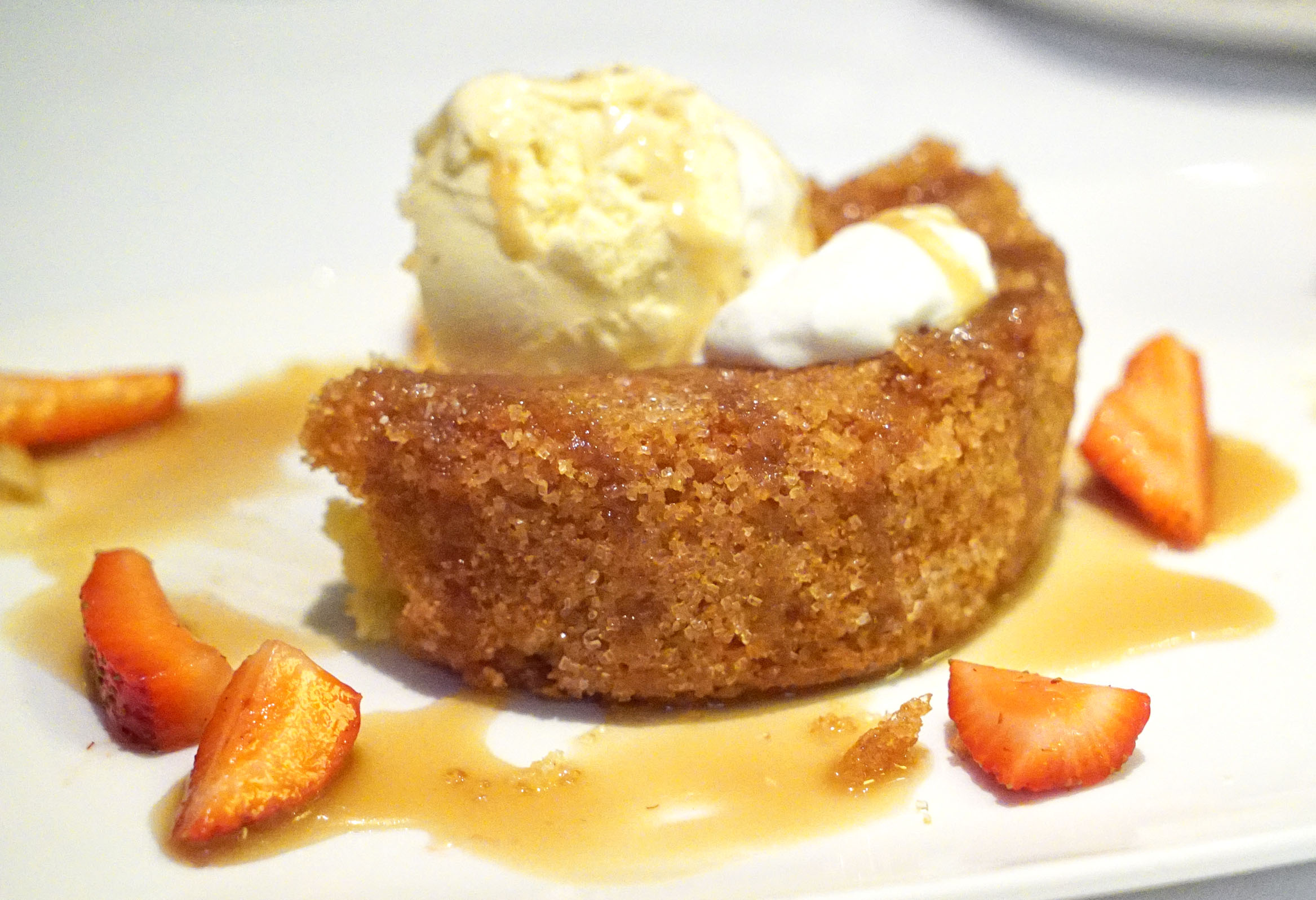
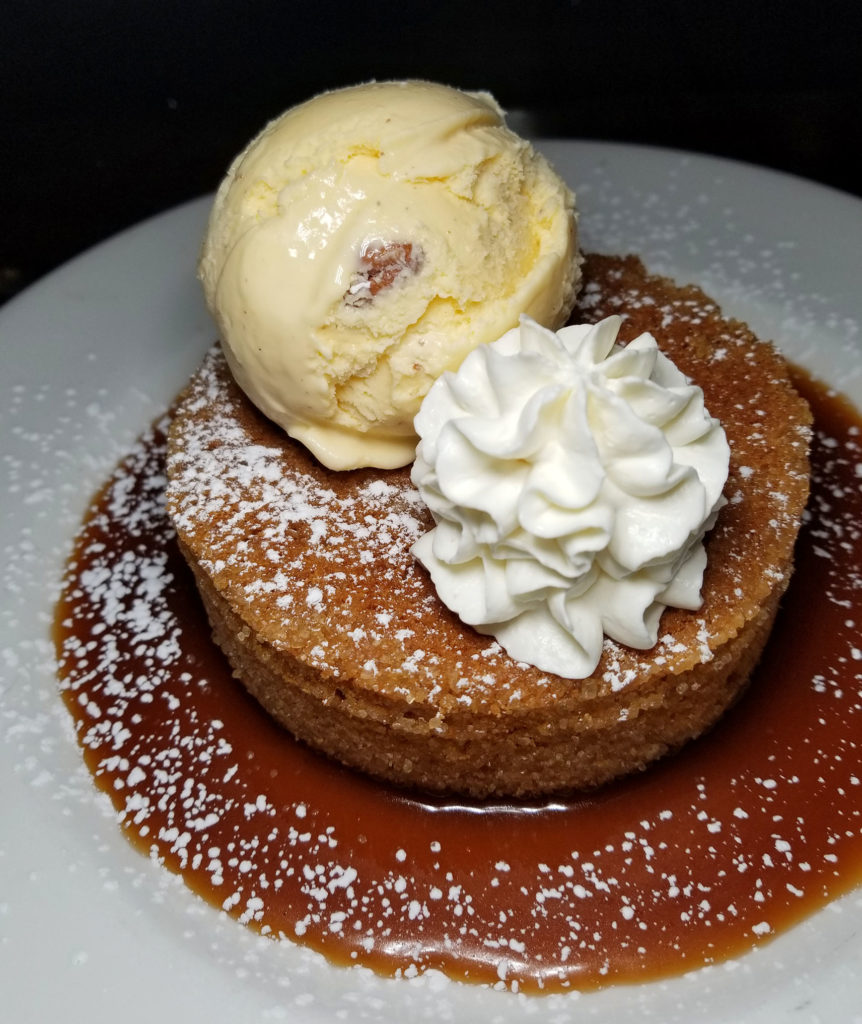
The other cake on the plate there with the lemon cake is something that the staff sent out for us on the house, since it was my buddy’s birthday. It was a butter cake with caramel ice cream. That shit was the best desert of the night, and it’s right up there with my favorites of all time.
The outside held a nice crunchy sweet crust, but the inside was buttery sweet with a slight bit of savory to boot. Drizzled with a little bit of sweet caramel and maple syrup type of shit, it really hit the spot.
Then the bad news showed up. DAMN! But worth every penny.
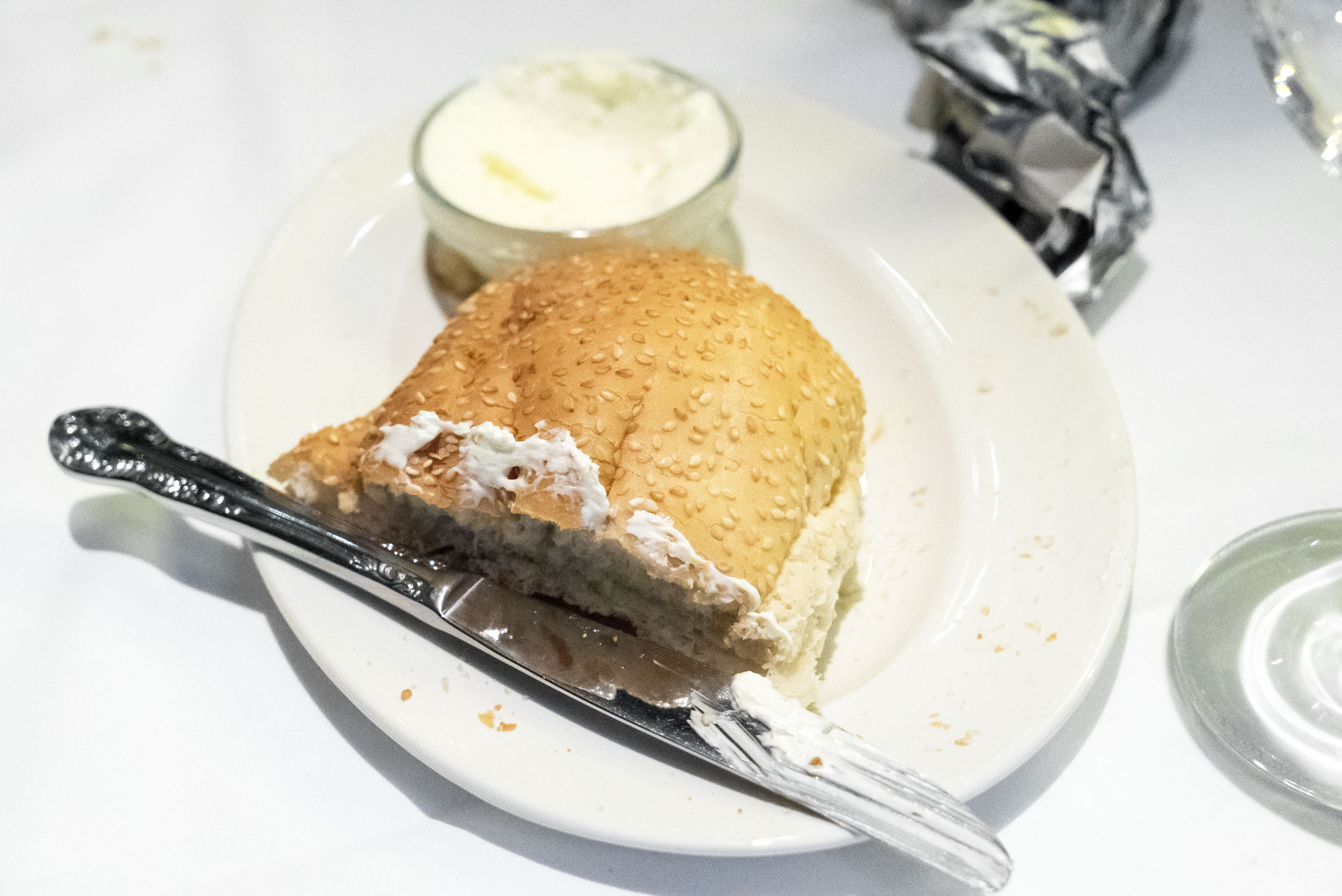
The bar here is still amazing, as I remembered. It was packed out all night, really great buzz. And the bread served at the table comes with a really soft whipped butter that has just the right amount of salt content.
So Del’s ended up remaining at a 97/100. I pulled one point for the apps/sides, since the burrata and the potatoes were both somewhat failures. I considered pulling a point for the plating since the plates weren’t as pretty as the past, but I reconsidered because that seems petty and retarded. I tacked on a point for price, though, since I really feel that despite the astronomical pricing of some of the shit here, it really is worth the money. If you’re going to splurge on a steak dinner, you may as well do it the right way. That means going to Del’s and being fully aware of the wallet rape that is to come.
Del Frisco’s Overall Score: 97/100 – price moved from 8/10 to 9/10, and apps/sides/desserts moved from 10/10 to 9/10. So we evened out and remained at 97.
Ever since I became obsessed with NYC steakhouses back in 2000, I have heard overwhelmingly great things about Del Frisco’s “Double Eagle” Steakhouse. I finally nailed down a time to go with a group of old friends and coworkers when one was back in town from California. A nice 25 second stroll from my office took me to one of the best steakhouses in the city. A second trip to this joint in December of 2012 solidified Del Frisco’s place in my top five. New info added on that trip is in italics. After a third trip, comments in BOLD, this place is tied for first.
Flavor: 10
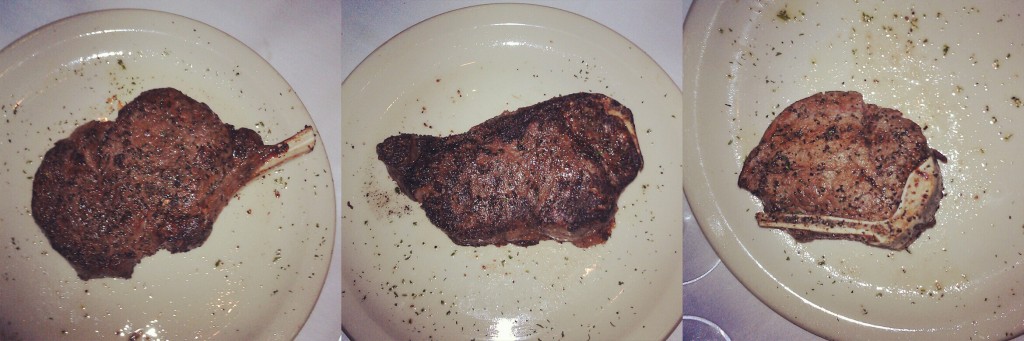
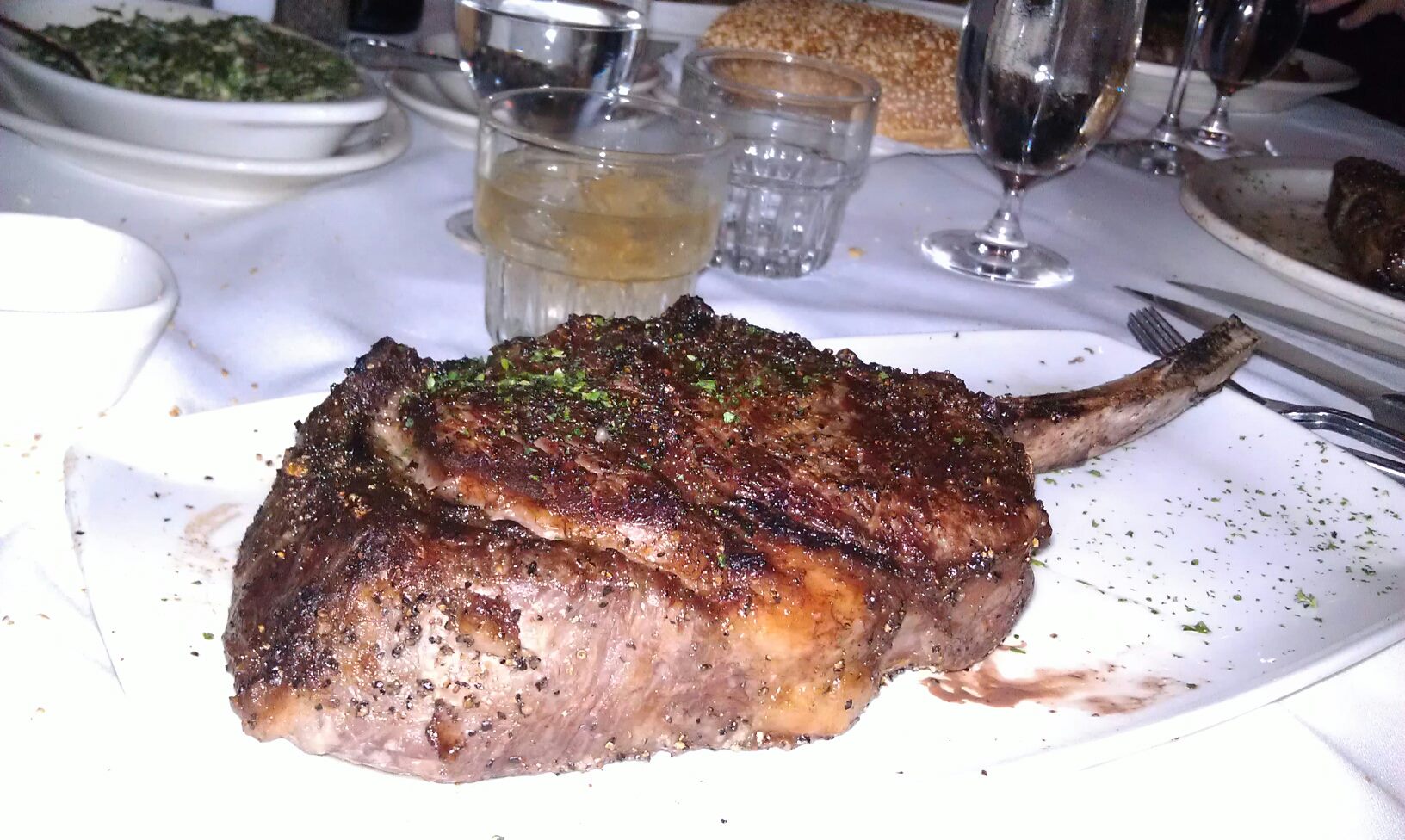
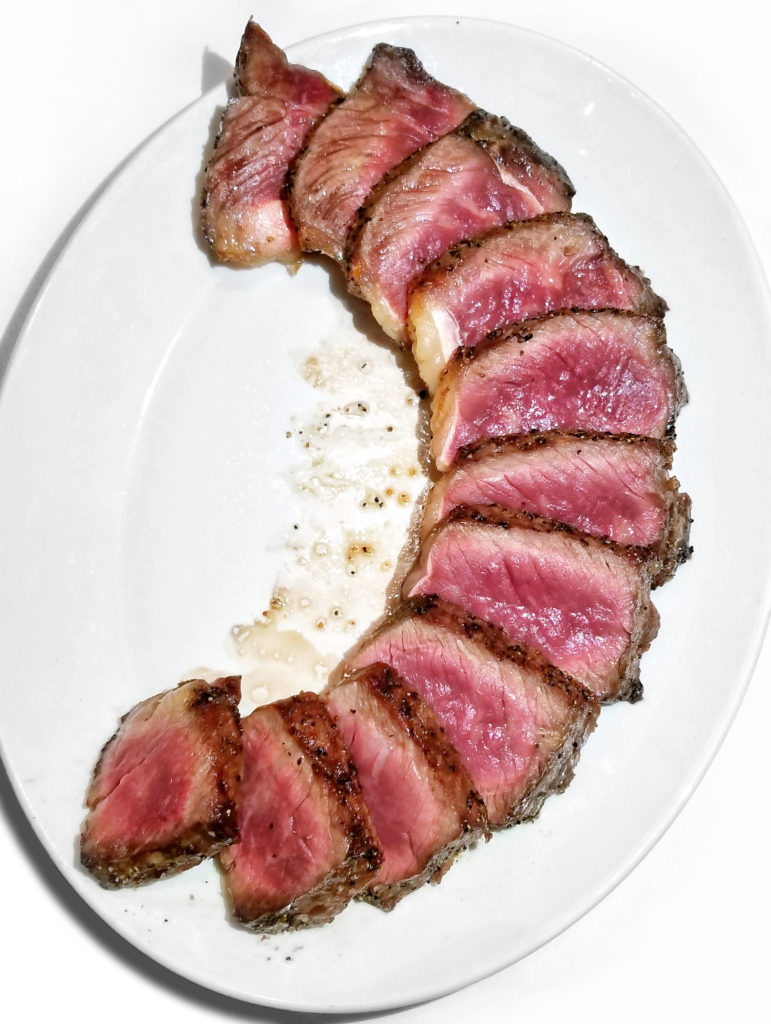
I ordered the ribeye that they had on special; a 22oz bone-in cut of heaven. It had a nice seasoned crust, the kind of marbled fat that just melts away and gets really soft, and it was perfectly cooked. It could have rested another two minutes, but that didn’t alter juice or flavor qualities. My friend ordered the filet. I had a bite of that, and it was delicious and well seasoned too. Del Frisco’s certainly lived up to the hype for me in terms of flavor. On a second trip with a couple of buddies from Junior High, High School and beyond, I ordered the house special: the double eagle bone-in strip. It, too was cooked perfectly and tasted delicious. On the third trip I had the $94 wagyu ribeye, which was easily one of the best steaks I’ve ever had in my life (if not THE best). It was 32oz of pure heaven. Delicious flavor from end to end; juicy, tender, and cooked to a perfect medium rare. See the pic below:
rib eye, strip, filet
32oz wagyu ribeye
Choice of Cuts & Quality Available: 10
Everything on the menu is prime quality. They only have the four basic cuts (filet, ribeye, porterhouse and strip), but they offer several varieties of each, like the 38oz longbone American “wagyu” ribeye and some specials (see below). This makes up for the initial point I was going to take for not having anything outside the basics. Del Frisco’s shows that when you do the basics the right way, nothing else is needed.
Portion Size & Plating: 9
The filet comes in two flavors: vaginal (8oz) and quasi-manly (12oz). They also have 16oz strips and ribeyes (boneless) – a bit on the small side but not horrific. They also offer a signature bone-in “double eagle” strip at 26oz, as well as a 24oz porterhouse, and a special bone-in filet at 16oz. The relatively smaller sizes make it easy for the eye to wander to the 38oz “wagyu” ribeye at 2x the price, or the specials at 1.5x the price. Well worth the up-charge, in my opinion. The plating is super-basic. But for real men with balls swinging between their legs, plating isn’t really something you go yammering to your friends about anyway.
Price: 8 (now 9/10)
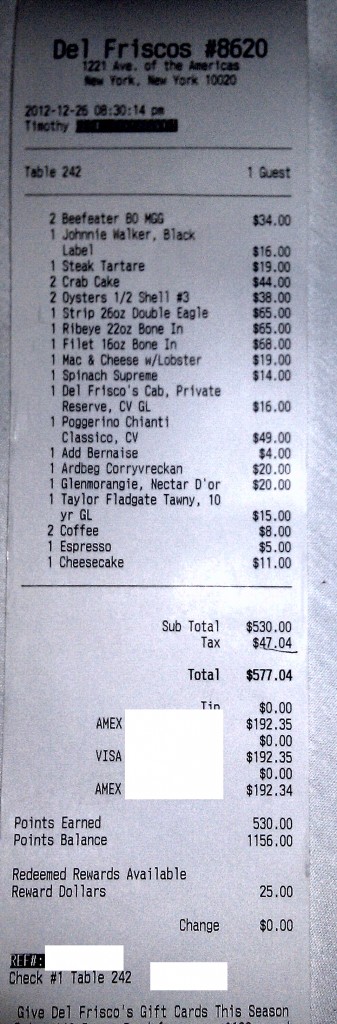
In my opinion the price was a bit on the hefty side for the size of the cuts, but relatively on par with other NYC steakhouses of even footing. What they lack in size is made up for in taste, so you kinda even out on price value. The filets are $40 and $47, ribeye $46, and strip $48. The porterhouse comes in at $58, and the wagyu at $92. The specials ran in the mid $60 range. The signature crab cake comes in at a pricey, but worthy, $21 (crab cake went up $1 since last visit, but I guess that’s just standard inflation). My martini at the bar was $18.50 (an incredible $20 when you leave a tip). The total bill for two appetizers, three beers, a vodka tonic, two steaks, two sides and a dessert was about $300 (tax and tip included). On my second trip, I took a photo of the elusive Mr. William Price, that way you scumbags can see just exactly what everything cost:
William Price
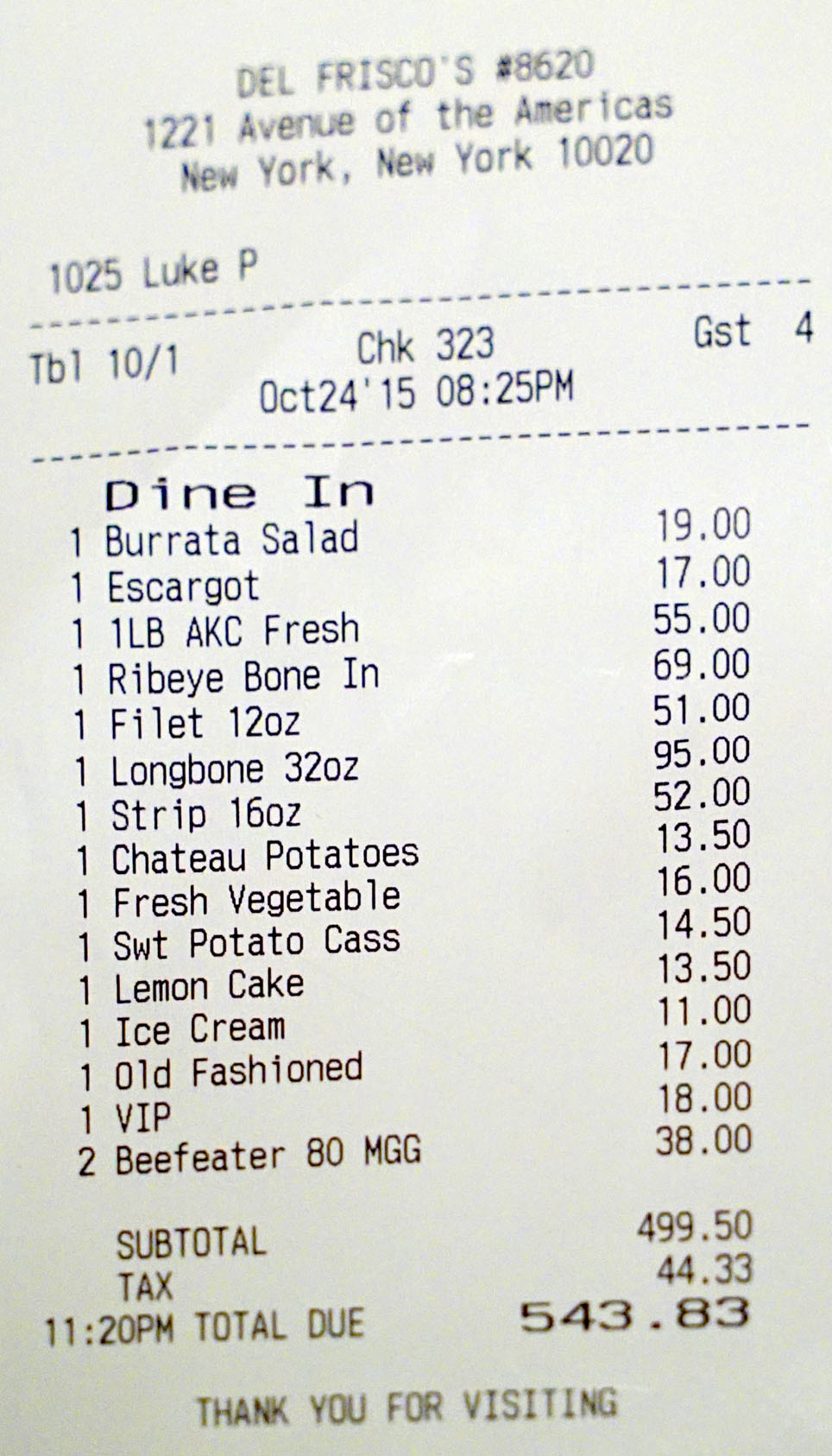
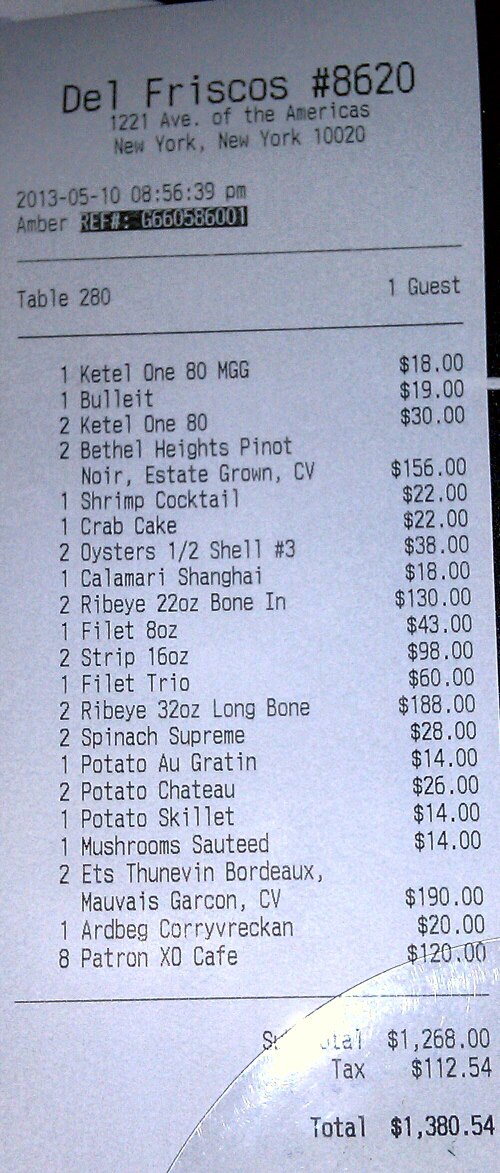
I HAD to include the bill from the third visit, simply because it oozed manliness (with the exception of the trio of filets that was ordered… and the patron cafe’s were also mocked as well):
Bar: 10
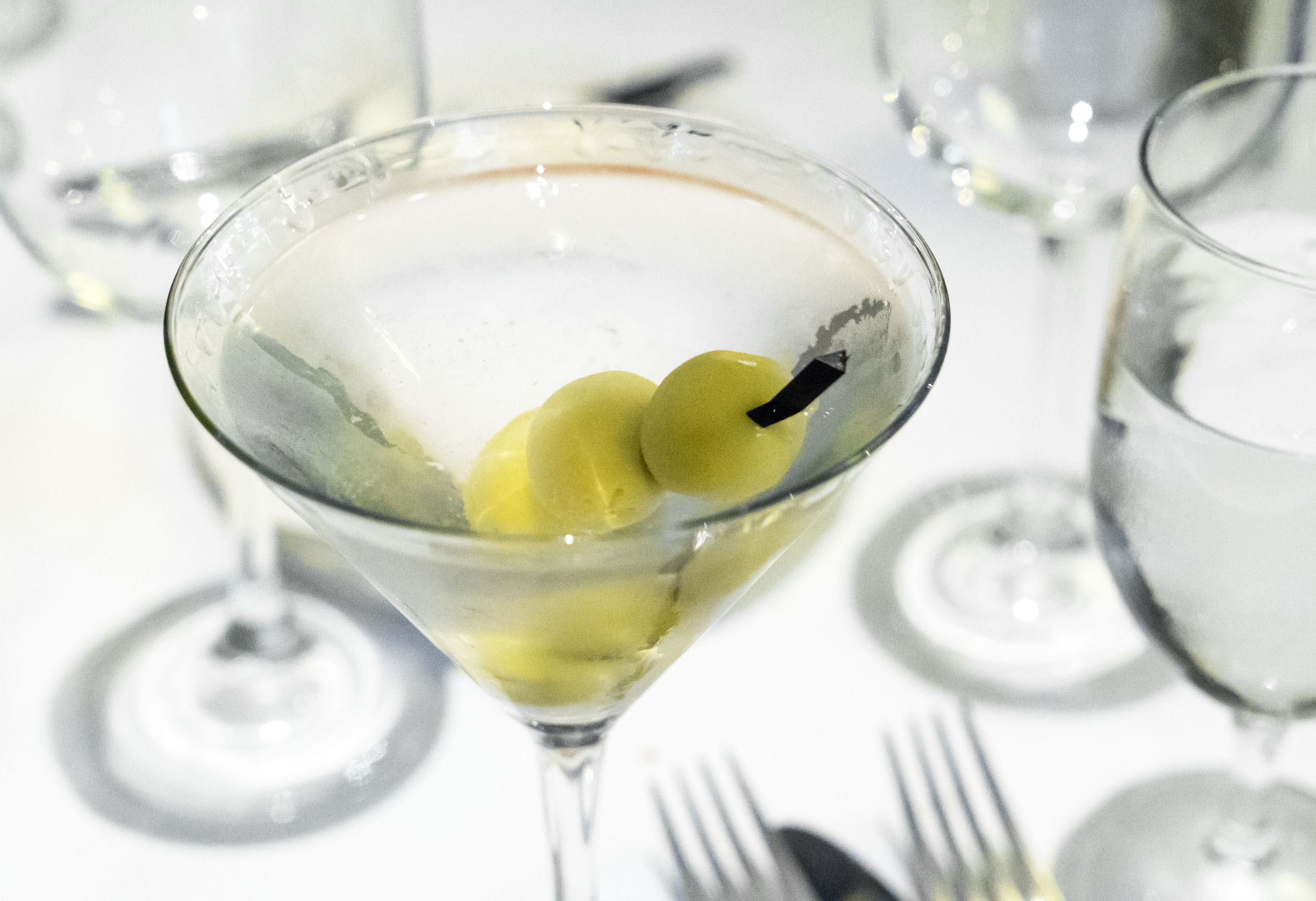
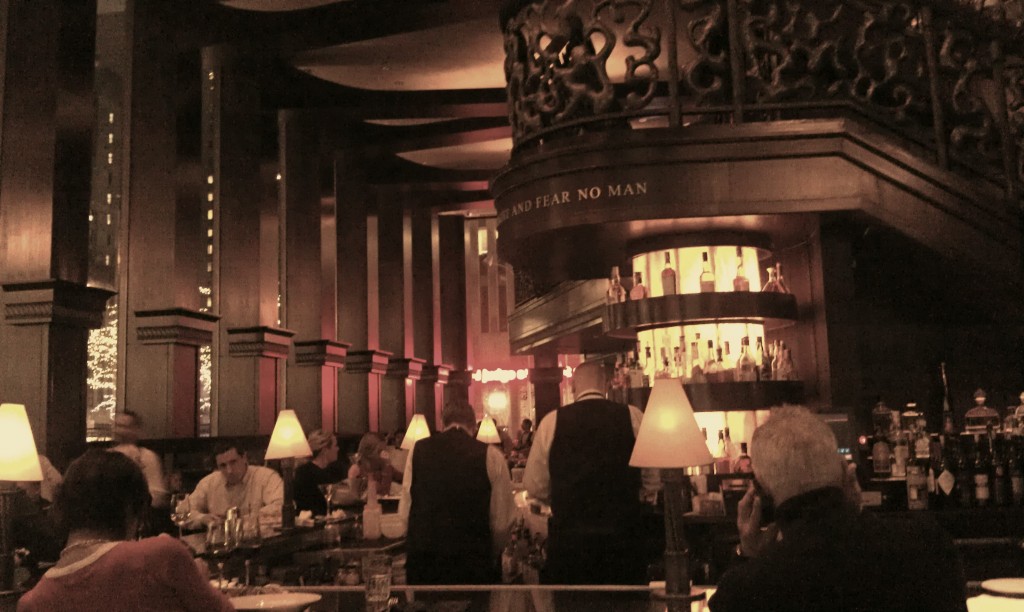
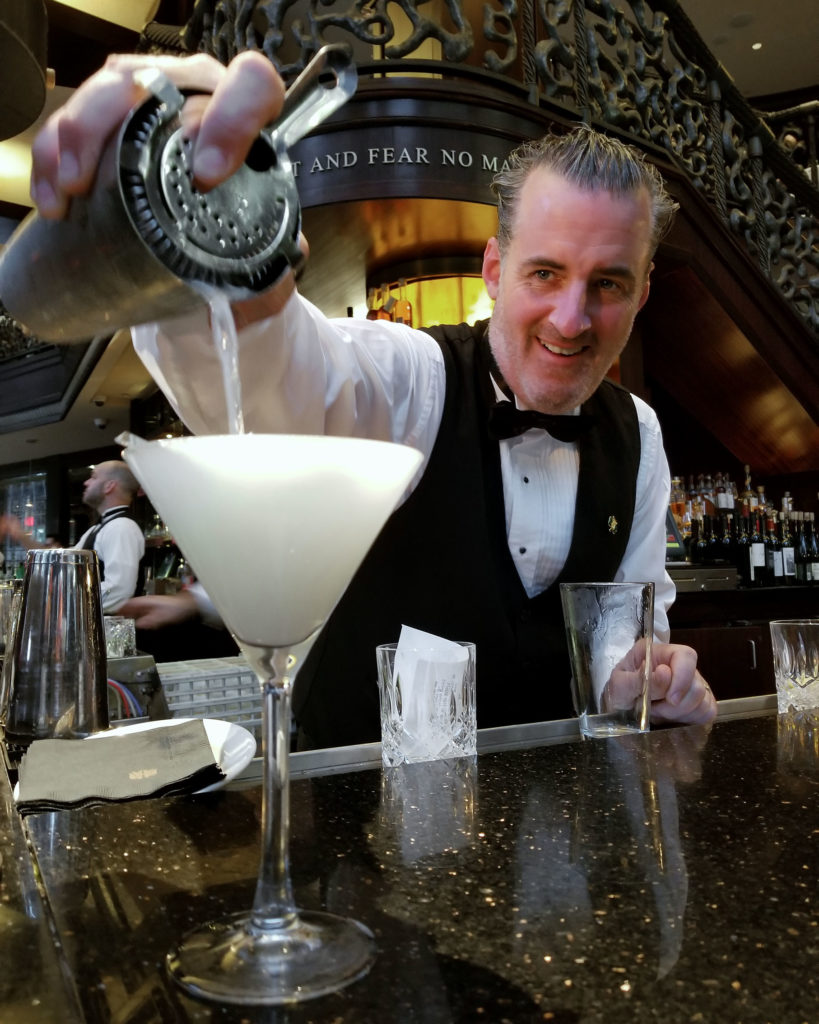
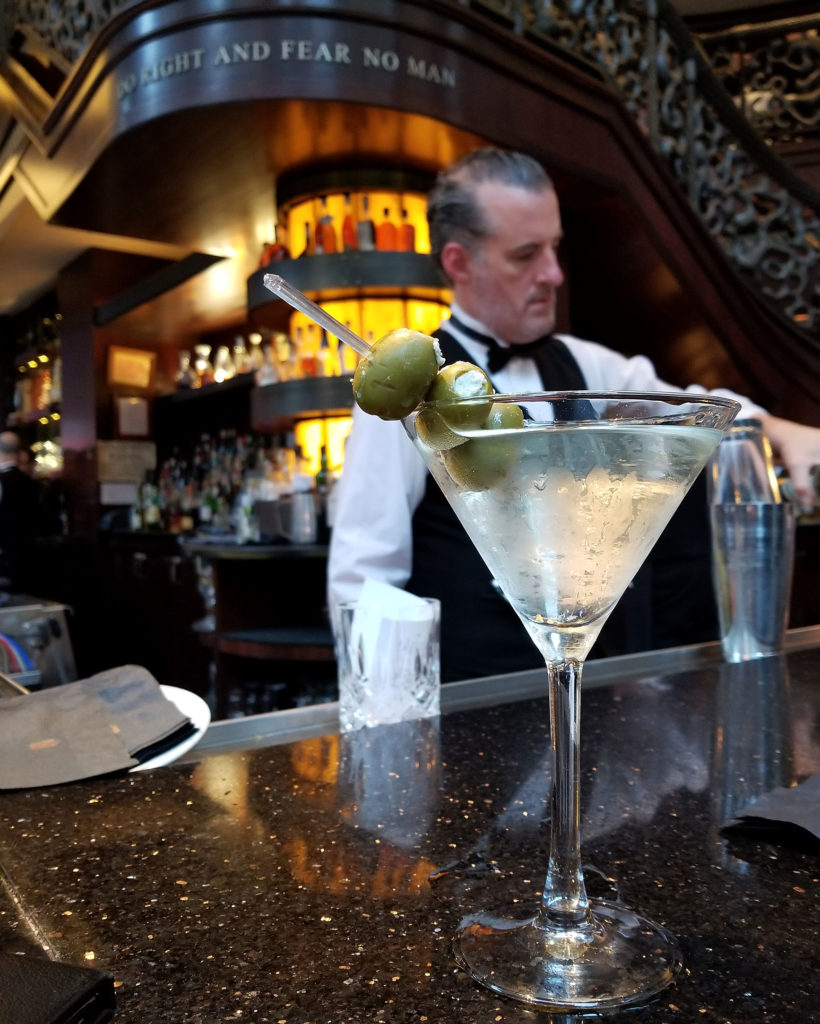
The main bar is really beautiful. Del Frisco’s has a wide open floor plan with a nice wrap-around bar internally positioned alongside the high windows in the corner of the restaurant. There is also a nice sized second bar on the second floor with a couple of flat panel TVs for sports. The martini could have used a little less vermouth, and was a bit pricey, but overall the bar experience was great. This is definitely an after work spot worth checking out after a hard day at the office, even if you don’t eat the meat. On my second trip, the martinis were made much nicer, our incredible waiter Tim introduced me to one of the most delicious, peaty scotches I have ever tasted (Ardbeg Corryvreckan), and we also ordered a wine from the extensive wine list. I also took note of an interesting passage featured above the bar: DO RIGHT AND FEAR NO MAN. The quote, as far as I can tell, dates back to a 15th century proverb out of England, and then later common in 18th century Scotland. On the third visit I had a chat with the manager about my score for the bar. I flat out told him that I just have a personal hold-out in giving this place a 10 because the martini is so fucking expensive. It really is an awesome bar though, and there are actually two bars (there’s one upstairs with a TV)… so… in the interest of making sure this place ties for first among NYC steakhouses, I am reluctantly giving full points here despite the cost of a martini.
Specials and Other Meats: 10
Aside from the “wagyu” ribeye, the other carcasses were on the order of lamb chops, veal porterhouse, pork porterhouse and roasted chicken. That covers the whole basic range. Those are all standard menu items, so it is a good selection for people who don’t feel like being a man. On special there was the 22oz bone-in ribeye, which I had ($65). There was also the conundrum 16oz bone-in filet ($68) and trio of filets (also somewhere in the low to mid $60s range). They also had some seasonal shellfish special appetizers too.
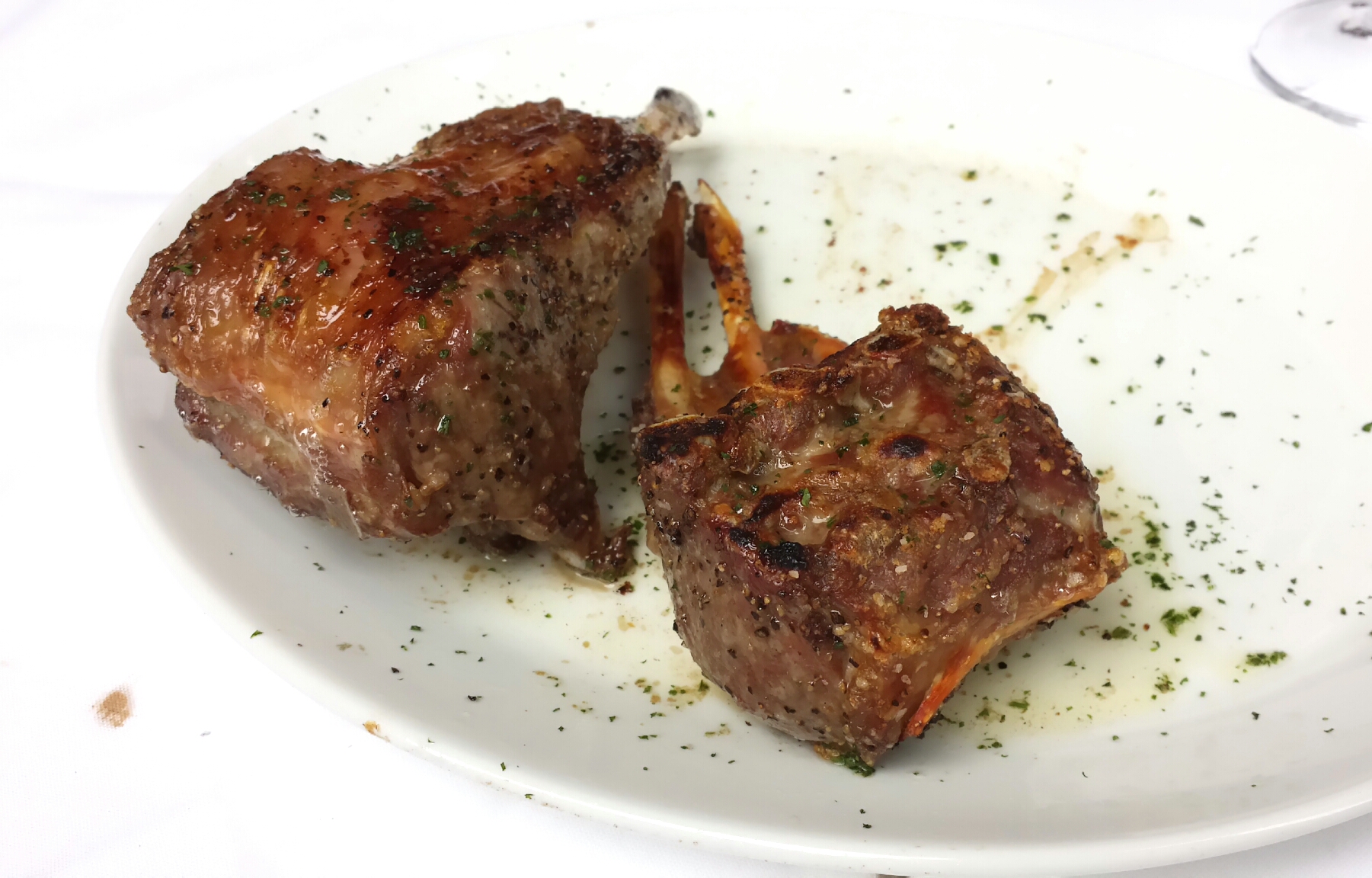
two 8oz lamb chops – fantastic
Apps, Sides & Desserts: 10 (now 9/10)
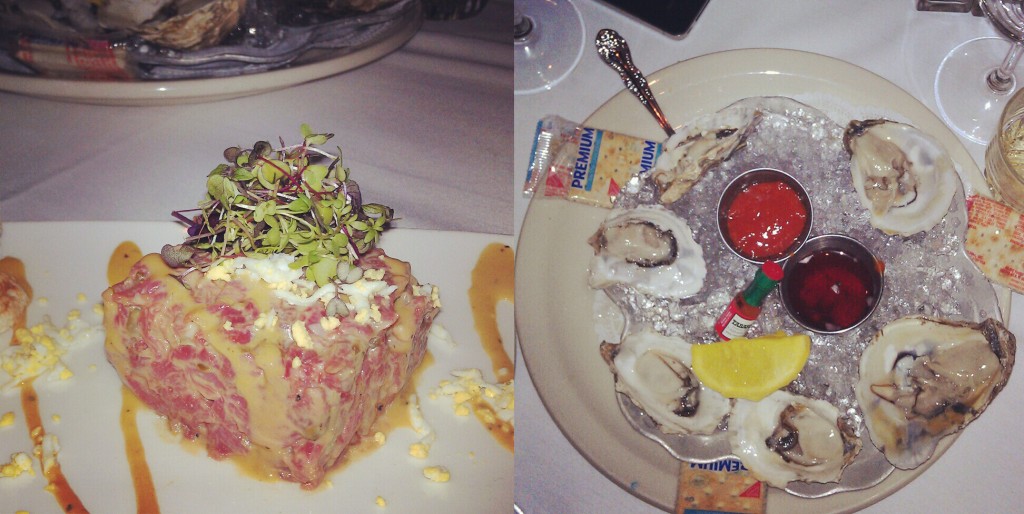
I had been told – no ORDERED – by a friend to get the crab cake, so I did. It was a succulent 4oz ball with mostly lump crab meat and a bit of breadcrumb for texture. It sat upon a nice spicy lobster-based, peppery sauce. The creamed spinach, called “spinach supreme,” had bacon folded into it, perhaps cheese as well. Delicious. My friend recommended the skillet potato dish as well – which was like fresh homemade potato chips topped with sauteed caramelized onions; not too greasy, not too salty. Really tasty. For dessert, we ordered a massive slice of lemon cake that was not on the menu (a secret item they don’t generally offer – you have to know about it). To quote one friend, it was WAY more moist than Starbucks’ lemon loaf, that is for damned sure. I’m generally not a cake person but it was yummy, even if rumors say it is made from four boxes of Duncan Hines cake mix. On a second trip, we had a dozen oysters, lobster mac & cheese, steak tartare, and the obligatory crab cakes and creamed spinach. I must say, the lobster mac & cheese was freaking delicious. It was nice and creamy, it had great crunch for texture, and the lobster bits were pretty good too. The oysters were perfect, but the steak tartare was one of the best and largest orders I’ve ever had. It had to be a solid 2-3 inches high, and 3-4 inches on each side. A nice brick of raw meat. What better way to prime the gullet before a nice steak dinner?
tartare & oysters
special burrata app
Seafood Selection: 10
An impressive selection of caviar graced the appetizer menu in addition to the delicious shellfish selections. On the entree menu was sea bass, scallops, salmon, tuna and a special catch of the day, as well as lobster. They also offered some special seafood items on the appetizer angle that weren’t on the menu. If you have a bleeding vagina, these might tempt you to not get steak.
Service: 10
Our waitress may have forgotten a water here and there but it was busy. She was very nice though, thorough, and wanted to personally thank us and email us deals and things. She certainly presented the specials in such a way that they were deemed much better than the regular menu items; perhaps looking for that up charge? Hey, if she did, then it worked on me… but it was worth it. I asked her about the differences between the standard 16oz and special 22oz ribeyes. She showed a well-versed meat lingo, but essentially said that one was bone-in and one was boneless. When our steaks arrived, the server asked us to cut into the center so he could make sure it was cooked properly. There was a warm sesame bread loaf and soft whipped butter as well. Our service was excellent on the second trip. Our waiter Tim went really above and beyond expectations. Before we could even remind him that we had ordered two plates of oysters, he came by with the second. He offered great insight into our scotch selections at dessert, and he helped us navigate the extensive wine list when picking a bottle to drink while eating our steak. He certainly knew his meat too, so I am giving the full 10 points here. While settling up the bill, I handed Tim one of my cards to let him know that I’d be giving the joint a great review and adding some points on his account. After that, Scott, the regional manager of the Del Frisco’s restaurant group, came over to greet us and thank us for our business. This is the kind of top notch service that really makes me smile, and want to go back for thirds.
Ambiance: 10
Del Frisco’s is set up with a nice, classy open design. It is semi-corporate in feel, simply by virtue of the surrounding neighborhood, but it still feels like old, art-deco New York. Despite its vastness, it manages to be really warm and inviting. There are floor to ceiling windows 30ft high. Beautiful views. This place would be amazing around the holidays. There was a bathroom attendant, but otherwise it was a normal style bathroom, nothing fancy. Just clean.
UPDATE 7/23/17
Dry Aged Strip: 10/10
This baby is delicious. A bit pricey at $70 for the special “up-charge” steak, but the flavor was excellent.